Cocoa Bean to Cocoa Powder Journey: A Complete Guide to the Manufacturing Process
Cocoa powder is one of the most widely used ingredients in the global food industry. It gives chocolate products their characteristic flavor and color and is used in bakery products, beverages, desserts, confectionery, and many other food applications.
However, cocoa powder does not come directly from grinding raw cocoa beans. It is produced through a series of carefully controlled operations that transform cocoa beans into cocoa mass, separate cocoa butter from cocoa solids, and process the resulting cocoa cake into a fine powder.
Understanding the journey from cocoa bean to cocoa powder helps food manufacturers, importers, and ingredient buyers evaluate product quality, processing methods, and supplier specifications more effectively.
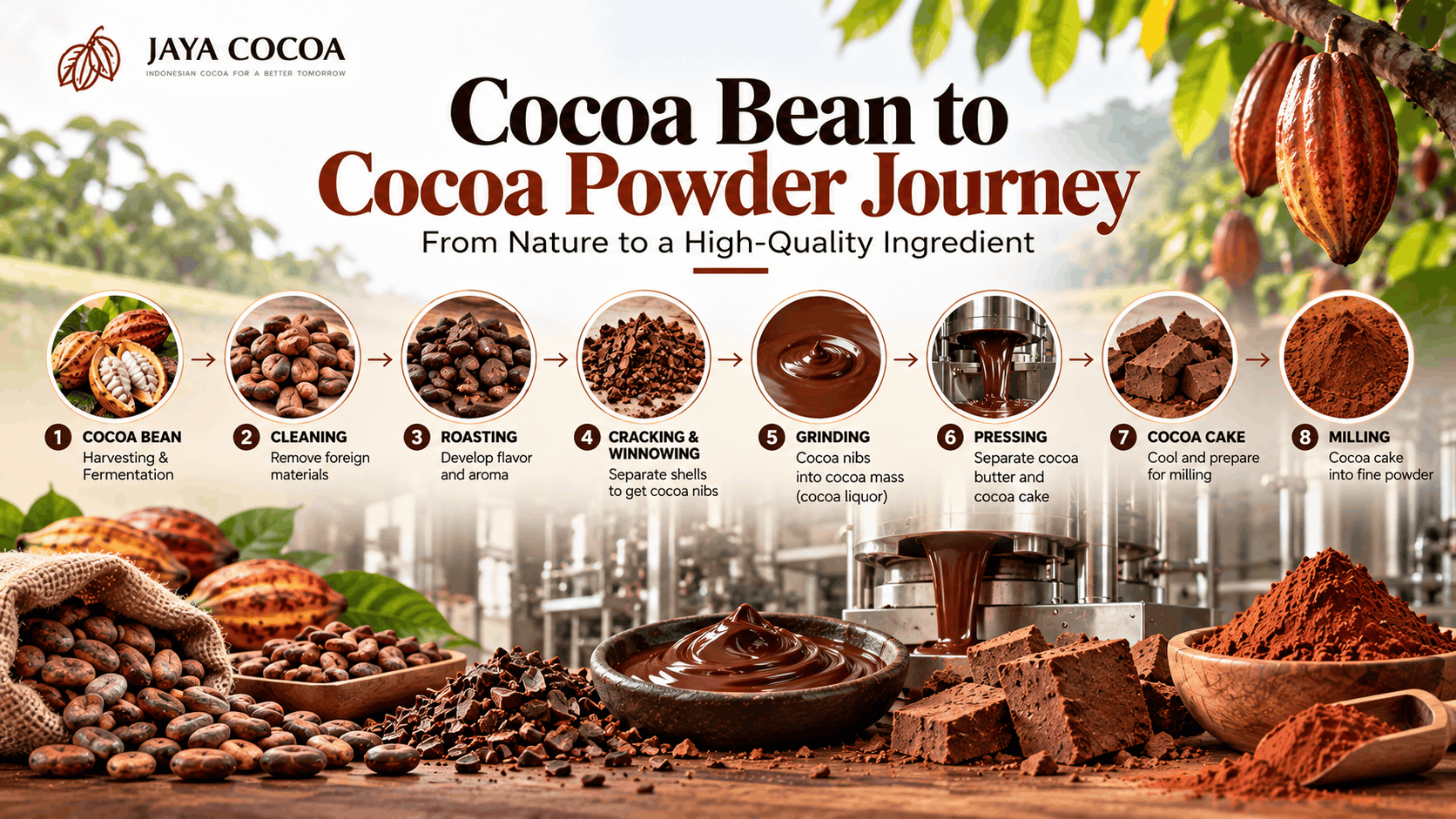
In this guide, we explain each major stage of cocoa powder manufacturing, from cocoa bean preparation to the final product.
1. The Cocoa Bean: Where the Journey Begins
Cocoa powder production begins with cocoa beans harvested from cacao trees. After harvesting, the beans undergo post-harvest processing before they reach a cocoa processing facility.
The quality of the incoming beans can influence the flavor, color, and consistency of the final cocoa ingredients.
Important factors include:
- Cocoa bean origin and variety
- Fermentation quality
- Drying conditions
- Moisture content
- Foreign material and physical defects
- Storage and transportation conditions
Fermentation and drying are particularly important because they help develop the precursors and characteristics associated with cocoa flavor while reducing moisture to a level suitable for storage.
Poorly handled beans may carry defects that later processing cannot completely correct. For this reason, cocoa powder quality management begins well before the beans enter the factory.
2. Cleaning and Preparation
Before processing, cocoa beans are cleaned to remove foreign materials such as stones, dust, metal fragments, and other unwanted substances.
Depending on the factory and equipment, cleaning may involve screens, aspiration systems, magnets, and other separation technologies.
This stage helps protect processing equipment and supports food safety and product consistency.
Incoming beans may also be inspected or tested according to the manufacturer’s quality assurance program and customer requirements.
Why it matters: Effective cleaning reduces the risk of physical contamination and helps prepare the beans for consistent processing.
3. Roasting: Developing Cocoa Flavor
Roasting applies controlled heat to cocoa beans or, in some processing systems, to cocoa nibs.
The roasting profile including temperature, time, moisture, and the material being roasted can influence aroma, flavor, color, and the behavior of the cocoa during subsequent processing.
Roasting may help develop desirable cocoa notes and reduce some unwanted sensory characteristics. The exact result depends on the raw material and processing conditions.
There is no single roasting profile that is best for every cocoa powder application. Manufacturers must balance flavor development, color expectations, processing efficiency, and relevant safety requirements.
For example, cocoa intended for a strongly flavored bakery application may have different sensory targets from cocoa intended for a beverage mix.
4. Cracking, Winnowing, and Cocoa Nib Separation
After appropriate preparation, cocoa beans are cracked to break them into smaller pieces. Winnowing then separates much of the outer shell from the inner cocoa nib.
Cocoa nibs are the edible inner portions of the cocoa bean and contain both cocoa solids and cocoa butter.
Removing shells is important because excessive shell material can affect product composition, quality, and compliance with applicable specifications.
The separated nibs become the main material used to produce cocoa mass.
5. Grinding Cocoa Nibs into Cocoa Mass
Cocoa nibs are ground using suitable milling equipment. As the nibs are broken down, friction and mechanical energy release their fat and transform the material into a thick paste or fluid mass.
This material is commonly called cocoa mass, cocoa liquor, or chocolate liquor. In this context, “liquor” does not mean an alcoholic beverage.
Cocoa mass contains cocoa solids and naturally occurring cocoa butter. It is an important intermediate ingredient used in chocolate manufacturing and in the production of cocoa powder.
The composition and characteristics of cocoa mass depend on the beans and processing conditions. Its particle size and other properties may influence downstream processing and the final product.
6. Optional Alkalization: Adjusting Color and Flavor
Alkalization, also known as Dutch processing, is an optional step used to modify the color, flavor, and acidity-related characteristics of cocoa material.
Depending on the manufacturing process, alkalization may be applied to cocoa nibs, cocoa mass, or cocoa cake.
The treatment uses an appropriate alkaline solution under controlled processing conditions. The resulting characteristics depend on the raw material, alkaline agent, concentration, temperature, time, and other process variables.
Alkalized cocoa powders can range from lighter reddish-brown shades to very dark brown or black. Natural cocoa powder, by contrast, is produced without this alkalization treatment.
Alkalization is not automatically better than natural processing. The right choice depends on the intended application and the buyer’s specifications.
For a deeper comparison, read our guide: Natural vs Alkalized Cocoa Powder: What’s the Difference?
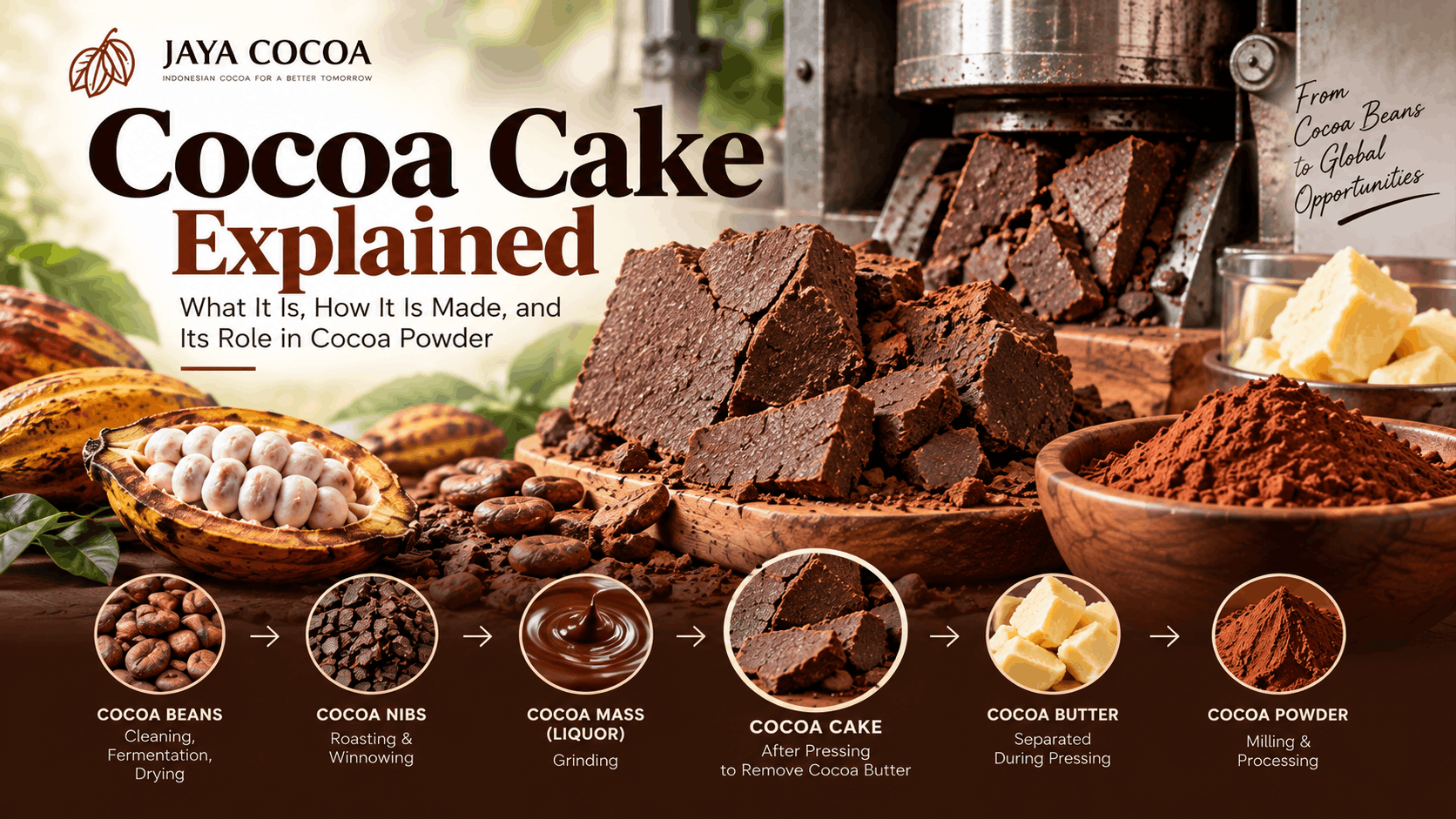
7. Cocoa Pressing: Separating Cocoa Butter from Cocoa Solids
One of the most important stages in cocoa powder production is pressing.
Cocoa mass is fed into a suitable press to separate part of its cocoa butter from the solid material. This operation produces two valuable products:
- Cocoa butter: The fat fraction separated during pressing.
- Cocoa cake: The solid material remaining after pressing.
The amount of cocoa butter removed influences the residual fat content of the resulting cocoa cake and, subsequently, the cocoa powder.
Pressing conditions and the characteristics of the cocoa mass affect the outcome. Manufacturers must control the process to achieve the required product specifications.
Why is pressing important?
Different customers require different cocoa powder fat levels. A food manufacturer may choose a powder based on its formulation, flavor profile, mouthfeel, processing needs, and cost targets.
Codex CXS 105-1981 distinguishes cocoa powder categories according to cocoa butter content. Under the standard, cocoa powder contains at least 20% cocoa butter on a dry-matter basis; fat-reduced cocoa powder contains at least 10% but less than 20%; and highly fat-reduced cocoa powder contains less than 10%.
These are Codex category definitions, not a claim that every commercial product must target a particular value. Buyers should confirm the applicable standard and the exact agreed specification.
For more information, read our article: Cocoa Powder Fat Content Explained.
8. Cooling and Preparing the Cocoa Cake
After pressing, cocoa cake must be handled and cooled under suitable conditions before further size reduction.
The material’s temperature and physical condition affect how it behaves during milling. Controlled cooling and handling help prepare the cake for efficient powder production.
The process must also account for cocoa butter’s physical properties. Poorly controlled cooling, handling, or storage may affect the cake’s consistency and its behavior during grinding.
At this stage, the cocoa cake is an intermediate product—not yet the finished cocoa powder.
9. Milling Cocoa Cake into Cocoa Powder
The cooled cocoa cake is broken down and processed through milling and classification equipment to obtain the required powder characteristics.
The manufacturing system and operating conditions influence particle distribution, flowability, and the finished powder’s handling properties.
Particle size is an important consideration, but finer powder is not automatically better for every application. Buyers should evaluate particle size alongside fat content, moisture, color, pH, flavor, and performance in their own formulations.
The finished powder may require additional controlled handling or conditioning to support stable physical properties.
For a more detailed explanation, read: Cocoa Powder Particle Size Explained.
10. Quality Control and Product Testing
Before cocoa powder is released for sale, manufacturers should verify that the product meets the agreed specification and applicable regulatory requirements.
Depending on the customer, market, and intended application, quality control may cover:
- Appearance and color: Visual consistency and agreed color specifications.
- Fat content: Confirmation of the required cocoa butter level.
- Moisture content: A key parameter for product quality, storage, and handling.
- pH: Particularly relevant when distinguishing natural and alkalized cocoa powders.
- Particle size: Measurement against the agreed distribution or fineness requirements.
- Flavor and aroma: Assessment against the approved sensory profile.
- Microbiological quality: Testing according to the risk assessment, applicable requirements, and buyer specification.
- Contaminants: Relevant chemical contaminants, mycotoxins, pesticides, or heavy metals, as required by the destination market and customer.
- Documentation: Batch identification, test results, and a Certificate of Analysis (COA), where agreed.
Testing methods and acceptance limits should be specified clearly. A supplier’s generic product sheet is not a substitute for a batch-specific COA when the buyer requires one.
Codex CXS 105-1981 provides an international reference for cocoa powders and dry mixtures of cocoa and sugars. The standard was amended in 2025, so buyers and manufacturers should consult the current version when reviewing applicable requirements.
11. Packaging and Storage
Once the cocoa powder meets the required quality criteria, it is packed in suitable food-contact packaging and prepared for storage or shipment.
Packaging choices depend on the product, the destination market, the customer’s requirements, and the distribution conditions. Industrial formats may include multi-wall paper bags with an inner liner or other approved barrier packaging.
Good packaging and storage practices help protect the product from moisture, contamination, damage, and unsuitable environmental conditions.
Important considerations include:
- Food-contact suitability of packaging materials
- Effective closure and protection against moisture
- Clear batch identification and labeling
- Appropriate warehouse conditions
- Palletization and protection during transport
- Compliance with destination-market labeling and documentation requirements
Packaging should be treated as part of the product and export specification, not simply as a final administrative step.
For more details, see: Cocoa Powder Packaging Options for Export.
12. From Factory to Food Manufacturer
After packaging, cocoa powder may be supplied to food manufacturers, ingredient distributors, importers, and private-label brands.
Its final application can vary widely, including:
- Bakery products such as cakes, cookies, brownies, and biscuits
- Beverage powders and cocoa drinks
- Ice cream and frozen desserts
- Confectionery and chocolate-flavored products
- Fillings, coatings, and dessert mixes
- Other food formulations requiring cocoa flavor or color
The most suitable cocoa powder depends on how it performs in the customer’s formulation. A specification that works well for one application may not deliver the same result in another.
For this reason, industrial buyers should evaluate samples under their actual processing and formulation conditions before approving a new product or supplier.
13. How the Manufacturing Process Affects Cocoa Powder Specifications
The journey from cocoa bean to cocoa powder involves several operations, each of which can influence the finished product.
| Processing stage | Potential impact on the final product |
|---|---|
| Bean selection and post-harvest handling | Flavor potential, defects, and raw-material consistency |
| Cleaning | Foreign-material control and process reliability |
| Roasting | Flavor, aroma, color, and processing characteristics |
| Winnowing | Shell removal and material quality |
| Nib grinding | Cocoa mass formation and particle characteristics |
| Optional alkalization | Color, flavor, and pH-related characteristics |
| Pressing | Residual cocoa butter and cocoa cake characteristics |
| Milling and classification | Particle-size distribution and handling properties |
| Quality testing | Verification against product specifications |
| Packaging and storage | Protection of quality during handling and distribution |
The final quality of cocoa powder is not determined by a single machine or processing stage. It results from the interaction of raw-material quality, process control, product formulation, testing, and storage.
14. What Should Buyers Ask a Cocoa Powder Manufacturer?
For importers and food manufacturers, understanding the manufacturing process helps make supplier evaluations more precise.
Before placing a commercial order, consider asking:
- Is the product natural, alkalized, or another specified type?
- What cocoa butter content and tolerance are guaranteed?
- What are the agreed pH, color, moisture, and particle-size specifications?
- Which analytical methods are used for testing?
- Can the supplier provide a representative sample and a batch-specific COA?
- What microbiological and contaminant tests are available or required?
- What packaging formats, labeling options, and batch-traceability systems are offered?
- What are the minimum order quantity, production lead time, payment terms, and shipping terms?
- Can the manufacturer provide the documents required for the destination market?
The answers should be documented in the product specification, purchase agreement, or other appropriate commercial documents.
Conclusion
The journey from cocoa bean to cocoa powder involves much more than grinding. It includes raw-material preparation, roasting, shell separation, nib grinding, optional alkalization, cocoa pressing, cake milling, quality testing, and packaging.
Each stage can influence the finished product’s characteristics and suitability for different food applications.
For buyers, the most effective approach is to select cocoa powder based on clearly defined specifications, verified quality documentation, application testing, and the supplier’s ability to deliver consistent products.
At Jaya Cocoa, we focus on cocoa powder solutions for industrial and international B2B customers. Buyers can discuss their requirements for natural or alkalized cocoa powder, product specifications, packaging, and export supply with our team.
Looking for a cocoa powder supplier from Indonesia? Contact Jaya Cocoa to discuss your application, target specifications, and sourcing requirements.
References and Further Reading
- International Cocoa Organization (ICCO). Processing Cocoa.
https://www.icco.org/processing-cocoa/ - Codex Alimentarius (FAO/WHO). CXS 105-1981: Standard for Cocoa Powders (Cocoas) and Dry Mixtures of Cocoa and Sugars. Amended 2025.
https://www.fao.org/fao-who-codexalimentarius/codex-texts/all-standards/en/ - Codex Alimentarius (FAO/WHO). CXS 141-1983: Standard for Cocoa (Cacao) Mass (Cocoa/Chocolate Liquor) and Cocoa Cake.
https://www.fao.org/fao-who-codexalimentarius/codex-texts/all-standards/en/ - Codex Alimentarius (FAO/WHO). CXS 86-1981: Standard for Cocoa Butter.
https://www.fao.org/fao-who-codexalimentarius/codex-texts/all-standards/en/