Cocoa Powder Particle Size Explained: Microns, Distribution, and Food Applications
When food manufacturers evaluate cocoa powder, they often look first at fat content, pH, color, flavor, and microbiological specifications.
Another technical parameter can be just as important for certain applications:
particle size.
Cocoa powder particle size affects how the powder behaves during manufacturing, including its flow, dispersion, reconstitution, and interaction with other ingredients. In some applications, the distribution of particle sizes can also influence the physical behavior of the finished product.
For cocoa buyers and food manufacturers, however, one important distinction must be made:
There is no single particle size that is universally “best” for every cocoa powder application.
The appropriate particle-size specification depends on the product, processing system, formulation, and desired performance.
This guide explains what cocoa powder particle size means, how it is measured, what D10, D50, and D90 mean, how particle size relates to cocoa powder processing, and what buyers should consider when evaluating a cocoa powder specification.
What Is Cocoa Powder Particle Size?
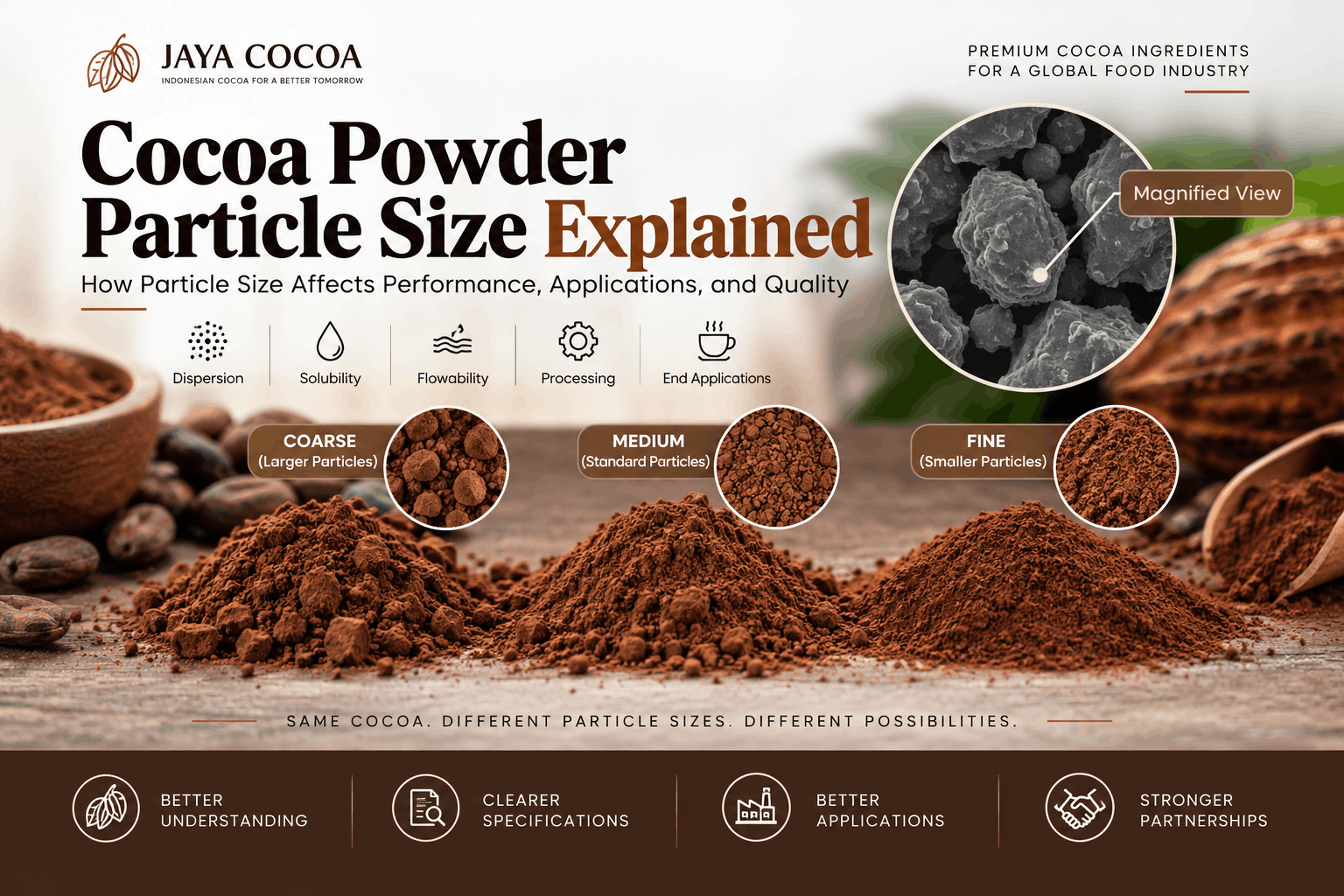
Cocoa powder particle size refers to the dimensions of the individual particles that make up a cocoa powder.
Although cocoa powder appears visually uniform, it is actually made up of particles with a range of different sizes.
This is why technical specifications often refer to a particle size distribution (PSD) rather than giving only one particle-size value.
For example, a cocoa powder sample may contain:
- Very fine particles
- Medium-sized particles
- Larger particles
The proportion of each fraction creates the powder’s overall particle-size distribution.
Research on cocoa powders has demonstrated that cocoa particles can have broad or even bimodal distributions rather than consisting of particles of exactly one size. A 2024 study of cocoa powders produced from different cocoa varieties, for example, reported bimodal particle-size distributions with smaller particles around 25 μm and larger populations around 500 μm under the study’s specific processing conditions.
Therefore, when a supplier reports particle size, buyers should ask how the value was measured and what parameter is being reported.
Why Does Particle Size Matter in Cocoa Powder?
Particle size can influence several physical properties of cocoa powder.
Depending on the formulation and processing conditions, particle size may affect:
- Dispersion
- Wettability
- Reconstitution
- Powder flow
- Mixing behavior
- Sedimentation
- Texture
- Mouthfeel
- Interaction with other ingredients
- Processing performance
However, these relationships are not always simple.
For example, making a powder finer does not automatically make it perform better in every application.
A cocoa powder intended for a beverage may have different requirements from one used in a bakery mix or a chocolate formulation.
Cocoa Powder Particle Size and Processing
Particle size is closely connected to cocoa processing.
After cocoa liquor is pressed, the resulting cocoa cake is broken and milled. ICCO explains that cocoa cake is milled to specified particle sizes according to the intended end use.
However, there is an important technical detail.
ICCO notes that the term “grinding” can be somewhat misleading in cocoa powder production. The final powder particle size is influenced by the particle size of the cocoa liquor that was pressed, while commonly used mills may primarily break up agglomerates rather than continuously reducing the underlying particle size of the cake.
This means particle size should not be viewed simply as:
More grinding = smaller cocoa particles
The actual result depends on the complete processing system and the physical characteristics of the cocoa material.
What Are D10, D50, and D90?
When particle-size distribution is measured instrumentally, manufacturers and laboratories may report percentile values such as D10, D50, and D90.
These values describe the distribution rather than simply stating one average particle diameter.
D10
D10 is the particle diameter below which approximately 10% of the measured particle population lies, according to the measurement basis being used.
D50
D50 is the median particle diameter.
Approximately 50% of the measured distribution is below this value and 50% is above it.
D50 is often particularly useful because it gives buyers a practical indication of the middle of the particle-size distribution.
D90
D90 is the particle diameter below which approximately 90% of the measured distribution lies.
It can therefore provide information about the larger-particle portion of the distribution.
Example of a Cocoa Powder Particle-Size Distribution
Imagine a specification reports:
| Parameter | Example value |
|---|---|
| D10 | 15 μm |
| D50 | 40 μm |
| D90 | 100 μm |
This does not mean that every particle is 40 μm.
Instead, the powder contains a distribution of particle sizes.
The D50 value indicates the median of the measured distribution, while D10 and D90 provide additional information about the finer and coarser portions.
This is why buyers should not evaluate a cocoa powder based only on a single number.
What Does “Micron” Mean?
A micron, or micrometer (μm), is one-millionth of a meter.
It is commonly used to describe fine particle sizes.
For example:
- 1 μm = 0.001 mm
- 10 μm = 0.01 mm
- 100 μm = 0.1 mm
- 1,000 μm = 1 mm
Particle sizes in cocoa powders can therefore be expressed in the micrometer range.
However, a reported micron value should always be interpreted together with the measurement method and distribution parameter.
A specification saying:
D50 = 30 μm
contains considerably more information than simply saying:
Particle size = 30 μm
because the first statement identifies what the 30 μm value represents.
How Is Cocoa Powder Particle Size Measured?
Particle size can be measured using different analytical techniques.
One commonly used modern approach is laser diffraction.
ISO 13320:2020 provides guidance for particle-size analysis using laser diffraction methods. The standard covers particle-size distributions across a broad range and explains that the reported distribution is derived from light-scattering measurements. It also notes that results for non-spherical particles can differ from those obtained by methods based on other physical principles, such as sieving or sedimentation.
This is particularly relevant for cocoa powder because cocoa particles are not necessarily perfect spheres.
Therefore, two laboratories can potentially report different results if they use different analytical methods, sample preparation procedures, or reporting bases.
Why the Measurement Method Matters
Suppose a supplier reports:
Cocoa powder particle size: 50 μm
A technical buyer should ask:
- Is 50 μm a D50?
- Is it an average diameter?
- Is it D90?
- Was it measured by laser diffraction?
- Was sieve analysis used?
- What sample preparation method was applied?
- Was the powder dispersed before measurement?
- What units and reporting basis were used?
Without this information, the number may be difficult to compare between suppliers.
ISO 13320 specifically highlights that particle-size results depend on the measurement principle, particularly when particles are non-spherical.
Cocoa Powder Particle Size and Beverage Applications
Particle size becomes particularly interesting in cocoa beverage applications.
Cocoa powder does not behave exactly like a fully soluble sugar or salt. Its dispersion and reconstitution depend on multiple physical and formulation factors.
Research on powdered cocoa beverages has shown that properties such as wettability, dispersibility, and solubility can vary considerably between commercial products. The study also found that agglomeration increased average particle size and that fine and agglomerated powders could show different instant properties.
Earlier research on instantized cocoa beverage powders also found that very fine fractions could exhibit substantially longer wetting times under particular experimental conditions. In one study, cocoa beverage powder with average particle sizes around 0.11–0.14 mm showed much longer wetting times than larger fractions.
This leads to an important practical lesson:
Smaller particle size does not automatically mean faster wetting or better beverage performance.
Powder structure, surface properties, fat content, agglomeration, formulation, and processing can all influence behavior.
Particle Size and Cocoa Powder Dispersion
Dispersion refers to how effectively cocoa powder becomes distributed throughout a liquid or another formulation.
Cocoa powder can be challenging to disperse because cocoa particles have hydrophobic characteristics and contain fat.
Research investigating cocoa powder dispersion has shown that particle characteristics and powder structure can influence dispersion kinetics. Granulation, for example, can modify the way cocoa powder disperses in water.
This means manufacturers developing instant beverages should evaluate the complete powder system, rather than selecting cocoa powder based only on the smallest possible particle size.
Particle Size and Chocolate Processing
Particle-size distribution is also important when cocoa powder is incorporated into chocolate systems.
Research published in Food & Function examined how particle-size distributions of cocoa powder and sugar affected the rheological behavior of model chocolates.
The researchers found that changing the particle-size distribution and the ratio of coarse to fine particles could significantly affect viscosity under certain formulations.
This demonstrates why particle size is not simply a cosmetic specification.
The physical distribution of solid particles can influence how particles pack within a fat-based system and consequently affect processing behavior.
Does Smaller Cocoa Powder Particle Size Mean Better Quality?
Not necessarily.
This is one of the most important points for cocoa buyers.
A very fine cocoa powder may be desirable for some applications, but that does not make it universally superior.
The ideal particle-size distribution depends on:
- Product formulation
- Processing equipment
- Intended application
- Desired texture
- Dispersion requirements
- Mixing conditions
- Fat content
- Other powder ingredients
- Final product specifications
A powder that performs well in a beverage may not be the best choice for another application.
Therefore:
Particle size should be treated as an application-specific quality parameter, not as a simple “smaller is better” ranking.
Cocoa Powder Particle Size vs Fineness
The terms particle size and fineness are related but should not always be treated as exactly the same thing.
Particle size describes the dimensions and distribution of particles.
Fineness is often used commercially to describe how fine a powder is, sometimes through a specific analytical or sieve-based criterion.
A supplier specification might therefore report:
- Particle size distribution
- D50
- D90
- Average particle size
- Sieve residue
- Percentage passing a specified sieve
These measurements are not automatically interchangeable.
For B2B purchasing, the buyer should understand exactly what the supplier’s specification means before comparing two products.
Particle Size Is Not the Same as Particle Shape
Two cocoa powders can have similar particle-size values but different particle shapes.
Particle shape can influence:
- Flow
- Packing
- Surface area
- Interaction with liquids
- Powder behavior
Research on cocoa powder has observed irregular polygonal and polyhedral particle shapes in microscopic analysis.
This is another reason why a single micron number cannot completely describe the physical behavior of cocoa powder.
Particle Size and Flowability
Particle size can also interact with powder flow.
Very fine powders can exhibit strong interparticle forces and may behave differently from coarser or agglomerated powders.
However, flowability depends on more than particle size alone.
Relevant factors can include:
- Particle shape
- Moisture
- Fat content
- Surface properties
- Bulk density
- Particle-size distribution
- Agglomeration
- Storage conditions
A 2024 study examining cocoa powders found that particle size and shape distributions were related to powder properties including flowability and reconstitutability, while also showing that cocoa variety itself did not necessarily produce large differences in these properties.
What Particle Size Should Cocoa Powder Have?
There is no single universal particle-size specification for all cocoa powders.
This distinction is important for buyers.
The Codex standard for cocoa powders, CXS 105-1981, establishes requirements for cocoa powders and dry mixtures of cocoa and sugars, including compositional and hygiene-related provisions, but it does not establish one universal micron value that every cocoa powder must meet.
Therefore, a commercial specification such as:
D50 ≤ XX μm
should be understood as a product or application specification, not automatically as a universal Codex requirement.
How Food Manufacturers Should Specify Cocoa Powder Particle Size
When purchasing cocoa powder, it is better to avoid asking only:
“How many microns is your cocoa powder?”
Instead, buyers should ask for the complete particle-size specification.
A good technical request may include:
Particle Size Distribution
- D10
- D50
- D90
Measurement Method
- Laser diffraction
- Sieve analysis
- Other validated method
Sample Preparation
- Dry or wet dispersion
- Dispersion medium
- Relevant preparation conditions
Specification Limits
- Minimum/maximum values
- Tolerance
- Test frequency
Application
This gives the buyer a much better basis for comparing suppliers.
Example Cocoa Powder Particle Size Specification
A technical specification could potentially look like this:
| Parameter | Example specification |
|---|---|
| D10 | ≥ 10 μm |
| D50 | 20–50 μm |
| D90 | ≤ 100 μm |
| Method | Laser diffraction |
| Application | Food manufacturing |
| Testing | Per batch or agreed frequency |
Important: These numbers are only an illustrative example, not a universal cocoa powder specification or recommendation.
Actual limits should be established according to the product, equipment, formulation, and validated customer requirements.
Particle Size and Other Cocoa Powder Specifications
Particle size should not be evaluated independently.
A professional cocoa powder specification may also include:
Fat Content
Fat level can affect the functionality and sensory characteristics of cocoa powder.
pH
Important when selecting natural versus alkalized cocoa powder.
Color
Important for controlling finished-product appearance.
Moisture
Important for powder stability and compliance with applicable specifications.
Microbiology
Important for food safety and customer requirements.
Contaminants
Requirements depend on the destination market and customer specification.
Flavor and Aroma
Important for the sensory profile of the finished product.
Particle Size
Important for physical behavior and application performance.
This is why professional cocoa buyers should evaluate the complete specification, rather than selecting a cocoa powder based on one parameter.
How Particle Size Relates to Natural and Alkalized Cocoa Powder
Particle size is a separate specification from natural versus alkalized processing.
A cocoa powder can be:
- Natural and finely milled
- Natural and coarser
- Alkalized and finely milled
- Alkalized and produced to another particle-size specification
In other words:
Alkalization determines chemical and sensory characteristics, while particle size describes a physical characteristic of the powder.
Both can matter to the final application.
For example, a beverage manufacturer may need a particular combination of:
- Alkalized cocoa
- Specific pH
- Specific color
- Controlled fat content
- Appropriate particle-size distribution
- Suitable dispersion characteristics
This is why cocoa powder purchasing should be based on the complete technical requirement, rather than a single specification.
What Cocoa Buyers Should Ask Their Supplier
Before purchasing cocoa powder for industrial production, buyers can ask:
1. What is the particle-size specification?
Ask for D10, D50, D90, or the supplier’s validated fineness specification.
2. How is particle size measured?
Ask whether the supplier uses laser diffraction, sieve analysis, or another method.
3. What is the test method?
The method should be clearly identified so results can be compared consistently.
4. Is the result reported for every batch?
This depends on the supplier’s quality-control system and customer agreement.
5. Is the powder agglomerated?
This can be particularly relevant for beverage applications.
6. What is the intended application?
The appropriate particle-size distribution depends on the final product.
7. Can the supplier provide a COA?
The Certificate of Analysis should identify the relevant quality parameters and test results.
8. Can the buyer test a sample?
Application testing is strongly recommended before committing to a large commercial order.
Why Particle Size Matters in Cocoa Powder Procurement
For international buyers, particle size is not simply a laboratory number.
It can become a practical manufacturing parameter.
A cocoa powder may meet the buyer’s basic requirements for:
- Fat
- pH
- Color
- Moisture
yet still behave differently during processing because its physical characteristics are different.
This is especially relevant when changing suppliers.
A manufacturer should therefore avoid assuming that two cocoa powders with similar chemical specifications will automatically perform identically in the production line.
Particle-size distribution is one of the parameters that should be evaluated during supplier qualification and product trials.
Final Takeaway
Cocoa powder particle size describes the size distribution of particles within the powder and can influence how the ingredient behaves during processing and formulation.
However, there is no universal particle size that is best for every cocoa powder application.
For technical buyers, the most useful approach is to evaluate:
- D10
- D50
- D90
- Measurement method
- Particle-size distribution
- Particle shape where relevant
- Agglomeration
- Fat content
- pH
- Color
- Application performance
The key lesson is simple:
The best cocoa powder particle size is the one that performs consistently in the intended application—not necessarily the one with the smallest particles.
For food manufacturers and cocoa importers, requesting a clear particle-size specification and testing the powder in the actual formulation can help reduce formulation risk and improve consistency between suppliers.
References
1. International Cocoa Organization — Processing Cocoa
2. ISO 13320:2020 — Particle Size Analysis: Laser Diffraction Methods
3. Feichtinger, Scholten & Sala — Food & Function
4. Moundanga et al. — Powder Technology, 2024
5. Factors Affecting Instant Properties of Powdered Cocoa Beverages
6. Codex Alimentarius — CXS 105-1981