
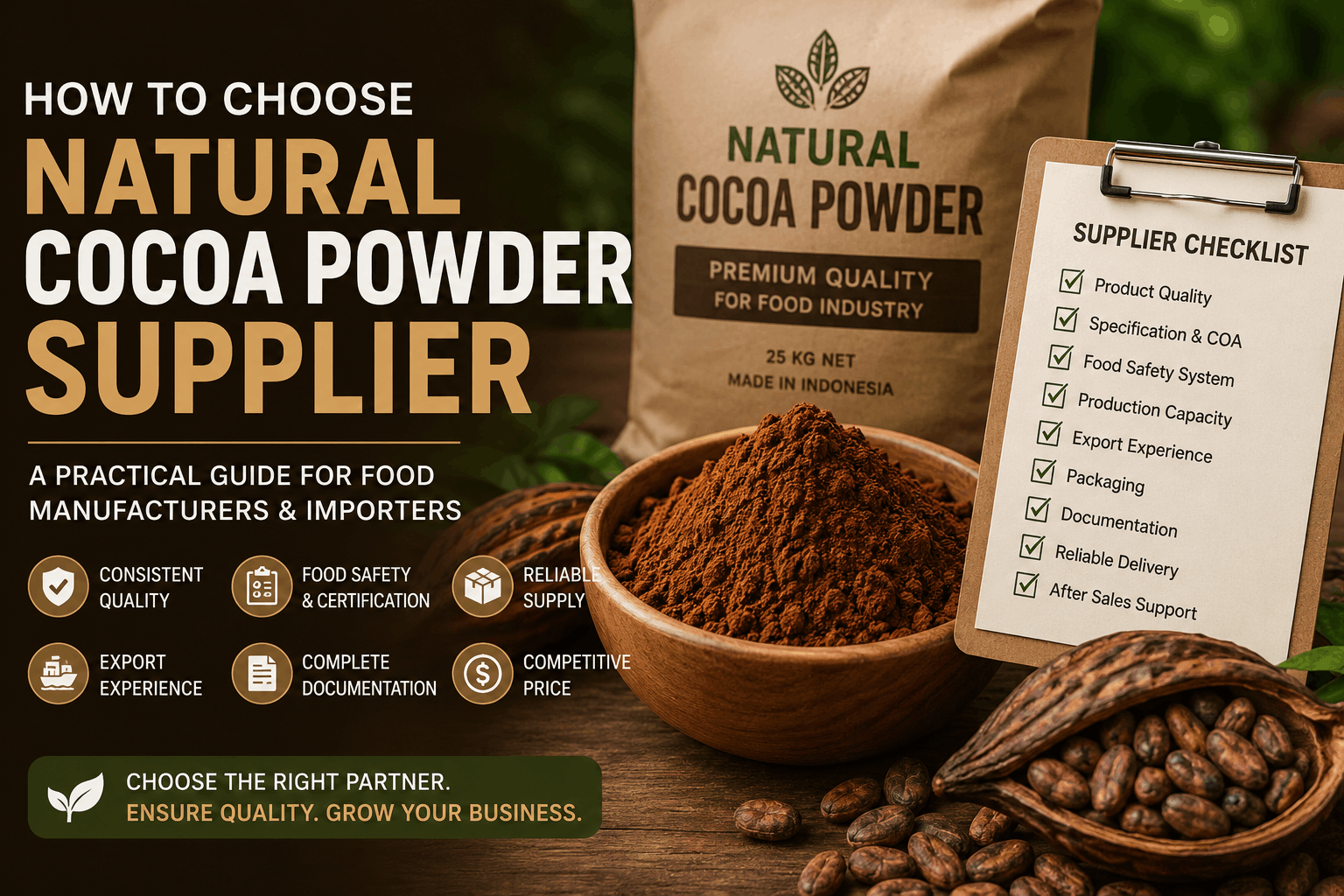
How to Choose a Natural Cocoa Powder Supplier: A Practical Guide for Food Manufacturers and Importers Choosing the right natural cocoa powder supplier is an important decision for food manufacturers, importers, distributors, and product developers. The lowest price does not always represent the lowest procurement cost, particularly when inconsistent specifications, delayed shipments, documentation problems, or quality issues can affect production. A reliable supplier should be able to provide more than cocoa powder. Buyers need consistent product specifications, food-safety controls, traceability, documentation, packaging, production capacity, and dependable export logistics. This guide explains how to evaluate a natural cocoa powder supplier step by step and what buyers should check before placing a commercial order. What Makes a Good Natural Cocoa Powder Supplier? A good supplier should demonstrate capability across several areas: Product quality Specification consistency Food safety Traceability Production capability Documentation Packaging Export experience Communication Commercial reliability For international buyers, supplier selection should therefore be treated as a quality and supply-chain decision, not simply a price comparison. The Codex Standard for Cocoa Powders, CXS 105-1981, provides an important international reference for cocoa powder characteristics, hygiene, food additives, and labeling. The standard was most recently listed by Codex with a 2025 amendment. 1. Start With the Product Specification Before comparing suppliers, define exactly what you need. The term natural cocoa powder alone is not sufficient to establish a purchasing specification. A buyer should consider parameters such as: Specification Why It Matters Product type Confirms natural/non-alkalized cocoa Fat content Influences flavor, mouthfeel and formulation pH Important for acidity and formulation behavior Moisture Important for quality and storage Color Influences finished-product appearance Particle size Affects texture and processing Flavor Determines sensory performance Microbiology Important for food safety Contaminants May be subject to destination-market limits Packaging Protects product during storage and transportation Shelf life Important for inventory planning Codex CXS 105-1981 establishes internationally recognized requirements for cocoa powders, including composition and hygiene provisions. However, a buyer’s commercial specification can be more specific or restrictive than the Codex baseline. This distinction is important. Regulatory standard ≠ complete commercial specification. Your supplier should understand both. 2. Confirm That the Product Is Actually Natural Cocoa Powder One of the first questions to ask is: Is the cocoa powder natural or alkalized? Natural cocoa powder is produced without the conventional alkalization treatment used to modify cocoa’s acidity and other characteristics. This matters because natural and alkalized cocoa powders can behave differently in food formulations. For example, a bakery manufacturer may select natural cocoa powder because its acidity can interact with an alkaline leavening system. A beverage manufacturer, meanwhile, may have completely different requirements concerning color, flavor, dispersion, and suspension. Therefore, your purchase specification should clearly state: Natural Cocoa Powder — Non-Alkalized rather than simply: Cocoa Powder For a more detailed technical comparison, buyers can also review the differences between natural and alkalized cocoa powder. 3. Ask for a Technical Data Sheet A professional supplier should be able to provide a Technical Data Sheet (TDS) or product specification. At minimum, review whether the document clearly identifies: Product name Product type Fat content pH Moisture Color Particle size Microbiological parameters Packaging Shelf life Storage conditions Country of origin The specification should also indicate whether values are: Typical values Minimum values Maximum values Guaranteed specifications This distinction is extremely important. For example: Fat: 10–12% is different from: Fat: Typical 11% The first can represent a defined commercial range, while the second may only describe an expected result. 4. Request a Recent Certificate of Analysis A TDS tells you what the supplier says the product should be. A Certificate of Analysis (COA) tells you what was measured for a particular batch. When evaluating a supplier, request a recent COA and compare it against the product specification. For example: Parameter Specification COA Result Fat 10–12% 11.2% Moisture ≤5% 3.8% pH 5.2–6.0 5.6 Color Agreed standard Within specification Microbiology Buyer requirement Pass The exact limits should be based on your agreed specification and applicable regulations. A buyer should be cautious if a supplier: Cannot provide a COA Provides an incomplete COA Provides identical results for every batch without explanation Cannot explain its testing methods Cannot connect the COA to a batch or lot number 5. Check Specification Consistency Across Batches This is one of the most important supplier-selection criteria. A supplier may send an excellent sample and still struggle to reproduce the same quality commercially. Therefore, ask: Can the supplier maintain the same specification from batch to batch? Look at parameters such as: Fat pH Moisture Color Particle size Microbiology Flavor A useful approach is to compare COAs from multiple production batches, rather than evaluating only one sample. For industrial food manufacturing, consistency is often more valuable than a small difference in purchase price. 6. Evaluate the Supplier’s Production Capability Before placing a large order, understand the supplier’s actual production capability. Ask: Production What is the monthly production capacity? Is cocoa powder produced continuously or on a campaign basis? Is production performed in-house? What processing equipment is used? Can the supplier handle repeat orders? Quality Is there an internal QC laboratory? Which tests are performed internally? Which tests are outsourced? How are batches released? Supply Where is the raw cocoa sourced? Is there more than one sourcing region? How does the supplier manage raw-material variation? A supplier that can produce your first 5 MT but struggles to deliver 50 MT consistently may not be suitable for long-term industrial procurement. 7. Understand Cocoa Processing Capability Natural cocoa powder quality is influenced by the processing chain. The International Cocoa Organization describes cocoa processing stages including cleaning, fermentation, roasting, grinding, pressing, and milling. Cocoa cake from the pressing stage is subsequently milled into cocoa powder according to the required particle characteristics and end use. This means supplier evaluation should not stop at the finished powder. Ask about: Cocoa bean sourcing Fermentation Drying Cleaning Roasting Grinding Pressing Cake milling Tempering Packaging A supplier with stronger process control is generally better positioned to maintain product consistency. 8. Review Food Safety
