Cocoa Mass (Cocoa Liquor) Explained: Processing, Composition, Uses & Specifications
Cocoa mass, also known as cocoa liquor or chocolate liquor, is one of the most important intermediate ingredients in cocoa processing.
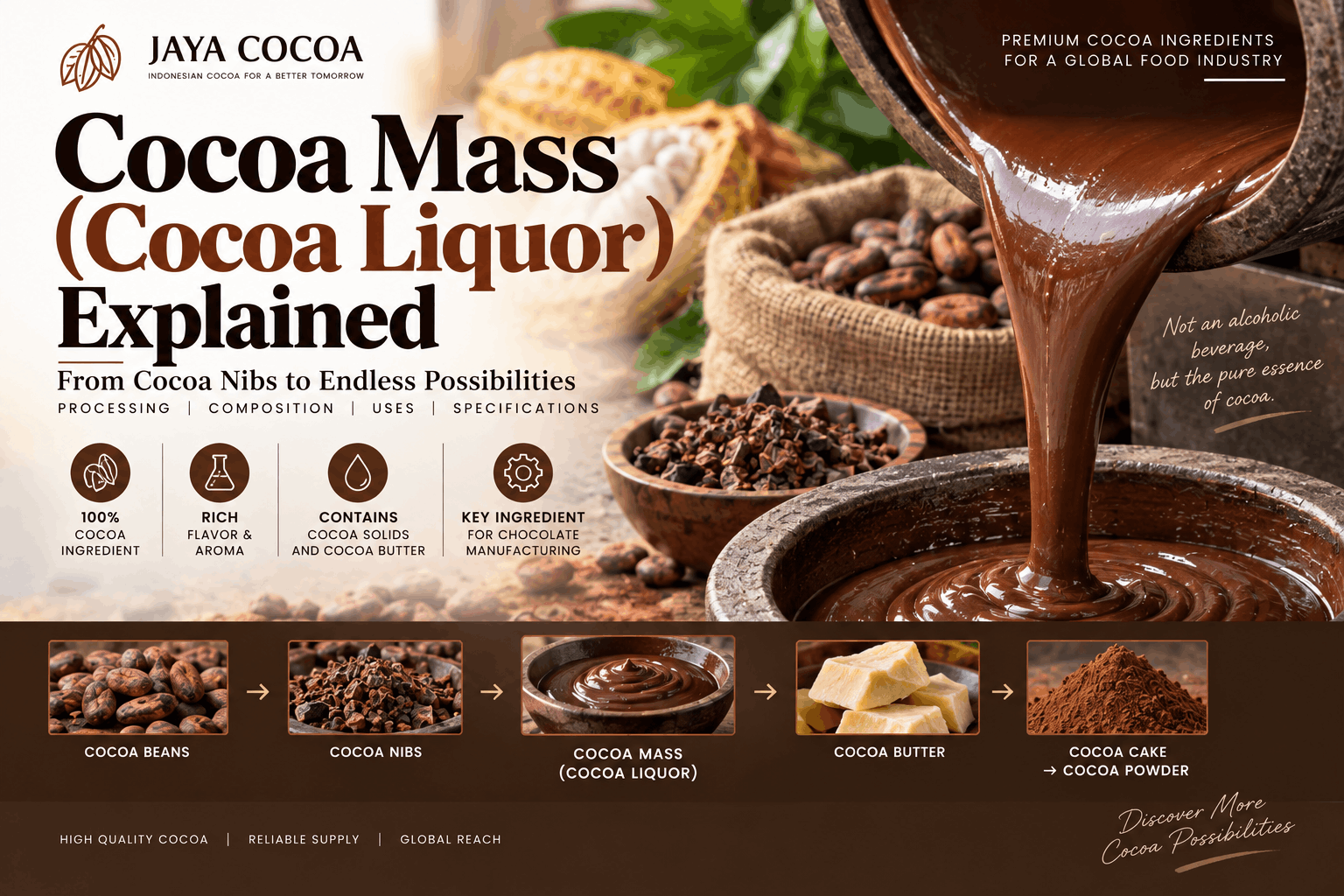
Despite the word “liquor,” cocoa liquor does not contain alcohol. It is a cocoa product made by grinding cocoa nibs into a fine mass containing both cocoa solids and cocoa butter.
For chocolate manufacturers, cocoa mass is particularly important because it provides the characteristic cocoa solids, cocoa fat, flavor, aroma, and color that form the foundation of many chocolate products.
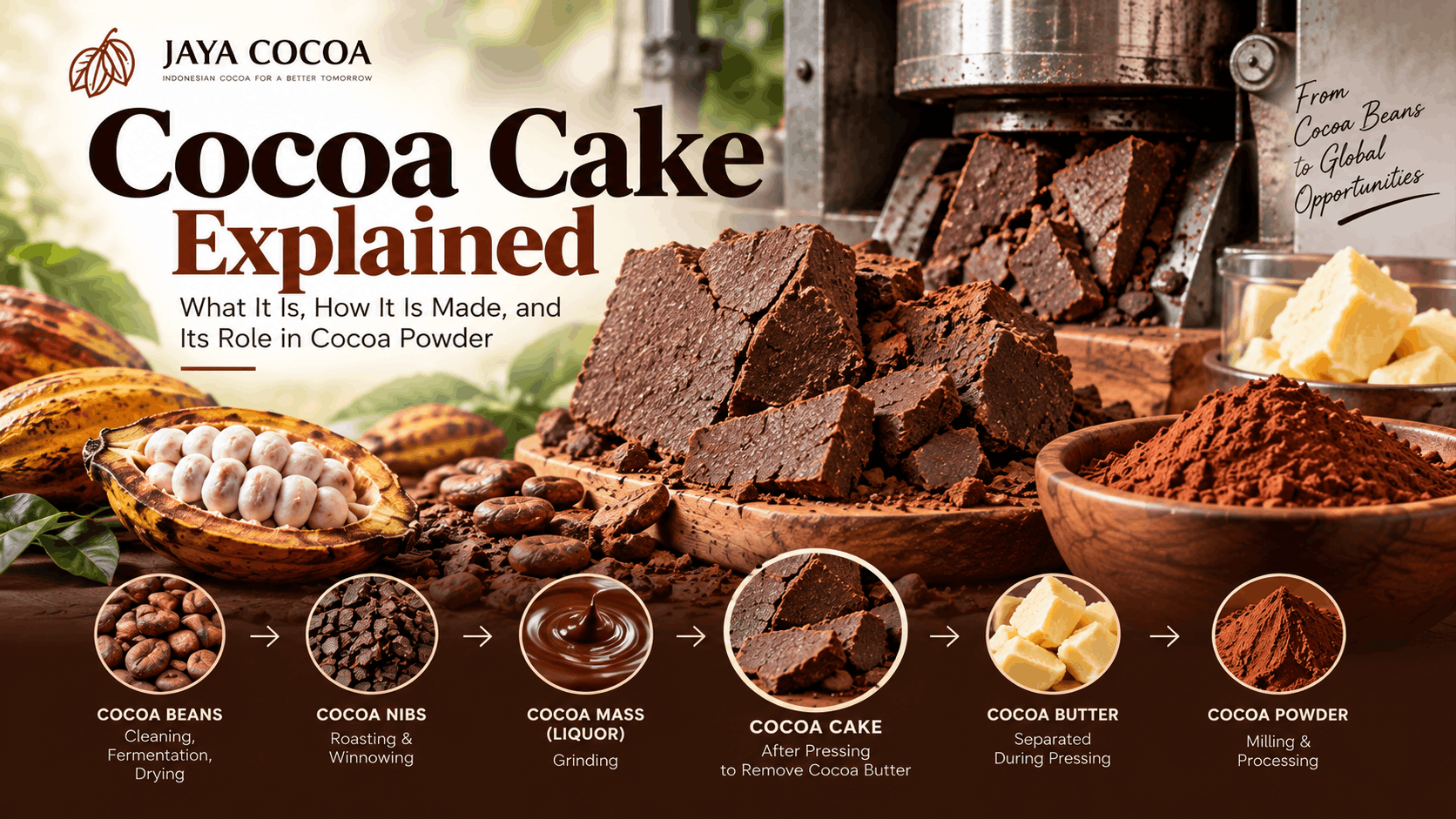
Cocoa mass can be used directly in chocolate manufacturing or further processed through pressing to separate it into cocoa butter and cocoa cake, with the latter subsequently processed into cocoa powder.
This guide explains what cocoa mass is, how it is produced, how it differs from cocoa powder and cocoa butter, its composition, applications, quality considerations, and what buyers should ask when sourcing cocoa liquor internationally.
What Is Cocoa Mass?
Cocoa mass is the product obtained by grinding cocoa nibs into a homogeneous cocoa paste or mass.
According to the current Codex Standard for Cocoa (Cacao) Mass (Cocoa/Chocolate Liquor) and Cocoa Cake, CXS 141-1983, cocoa mass or cocoa/chocolate liquor is obtained from cocoa nib produced from merchantable-quality cocoa beans that have been cleaned and freed from shells as thoroughly as technically possible. The standard permits the product to be made with or without roasting and with or without removal or addition of constituents, subject to the standard’s requirements.
In practical cocoa processing:
Cocoa beans
↓
Cleaning
↓
Roasting
↓
Cracking & Winnowing
↓
Cocoa Nibs
↓
Grinding
↓
Cocoa Mass / Cocoa Liquor
The exact processing sequence can vary depending on the manufacturer’s process and the desired product characteristics. The International Cocoa Organization (ICCO) describes nib grinding as the stage where cocoa nibs are converted into a paste or fluid material, with heat generated during grinding contributing to the formation of cocoa liquor.
Is Cocoa Liquor the Same as Cocoa Mass?
For most commercial cocoa-processing contexts, cocoa liquor, cocoa mass, and cocoa/chocolate liquor refer to essentially the same cocoa product.
Codex itself groups the terminology together under:
Cocoa (Cacao) Mass (Cocoa/Chocolate Liquor)
The standard also recognizes names including cocoa mass, cocoa/chocolate liquor, cocoa paste, unsweetened chocolate, and bitter chocolate, provided the product complies with the applicable requirements.
However, terminology can vary between suppliers, manufacturers, and markets.
Therefore, international buyers should always verify the technical specification and product definition rather than relying only on the commercial name.
Why Is It Called “Liquor”?
The word liquor can be confusing.
Cocoa liquor is not an alcoholic beverage.
The term refers to the fluid or semi-fluid cocoa mass produced by grinding cocoa nibs.
During grinding, friction generates heat and melts cocoa butter naturally present in the nibs. This allows the ground cocoa material to form a thick paste or fluid mass.
As the cocoa mass cools, it can become solid.
Therefore, cocoa liquor may be supplied or handled as a liquid/flowable mass when warm or as a solidified mass or blocks when cooled, depending on the processing and packaging system.
How Is Cocoa Mass Produced?
The production of cocoa mass begins with cocoa beans and involves several important processing stages.
1. Cocoa Bean Cleaning
Raw cocoa beans are cleaned to remove foreign materials before further processing.
Proper cleaning is important because cocoa beans can contain unwanted materials originating from harvesting, transportation, and storage.
ICCO identifies cleaning and inspection as important early stages in cocoa processing.
2. Roasting
Depending on the manufacturing process, cocoa beans or nibs are roasted before grinding.
Roasting contributes significantly to cocoa flavor development.
A recent 2025 review of cocoa chemistry and roasting describes roasting as a major processing step affecting cocoa flavor and chemical composition, including flavor precursors, volatile compounds, organic acids, and certain food-safety-related compounds.
Roasting conditions are not universal.
Temperature, time, equipment, bean origin, moisture, and desired flavor profile can all influence the final product.
3. Cracking and Winnowing
After roasting, the cocoa beans are cracked and winnowed to separate the shell from the nib.
The objective is to obtain cocoa nibs with as little shell and germ material as reasonably possible.
The nib is the primary cocoa fraction used to produce cocoa mass.
4. Grinding the Cocoa Nibs
The cleaned cocoa nibs are then ground.
During grinding, cocoa particles are progressively reduced in size while the natural cocoa butter becomes fluid due to the heat generated by the process.
The result is cocoa mass or cocoa liquor.
ICCO describes nib grinding as a process that can produce material ranging from a paste to a fluid consistency depending on the grinding system.
Cocoa Mass Processing Flow
A simplified industrial flow is:
Cocoa Beans
     ↓
Cleaning
     ↓
Roasting
     ↓
Cracking & Winnowing
     ↓
Cocoa Nibs
     ↓
Grinding
     ↓
COCOA MASS / COCOA LIQUOR
     │
     ├──────────────→ Chocolate Manufacturing
     │
     ↓
   Pressing
     │
     ├──────────────→ Cocoa Butter
     │
     ↓
  Cocoa Cake
     ↓
   Grinding
     ↓
  Cocoa Powder
This relationship is important because cocoa mass sits at the center of several cocoa product streams.
What Is Cocoa Mass Made Of?
Cocoa mass contains both:
- Cocoa solids
- Cocoa butter
Unlike cocoa powder, cocoa mass has not undergone the conventional pressing step used to remove a substantial portion of its cocoa butter.
Codex CXS 141-1983 specifies 47–60% cocoa butter by mass for cocoa mass/cocoa liquor covered by the standard.
This range is particularly important for industrial buyers because cocoa butter content directly influences the physical behavior and functionality of cocoa mass.
It also helps explain why cocoa mass behaves differently from low-fat cocoa powder.
Cocoa Mass vs Cocoa Powder
The biggest difference is fat separation.
| Characteristic | Cocoa Mass / Liquor | Cocoa Powder |
|---|---|---|
| Starting material | Cocoa nibs | Cocoa cake |
| Cocoa butter | Naturally retained | Partially removed |
| Physical form | Paste / solid mass | Powder |
| Typical use | Chocolate manufacturing | Beverages, bakery, desserts, etc. |
| Pressing step | Not yet pressed | Produced after pressing |
| Main function | Cocoa solids + cocoa fat | Cocoa solids, flavor, color |
| Codex reference | CXS 141-1983 | CXS 105-1981 |
Codex defines cocoa cake as the product obtained through partial or complete removal of fat from cocoa nib or cocoa mass. The resulting cake can then be further processed into cocoa powder.
Cocoa Mass vs Cocoa Butter
Cocoa mass and cocoa butter come from the same cocoa processing stream, but they are not the same product.
Cocoa mass contains cocoa solids and cocoa butter.
Cocoa butter is the fat fraction separated from cocoa mass through pressing and other processing routes.
A simplified relationship is:
COCOA NIB
    ↓
COCOA MASS
    ↓
PRESSING
    ├──→ COCOA BUTTER
    │
    └──→ COCOA CAKE
              ↓
        COCOA POWDER
ICCO identifies cocoa butter and cocoa cake as the two major products resulting from pressing cocoa liquor.
What Is Cocoa Mass Used For?
The primary industrial application of cocoa mass is chocolate manufacturing.
Cocoa mass can provide:
- Cocoa flavor
- Cocoa aroma
- Cocoa solids
- Cocoa color
- Cocoa butter
- Part of the fat phase of chocolate
ICCO identifies cocoa liquor, cocoa butter, and sugar as major ingredients used in chocolate manufacturing, with other ingredients added depending on the chocolate formulation.
Cocoa mass may therefore be used in products such as:
Dark Chocolate
Dark chocolate formulations commonly rely heavily on cocoa-derived ingredients, including cocoa mass and cocoa butter.
Milk Chocolate
Milk chocolate may combine cocoa mass and cocoa butter with milk ingredients and sugar.
Couverture Chocolate
Professional chocolate formulations may use cocoa mass as part of the cocoa component together with cocoa butter and other ingredients.
Compound and Confectionery Products
Depending on the formulation, cocoa mass or cocoa-derived ingredients can contribute cocoa flavor and solids to confectionery products.
Why Chocolate Manufacturers Use Cocoa Mass
Cocoa mass provides something that cocoa powder alone cannot provide in the same way:
both cocoa solids and cocoa fat in one ingredient.
This makes cocoa mass particularly useful when a chocolate manufacturer wants to build the cocoa component of a formulation while retaining cocoa butter.
The Encyclopedia of Food Safety describes cocoa liquor as cocoa particles dispersed in cocoa butter and explains that cocoa liquor can either be used directly for chocolate manufacturing or pressed into cocoa butter and cocoa press cake.
Natural Cocoa Mass vs Alkalized Cocoa Mass
Cocoa mass can also be processed through alkalization, depending on the manufacturer’s process and product requirements.
ICCO describes alkalization as an optional process that can be applied to cocoa liquor, nibs, or cocoa cake to modify characteristics such as color and flavor. Common alkaline materials include potassium carbonate, calcium carbonate, and sodium hydroxide.
Natural Cocoa Mass
Natural cocoa mass generally retains the natural acidity and flavor characteristics associated with the cocoa material and roasting process.
Alkalized Cocoa Mass
Alkalization can modify:
- Color
- Acidity
- Flavor profile
- Certain processing characteristics
The extent of these changes depends on the cocoa material, alkaline treatment, processing conditions, and degree of alkalization.
Therefore:
Alkalized cocoa mass should not automatically be considered better than natural cocoa mass.
The appropriate type depends on the chocolate formulation and desired product characteristics.
What Determines Cocoa Mass Quality?
For industrial buyers, the product name alone is not enough.
Cocoa mass quality can be influenced by several factors.
1. Cocoa Bean Origin
Bean origin can influence:
- Flavor
- Acidity
- Aroma
- Color
- Fat characteristics
- Overall sensory profile
Different origins can therefore produce cocoa masses with different flavor profiles.
2. Fermentation Quality
Fermentation is one of the major factors influencing cocoa flavor development.
Poor fermentation can contribute to undesirable flavor characteristics, while appropriate fermentation supports the development of desirable cocoa flavor precursors.
This means cocoa mass quality begins well before the grinding stage.
3. Roasting Profile
Roasting affects the chemical and sensory profile of cocoa.
A chocolate manufacturer may therefore evaluate the roasting profile according to the desired flavor target.
Recent research reviews emphasize that roasting substantially changes cocoa flavor and chemical composition.
4. Cocoa Butter Content
Cocoa butter is one of the most important technical characteristics of cocoa mass.
Codex CXS 141-1983 specifies:
47–60% cocoa butter by mass
for cocoa mass/cocoa liquor covered by the standard.
However, buyers should distinguish between a Codex compositional requirement and a commercial specification agreed between buyer and supplier.
A buyer may specify a narrower target depending on the formulation.
5. Particle Size
Particle size is another important technical parameter.
Grinding affects the physical structure of cocoa mass and can influence subsequent chocolate processing.
A recent 2026 study specifically investigated the effect of operating parameters on cocoa liquor grinding performance and emphasized the importance of particle-size control in chocolate manufacturing.
This connects directly with our previous article on:
Cocoa Powder Particle Size Explained
because particle-size control is important across multiple cocoa processing stages.
Cocoa Mass and Chocolate Viscosity
Cocoa mass contributes not only cocoa flavor but also to the rheological behavior of chocolate.
Chocolate manufacturers need to control viscosity because it affects:
- Depositing
- Moulding
- Enrobing
- Coating
- Flow through production equipment
- Final product texture
The amount and characteristics of cocoa butter are particularly important because cocoa butter is a major contributor to the continuous fat phase of chocolate.
Therefore, cocoa mass specifications should be considered together with the complete chocolate formulation rather than evaluated in isolation.
Cocoa Mass Quality Specifications for Buyers
A professional cocoa mass specification may include parameters such as:
| Parameter | Why It Matters |
|---|---|
| Cocoa butter | Determines fat contribution |
| Moisture | Important for product quality and storage |
| Particle size | Influences processing characteristics |
| pH | Important for acidity and formulation |
| Color | Influences final product appearance |
| Flavor | Determines sensory profile |
| Aroma | Important for chocolate character |
| Microbiology | Food safety and quality |
| Shell & germ | Indicates material purity |
| Heavy metals | Regulatory compliance |
| Pesticide residues | Market compliance |
| Foreign matter | Product safety |
| Packaging | Storage and transport protection |
Not every buyer will require exactly the same specification.
The final specification should be agreed between the supplier and buyer based on the intended application and destination-market requirements.
Codex Requirements for Cocoa Mass
The most important international reference for cocoa mass is:
Codex CXS 141-1983 — Standard for Cocoa (Cacao) Mass (Cocoa/Chocolate Liquor) and Cocoa Cake.
The current Codex document was adopted in 1983 and amended in 2025. The 2025 amendment updated the referenced methods of analysis and sampling.
The standard specifies, among other requirements:
Cocoa Mass / Cocoa Liquor
Cocoa butter:
47–60% m/m
Cocoa shell and germ:
Not more than 5% m/m calculated on fat-free dry matter, subject to the alternative basis specified in the standard.
The standard also addresses:
- Food additives
- Flavourings
- Hygiene
- Labelling
- Non-retail containers
- Methods of analysis and sampling
For international trade, the Codex standard is therefore a useful reference when developing a cocoa mass specification.
Cocoa Mass Packaging for Export
Cocoa mass packaging depends heavily on its physical state and the buyer’s processing system.
Unlike cocoa powder, cocoa mass can become solid when cooled, so industrial handling may require packaging and temperature management appropriate to the product.
Potential commercial formats can include:
- Blocks
- Cartons
- Food-grade lined containers
- Drums
- Bulk systems
- Other buyer-specific industrial packaging
The exact packaging should be agreed according to:
- Product temperature
- Storage conditions
- Shipment duration
- Destination climate
- Handling equipment
- Buyer melting/reprocessing system
- Food-contact requirements
For international shipments, packaging should be evaluated together with the product’s temperature and storage requirements.
How Should Cocoa Mass Be Stored?
Storage conditions should protect the product from:
- Excessive heat
- Moisture
- Contamination
- Foreign odors
- Physical damage
- Poor hygiene conditions
The exact storage temperature and handling procedure should follow the supplier’s validated specification and the buyer’s processing requirements.
This is particularly important because cocoa mass contains a substantial amount of cocoa butter.
Temperature affects the physical state of cocoa butter and therefore the handling characteristics of the cocoa mass.
Cocoa Mass vs Cocoa Powder vs Cocoa Butter
For buyers who are comparing cocoa ingredients, this distinction is essential.
| Product | Cocoa Solids | Cocoa Butter | Main Industrial Role |
|---|---|---|---|
| Cocoa Mass / Liquor | Yes | Yes | Chocolate manufacturing |
| Cocoa Butter | Very little/non-fat cocoa solids | Predominantly fat | Fat phase, chocolate formulation |
| Cocoa Powder | Yes | Reduced | Flavor, color, solids |
These products are not interchangeable.
A chocolate manufacturer choosing between cocoa mass and cocoa powder is making a formulation decision involving both cocoa solids and cocoa fat.
What Should Buyers Ask a Cocoa Mass Supplier?
Before purchasing cocoa mass internationally, procurement teams should ask suppliers for:
Product Identity
- Is the product natural or alkalized?
- Is it cocoa mass, cocoa liquor, or another cocoa product?
- What cocoa bean origin or blend is used?
Technical Specification
- Cocoa butter content
- Moisture
- Particle size
- pH
- Color
- Flavor profile
- Microbiological parameters
- Heavy metals
- Pesticide residues
- Foreign matter
- Shell and germ
Processing Information
- Bean origin
- Fermentation process
- Roasting process
- Grinding process
- Alkalization, if applicable
- Sterilization or microbial reduction treatment
Documentation
- COA
- Product specification
- Food safety documentation
- Packaging specification
- Certificate of origin where required
- Relevant certifications
- Destination-market compliance documentation
This information allows the buyer to evaluate whether the cocoa mass is suitable for the intended chocolate formulation.
Is Cocoa Mass the Same as Chocolate?
No.
This is another common misunderstanding.
Cocoa mass is an ingredient.
Chocolate is a formulated food product containing cocoa-derived ingredients and other components.
For example, chocolate manufacturing may combine:
- Cocoa mass
- Cocoa butter
- Sugar
- Milk ingredients for milk chocolate
- Emulsifiers
- Flavoring ingredients
The exact formulation depends on the type of chocolate and manufacturer’s recipe.
ICCO identifies cocoa liquor, cocoa butter, and sugar as major ingredients in chocolate manufacturing.
Therefore:
Cocoa mass is one of the foundational cocoa ingredients used to manufacture chocolate, but cocoa mass itself is not synonymous with finished chocolate.
Is Cocoa Liquor Liquid?
Not necessarily.
The terminology can create confusion.
Cocoa liquor is a ground cocoa mass that can be fluid when warm because of its cocoa butter content.
When cooled, it can solidify.
Therefore, “liquor” describes the cocoa processing product rather than meaning that it must remain liquid at room temperature.
This is one reason industrial buyers should always specify:
- Physical form
- Packaging
- Storage temperature
- Melting/handling requirements
when purchasing cocoa liquor.
Why Cocoa Mass Is Important in the Cocoa Supply Chain
Cocoa mass sits at a strategic point in cocoa processing.
From one cocoa processing stream, manufacturers can produce several commercially important ingredients:
                    COCOA BEANS
                         ↓
                    COCOA NIBS
                         ↓
                COCOA MASS / LIQUOR
                         │
              ┌──────────┴──────────┐
              ↓                     ↓
      CHOCOLATE MAKING          PRESSING
                                      │
                         ┌────────────┴────────────┐
                         ↓                         ↓
                  COCOA BUTTER                 COCOA CAKE
                                                     ↓
                                              COCOA POWDER
This is why cocoa mass is so important to the global cocoa-processing industry.
It connects the raw cocoa bean with multiple downstream cocoa ingredients and finished chocolate products.
Final Takeaway
Cocoa mass, cocoa liquor, and cocoa/chocolate liquor are closely related terms for the ground cocoa product made from cocoa nibs.
Unlike cocoa powder, cocoa mass retains a substantial proportion of the cocoa butter naturally present in cocoa nibs.
Under the current Codex standard CXS 141-1983, cocoa mass/cocoa liquor has a specified cocoa butter range of 47–60% m/m.
Cocoa mass can be used directly as a key ingredient in chocolate manufacturing or pressed to separate cocoa butter from cocoa cake, which can subsequently be processed into cocoa powder.
For international buyers, the most important considerations are not simply the name “cocoa liquor,” but the actual technical specification, cocoa butter content, flavor profile, processing method, particle size, microbiological quality, contaminants, packaging, and intended application.
A reliable cocoa mass specification should therefore be established between buyer and supplier before commercial shipment.
References & Sources
1. Codex Alimentarius — CXS 141-1983
Standard for Cocoa (Cacao) Mass (Cocoa/Chocolate Liquor) and Cocoa Cake
2. International Cocoa Organization — Processing Cocoa
3. A Review — Status, Supply Chain and Processing of Cocoa
4. Recent Advances in Cocoa Chemistry and Roasting
5. Cocoa Liquor — Encyclopedia of Food Safety
6. 2026 Study on Cocoa Liquor Grinding