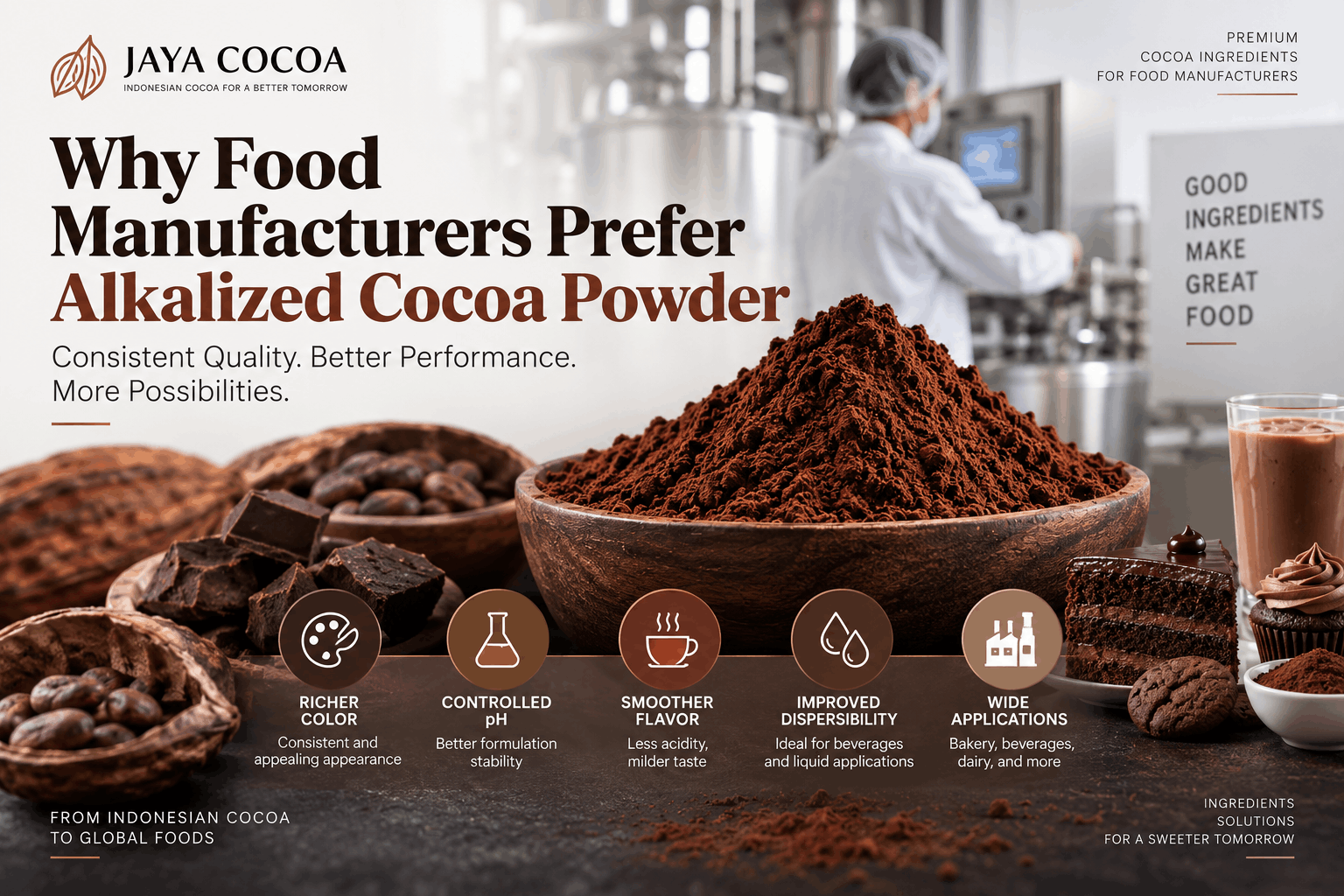
Why Food Manufacturers Prefer Alkalized Cocoa Powder
For food manufacturers, choosing a cocoa powder is not simply about finding the darkest color or the lowest price.
The cocoa powder must perform consistently inside a formulation. Its pH, color, flavor, dispersibility, fat content, particle characteristics, and batch-to-batch consistency can all influence the final product.
This is one reason many manufacturers choose alkalized cocoa powder for specific food applications.
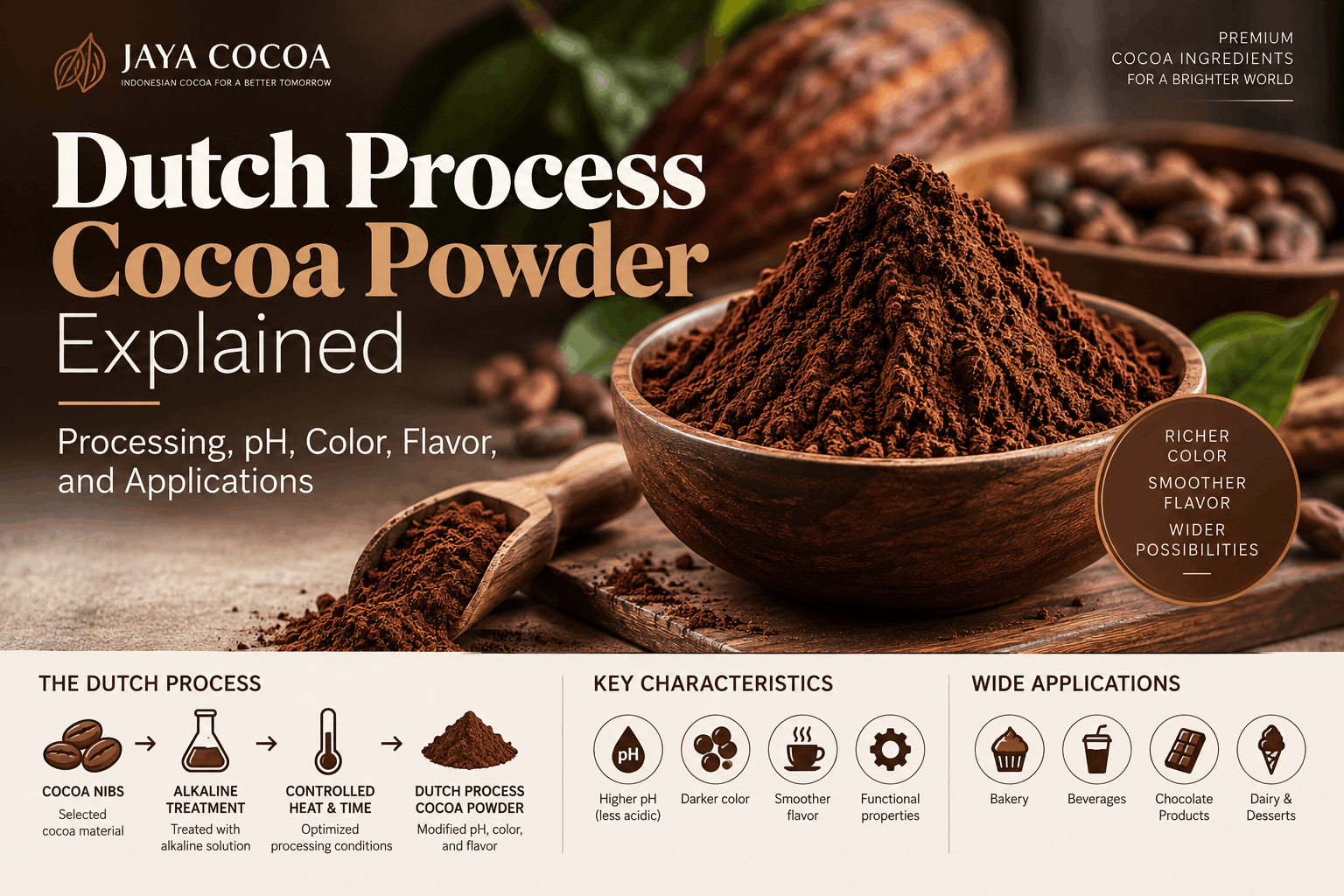
Alkalized cocoa powder, also known as Dutch-process cocoa powder, is cocoa that has undergone an alkaline treatment designed to modify its acidity and other physicochemical characteristics. The International Cocoa Organization (ICCO) describes alkalization as an optional processing step used to modify the flavor and color of cocoa liquor and cocoa powder.
But why do food manufacturers prefer it?
The answer is not simply that alkalized cocoa is “better.” Rather, alkalization gives manufacturers greater control over characteristics that are important in industrial food formulations.
What Is Alkalized Cocoa Powder?
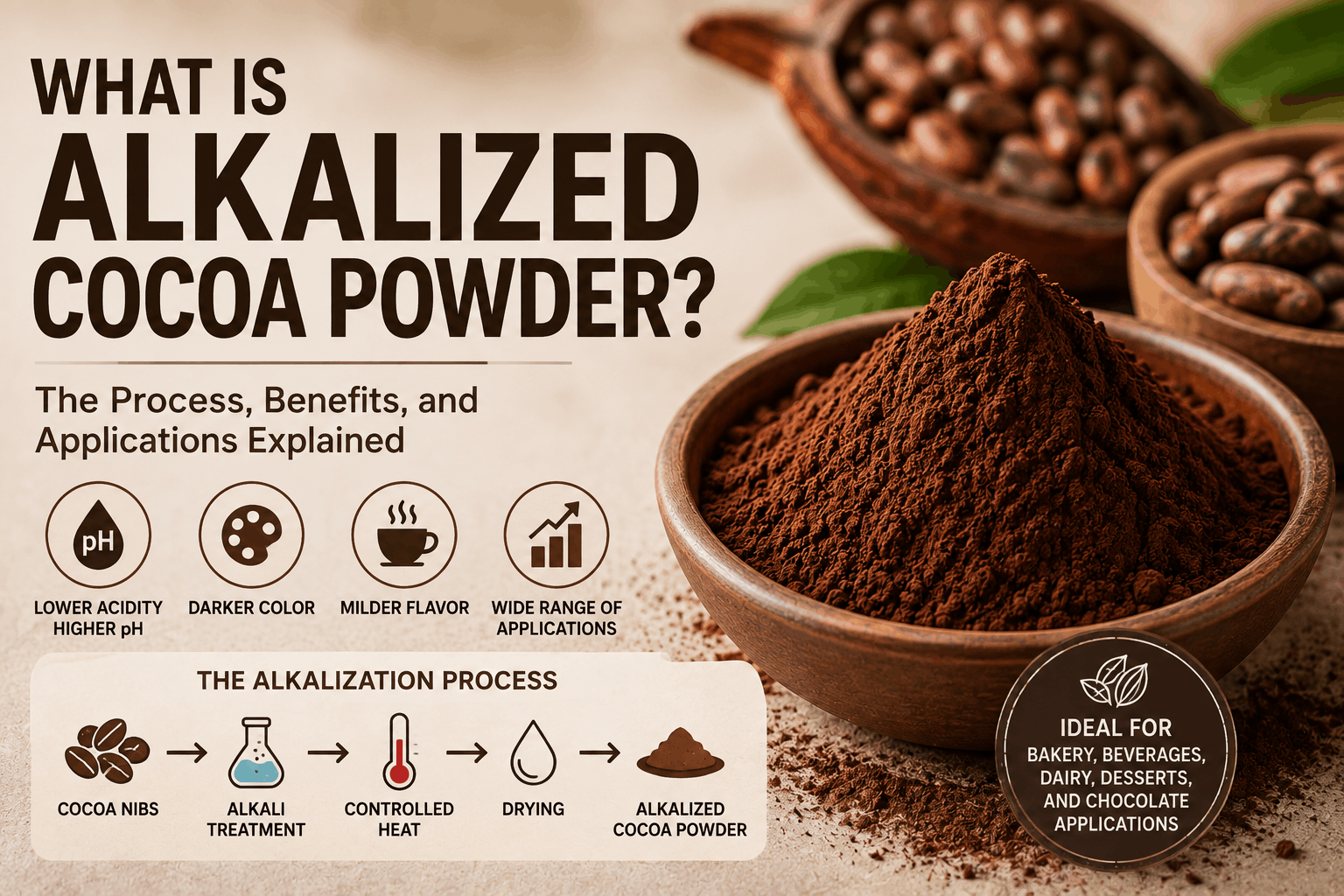
Alkalized cocoa powder is produced by treating selected cocoa material with an alkaline solution under controlled processing conditions.
Depending on the manufacturing process, alkalization can be applied to:
- Cocoa nibs
- Cocoa liquor
- Cocoa cake
ICCO identifies alkaline compounds such as potassium carbonate, calcium carbonate, and sodium hydroxide as examples used in cocoa alkalization. The resulting color can range from light red to very dark or charcoal black, depending on the processing conditions.
The degree of alkalization is not necessarily the same from one cocoa powder to another.
Manufacturers can produce different grades with different:
- pH
- Color
- Flavor
- Dispersibility
- Functional characteristics
This flexibility is one of the main reasons alkalized cocoa is valuable to the food industry.
1. More Control Over Cocoa Powder Color
One of the most obvious reasons food manufacturers choose alkalized cocoa powder is color control.
Natural cocoa powder generally has a lighter reddish-brown to brown appearance. Alkalization can produce significantly darker shades, depending on the degree of treatment.
Commercial alkalized cocoa powders may range from:
- Light brown
- Reddish brown
- Dark brown
- Brown-black
- Very dark or black
ICCO notes that alkalization can produce colors ranging from light red to charcoal black.
This gives food manufacturers more options when developing products where cocoa color is an important part of the consumer experience.
Examples include:
- Chocolate cakes
- Brownies
- Cookies
- Biscuits
- Chocolate beverages
- Ice cream
- Dessert products
- Chocolate-flavored fillings
Color can be especially important in products where consumers associate a darker appearance with a stronger chocolate character.
However, manufacturers should not assume that darker cocoa automatically means better cocoa.
The appropriate color depends on the formulation and the desired finished product.
2. Higher and More Controlled pH
Another major reason manufacturers use alkalized cocoa powder is its modified acidity.
Natural cocoa is naturally acidic, while alkalization increases its pH.
The exact pH of alkalized cocoa varies according to the processing conditions and degree of alkalization. There is therefore no single pH value that applies to every alkalized cocoa powder.
Research by Sioriki et al. demonstrated that alkali concentration can significantly affect cocoa powder pH, while Demirci et al. showed that alkalization temperature, time, and alkali concentration can be optimized to produce different quality characteristics.
For food manufacturers, this matters because pH is part of formulation chemistry.
Changing cocoa powder pH can affect:
- Batter chemistry
- Flavor perception
- Color development
- Leavening systems
- Stability
- Interaction with other ingredients
Therefore, manufacturers often specify a target pH rather than simply ordering “alkalized cocoa.”
3. A Different and Often Milder Flavor Profile
Alkalization can also change cocoa’s sensory characteristics.
Natural cocoa can have a relatively acidic, sharp, bitter, or astringent profile.
Alkalization modifies some of these characteristics.
Research published in LWT found that alkalization can reduce acidity, bitterness, and astringency while changing the aroma profile of cocoa beverages.
A separate study published in Food Chemistry found that alkalization altered volatile compounds associated with acidity, fruity, floral, and cocoa aromas. The researchers noted that medium alkalization could produce sensory characteristics different from both natural and heavily alkalized cocoa.
For manufacturers, this can be useful when the desired product profile calls for:
- A smoother cocoa character
- Lower perceived acidity
- Reduced astringency
- A particular chocolate flavor profile
But flavor should always be evaluated through application and sensory testing.
Two alkalized cocoa powders can have different flavor profiles even when their pH and color appear similar.
4. Improved Dispersibility for Certain Applications
Another reason alkalized cocoa powder can be attractive to manufacturers is its dispersibility.
Research has reported that alkalization can improve cocoa powder dispersibility.
This can be particularly relevant to formulations where cocoa needs to be incorporated into a liquid system.
Potential applications include:
- Cocoa beverages
- Chocolate milk
- Dairy drinks
- Dessert beverages
- Cocoa mixes
However, it is important to distinguish dispersibility from complete suspension stability.
A cocoa powder that disperses well does not necessarily remain suspended indefinitely.
Final performance can also depend on:
- Particle size
- Fat content
- Formulation composition
- Stabilizers
- Processing conditions
- Mixing equipment
Therefore, beverage manufacturers should test the actual cocoa grade in the finished formulation.
5. Greater Flexibility in Product Appearance
Food manufacturers often develop multiple products that require different visual characteristics.
One product may require a reddish-brown cocoa.
Another may require a dark chocolate appearance.
Another may require almost black cocoa.
Alkalization provides a wider range of possible cocoa colors than conventional natural cocoa processing.
This means manufacturers can select different alkalized cocoa grades according to the visual requirements of the final product.
For example:
| Product | Possible Cocoa Requirement |
|---|---|
| Chocolate cake | Medium/dark brown |
| Brownie | Dark brown |
| Chocolate biscuit | Brown/dark brown |
| Chocolate beverage | Brown to dark brown |
| Black cookie | Very dark/black |
| Dessert filling | Application-dependent |
The important point is that the manufacturer chooses the cocoa according to the finished product, rather than choosing the darkest available powder.
6. Better Compatibility With Specific Formulations
Food manufacturers do not select ingredients independently.
Every ingredient interacts with the rest of the formulation.
Cocoa powder can interact with:
- Sodium bicarbonate
- Acids
- Sugars
- Dairy ingredients
- Starches
- Emulsifiers
- Stabilizers
- Fats
- Other flavor ingredients
Because alkalization changes cocoa’s acidity, it can affect the formulation’s overall acid-base balance.
This is particularly important in bakery products.
For example, a formulation designed around natural cocoa may depend partly on cocoa’s acidity as part of the leavening system.
Replacing natural cocoa with strongly alkalized cocoa can therefore change the formulation’s performance.
This does not mean alkalized cocoa is unsuitable for baking.
Rather, it means:
The cocoa powder grade should be selected together with the formulation.
Industrial manufacturers should validate the substitution through application testing.
7. Consistent Color Can Be Valuable for Large-Scale Production
For an industrial food manufacturer, consistency is often more important than achieving an impressive result in one laboratory batch.
Imagine producing:
100,000 units of chocolate biscuits.
If the cocoa color changes significantly from one batch of ingredient to another, the finished product may also change in appearance.
This can create problems with:
- Product consistency
- Consumer expectations
- Quality control
- Production adjustment
- Finished-product specifications
Therefore, manufacturers often purchase cocoa powder according to defined specifications for:
- pH
- Color
- Fat
- Moisture
- Particle size
- Flavor
- Microbiology
Alkalized cocoa is particularly useful when a manufacturer requires a specific color range that can be maintained across production batches.
However, consistency is ultimately a supplier and process-control issue, not simply a consequence of alkalization.
8. It Can Expand Cocoa Powder’s Application Range
Research published in Food Research International in 2024 described alkalization as an important process for extending the usage of cocoa powder beyond traditional chocolate applications. The researchers noted that processing conditions influence properties such as color, aroma, flavor, and solubility.
This helps explain why alkalized cocoa powder is found across many industrial applications.
Bakery
- Cakes
- Brownies
- Cookies
- Biscuits
- Wafers
Beverage
- Cocoa drinks
- Chocolate beverages
- Dairy drinks
- Instant cocoa mixes
Dairy and frozen products
- Ice cream
- Chocolate milk
- Dairy desserts
Other food applications
- Dessert mixes
- Fillings
- Chocolate-flavored products
- Food coatings
The appropriate cocoa grade still depends on the specific formulation.
9. Manufacturers Can Specify Different Degrees of Alkalization
Another important advantage is that alkalization is not simply an on/off process.
Manufacturers can produce cocoa with different degrees of alkalization.
A simplified commercial spectrum can look like:
Natural Cocoa
↓
Lightly Alkalized
↓
Medium Alkalized
↓
Strongly Alkalized
↓
Very Dark / Black Cocoa
These terms are useful commercially, but they should not be treated as universal regulatory categories.
The actual product should be defined by measurable specifications.
For example:
- pH
- Color
- Fat content
- Moisture
- Particle size
- Microbiological limits
This is particularly important when different suppliers use terms such as “medium alkalized” or “dark alkalized” differently.
10. Alkalization Can Be Optimized for Different Quality Targets
Modern cocoa research increasingly looks at alkalization as a process optimization problem rather than simply a method for making cocoa darker.
Demirci et al. (2024) used response-surface methodology to investigate how alkaline concentration, temperature, and processing time influence different cocoa powder quality parameters. Their work demonstrated that different quality objectives can require different processing conditions.
This is highly relevant to industrial food manufacturing.
A cocoa manufacturer may optimize for:
- Color
- pH
- Flavor
- Solubility
- Moisture
- Ash
- Polyphenol retention
- Volatile profile
The optimal processing condition for one target may not be optimal for another.
This is why there is no single definition of the “best” alkalized cocoa powder.
11. But Alkalization Also Has Trade-Offs
A credible explanation of why manufacturers use alkalized cocoa should also discuss its limitations.
Alkalization can modify desirable cocoa characteristics, but it can also reduce certain naturally occurring compounds.
Research has shown that stronger alkalization conditions can reduce certain phytochemicals, including flavan-3-ols such as epicatechin.
The 2026 review by Binello et al. describes alkalization as a process intended to improve sensory and technological properties but notes that it can also cause changes in nutritional and physicochemical characteristics. The review emphasizes that the outcome depends on the cocoa matrix, raw material, alkali, and processing conditions.
Therefore, manufacturers should not assume:
More alkalization = better cocoa.
In many cases, the goal is to achieve the right degree of alkalization for the intended application.
Natural Cocoa vs Alkalized Cocoa: Why Do Manufacturers Choose One?
The decision ultimately depends on the formulation.
| Characteristic | Natural Cocoa | Alkalized Cocoa |
|---|---|---|
| Acidity | Higher | Reduced |
| pH | Generally lower | Generally higher |
| Color | Often lighter/reddish | Wider range of darker colors |
| Flavor | More acidic/sharp | Often smoother/less acidic |
| Dispersibility | Application-dependent | Can be improved through alkalization |
| Formulation chemistry | Retains natural acidity | Modified acidity |
| Color customization | More limited | Greater flexibility |
| Phytochemical retention | Generally higher for some compounds | Some compounds may decrease with stronger treatment |
These are general tendencies, not universal specifications.
The right choice depends on:
- Product formulation
- Desired color
- Target pH
- Flavor profile
- Processing conditions
- Regulatory requirements
- Consumer expectations
- Cost
For a detailed comparison, manufacturers can also refer to our guide on [Natural vs Alkalized Cocoa Powder].
Why Bakery Manufacturers Often Use Alkalized Cocoa Powder
Bakery is one of the clearest examples of why manufacturers may prefer alkalized cocoa.
Cocoa contributes not only flavor but also:
- Color
- Acidity
- Dry solids
- Fat
- Texture
- Interaction with leavening systems
An alkalized cocoa powder can provide a darker and less acidic cocoa profile.
However, manufacturers must consider the entire recipe.
If the formulation uses sodium bicarbonate and relies on acidic ingredients for the required acid-base reaction, changing cocoa powder from natural to alkalized can affect the balance.
For this reason, professional product development teams typically conduct trials before changing cocoa suppliers or cocoa grades.
Why Beverage Manufacturers Often Use Alkalized Cocoa Powder
Beverage manufacturers may select alkalized cocoa when they want:
- Darker beverage color
- Modified cocoa flavor
- Reduced acidity
- Suitable dispersibility
- A consistent visual appearance
Research has demonstrated that alkalization can improve cocoa powder dispersibility and modify beverage aroma and flavor characteristics.
However, beverage performance should be tested in the actual system.
A manufacturer should consider:
- Mixing conditions
- Particle size
- Fat content
- Suspension stability
- Stabilizers
- Homogenization
- Storage conditions
Therefore, a cocoa powder that performs well in one beverage formulation may not behave identically in another.
What Food Manufacturers Should Ask Their Cocoa Supplier
Before purchasing an alkalized cocoa powder, manufacturers should request more than a product name.
A proper technical discussion should cover:
Product Specification
Ask for:
- pH
- Fat content
- Moisture
- Color
- Particle size
- Flavor profile
Certificate of Analysis
Ask for a recent COA and confirm which parameters are routinely tested.
Microbiological Requirements
Depending on the application and destination market, confirm:
- Total Plate Count
- Yeast & Mold
- Coliforms
- Other relevant microbiological parameters
Contaminant Testing
Depending on the market and application, buyers may need information on:
- Heavy metals
- Mycotoxins
- Pesticide residues
- Other contaminants
Processing Information
Where commercially appropriate, buyers may also ask about:
- Degree/type of alkalization
- Processing consistency
- Raw material origin
- Production controls
Application Sample
The most important test is often the simplest:
Test the cocoa powder in your actual formulation.
A specification sheet tells you what the ingredient is supposed to be.
An application trial tells you how it actually performs.
Is Alkalized Cocoa Powder Always Better?
No.
This is an important distinction.
Food manufacturers prefer alkalized cocoa powder when its characteristics match their product requirements.
A natural cocoa powder may be preferable when a formulation requires:
- Higher natural acidity
- A specific flavor profile
- Certain phytochemical characteristics
- Compatibility with an acidic leavening system
- A lighter cocoa color
An alkalized cocoa powder may be preferable when the formulation requires:
- Darker color
- Higher pH
- Reduced acidity
- Different flavor characteristics
- Improved dispersibility for certain applications
- More control over cocoa appearance
The best cocoa powder is therefore not determined by whether it is natural or alkalized.
It is determined by application fit.
How to Choose the Right Alkalized Cocoa Powder
For food manufacturers, I recommend following a structured selection process.
Step 1: Define the final product
Determine whether the cocoa will be used for:
- Bakery
- Beverage
- Dairy
- Ice cream
- Dessert
- Chocolate
- Other processed foods
Step 2: Define technical requirements
Specify:
- pH
- Color
- Fat
- Moisture
- Particle size
- Flavor
Step 3: Request samples
Obtain representative samples before committing to large-volume purchases.
Step 4: Conduct application testing
Test the cocoa in the actual formulation.
Step 5: Review documentation
Request:
- Product specification
- COA
- Food safety documentation
- Regulatory information
- Relevant contaminant testing
Step 6: Evaluate batch consistency
For long-term supply, consistency is critical.
A supplier that produces a perfect sample but cannot maintain the specification across production batches may not be suitable for industrial manufacturing.
Frequently Asked Questions
Why do food manufacturers prefer alkalized cocoa powder?
Manufacturers may prefer alkalized cocoa because it can provide greater control over cocoa powder color, pH, flavor, and certain functional characteristics, depending on the degree and conditions of alkalization.
Is alkalized cocoa powder better than natural cocoa powder?
Not universally. The appropriate choice depends on the formulation, desired color, pH, flavor, processing system, and application requirements.
Why is alkalized cocoa darker?
Alkalization changes the chemical environment of cocoa and can significantly reduce its lightness. The final color depends on alkali type, concentration, temperature, time, cocoa material, and other processing conditions.
Does alkalization improve cocoa flavor?
It can modify flavor by reducing acidity, bitterness, and astringency, but the overall sensory effect depends on processing conditions and the cocoa raw material.
Is alkalized cocoa powder suitable for beverages?
Yes. It is commonly used in cocoa beverage formulations, and research indicates that alkalization can improve dispersibility while changing aroma and flavor characteristics.
Is alkalized cocoa powder suitable for baking?
Yes, but the formulation should be evaluated because alkalization changes cocoa acidity and therefore can influence acid-base reactions in bakery systems.
Does alkalization reduce cocoa’s natural compounds?
Some compounds can decrease, particularly under stronger alkalization conditions. The degree of change depends on the processing conditions and cocoa matrix.
Conclusion
Food manufacturers often choose alkalized cocoa powder because it gives them greater control over important formulation characteristics, particularly color, pH, flavor, and certain functional properties.
Alkalization can produce cocoa powders ranging from light reddish-brown to very dark colors, modify cocoa acidity, change sensory characteristics, and improve dispersibility for certain applications. ICCO identifies alkalization as an optional cocoa-processing step specifically used to modify flavor and color.
Scientific research also shows that the result depends strongly on the processing conditions. Alkali concentration, temperature, time, cocoa material, and other variables can influence the final cocoa powder.
However, more alkalization is not automatically better. Stronger treatment can also alter or reduce certain naturally occurring cocoa compounds. Recent research therefore increasingly focuses on optimizing alkalization for the desired combination of sensory, technological, and quality characteristics.
For food manufacturers, the best approach is to select alkalized cocoa powder based on application requirements, measurable specifications, supplier consistency, and actual formulation performance.
The goal is not simply to find the darkest cocoa powder.
The goal is to find the right cocoa powder for the product.
References
1. International Cocoa Organization (ICCO) — Processing Cocoa
2. Sioriki, E., et al. (2021)
“Impact of alkalization conditions on the phytochemical content of cocoa powder and the aroma of cocoa drinks.” LWT – Food Science and Technology, 145, 111181.
3. Demirci, S., et al. (2024)
“Influence of process conditions of alkalization on quality of cocoa powder.” Food Research International, 182, 114147.
4. Sioriki, E., et al. (2022)
“The effect of cocoa alkalization on the non-volatile and volatile mood-enhancing compounds.” Food Chemistry, 381, 132082.
5. Binello, A., Cravotto, G., Mantegna, S., & Tagliapietra, S. (2026)
“An upgrade in cocoa alkalization: Functional changes, chemistry and new perspectives.” Food Chemistry, 499, 147370.