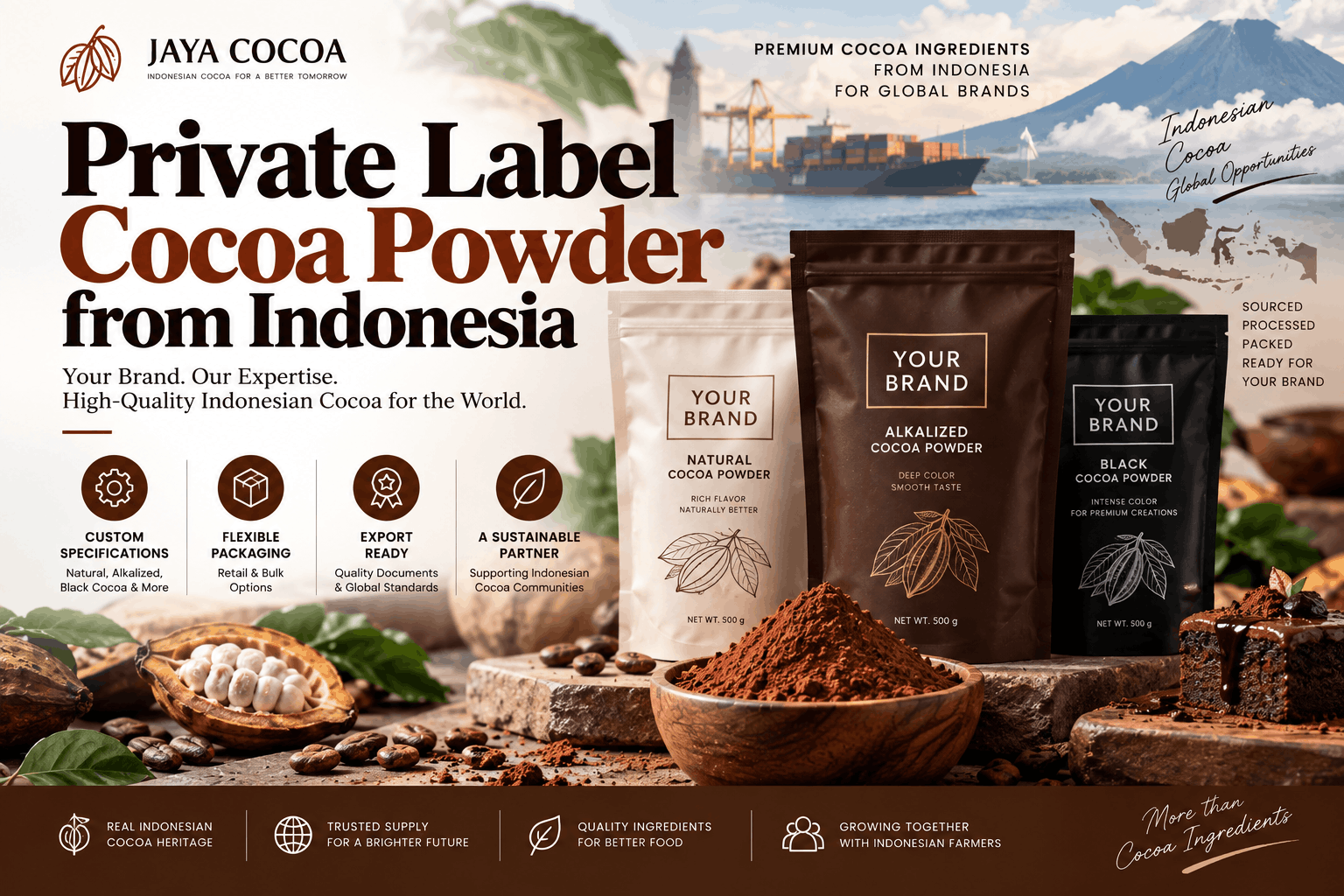
Private Label Cocoa Powder from Indonesia
Indonesia is one of the countries with an established cocoa processing industry, supplying cocoa ingredients for food and beverage applications in international markets. For companies looking to launch their own cocoa powder brand, working with an Indonesian manufacturer or exporter can provide access to cocoa powder manufacturing, customized specifications, export packaging, and private label production.
But private label cocoa powder is more than simply putting a customer’s logo on a bag.
A successful private label program requires the buyer and supplier to agree on the cocoa powder specification, processing profile, packaging, labeling, quality documentation, production requirements, and export arrangements before commercial production begins.
This guide explains how private label cocoa powder from Indonesia works and what international buyers should consider before choosing a supplier.
What Is Private Label Cocoa Powder?
Private label cocoa powder is cocoa powder manufactured or packed by a supplier for sale under another company’s brand name.
For example, an Indonesian cocoa manufacturer may produce cocoa powder according to a buyer’s agreed specification, while the finished product is sold under the buyer’s own brand in its target market.
Private label arrangements can involve:
- The buyer’s own brand name
- Customized packaging
- Customized product specifications
- Different cocoa powder types
- Buyer-specific labels
- Contract manufacturing
- Export documentation
- Batch and lot identification
- Long-term supply agreements
The exact arrangement depends on the contract between the buyer and manufacturer.
Private label should therefore be understood as a commercial manufacturing and branding model, rather than a separate type of cocoa powder.
The underlying cocoa powder still needs to comply with the applicable food standards and regulations in the country where it is produced and marketed.
Why Choose Indonesia for Private Label Cocoa Powder?
Indonesia has an established cocoa processing and export industry, including manufacturers and exporters supplying cocoa powder and other cocoa derivatives.
The International Cocoa Organization describes cocoa processing as a chain that includes cleaning, fermentation, roasting, nib grinding, optional alkalization, liquor pressing, and cocoa cake grinding. Cocoa cake is subsequently milled to particle sizes according to the intended end use.
This processing capability allows suppliers to produce different cocoa powder profiles for applications such as:
- Bakery
- Biscuits
- Beverages
- Ice cream
- Confectionery
- Chocolate products
- Dessert products
- Food ingredient manufacturing
Indonesia’s export ecosystem also includes companies listed through the Indonesian Ministry of Trade’s Inaexport platform offering cocoa powder in different commercial specifications and packaging formats. For example, current listings show natural and alkalized cocoa powder, customized particle size, different fat contents, and export-oriented packaging. These listings are commercial examples rather than universal Indonesian industry standards.
What Types of Cocoa Powder Can Be Used for Private Label?
A private label program can be developed around different cocoa powder profiles.
1. Natural Cocoa Powder
Natural cocoa powder is generally produced without an alkalization step.
It is commonly used in:
- Bakery products
- Biscuits
- Cocoa beverages
- Desserts
- Food formulations requiring a more acidic cocoa profile
The exact pH, fat content, color, particle size, and flavor should be agreed through a technical specification rather than assumed from the term “natural.”
2. Alkalized Cocoa Powder
Alkalized cocoa powder, also known as Dutch-process cocoa powder, is treated with an alkaline material to modify characteristics such as color and flavor.
The International Cocoa Organization explains that alkalization can be applied to cocoa cake, nibs, or cocoa liquor and can produce colors ranging from light red to very dark/charcoal depending on the process.
This makes alkalized cocoa powder useful for applications where manufacturers require specific:
3. Black Cocoa Powder
Black cocoa is a highly alkalized cocoa powder designed to produce a very dark color.
It is often associated with products such as:
- Cookies
- Sandwich biscuits
- Dark bakery products
- Decorative applications
- Chocolate-flavored snacks
However, the exact color and processing profile should be defined by specification and sample approval rather than by the product name alone.
What Can Be Customized in a Private Label Program?
One of the main advantages of private label production is the ability to establish a product specification specifically for the buyer’s application.
Depending on the manufacturer’s capabilities, customization may include:
Cocoa Powder Type
- Natural
- Alkalized
- Black cocoa
- Other application-specific profiles
Fat Content
Different applications may require different cocoa butter levels.
The Codex standard for cocoa powders recognizes cocoa powders and fat-reduced cocoa powders and provides compositional requirements for these products. The current Codex listing shows CXS 105-1981 as the applicable standard for cocoa powders and dry mixtures of cocoa and sugars, with the standard last modified in 2025.
Color
Color may be specified using a buyer’s required measurement system or an agreed physical standard.
pH
pH is particularly important when selecting natural versus alkalized cocoa powder.
Particle Size
Particle size can influence processing and application performance.
The ICCO notes that cocoa cake is milled to particle sizes determined by the intended end use.
Flavor Profile
The buyer and supplier can establish an acceptable flavor profile through samples and technical specifications.
Microbiological Requirements
Buyers may establish microbiological specifications based on the intended application and destination-market requirements.
Contaminant Requirements
Depending on the destination market, buyers may need requirements relating to contaminants, residues, heavy metals, or other food-safety parameters.
The exact testing requirements should be agreed before production.
Private Label Cocoa Powder Packaging
Packaging is one of the most visible parts of a private label project.
Depending on the market and product format, packaging can include:
- 500 g bags
- 1 kg bags
- 5 kg bags
- 10 kg bags
- 20–25 kg industrial bags
- Bulk packaging
- Customized retail packaging
- Customized master cartons
For industrial cocoa powder, commercial Indonesian export listings demonstrate the use of formats such as 25 kg bags and other export packaging configurations. Again, these are examples from individual suppliers, not a universal requirement.
The buyer should discuss packaging before production because the packaging specification can affect:
- Product protection
- Moisture protection
- Shelf life
- Storage
- Container loading
- Shipping cost
- Retail presentation
- Labeling requirements
Private Label Packaging vs Bulk Cocoa Powder
There is an important difference between bulk cocoa powder supply and private label cocoa powder.
| Bulk Cocoa Powder | Private Label Cocoa Powder |
|---|---|
| Supplier’s standard packaging | Buyer’s branded packaging |
| Standard product specification | Buyer-specific specification may be used |
| Usually industrial/B2B | Can be B2B or retail-oriented |
| Supplier branding may be absent | Buyer’s brand is displayed |
| Simpler packaging process | Requires artwork and label approval |
| Usually easier to start | More coordination required |
A buyer importing cocoa powder for use as an ingredient may prefer bulk packaging.
A company launching its own cocoa powder brand may require private label packaging.
What Should Be Included on the Private Label?
The final label depends on the destination market and whether the product is sold at retail or supplied as an ingredient.
Typical information may include:
- Product name
- Brand name
- Net weight
- Ingredient information
- Manufacturer information
- Importer/distributor information where required
- Production or lot code
- Best-before/expiry information
- Storage instructions where required
- Nutrition information where required
- Certification marks where applicable
- Country-of-origin information where required
For Indonesia, BPOM’s labeling guidance requires food labels to provide specified information and states that labels must be truthful, clear, readable, and not misleading. BPOM also provides specific guidance for contract-produced food, including identification of the contracting and contracted parties.
BPOM’s current legal database also shows that the labeling framework under PerBPOM No. 31/2018 has been amended, including amendments in 2021 and 2024.
Important: the label requirements of the destination country should always be checked separately. A label that is acceptable in Indonesia is not automatically compliant with another country’s requirements.
Quality Documents for Private Label Cocoa Powder
A serious private label cocoa powder program should not rely only on product photographs or a supplier’s brochure.
International buyers should ask for appropriate technical and quality documentation.
Depending on the product and market, this may include:
Certificate of Analysis (COA)
A COA should correspond to the actual product or batch and may include parameters such as:
- Moisture
- Fat
- pH
- Ash
- Particle size
- Microbiology
- Other agreed parameters
Product Specification
The specification should clearly define the agreed product characteristics and acceptance limits.
Food Safety Documentation
Depending on the supplier and destination market, buyers may request documentation relating to food-safety systems and certifications.
Halal Certificate
Halal certification may be relevant when required by the buyer or destination market.
Certificate of Origin
This may be required for customs or preferential trade purposes depending on the destination and applicable trade arrangement.
Health or Sanitary Documentation
Requirements vary by destination and product.
The buyer should therefore establish the documentation checklist before shipment rather than waiting until the container is ready to load.
Is SNI Required for Cocoa Powder?
Indonesia has a national standard specifically for cocoa powder.
The Indonesian National Standardization Agency (BSN) lists SNI 3747:2024 — Kakao bubuk as a current standard, alongside the earlier SNI 3747:2013 listing.
However, buyers should distinguish between:
- Indonesian product standards
- Destination-country regulations
- Buyer-specific specifications
- International standards such as Codex
For export transactions, the applicable requirements depend on the product, destination market, and regulatory status of the particular product.
For example, Indonesia’s Ministry of Trade provides destination-specific technical information for cocoa exports. Its UAE guidance identifies requirements relating to cocoa powder standards, food labeling, hygiene, microbiological criteria, and testing methods.
Therefore, a private label supplier should work from the destination-market requirements, not simply assume that one certificate or standard covers every country.
How the Private Label Cocoa Powder Process Works
A typical private label project can follow this sequence:
Step 1 — Define the Market
Determine:
- Destination country
- Retail or B2B application
- Target consumer
- Intended application
- Package size
- Required certifications
Step 2 — Define the Product
Specify:
- Natural or alkalized
- Fat content
- pH
- Color
- Particle size
- Flavor
- Moisture
- Microbiological requirements
- Other technical parameters
Step 3 — Request Samples
The supplier should provide samples corresponding to the proposed specification.
The buyer can then evaluate:
- Color
- Aroma
- Flavor
- Dispersion
- Application performance
- Final product appearance
Step 4 — Approve the Specification
Once the sample is accepted, both parties should document the specification.
This is important because the phrase “premium cocoa powder” is not specific enough for commercial production.
A written specification provides a much clearer reference.
Step 5 — Approve Packaging
The buyer provides or approves:
- Packaging artwork
- Bag dimensions
- Material
- Net weight
- Label information
- Carton design if applicable
Step 6 — Confirm Commercial Terms
The contract should define:
- MOQ
- Price
- Incoterm
- Payment terms
- Production lead time
- Packaging responsibility
- Inspection procedure
- Claims procedure
- Documentation
- Shipment requirements
Step 7 — Production
The supplier produces the cocoa powder according to the approved specification and packaging requirements.
Step 8 — Quality Control
The finished product should be tested against the agreed specification.
Step 9 — Packing and Export
After approval, the product is packed and prepared for shipment with the required export documentation.
What Is the MOQ for Private Label Cocoa Powder?
There is no single global MOQ for private label cocoa powder.
MOQ depends on factors such as:
- Packaging format
- Printing method
- Packaging supplier
- Product specification
- Production batch size
- Supplier capacity
- Destination market
- Whether the buyer wants retail packaging or bulk packaging
Current Indonesian commercial listings illustrate this variation. For example, some cocoa powder listings on Inaexport show minimum orders of 5,000 kg, 17 tons, or 19 tons, while individual suppliers offering private-label programs may specify their own MOQs. These figures should be treated as supplier-specific commercial terms rather than industry-wide requirements.
For a new brand, it is therefore useful to ask suppliers for two separate MOQs:
Product MOQ: minimum quantity of cocoa powder required for production.
Packaging MOQ: minimum quantity of printed packaging required by the packaging manufacturer.
These two numbers may be different.
How Much Does Private Label Cocoa Powder Cost?
There is no single private-label price because the final cost depends on several variables.
A quotation may depend on:
- Cocoa powder type
- Fat content
- Alkalization level
- Color
- Particle size
- Quality requirements
- Testing requirements
- Packaging material
- Package size
- Printed packaging
- Order quantity
- Certification requirements
- Incoterm
- Destination
For this reason, a buyer should avoid comparing suppliers using only a price per kilogram.
A more meaningful comparison is:
Product specification + packaging + documentation + quantity + Incoterm + payment terms
This provides a more realistic picture of the total supply arrangement.
What Should Buyers Ask an Indonesian Private Label Supplier?
Before placing an order, international buyers should ask:
Product
- What cocoa powder types are available?
- What fat contents are available?
- What pH range can you provide?
- What color specifications are available?
- What particle size can you provide?
- Can you match a reference sample?
Quality
- Can you provide a COA?
- What microbiological testing is performed?
- What food-safety certifications are available?
- Can you provide batch traceability?
- What is the shelf life?
- How is the product stored before shipment?
Packaging
- What packaging materials are available?
- Can you print our brand?
- What is the packaging MOQ?
- Can we use our own artwork?
- Can you provide retail and bulk formats?
Export
- What Incoterms do you offer?
- Which export port do you use?
- What documents are included?
- What is the production lead time?
- Can you arrange inspection before shipment?
Commercial
- What is the product MOQ?
- What is the private-label MOQ?
- What payment terms are available?
- Is a sample order possible?
- What happens if the product does not meet the agreed specification?
Private Label vs Developing Your Own Cocoa Powder Brand
Private label can reduce the need for a buyer to build an entire cocoa-processing facility.
Instead of investing in:
- Cocoa processing machinery
- Grinding equipment
- Alkalization systems
- Packaging machinery
- Quality-control laboratories
- Food-processing infrastructure
the brand owner can work with an existing manufacturer.
This allows the buyer to concentrate more heavily on:
- Brand development
- Distribution
- Marketing
- Customer acquisition
- Retail relationships
- Product positioning
However, private label also creates a dependency on the manufacturing partner. That makes supplier verification, specification control, sample approval, quality documentation, and contractual terms particularly important.
Private Label Cocoa Powder for Different Markets
A private label product may be designed differently depending on its intended market.
Retail Cocoa Powder
Focus may include:
- Attractive packaging
- Consumer-friendly sizes
- Label compliance
- Brand positioning
- Shelf presentation
Foodservice Cocoa Powder
Focus may include:
- Larger package sizes
- Cost efficiency
- Consistency
- Ease of handling
Industrial Cocoa Powder
Focus may include:
- Technical specification
- Batch consistency
- Particle size
- Fat content
- pH
- Microbiology
- Contaminant requirements
- Long-term supply
The correct product should therefore be designed around the application and market, rather than simply selecting the lowest-cost cocoa powder.
How to Choose a Private Label Cocoa Powder Supplier in Indonesia
A supplier evaluation should cover more than price.
A practical due-diligence checklist includes:
1. Manufacturing capability
Can the supplier actually produce the required specification?
2. Quality system
Does the supplier have appropriate quality-control procedures and documentation?
3. Product consistency
Can the supplier maintain the agreed specification from batch to batch?
4. Private-label capability
Can the supplier handle customized packaging and labeling?
5. Export experience
Does the supplier understand the documentation and logistics required for international shipments?
6. Traceability
Can the supplier identify production lots and provide appropriate batch documentation?
7. Communication
Can the supplier respond clearly to technical and commercial questions?
8. Contract clarity
Are specifications, payment terms, delivery terms, claims procedures, and responsibilities documented?
These points are especially important when developing a private-label product intended to become a long-term brand.
Indonesia Private Label Cocoa Powder: What Buyers Should Prepare
Before contacting an Indonesian supplier, prepare a simple product brief containing:
Product
- Natural / alkalized / black
- Target fat content
- Target pH
- Target color
- Particle size
- Application
Packaging
- Package size
- Packaging material
- Retail or bulk
- Printed packaging
Market
- Destination country
- B2B or retail
- Required certifications
- Target market segment
Commercial
- Estimated annual volume
- Initial order quantity
- Target shipment schedule
- Preferred Incoterm
The more specific the brief, the easier it is for a manufacturer to provide a meaningful quotation and sample.
Final Thoughts
Private label cocoa powder from Indonesia can be structured as a customized B2B supply program covering product formulation, technical specifications, packaging, branding, quality documentation, and export logistics.
The most important point is that private label should not begin with the question:
“How much is your cocoa powder?”
A better starting point is:
“Can you produce this specification, package it under our brand, provide the required documentation, and supply it consistently to our target market?”
Once the product specification, packaging, regulatory requirements, MOQ, and commercial terms are clearly defined, the private-label project becomes much easier to evaluate.
For international buyers, the strongest supplier relationship is not simply based on the first quotation. It is built around clear specifications, verified quality, consistent production, transparent documentation, and reliable export execution.
Indonesia’s cocoa-processing industry provides an established base for these types of supply arrangements, while individual suppliers differ significantly in their capabilities, certifications, MOQs, specifications, and private-label services. Buyers should therefore evaluate each supplier against their own product and destination-market requirements rather than assuming that all Indonesian cocoa suppliers offer the same service.
Frequently Asked Questions
What is private label cocoa powder?
Private label cocoa powder is cocoa powder manufactured or packed by a supplier for sale under the buyer’s own brand.
Can Indonesian suppliers produce customized cocoa powder?
Yes. Indonesian commercial listings demonstrate suppliers offering different cocoa powder types and customized specifications, although capabilities and MOQs vary by supplier.
Can I customize the packaging?
Private-label suppliers may offer customized packaging, but packaging capabilities and minimum quantities vary. Buyers should confirm the packaging material, printing method, MOQ, and artwork requirements before placing an order.
What cocoa powder types are available?
Common commercial options include natural, alkalized, and black cocoa powder. The exact specifications depend on the supplier and intended application.
What documents should I request?
Depending on the destination and product, buyers may request a product specification, COA, food-safety documentation, certification documents, export documents, and other market-specific documentation.
What is the minimum order quantity?
There is no universal MOQ. Current Indonesian commercial listings show MOQs ranging from several metric tons to around 20 tons or more, depending on the supplier and product.
Is private label cocoa powder suitable for retail brands?
Yes, provided the product, packaging, labeling, food-safety requirements, and destination-market regulations are properly addressed.
References & Recommended Sources
- Codex Alimentarius — Cocoa Powder Standards (CXS 105-1981)
- Codex Alimentarius — Official Standards Database
- International Cocoa Organization — Processing Cocoa
- Badan Standardisasi Nasional — SNI 3747:2024 Kakao Bubuk
- BPOM — Contoh dan Ketentuan Label Pangan Olahan
- BPOM — PerBPOM No. 6 Tahun 2024 tentang Perubahan Label Pangan Olahan
- Kementerian Perdagangan — Persyaratan Mutu Ekspor Produk Kakao ke Uni Emirat Arab
- Inaexport — Indonesian Cocoa Powder Export Listings