
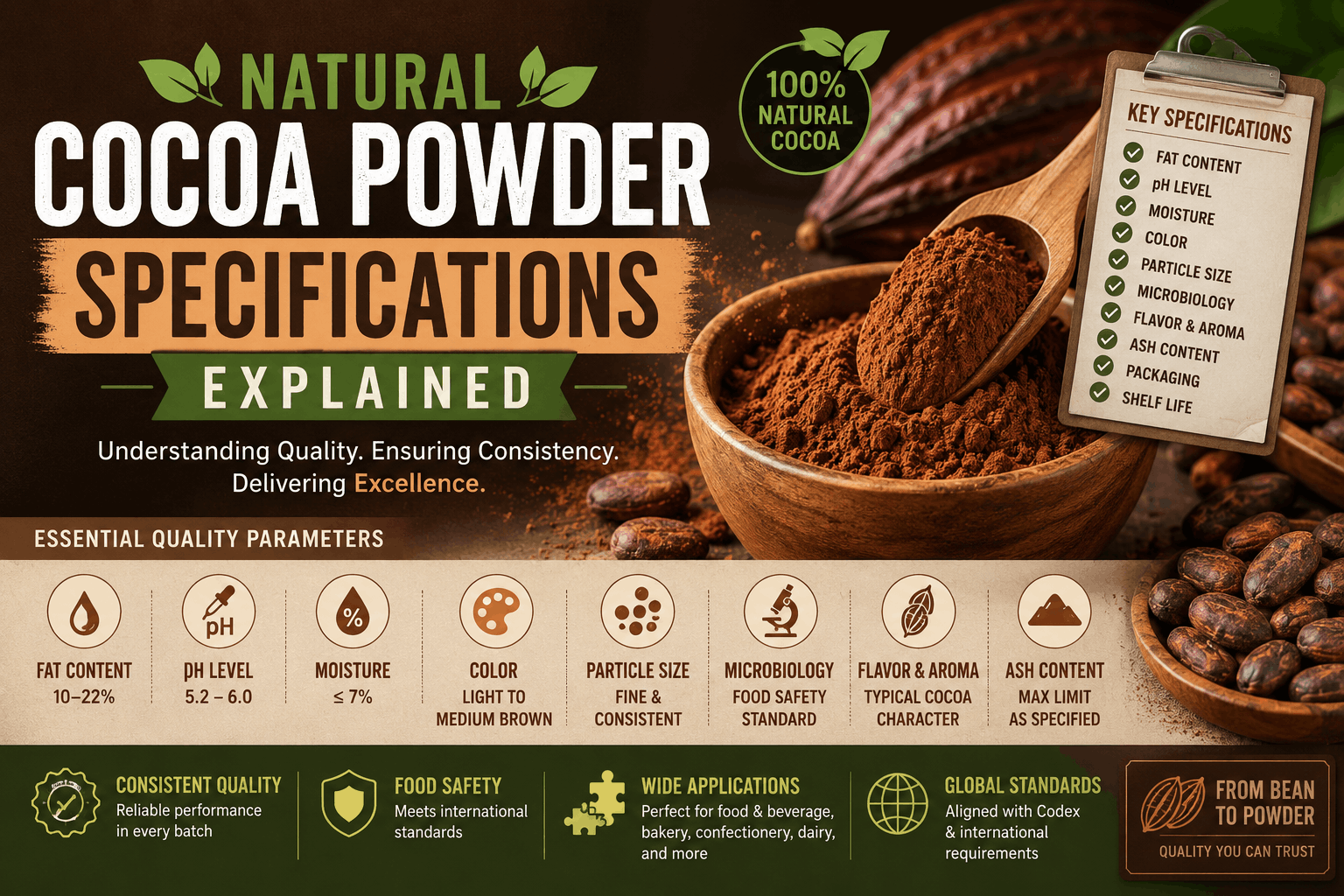
Natural Cocoa Powder Specifications Explained A Technical Guide to pH, Fat Content, Moisture, Color, Particle Size, Microbiology, and Quality Parameters Natural cocoa powder specifications are important for food manufacturers, ingredient buyers, importers, and product developers who need consistent quality and predictable performance from cocoa powder. Key specifications include fat content, pH, moisture, color, particle size, microbiological quality, flavor, and other requirements established by applicable standards and commercial agreements. Understanding these specifications helps buyers select the appropriate cocoa powder for their applications, compare suppliers, evaluate Certificates of Analysis (COAs), and establish clear quality requirements before purchasing. Natural cocoa powder is widely used as an ingredient in bakery, beverages, confectionery, dairy products, desserts, and other food applications. However, purchasing natural cocoa powder for industrial production requires more than specifying the product name. For food manufacturers, importers, procurement teams, and product developers, a reliable specification should describe measurable characteristics such as fat content, pH, moisture, color, particle size, microbiological quality, flavor, and packaging. Natural cocoa powder specifications are important for food manufacturers, ingredient buyers, importers, and product developers who need consistent quality and predictable performance from cocoa powder. These specifications help buyers evaluate important parameters such as fat content, pH, moisture, color, particle size, microbiological quality, flavor, packaging, and shelf life. This guide explains the most important natural cocoa powder specifications, distinguishes international baseline requirements from supplier-specific commercial specifications, and explains why each parameter matters when selecting cocoa powder. What Is a Natural Cocoa Powder Specification? A cocoa powder specification is a documented set of physical, chemical, microbiological, sensory, packaging, and other quality requirements that a product must meet. A typical industrial specification may contain: Product description Cocoa powder type Fat content pH Moisture Color Particle size Ash Microbiological limits Flavor and odor Foreign matter requirements Packaging Shelf life Storage conditions Not every specification contains exactly the same parameters. The requirements should be based on the intended application, destination market, food-safety requirements, and agreement between the buyer and supplier. Natural Cocoa Powder Specification at a Glance The following table provides a practical framework for evaluating natural cocoa powder. Parameter Typical / Reference Consideration Why It Matters Type Natural, non-alkalized Determines processing and formulation characteristics Fat Common commercial grades include 10–12% and higher-fat products Influences flavor, mouthfeel, and application pH Often around 5.2–6.0 for natural cocoa Affects acidity and formulation behavior Moisture Codex maximum 7% m/m Important for quality and storage Color Supplier-specific specification Influences finished-product appearance Particle size Buyer/supplier specification Affects texture and processing Flavor Characteristic cocoa profile Determines sensory performance Odor Characteristic, free from objectionable odors Indicates product quality Microbiology Buyer/destination specification Important for food safety Packaging Food-grade, moisture-protective packaging Protects product during storage and transport Shelf life Supplier specification Important for inventory and export planning Important: This table should not be interpreted as a universal commercial specification. Actual limits should be established through the supplier’s technical specification, COA, applicable regulations, and buyer requirements. 1. Cocoa Powder Type: Natural vs Alkalized The first specification should clearly identify whether the product is natural cocoa powder or alkalized cocoa powder. Natural cocoa powder is generally produced without the conventional alkalization treatment used to raise pH and modify cocoa’s color and flavor. Scientific literature commonly reports natural cocoa powder at approximately pH 5.2–6.0, although the exact value varies with raw material and processing. Alkalized cocoa powder, by comparison, undergoes an alkaline treatment that can substantially increase pH and alter color, flavor, and other physicochemical characteristics. Recent research demonstrates that alkalization conditions can significantly change cocoa powder pH and other quality parameters. Therefore, a purchasing specification should explicitly state: Natural Cocoa Powder — Non-Alkalized rather than simply: Cocoa Powder This avoids ambiguity between product types. 2. Fat Content Fat content is one of the most important natural cocoa powder specifications. Cocoa powder is produced by pressing cocoa liquor to remove part of its cocoa butter. The amount of cocoa butter remaining in the powder determines its fat category. The Codex Standard CXS 105-1981 classifies cocoa powders according to cocoa butter content on a dry-matter basis: Category Cocoa Butter Content Cocoa Powder ≥20% Fat-Reduced Cocoa Powder ≥10% and <20% Highly Fat-Reduced Cocoa Powder <10% These are Codex classification thresholds, not necessarily the commercial grades used by every supplier. In commercial trade, buyers commonly encounter products described as: 10–12% fat 12–14% fat 20–22% fat The exact range should always be confirmed through the supplier’s specification and COA. Why does fat content matter? Fat can influence: Cocoa flavor intensity Mouthfeel Richness Dispersion Processing behavior Finished-product texture Higher-fat cocoa powders may provide a richer cocoa character, while lower-fat powders may be selected when the formulation requires lower fat contribution. For more information, see: Cocoa Powder Fat Content Explained: Which One Should You Choose? 3. pH pH is another critical specification for natural cocoa powder. Natural cocoa powder is generally acidic, with scientific literature commonly reporting values around 5.2–6.0. However, manufacturers should avoid treating this range as a universal specification. The actual pH can vary according to: Cocoa origin Fermentation Roasting Processing Measurement method Product formulation Why is pH important? pH can influence: Flavor Color Leavening reactions Formulation chemistry Interaction with other ingredients This is particularly important in bakery formulations. For example, natural cocoa’s acidity may interact with alkaline leavening systems such as sodium bicarbonate. For a detailed explanation: Cocoa Powder pH Explained 4. Moisture Content Moisture is an important quality parameter for cocoa powder because excessive moisture can affect handling, storage stability, and product quality. The Codex Standard for Cocoa Powders specifies: No more than 7% m/m moisture for cocoa powders covered by the standard. However, an industrial buyer may have a tighter specification. For example, a supplier specification might establish a lower maximum based on: Application Packaging Storage conditions Customer requirements Quality system Therefore: Codex maximum ≠ automatically the buyer’s commercial specification. This distinction is important when reviewing a COA. 5. Cocoa Powder Color Color is a major commercial consideration because cocoa powder is frequently used to create or modify the appearance of finished foods. Natural cocoa powder
