Cocoa Powder Packaging Options for Export: A Practical Guide for International Buyers
Cocoa powder packaging plays an important role in protecting product quality during storage, handling, transportation, and international shipment.
For exporters and food manufacturers, packaging is not simply a container for cocoa powder. It needs to help protect the product from moisture, contamination, physical damage, and unsuitable storage conditions while remaining practical for warehouse handling and production use.
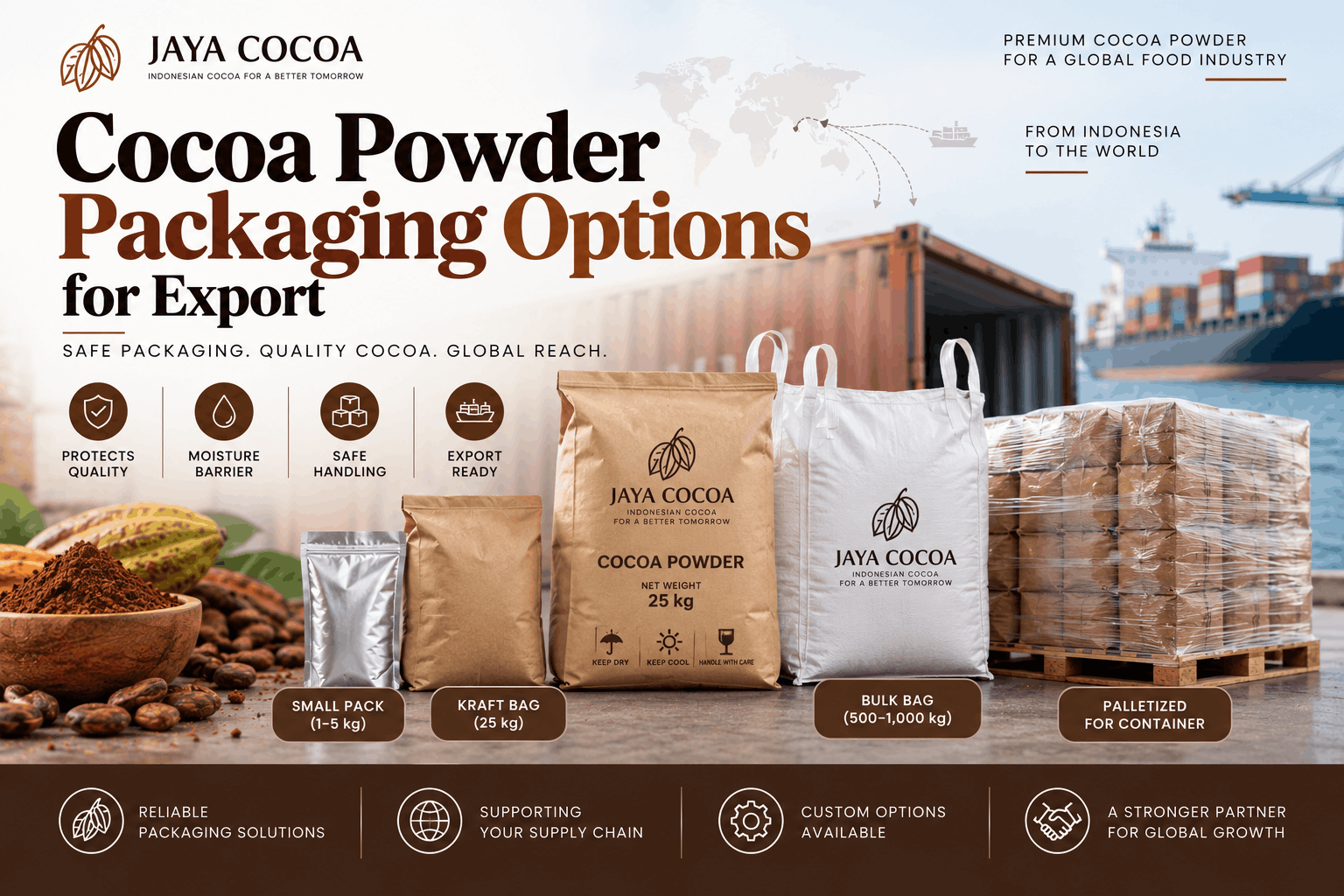
For international cocoa powder shipments, commonly used formats include multi-wall kraft paper bags with an inner plastic liner, smaller food-grade bags, bulk bags, and customized packaging solutions.
However, there is no single packaging format that is suitable for every buyer.
The right choice depends on the cocoa powder specification, shipment size, destination, storage conditions, production system, transportation method, and buyer requirements.
This guide explains the main cocoa powder packaging options for export and the factors food manufacturers and importers should consider when selecting them.
Why Cocoa Powder Packaging Matters
Cocoa powder is a dry food ingredient that can be affected by environmental conditions during storage.
One of the most important concerns is moisture absorption.
Research on cocoa powder storage has shown that cocoa powder can absorb moisture from its surrounding environment. Packaging therefore plays an important role in controlling moisture transfer and maintaining product quality.
Poor packaging or damaged packaging can contribute to:
- Moisture absorption
- Caking or loss of free-flowing characteristics
- Changes in product quality
- Contamination
- Odor transfer
- Physical damage during handling
- Reduced shelf-life performance
Packaging is particularly important for export shipments because cocoa powder may pass through several stages before reaching the final manufacturing facility:
Factory → Warehouse → Container → Port → Ocean Freight → Import Warehouse → Food Factory
Each stage creates opportunities for exposure to humidity, handling damage, contamination, or unsuitable storage.
Therefore, packaging should be considered part of the overall cocoa powder quality management system.
Common Cocoa Powder Packaging Options for Export
There is no universal packaging requirement for all cocoa powder exports.
However, several formats are commonly used in international trade.
1. Multi-Wall Kraft Paper Bags with Inner PE Liner
One of the most practical formats for industrial cocoa powder is a multi-wall kraft paper bag combined with an inner polyethylene (PE) liner.
A typical structure consists of:
Outer layer:
Multi-ply kraft paper
Inner layer:
Food-grade plastic liner, commonly PE
The kraft paper provides mechanical strength, while the inner liner helps provide a barrier against moisture and contamination.
This format is widely used for industrial cocoa powder. Indonesian export listings also show cocoa powder offered in 25 kg kraft paper bags with inner PE liners.
Typical advantages
- Suitable for industrial handling
- Easy to stack
- Practical for palletization
- Relatively easy to handle manually
- Suitable for container transportation
- Provides an additional moisture barrier through the inner liner
- Suitable for many food manufacturing operations
However, the exact paper construction, liner material, thickness, closure system, and food-contact suitability should be confirmed against the buyer’s specification and destination-market requirements.
2. 25 kg Cocoa Powder Bags
The 25 kg bag is a common commercial format for industrial cocoa powder.
It provides a practical balance between product quantity and handling requirements.
For example, Indonesian cocoa exporters commonly offer cocoa powder in 25 kg bags, including kraft paper bags with inner PE liners.
A 25 kg bag can be practical for:
- Food factories
- Bakery manufacturers
- Beverage manufacturers
- Chocolate manufacturers
- Ingredient distributors
- Industrial warehouses
- Palletized shipments
However, 25 kg should not be treated as a mandatory international standard.
A buyer may request:
- 20 kg
- 25 kg
- 50 kg
- Smaller bags
- Bulk packaging
- Customized private-label packaging
The appropriate net weight depends on the buyer’s production system and logistics requirements.
3. Kraft Paper Bags
Kraft paper is commonly used as the outer layer of industrial cocoa powder packaging.
Its main function is mechanical rather than serving as the sole moisture barrier.
The paper structure can provide:
- Strength during handling
- Protection against abrasion
- Better stacking characteristics
- Practical handling during warehouse operations
- A suitable surface for product identification and printing
However, kraft paper alone should not automatically be assumed to provide sufficient moisture protection for cocoa powder.
For moisture-sensitive applications, an appropriate inner liner or barrier structure may be required.
Research from IPB University found that cocoa powder packaging with stronger moisture-barrier characteristics can provide better shelf-life performance under the study conditions. In one study, aluminum-foil standing pouches produced longer estimated shelf life than kraft standing pouches at the tested temperature and relative humidity conditions.
This does not mean aluminum foil is always the best export packaging.
It demonstrates an important principle:
Packaging performance depends on the barrier properties of the packaging and the storage environment.
4. PE Inner Liner
An inner PE liner can be used inside a kraft paper bag to provide an additional barrier between the cocoa powder and the external environment.
This is particularly useful because cocoa powder needs protection from unwanted moisture exposure.
The packaging structure can therefore look like:
Cocoa powder
↓
PE inner liner
↓
Multi-wall kraft paper
↓
Outer packaging / pallet / stretch film
The liner specification should be agreed with the buyer.
Important considerations include:
- Food-contact suitability
- Material specification
- Thickness
- Sealing method
- Closure system
- Moisture-barrier requirements
- Destination-market requirements
The liner should also remain intact throughout filling, closing, palletizing, and transportation.
5. Aluminum-Based Barrier Packaging
For smaller quantities, specialty products, samples, or applications requiring stronger barrier protection, packaging incorporating aluminum foil or aluminum-based barrier structures may be considered.
Research on cocoa powder storage has demonstrated that packaging with aluminum foil can provide stronger moisture protection than kraft packaging under certain controlled conditions.
Potential advantages include:
- Strong moisture barrier
- Better protection against environmental exposure
- Useful for sensitive products
- Suitable for certain retail or specialty formats
However, this type of packaging may have higher material and packaging costs.
Therefore, it may not be the most economical solution for large industrial shipments.
For a 20–25 MT industrial shipment, the buyer and exporter normally need to balance product protection against packaging cost and logistics efficiency.
6. Vacuum or High-Barrier Plastic Packaging
Vacuum or high-barrier plastic packaging can also be considered for specific applications.
Research on cocoa powder packaging has examined vacuum embossed plastic and other packaging structures and found differences in moisture behavior during storage.
However, vacuum packaging should not automatically be considered necessary for standard industrial cocoa powder exports.
Its suitability depends on:
- Product characteristics
- Packaging format
- Storage duration
- Destination climate
- Transportation conditions
- Buyer requirements
- Cost considerations
For standard bulk export shipments, a properly specified multi-wall bag with an appropriate inner liner may be more practical.
7. Bulk Bags and Large-Volume Packaging
For large industrial users, bulk packaging can potentially improve handling efficiency.
Large-volume packaging may be considered when the buyer has:
- Automated material handling
- Bulk receiving systems
- Large production capacity
- Suitable warehouse equipment
- Forklift or lifting infrastructure
However, bulk packaging requires more careful consideration of:
- Bag construction
- Food-contact suitability
- Lifting requirements
- Discharge system
- Storage configuration
- Container loading
- Unloading equipment
Therefore, bulk packaging should generally be agreed with the buyer before shipment rather than selected solely to maximize container capacity.
Cocoa Powder Packaging Comparison
| Packaging Option | Main Advantage | Typical Use |
|---|---|---|
| Multi-wall kraft + PE liner | Balance of protection and handling | Industrial export |
| Kraft paper bag | Mechanical strength | Outer packaging |
| PE inner liner | Moisture protection | Industrial cocoa powder |
| Aluminum-based barrier | Higher barrier protection | Specialty/smaller formats |
| Vacuum/high-barrier plastic | Stronger environmental protection | Specific applications |
| Bulk bag | Efficient large-volume handling | Large industrial users |
| Customized packaging | Matches buyer requirements | Private label / special markets |
The table should be treated as a general comparison, not a universal specification.
Why the Inner Liner Matters
For cocoa powder exporters, one of the most important packaging questions is:
Does the cocoa powder have an appropriate moisture barrier?
Cocoa powder is a low-moisture food ingredient, but that does not mean it is unaffected by humid environments.
A study from IPB University describes cocoa powder as hygroscopic and emphasizes the importance of packaging with good water-vapor barrier properties.
This is particularly relevant for tropical supply chains.
For example:
Indonesia → Port → Ocean Freight → Middle East / Europe / Asia → Import Warehouse
The cargo may encounter different temperature and humidity conditions during the journey.
Therefore, packaging should be selected with the entire logistics chain in mind.
Packaging and Palletization
Packaging selection cannot be separated from palletization.
A 25 kg bag may be perfectly suitable for the product but still create problems if the pallet configuration is poorly designed.
Exporters should consider:
- Bag dimensions
- Number of bags per pallet
- Pallet dimensions
- Maximum pallet height
- Pallet material
- Stretch wrapping
- Forklift access
- Container dimensions
- Destination handling requirements
For export shipments, pallet selection may also need to consider the importing country’s requirements for wood packaging.
Where wooden pallets are used, exporters should verify the applicable phytosanitary requirements and treatment documentation for the destination market.
Should Cocoa Powder Bags Be Stretch-Wrapped?
Stretch wrapping can help stabilize palletized cargo during handling and transportation.
It can reduce the risk of:
- Bags shifting
- Pallet instability
- Exposure to external dirt
- Packaging damage during handling
However, stretch film should not be treated as a substitute for the primary food-contact packaging.
The bag and inner liner remain the primary product packaging.
Stretch film is primarily a secondary load-stabilization measure.
Cocoa Powder Packaging and Container Loading
Packaging also affects how efficiently cocoa powder can be loaded into a shipping container.
The exporter needs to consider:
- Bag dimensions
- Pallet configuration
- Number of bags
- Container size
- Gross weight
- Net weight
- Floor loading versus palletized loading
- Destination handling requirements
For example, floor-loaded bags can sometimes maximize cargo utilization, while palletized cargo may offer easier unloading and handling.
The best choice depends on the buyer’s warehouse and unloading system.
Packaging therefore should be discussed together with the container loading plan, rather than treated as a completely separate decision.
Moisture Protection During Export
One of the biggest risks during cocoa powder transportation is uncontrolled exposure to moisture.
Codex’s current standard for cocoa powders, CXS 105-1981, specifies a maximum moisture level of 7% for cocoa powders covered by the standard.
However, this specification applies to the product.
It should not be interpreted to mean that cocoa powder can safely be exposed to humid conditions during transportation.
The exporter should still ensure:
- Packaging is intact
- Inner liners are properly closed
- Containers are dry and clean
- Cargo is protected from water
- Packaging is not damaged
- Storage areas are dry
- Strong odors are avoided
- Product is protected from contamination
This distinction is important:
A low product moisture specification does not eliminate the need for moisture protection during transportation.
What Information Should Appear on Cocoa Powder Export Packaging?
Labeling requirements vary depending on the destination market, packaging format, and whether the product is sold as retail food or a non-retail ingredient.
For prepackaged foods, Codex’s General Standard for the Labelling of Pre-packaged Foods (CXS 1-1985) establishes general principles for mandatory information and requires labeling information to be clear, prominent, legible, and appropriately applied to the container.
Depending on the market and buyer requirements, commercial cocoa powder packaging may include information such as:
- Product name
- Product type
- Net weight
- Batch or lot number
- Production date
- Best-before or expiry information
- Manufacturer/exporter identification
- Country of origin
- Storage instructions
- Product code
- Customer or private-label information
Exporters should always check the specific regulations of the destination country.
Codex provides international standards and guidance, but importing-country legislation may impose additional requirements.
For non-retail containers, Codex also has a separate standard, CXS 346-2021, for labeling non-retail containers of foods.
Food-Grade Packaging Is Essential
Cocoa powder is normally supplied as an ingredient for food manufacturing.
Therefore, packaging materials that directly contact the product need to be appropriate for the intended food-contact application.
The exporter should be able to provide relevant packaging information when requested by the buyer.
Depending on the market and buyer requirements, this may include:
- Food-contact declaration
- Packaging material specification
- Material composition
- Compliance documentation
- Packaging supplier information
- Migration/compliance documentation where applicable
The exact requirements depend on the destination market and the packaging material used.
How Should Buyers Choose Cocoa Powder Packaging?
The best packaging is not necessarily the most expensive packaging.
Instead, buyers should evaluate packaging against their actual supply-chain requirements.
A practical decision process is:
Step 1 — Define the application
Is the cocoa powder intended for:
- Bakery
- Beverage
- Chocolate
- Dairy
- Ice cream
- Confectionery
- Ingredient distribution
Step 2 — Define the order volume
Small-volume buyers may prefer smaller packaging formats.
Large industrial buyers may benefit from standardized 20–25 kg bags or bulk handling systems.
Step 3 — Evaluate the logistics route
Consider:
- Origin climate
- Destination climate
- Ocean freight duration
- Port handling
- Warehouse conditions
- Expected storage duration
Step 4 — Determine the moisture-barrier requirement
This is especially important when cocoa powder will be transported or stored in humid environments.
Step 5 — Confirm the buyer’s packaging specification
Before production, confirm:
- Bag weight
- Bag dimensions
- Liner specification
- Bag material
- Printing
- Pallet requirements
- Label requirements
- Container loading requirements
Step 6 — Conduct a packaging compatibility review
For large recurring shipments, packaging should be validated under realistic transportation and storage conditions.
What Should Importers Ask a Cocoa Powder Supplier?
Before placing an export order, buyers can ask the supplier:
- What packaging format do you normally use?
- Is the outer bag kraft paper?
- Does the bag have an inner PE liner?
- What is the standard net weight per bag?
- Is the packaging food-contact compliant?
- Can the packaging be customized?
- Can you provide packaging specifications?
- Can you provide packaging photos before shipment?
- Are pallets used?
- What pallet material is available?
- Is the cargo floor-loaded or palletized?
- How is the container protected against moisture?
- What labeling information is printed on the bags?
- Can you follow our destination-specific packaging requirements?
- Can you provide a packaging sample before a large shipment?
These questions help procurement teams evaluate not only the cocoa powder itself but also the reliability of the export supply chain.
Cocoa Powder Packaging Should Be Part of the Product Specification
When purchasing cocoa powder internationally, packaging should not be treated as an afterthought.
A complete commercial specification can include:
Product
- Natural or alkalized
- Fat content
- pH
- Color
- Moisture
- Particle size
- Microbiological requirements
Packaging
- Net weight
- Bag construction
- Inner liner
- Closure
- Label
- Pallet configuration
Logistics
- Container type
- Loading method
- Palletization
- Destination
- Storage conditions
This creates a much clearer specification between supplier and buyer.
Final Takeaway
There is no single best cocoa powder packaging option for export.
For many industrial shipments, multi-wall kraft paper bags with an appropriate food-grade inner liner provide a practical combination of mechanical strength, handling efficiency, and moisture protection.
However, buyers with different applications or supply-chain conditions may require other solutions, including higher-barrier packaging, customized formats, or bulk packaging.
The most important principle is:
Choose cocoa powder packaging according to the product, application, transportation route, storage environment, and buyer requirements—not simply according to the lowest packaging cost.
For international cocoa powder buyers, packaging should be evaluated together with the product specification, COA, shelf-life requirements, palletization, container loading, and destination-market regulations.
A well-designed packaging system helps protect the cocoa powder from the moment it leaves the production facility until it reaches the buyer’s manufacturing line.
References & Sources
1. Codex Alimentarius — Cocoa Powders
CXS 105-1981 — Standard for Cocoa Powders (Cocoas) and Dry Mixtures of Cocoa and Sugars
2. Codex Alimentarius — Food Labelling
CXS 1-1985 — General Standard for the Labelling of Pre-packaged Foods
3. Codex Alimentarius — Non-Retail Containers
CXS 346-2021 — General Standard for the Labelling of and Claims for Prepackaged Foods / non-retail container provisions
4. IPB University — Cocoa Powder Packaging and Shelf Life
5. University of Mataram — Effect of Packaging Type on Cocoa Powder
6. Indonesian Cocoa Export Examples