
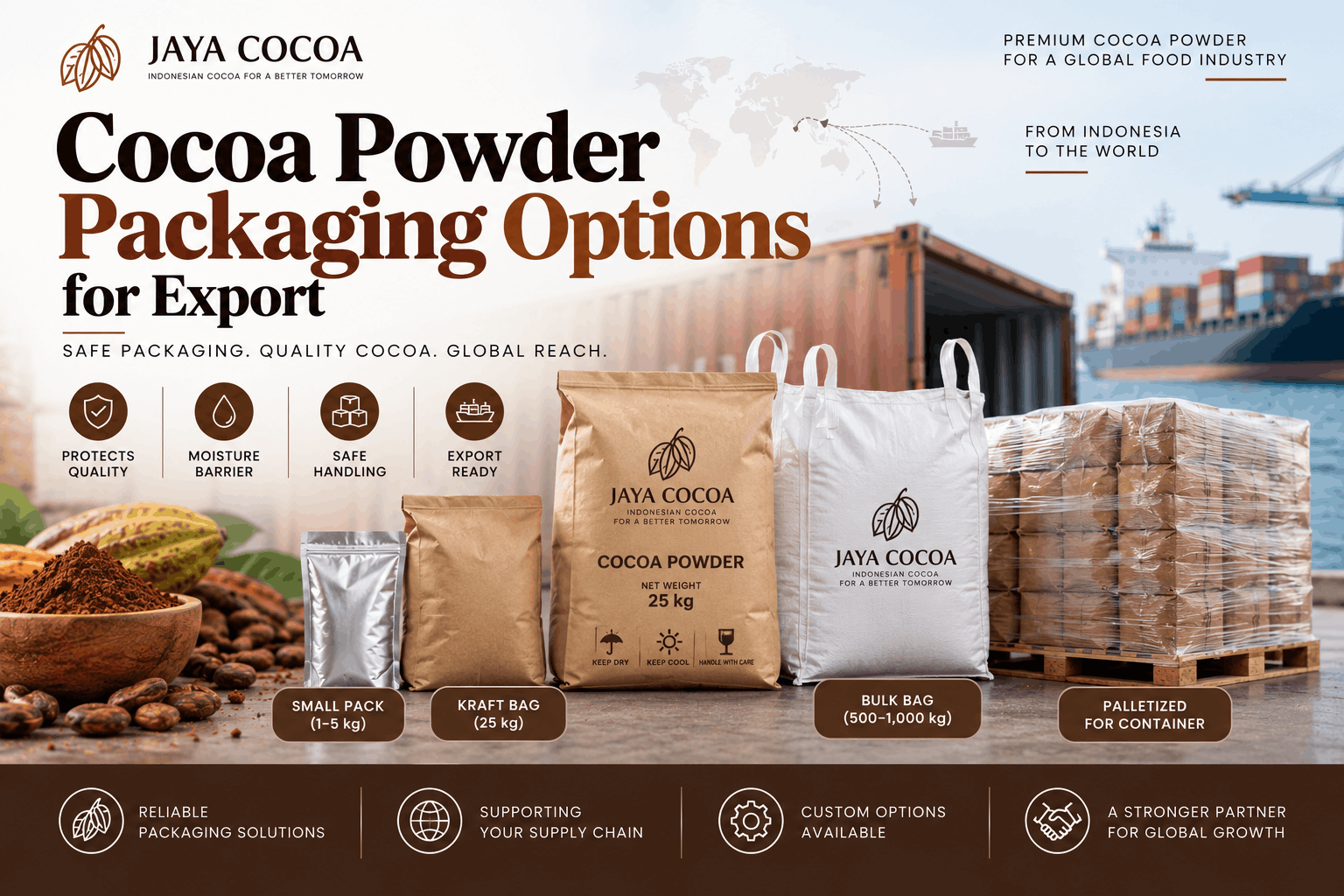
Cocoa Powder Packaging Options for Export: A Practical Guide for International Buyers Cocoa powder packaging plays an important role in protecting product quality during storage, handling, transportation, and international shipment. For exporters and food manufacturers, packaging is not simply a container for cocoa powder. It needs to help protect the product from moisture, contamination, physical damage, and unsuitable storage conditions while remaining practical for warehouse handling and production use. For international cocoa powder shipments, commonly used formats include multi-wall kraft paper bags with an inner plastic liner, smaller food-grade bags, bulk bags, and customized packaging solutions. However, there is no single packaging format that is suitable for every buyer. The right choice depends on the cocoa powder specification, shipment size, destination, storage conditions, production system, transportation method, and buyer requirements. This guide explains the main cocoa powder packaging options for export and the factors food manufacturers and importers should consider when selecting them. Why Cocoa Powder Packaging Matters Cocoa powder is a dry food ingredient that can be affected by environmental conditions during storage. One of the most important concerns is moisture absorption. Research on cocoa powder storage has shown that cocoa powder can absorb moisture from its surrounding environment. Packaging therefore plays an important role in controlling moisture transfer and maintaining product quality. Poor packaging or damaged packaging can contribute to: Moisture absorption Caking or loss of free-flowing characteristics Changes in product quality Contamination Odor transfer Physical damage during handling Reduced shelf-life performance Packaging is particularly important for export shipments because cocoa powder may pass through several stages before reaching the final manufacturing facility: Factory → Warehouse → Container → Port → Ocean Freight → Import Warehouse → Food Factory Each stage creates opportunities for exposure to humidity, handling damage, contamination, or unsuitable storage. Therefore, packaging should be considered part of the overall cocoa powder quality management system. Common Cocoa Powder Packaging Options for Export There is no universal packaging requirement for all cocoa powder exports. However, several formats are commonly used in international trade. 1. Multi-Wall Kraft Paper Bags with Inner PE Liner One of the most practical formats for industrial cocoa powder is a multi-wall kraft paper bag combined with an inner polyethylene (PE) liner. A typical structure consists of: Outer layer:Multi-ply kraft paper Inner layer:Food-grade plastic liner, commonly PE The kraft paper provides mechanical strength, while the inner liner helps provide a barrier against moisture and contamination. This format is widely used for industrial cocoa powder. Indonesian export listings also show cocoa powder offered in 25 kg kraft paper bags with inner PE liners. Typical advantages Suitable for industrial handling Easy to stack Practical for palletization Relatively easy to handle manually Suitable for container transportation Provides an additional moisture barrier through the inner liner Suitable for many food manufacturing operations However, the exact paper construction, liner material, thickness, closure system, and food-contact suitability should be confirmed against the buyer’s specification and destination-market requirements. 2. 25 kg Cocoa Powder Bags The 25 kg bag is a common commercial format for industrial cocoa powder. It provides a practical balance between product quantity and handling requirements. For example, Indonesian cocoa exporters commonly offer cocoa powder in 25 kg bags, including kraft paper bags with inner PE liners. A 25 kg bag can be practical for: Food factories Bakery manufacturers Beverage manufacturers Chocolate manufacturers Ingredient distributors Industrial warehouses Palletized shipments However, 25 kg should not be treated as a mandatory international standard. A buyer may request: 20 kg 25 kg 50 kg Smaller bags Bulk packaging Customized private-label packaging The appropriate net weight depends on the buyer’s production system and logistics requirements. 3. Kraft Paper Bags Kraft paper is commonly used as the outer layer of industrial cocoa powder packaging. Its main function is mechanical rather than serving as the sole moisture barrier. The paper structure can provide: Strength during handling Protection against abrasion Better stacking characteristics Practical handling during warehouse operations A suitable surface for product identification and printing However, kraft paper alone should not automatically be assumed to provide sufficient moisture protection for cocoa powder. For moisture-sensitive applications, an appropriate inner liner or barrier structure may be required. Research from IPB University found that cocoa powder packaging with stronger moisture-barrier characteristics can provide better shelf-life performance under the study conditions. In one study, aluminum-foil standing pouches produced longer estimated shelf life than kraft standing pouches at the tested temperature and relative humidity conditions. This does not mean aluminum foil is always the best export packaging. It demonstrates an important principle: Packaging performance depends on the barrier properties of the packaging and the storage environment. 4. PE Inner Liner An inner PE liner can be used inside a kraft paper bag to provide an additional barrier between the cocoa powder and the external environment. This is particularly useful because cocoa powder needs protection from unwanted moisture exposure. The packaging structure can therefore look like: Cocoa powder ↓ PE inner liner ↓ Multi-wall kraft paper ↓ Outer packaging / pallet / stretch film The liner specification should be agreed with the buyer. Important considerations include: Food-contact suitability Material specification Thickness Sealing method Closure system Moisture-barrier requirements Destination-market requirements The liner should also remain intact throughout filling, closing, palletizing, and transportation. 5. Aluminum-Based Barrier Packaging For smaller quantities, specialty products, samples, or applications requiring stronger barrier protection, packaging incorporating aluminum foil or aluminum-based barrier structures may be considered. Research on cocoa powder storage has demonstrated that packaging with aluminum foil can provide stronger moisture protection than kraft packaging under certain controlled conditions. Potential advantages include: Strong moisture barrier Better protection against environmental exposure Useful for sensitive products Suitable for certain retail or specialty formats However, this type of packaging may have higher material and packaging costs. Therefore, it may not be the most economical solution for large industrial shipments. For a 20–25 MT industrial shipment, the buyer and exporter normally need to balance product protection against packaging cost and logistics efficiency. 6. Vacuum or High-Barrier Plastic Packaging Vacuum or high-barrier
