Cocoa Powder Moisture Content Explained: Standards, Quality, Storage, and Testing
Moisture content is one of the basic but important quality parameters in cocoa powder.
Although cocoa powder is a low moisture food ingredient, the amount of water present in the powder can influence its storage stability, physical handling, flowability, caking behavior, packaging requirements, and overall product quality.
For cocoa powder buyers, however, moisture should not be evaluated in isolation.
A professional specification should distinguish between moisture content and water activity, because these two measurements describe different properties of water in a food material.
This guide explains what cocoa powder moisture content means, the applicable international standard, how moisture affects cocoa powder, how it is measured, and what buyers should consider when reviewing a cocoa powder specification or Certificate of Analysis (COA).
What Is Cocoa Powder Moisture Content?
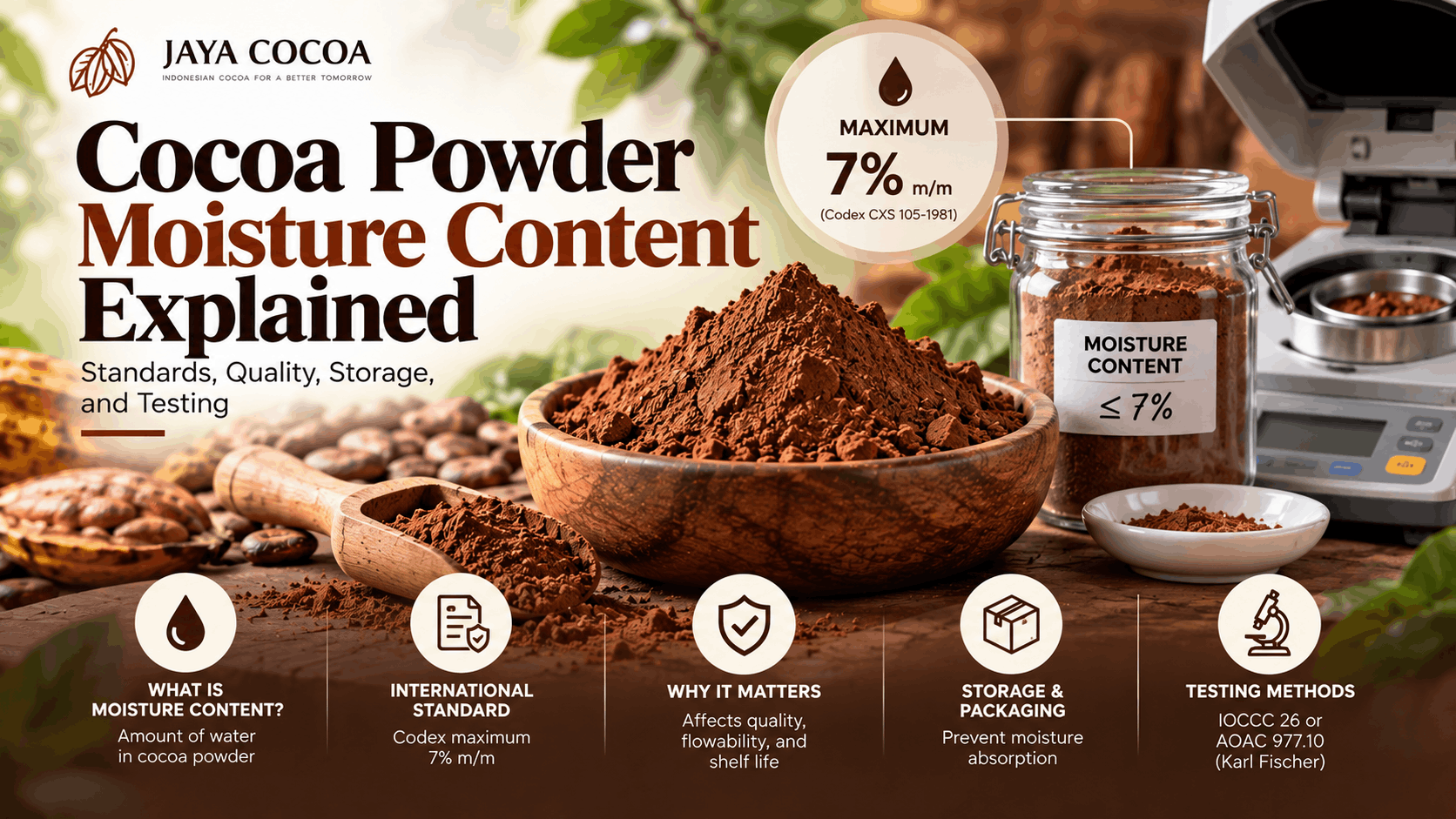
Moisture content is the amount of water present in cocoa powder, normally expressed as a percentage by mass.
For example, if a 100 g sample contains 5 g of water according to the specified analytical method, its reported moisture content would be approximately:
5% moisture
Moisture is different from the cocoa powder’s fat, protein, mineral, or cocoa solids content.
It is also different from water activity (aᵥ), which describes the thermodynamic availability of water rather than simply the total quantity of water present.
This distinction is important because two cocoa powders with similar moisture percentages can behave differently depending on how the water interacts with the powder matrix.
What Is the Maximum Moisture Content for Cocoa Powder?
The international Codex standard provides an important reference.
Codex CXS 105-1981, Standard for Cocoa Powders (Cocoas) and Dry Mixtures of Cocoa and Sugars, specifies a maximum moisture content of 7% m/m for cocoa powders covered by the standard. The current Codex document was adopted in 1981 and amended in 2025. FAOHome
In other words:
Codex maximum moisture content for cocoa powder: 7% m/m
However, this should not be interpreted as meaning that every commercial cocoa powder should target exactly 7%.
A commercial supplier may establish a tighter internal specification depending on:
- Product type
- Processing conditions
- Intended application
- Packaging
- Storage conditions
- Customer requirements
- Destination market requirements
Therefore, the Codex maximum is a regulatory/standard reference, while an actual commercial specification may be more restrictive.
Why Is Moisture Important in Cocoa Powder?
Moisture can influence several aspects of cocoa powder performance.
These include:
- Powder flowability
- Caking and lump formation
- Storage stability
- Packaging performance
- Handling and conveying
- Reconstitution behavior
- Water activity
- Microbiological risk management
- Shelf life performance
But the relationship is not always as simple as:
Higher moisture = worse cocoa powder
The actual effect depends on the powder’s composition, temperature, packaging, relative humidity, water activity, particle characteristics, and storage conditions.
Research on cocoa powder has demonstrated that storage-related caking can depend strongly on fat content and temperature, rather than moisture alone. ScienceDirect
Moisture Content vs Water Activity
This is one of the most important concepts for cocoa powder buyers.
Moisture Content
Moisture content tells you:
How much water is present in the product.
It is usually reported as a percentage.
For example:
Moisture = 4.5%
means that the analytical result corresponds to approximately 4.5% water by mass under the specified method.
Water Activity (aᵥ)
Water activity tells you:
How available that water is for physical, chemical, and microbiological processes.
Water activity is expressed on a scale from 0 to 1.
It is therefore possible for two powders to have similar moisture contents but different water activity behavior.
The FDA has used water activity characteristics when establishing moisture conditions for its cocoa powder reference material, illustrating the analytical importance of the relationship between moisture, relative humidity, and water activity. PubMed
Why Water Activity Matters for Cocoa Powder
Codex’s Code of Hygienic Practice for Low-Moisture Foods defines low-moisture foods as foods with a water activity of 0.85 or below. Cocoa and chocolate are explicitly included within the scope of the code. FAOHome
However, 0.85 should not be interpreted as a target specification for cocoa powder.
It is a definition used within the Codex hygienic-practice framework.
For low-moisture foods, reducing available water can prevent the growth of many microorganisms, but pathogens such as Salmonella can survive for extended periods in dry environments. Codex therefore emphasizes hygienic controls throughout production rather than relying solely on low moisture or low water activity. FAOHome
This is particularly relevant to cocoa powder because it is a dry food ingredient that may be exposed to the environment during processing, handling, and packaging.
Does Low Moisture Automatically Mean Better Cocoa Powder?
Not necessarily.
A lower moisture result may look attractive on a COA, but it should be interpreted together with the rest of the specification.
For example, a buyer may also need to consider:
- Fat content
- pH
- Color
- Particle size
- Microbiological quality
- Water activity
- Packaging
- Storage temperature
- Shelf life
- Application performance
The goal is not simply to obtain the lowest possible moisture.
The goal is to maintain moisture within an appropriate and controlled range for the product and its intended application.
How Moisture Affects Cocoa Powder Flowability
Powder flowability describes how easily a powder moves during:
- Conveying
- Filling
- Weighing
- Mixing
- Packaging
- Discharge from storage equipment
Water activity can influence the cohesive behavior of cocoa-based powders.
A 2015 study examining cocoa products found that increasing water activity increased powder cohesion, while particle size also influenced cohesive forces and compressibility. ScienceDirect
This means moisture related behavior can affect how cocoa powder handles during industrial processing.
However, moisture is only one factor.
Other variables include:
- Particle size
- Particle shape
- Fat content
- Temperature
- Bulk density
- Surface properties
- Storage time
Moisture and Cocoa Powder Caking
Caking occurs when individual powder particles form aggregates or lumps.
For cocoa powder, caking can interfere with:
- Powder flow
- Packaging
- Dosing
- Conveying
- Mixing
- Rehydration or dispersion
But cocoa powder caking is not controlled by moisture alone.
A detailed study published in the Journal of Food Engineering investigated cocoa powders with different fat contents under different temperature and water-activity conditions. The researchers found that significant caking occurred particularly in fatty cocoa powders at elevated temperature, where cocoa fat could melt and form bridges between particles. ScienceDirect
This is an important point for buyers:
Moisture control is important, but cocoa powder caking cannot be explained by moisture alone.
Temperature and fat content can be equally important depending on the product.
How Moisture Can Affect Cocoa Powder During Storage
Cocoa powder can interact with moisture from its surrounding environment.
If packaging allows moisture transfer, the powder can move toward a new moisture equilibrium with the surrounding relative humidity.
Research from IPB University investigated the moisture sorption behavior and shelf life of cocoa powder in aluminum-foil and kraft standing-pouch packaging.
The study found different estimated shelf lives depending on packaging and relative humidity conditions, demonstrating that packaging is closely connected to moisture management and storage stability. Jurnal IPB
Under the study conditions, estimated shelf life was longer for the aluminum-foil standing pouch than the kraft standing pouch at the tested 30°C and 75–80% relative humidity conditions. These values are study-specific results, not universal shelf-life values for all cocoa powders or packaging systems. Jurnal IPB
Moisture and Cocoa Powder Packaging
Packaging is therefore an important part of moisture control.
A cocoa powder specification may be excellent when the product leaves the factory, but poor moisture-barrier packaging can allow the product to interact with humid air during:
- Storage
- Container loading
- Sea transportation
- Warehouse handling
- Distribution
For international shipments, buyers should consider:
Packaging Barrier
The packaging should provide appropriate protection against moisture transfer.
Sealing
Poor seals can allow moisture ingress even when the packaging material itself has good barrier properties.
Storage Environment
High relative humidity can increase the moisture challenge.
Container Conditions
Long-distance ocean transportation can expose cargo to changing temperature and humidity conditions.
Handling
Repeated opening and closing of bulk containers can expose the powder to humid air.
Therefore:
Moisture specification and packaging specification should be considered together.
How Is Cocoa Powder Moisture Measured?
Moisture measurement depends on the analytical method specified by the applicable standard or buyer specification.
The current Codex CXS 105-1981 lists IOCCC 26 or AOAC 977.10 (Karl Fischer method) for determination of moisture in cocoa powders and dry cocoa-sugar mixtures. FAOHome
This is important because the reported moisture value is not meaningful without knowing how the measurement was performed.
A buyer reviewing a COA should therefore consider asking:
- What analytical method was used?
- Is the method based on the agreed standard?
- What laboratory performed the analysis?
- Was the sample representative of the batch?
- What sampling procedure was used?
- Are results reported on the same basis across suppliers?
Karl Fischer Method for Cocoa Products
Karl Fischer titration is a widely recognized method for determining water.
Codex’s current cocoa powder standard references AOAC 977.10 (Karl Fischer method) as one of the applicable methods for moisture determination. FAOHome
The advantage of Karl Fischer analysis is that it is designed specifically to quantify water through a chemical titration reaction.
However, buyers should not assume that every laboratory method producing a number labeled “moisture” is directly interchangeable.
Different analytical principles can produce differences if sample preparation, method conditions, or reporting conventions differ.
For commercial transactions, therefore, the agreed analytical method matters.
Why Sampling Matters
Moisture testing is only as reliable as the sample used for testing.
Powders can experience moisture gradients during:
- Production
- Cooling
- Packaging
- Storage
- Transportation
A sample taken from one location in a bulk lot may not perfectly represent the entire shipment.
For this reason, a commercial quality-control system should establish:
- Sampling procedure
- Sample quantity
- Sampling locations
- Testing frequency
- Laboratory method
- Acceptance limits
For export shipments, these details can become particularly important when a buyer and supplier have different test results.
What Should Be Included on a Cocoa Powder COA?
For B2B cocoa powder purchases, moisture should normally appear as one of the product-quality parameters on the Certificate of Analysis where required by the agreed specification.
A COA may include:
| Parameter | Example of Information |
|---|---|
| Moisture | % |
| Fat | % |
| pH | Value/range |
| Ash | % |
| Particle Size | Specification/method |
| Color | Measurement/specification |
| Microbiology | Test results |
| Heavy Metals | Test results where required |
| Batch/Lot | Identification |
| Production Date | Date |
| Best Before | Date |
The exact parameters should be determined by the product and buyer specification.
Do not copy the example values above into a commercial specification without validating them.
What Moisture Specification Should a Buyer Request?
There is no single commercial moisture specification that is automatically appropriate for every cocoa powder.
Codex provides the 7% maximum for cocoa powders covered by CXS 105-1981. FAOHome
A buyer may nevertheless specify a tighter contractual limit depending on:
- Product type
- Application
- Storage duration
- Packaging
- Destination climate
- Customer requirements
- Internal quality standards
A better purchasing approach is therefore:
Start with the applicable regulatory/standard requirement, then establish a tighter commercial specification if technically justified.
Example of a Cocoa Powder Moisture Specification
For illustration only, a commercial specification could be structured as:
| Parameter | Specification |
|---|---|
| Moisture | Maximum X% |
| Test Method | Agreed analytical method |
| Sampling | Agreed sampling procedure |
| Reporting | % m/m |
| Batch Identification | Required |
| COA | Required |
The value X should be determined by the actual product specification.
It should not be chosen simply because a competitor or another supplier uses the same number.
Moisture Content in Natural vs Alkalized Cocoa Powder
Natural and alkalized cocoa powders can have different processing profiles.
Natural cocoa powder is generally produced without an alkalization step, while alkalized cocoa powder undergoes alkaline treatment.
Moisture should therefore be evaluated based on the finished product specification, rather than assuming that natural cocoa powder must have one moisture level and alkalized cocoa powder another.
The key questions are:
- What is the agreed moisture limit?
- What analytical method is used?
- Is the product within specification?
- Is the result consistent between batches?
- How is the product protected after testing?
Moisture and Cocoa Powder Shelf Life
Moisture is one of the parameters relevant to shelf-life assessment, but it does not determine shelf life by itself.
Shelf life can also depend on:
- Water activity
- Fat content
- Oxidation
- Packaging barrier
- Temperature
- Relative humidity
- Microbiological status
- Light exposure
- Storage duration
The IPB University cocoa powder study illustrates why packaging and environmental humidity must be considered together when estimating shelf life. Jurnal IPB
Therefore, a statement such as:
“Cocoa powder with X% moisture always has a shelf life of Y months”
would be scientifically inappropriate without specifying the product, packaging, storage conditions, and study methodology.
Does Moisture Cause Mold in Cocoa Powder?
Moisture can contribute to conditions favorable to microbial activity, but it would be incorrect to say that a particular moisture percentage automatically causes mold.
Microbial growth depends on water activity and environmental conditions, not moisture content alone.
Codex’s low-moisture-food hygiene code emphasizes that pathogens such as Salmonella may survive for long periods in dry foods even when they cannot multiply under low-water-activity conditions. Therefore, food safety requires hygienic control of the production environment, ingredients, equipment, and post-process handling—not simply a low moisture result. FAOHome
For cocoa powder manufacturers and buyers, this distinction is critical.
A satisfactory moisture result does not replace microbiological testing or an appropriate food-safety system.
Moisture During International Cocoa Powder Shipping
Export transportation creates another moisture-control challenge.
Cocoa powder may spend weeks in:
- Factory storage
- Truck transportation
- Port storage
- Container loading
- Ocean transportation
- Destination port
- Importer’s warehouse
During this period, the product can encounter different:
- Temperatures
- Relative humidities
- Condensation conditions
This is why export packaging should be designed around the complete logistics chain.
A moisture specification should not be considered separately from:
Product → Packaging → Container → Transportation → Warehouse
What Happens If Cocoa Powder Absorbs Moisture?
Depending on the amount of moisture absorbed and the product’s composition, possible consequences can include:
- Increased cohesion
- Reduced flowability
- Lumping
- Caking
- Changes in handling behavior
- Changes in dispersion/reconstitution
- Increased water activity
Research on cocoa-based powders has shown that higher water activity can increase cohesion and affect powder mechanical behavior. ScienceDirect
However, cocoa powder caking can also be driven by fat migration and temperature, particularly in higher-fat powders. ScienceDirect
This is why moisture should be treated as one part of a broader powder-stability system.
How Can Manufacturers Control Cocoa Powder Moisture?
Moisture control starts during production and continues through packaging and storage.
Important control points can include:
1. Processing Control
The cocoa powder should leave the production process within the established moisture specification.
2. Cooling
The product should be handled appropriately before packaging so that temperature and moisture conditions are controlled.
3. Testing
Finished batches should be tested according to the agreed analytical method.
4. Packaging
Packaging should provide appropriate moisture protection.
5. Warehouse Conditions
Storage areas should be controlled to reduce exposure to excessive humidity and temperature.
6. Transportation
Export logistics should minimize unnecessary exposure to moisture and unsuitable conditions.
7. Batch Traceability
Each shipment should be traceable to the relevant production batch and analytical results.
Moisture Content vs Other Cocoa Powder Specifications
Moisture is only one parameter in a cocoa powder specification.
For example:
Moisture
Describes the amount of water present.
Fat
Describes the cocoa butter content remaining in the powder.
pH
Provides information about the acidity/alkalinity of the product.
Particle Size
Describes the physical size distribution of cocoa powder particles.
Color
Provides information about the visual characteristics of the cocoa powder.
Microbiology
Provides information relevant to food safety and product quality.
Water Activity
Provides information about the availability of water.
A professional buyer should therefore avoid selecting cocoa powder based on moisture alone.
Questions Buyers Should Ask a Cocoa Powder Supplier
Before purchasing, consider asking:
Moisture
- What is your standard moisture specification?
- What is the maximum moisture limit?
- What analytical method do you use?
- Is the result reported as % m/m?
- Is the method aligned with the agreed standard?
Water Activity
- Do you test water activity?
- What method is used?
- Is water activity included in the COA?
Packaging
- What packaging material is used?
- What moisture barrier does it provide?
- Is an inner PE liner used?
- How is the package sealed?
Storage
- What are the recommended storage conditions?
- What temperature range is recommended?
- What relative humidity conditions are recommended?
Quality Control
- Is moisture tested for every batch?
- Can you provide a batch-specific COA?
- What sampling procedure is used?
- Can an independent laboratory perform verification testing?
A Practical Cocoa Powder Moisture Checklist for Buyers
Before approving a supplier, verify:
Product
- Cocoa powder type identified
- Fat content specified
- Moisture specification agreed
- pH specified
- Particle size specified
- Color specified
Testing
- Analytical method agreed
- Sampling procedure agreed
- COA available
- Batch identification available
Packaging
- Packaging material specified
- Moisture protection considered
- Seal integrity controlled
- Storage instructions provided
Logistics
- Container conditions considered
- Transit duration considered
- Destination climate considered
- Warehouse conditions considered
This approach is much more useful than asking only:
“What is your cocoa powder moisture?”
Final Takeaway
Cocoa powder moisture content is an important quality parameter, but it should never be evaluated in isolation.
The current Codex CXS 105-1981 standard specifies a maximum moisture content of 7% m/m for cocoa powders covered by the standard. FAOHome
However, commercial cocoa powder specifications can be tighter depending on the product, application, packaging, storage conditions, and buyer requirements.
For professional cocoa buyers, the most important distinction is between:
Moisture content
→ How much water is present.
Water activity
→ How available that water is.
These measurements provide different information about the behavior and stability of cocoa powder.
Moisture can affect powder handling and storage, but research shows that factors such as fat content and temperature can also play major roles in caking and physical stability. ScienceDirect
For export cocoa powder, the best approach is therefore to manage the complete system:
Moisture + Water Activity + Packaging + Temperature + Storage + Microbiological Control
When these parameters are controlled together, manufacturers and buyers have a much stronger basis for maintaining consistent cocoa powder quality throughout international supply chains.
Frequently Asked Questions
What is the maximum moisture content for cocoa powder?
Codex CXS 105-1981 specifies a maximum moisture content of 7% m/m for cocoa powders covered by the standard. FAOHome
What is a good moisture content for cocoa powder?
There is no single commercial target that applies to every cocoa powder. The appropriate specification depends on the product, application, packaging, storage conditions, and buyer requirements.
Is moisture the same as water activity?
No. Moisture content measures the amount of water present, while water activity describes the availability of that water.
Does high moisture cause cocoa powder to cake?
Moisture can contribute to powder instability, but cocoa powder caking is influenced by multiple factors. Research has shown that high fat content combined with elevated temperature can be an important caking mechanism in cocoa powder. ScienceDirect
How is cocoa powder moisture tested?
The current Codex cocoa powder standard lists IOCCC 26 or AOAC 977.10 (Karl Fischer method) for moisture determination. FAOHome
Should moisture be included in a cocoa powder COA?
For commercial B2B supply, moisture is commonly included as a quality parameter where required by the agreed specification. The buyer and supplier should agree on the test method, sampling procedure, and acceptance limit.
Can cocoa powder absorb moisture during storage?
Yes. Cocoa powder can interact with moisture in its surrounding environment, which is why packaging and storage conditions are important. Research on cocoa powder has demonstrated the relationship between moisture sorption, packaging, relative humidity, and shelf-life behavior. Jurnal IPB
References
1. Codex Alimentarius — CXS 105-1981
2. Codex Alimentarius — CXC 75-2015
3. Hasbullah & Mahdania — IPB University, 2023
4. Petit et al. — Journal of Food Engineering, 2017
5. Ostrowska-Ligęza & Lenart — LWT, 2015
6. Cunningham — Analytical and Bioanalytical Chemistry, 2013