
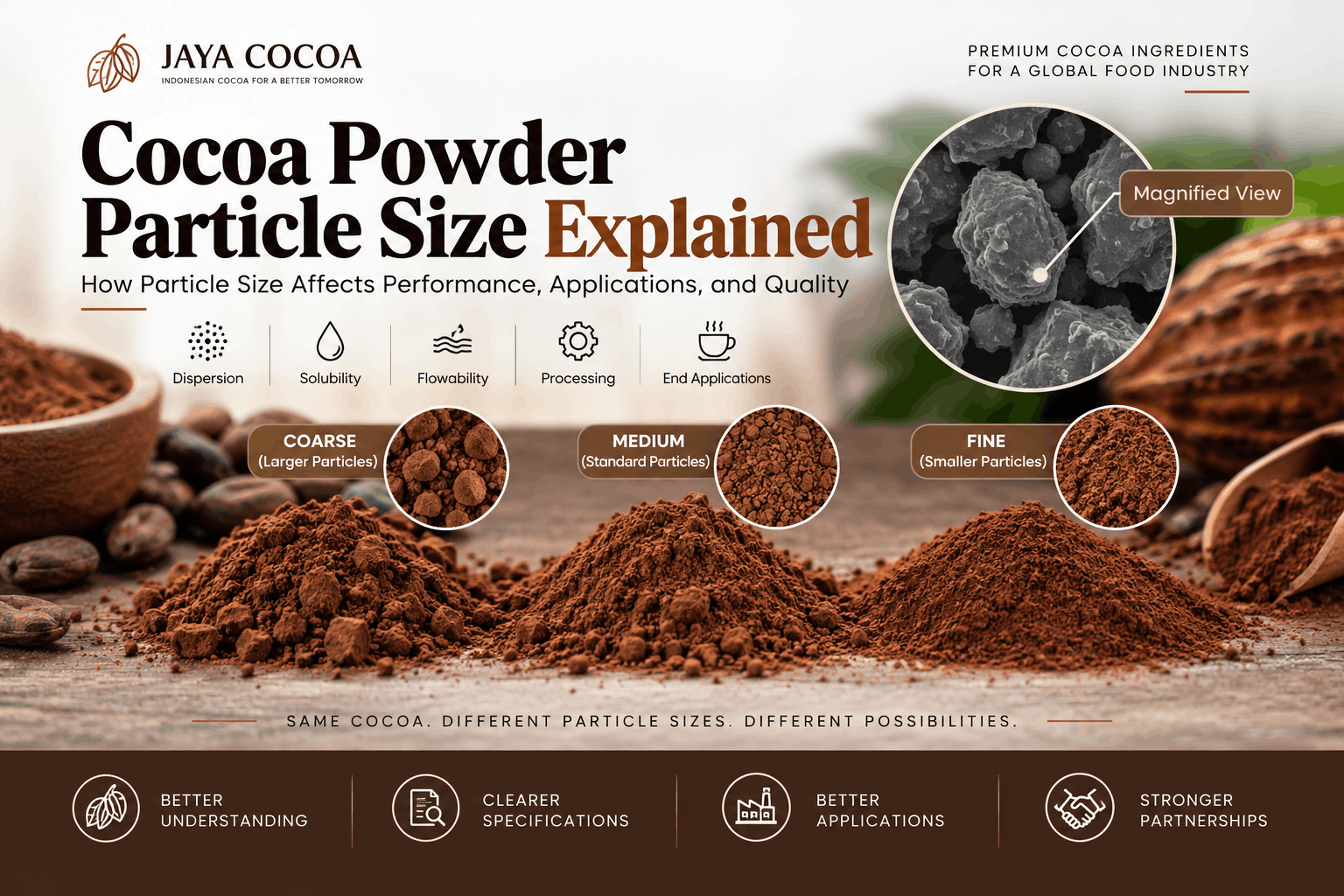
Cocoa Powder Particle Size Explained: Microns, Distribution, and Food Applications When food manufacturers evaluate cocoa powder, they often look first at fat content, pH, color, flavor, and microbiological specifications. Another technical parameter can be just as important for certain applications: particle size. Cocoa powder particle size affects how the powder behaves during manufacturing, including its flow, dispersion, reconstitution, and interaction with other ingredients. In some applications, the distribution of particle sizes can also influence the physical behavior of the finished product. For cocoa buyers and food manufacturers, however, one important distinction must be made: There is no single particle size that is universally “best” for every cocoa powder application. The appropriate particle-size specification depends on the product, processing system, formulation, and desired performance. This guide explains what cocoa powder particle size means, how it is measured, what D10, D50, and D90 mean, how particle size relates to cocoa powder processing, and what buyers should consider when evaluating a cocoa powder specification. What Is Cocoa Powder Particle Size? Cocoa powder particle size refers to the dimensions of the individual particles that make up a cocoa powder. Although cocoa powder appears visually uniform, it is actually made up of particles with a range of different sizes. This is why technical specifications often refer to a particle size distribution (PSD) rather than giving only one particle-size value. For example, a cocoa powder sample may contain: Very fine particles Medium-sized particles Larger particles The proportion of each fraction creates the powder’s overall particle-size distribution. Research on cocoa powders has demonstrated that cocoa particles can have broad or even bimodal distributions rather than consisting of particles of exactly one size. A 2024 study of cocoa powders produced from different cocoa varieties, for example, reported bimodal particle-size distributions with smaller particles around 25 μm and larger populations around 500 μm under the study’s specific processing conditions. Therefore, when a supplier reports particle size, buyers should ask how the value was measured and what parameter is being reported. Why Does Particle Size Matter in Cocoa Powder? Particle size can influence several physical properties of cocoa powder. Depending on the formulation and processing conditions, particle size may affect: Dispersion Wettability Reconstitution Powder flow Mixing behavior Sedimentation Texture Mouthfeel Interaction with other ingredients Processing performance However, these relationships are not always simple. For example, making a powder finer does not automatically make it perform better in every application. A cocoa powder intended for a beverage may have different requirements from one used in a bakery mix or a chocolate formulation. Cocoa Powder Particle Size and Processing Particle size is closely connected to cocoa processing. After cocoa liquor is pressed, the resulting cocoa cake is broken and milled. ICCO explains that cocoa cake is milled to specified particle sizes according to the intended end use. However, there is an important technical detail. ICCO notes that the term “grinding” can be somewhat misleading in cocoa powder production. The final powder particle size is influenced by the particle size of the cocoa liquor that was pressed, while commonly used mills may primarily break up agglomerates rather than continuously reducing the underlying particle size of the cake. This means particle size should not be viewed simply as: More grinding = smaller cocoa particles The actual result depends on the complete processing system and the physical characteristics of the cocoa material. What Are D10, D50, and D90? When particle-size distribution is measured instrumentally, manufacturers and laboratories may report percentile values such as D10, D50, and D90. These values describe the distribution rather than simply stating one average particle diameter. D10 D10 is the particle diameter below which approximately 10% of the measured particle population lies, according to the measurement basis being used. D50 D50 is the median particle diameter. Approximately 50% of the measured distribution is below this value and 50% is above it. D50 is often particularly useful because it gives buyers a practical indication of the middle of the particle-size distribution. D90 D90 is the particle diameter below which approximately 90% of the measured distribution lies. It can therefore provide information about the larger-particle portion of the distribution. Example of a Cocoa Powder Particle-Size Distribution Imagine a specification reports: Parameter Example value D10 15 μm D50 40 μm D90 100 μm This does not mean that every particle is 40 μm. Instead, the powder contains a distribution of particle sizes. The D50 value indicates the median of the measured distribution, while D10 and D90 provide additional information about the finer and coarser portions. This is why buyers should not evaluate a cocoa powder based only on a single number. What Does “Micron” Mean? A micron, or micrometer (μm), is one-millionth of a meter. It is commonly used to describe fine particle sizes. For example: 1 μm = 0.001 mm 10 μm = 0.01 mm 100 μm = 0.1 mm 1,000 μm = 1 mm Particle sizes in cocoa powders can therefore be expressed in the micrometer range. However, a reported micron value should always be interpreted together with the measurement method and distribution parameter. A specification saying: D50 = 30 μm contains considerably more information than simply saying: Particle size = 30 μm because the first statement identifies what the 30 μm value represents. How Is Cocoa Powder Particle Size Measured? Particle size can be measured using different analytical techniques. One commonly used modern approach is laser diffraction. ISO 13320:2020 provides guidance for particle-size analysis using laser diffraction methods. The standard covers particle-size distributions across a broad range and explains that the reported distribution is derived from light-scattering measurements. It also notes that results for non-spherical particles can differ from those obtained by methods based on other physical principles, such as sieving or sedimentation. This is particularly relevant for cocoa powder because cocoa particles are not necessarily perfect spheres. Therefore, two laboratories can potentially report different results if they use different analytical methods, sample preparation procedures, or reporting bases. Why the Measurement Method Matters Suppose a supplier
Why Food Manufacturers Prefer Alkalized Cocoa Powder
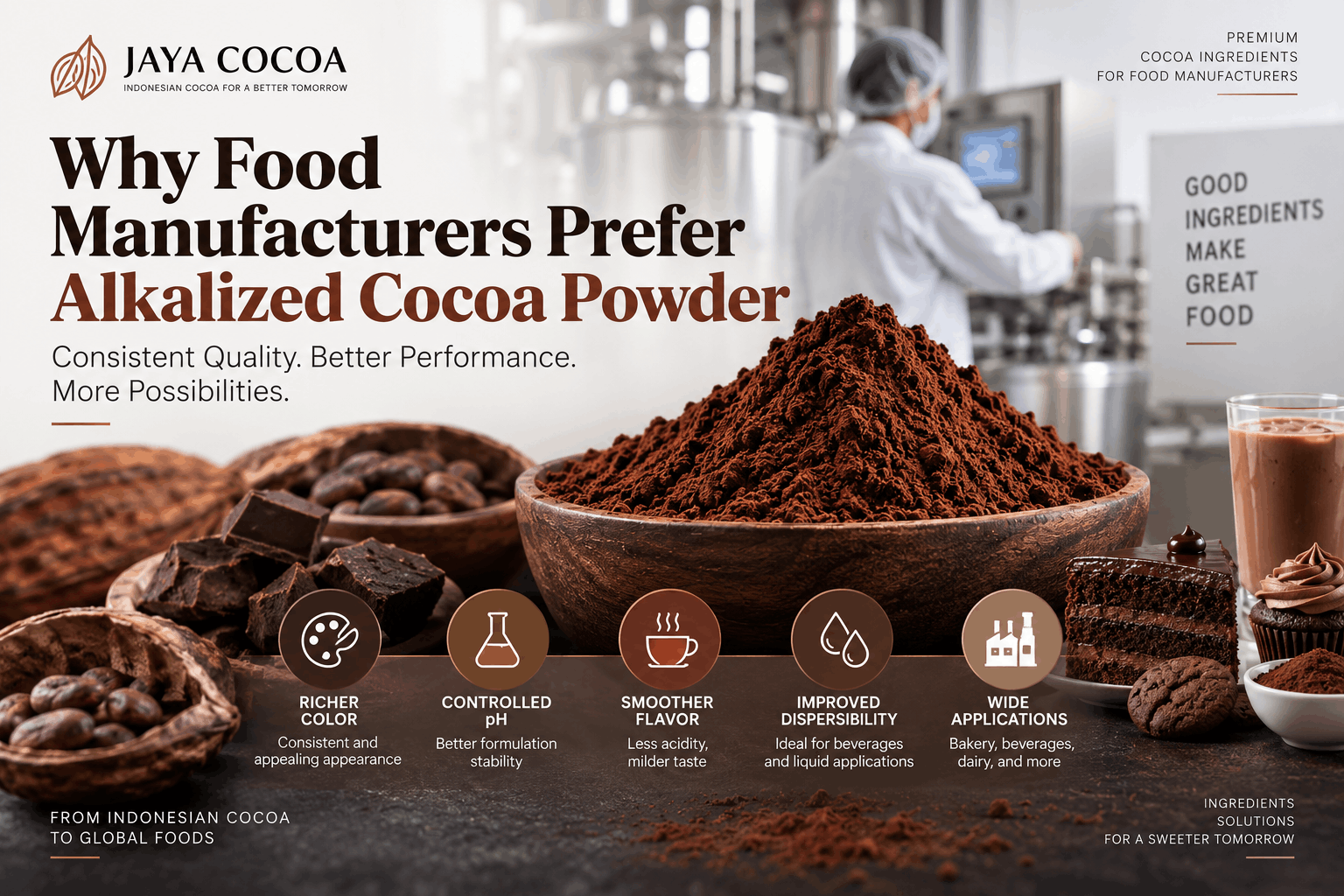
Why Food Manufacturers Prefer Alkalized Cocoa Powder For food manufacturers, choosing a cocoa powder is not simply about finding the darkest color or the lowest price. The cocoa powder must perform consistently inside a formulation. Its pH, color, flavor, dispersibility, fat content, particle characteristics, and batch-to-batch consistency can all influence the final product. This is one reason many manufacturers choose alkalized cocoa powder for specific food applications. Alkalized cocoa powder, also known as Dutch-process cocoa powder, is cocoa that has undergone an alkaline treatment designed to modify its acidity and other physicochemical characteristics. The International Cocoa Organization (ICCO) describes alkalization as an optional processing step used to modify the flavor and color of cocoa liquor and cocoa powder. But why do food manufacturers prefer it? The answer is not simply that alkalized cocoa is “better.” Rather, alkalization gives manufacturers greater control over characteristics that are important in industrial food formulations. What Is Alkalized Cocoa Powder? Alkalized cocoa powder is produced by treating selected cocoa material with an alkaline solution under controlled processing conditions. Depending on the manufacturing process, alkalization can be applied to: Cocoa nibs Cocoa liquor Cocoa cake ICCO identifies alkaline compounds such as potassium carbonate, calcium carbonate, and sodium hydroxide as examples used in cocoa alkalization. The resulting color can range from light red to very dark or charcoal black, depending on the processing conditions. The degree of alkalization is not necessarily the same from one cocoa powder to another. Manufacturers can produce different grades with different: pH Color Flavor Dispersibility Functional characteristics This flexibility is one of the main reasons alkalized cocoa is valuable to the food industry. 1. More Control Over Cocoa Powder Color One of the most obvious reasons food manufacturers choose alkalized cocoa powder is color control. Natural cocoa powder generally has a lighter reddish-brown to brown appearance. Alkalization can produce significantly darker shades, depending on the degree of treatment. Commercial alkalized cocoa powders may range from: Light brown Reddish brown Dark brown Brown-black Very dark or black ICCO notes that alkalization can produce colors ranging from light red to charcoal black. This gives food manufacturers more options when developing products where cocoa color is an important part of the consumer experience. Examples include: Chocolate cakes Brownies Cookies Biscuits Chocolate beverages Ice cream Dessert products Chocolate-flavored fillings Color can be especially important in products where consumers associate a darker appearance with a stronger chocolate character. However, manufacturers should not assume that darker cocoa automatically means better cocoa. The appropriate color depends on the formulation and the desired finished product. 2. Higher and More Controlled pH Another major reason manufacturers use alkalized cocoa powder is its modified acidity. Natural cocoa is naturally acidic, while alkalization increases its pH. The exact pH of alkalized cocoa varies according to the processing conditions and degree of alkalization. There is therefore no single pH value that applies to every alkalized cocoa powder. Research by Sioriki et al. demonstrated that alkali concentration can significantly affect cocoa powder pH, while Demirci et al. showed that alkalization temperature, time, and alkali concentration can be optimized to produce different quality characteristics. For food manufacturers, this matters because pH is part of formulation chemistry. Changing cocoa powder pH can affect: Batter chemistry Flavor perception Color development Leavening systems Stability Interaction with other ingredients Therefore, manufacturers often specify a target pH rather than simply ordering “alkalized cocoa.” 3. A Different and Often Milder Flavor Profile Alkalization can also change cocoa’s sensory characteristics. Natural cocoa can have a relatively acidic, sharp, bitter, or astringent profile. Alkalization modifies some of these characteristics. Research published in LWT found that alkalization can reduce acidity, bitterness, and astringency while changing the aroma profile of cocoa beverages. A separate study published in Food Chemistry found that alkalization altered volatile compounds associated with acidity, fruity, floral, and cocoa aromas. The researchers noted that medium alkalization could produce sensory characteristics different from both natural and heavily alkalized cocoa. For manufacturers, this can be useful when the desired product profile calls for: A smoother cocoa character Lower perceived acidity Reduced astringency A particular chocolate flavor profile But flavor should always be evaluated through application and sensory testing. Two alkalized cocoa powders can have different flavor profiles even when their pH and color appear similar. 4. Improved Dispersibility for Certain Applications Another reason alkalized cocoa powder can be attractive to manufacturers is its dispersibility. Research has reported that alkalization can improve cocoa powder dispersibility. This can be particularly relevant to formulations where cocoa needs to be incorporated into a liquid system. Potential applications include: Cocoa beverages Chocolate milk Dairy drinks Dessert beverages Cocoa mixes However, it is important to distinguish dispersibility from complete suspension stability. A cocoa powder that disperses well does not necessarily remain suspended indefinitely. Final performance can also depend on: Particle size Fat content Formulation composition Stabilizers Processing conditions Mixing equipment Therefore, beverage manufacturers should test the actual cocoa grade in the finished formulation. 5. Greater Flexibility in Product Appearance Food manufacturers often develop multiple products that require different visual characteristics. One product may require a reddish-brown cocoa. Another may require a dark chocolate appearance. Another may require almost black cocoa. Alkalization provides a wider range of possible cocoa colors than conventional natural cocoa processing. This means manufacturers can select different alkalized cocoa grades according to the visual requirements of the final product. For example: Product Possible Cocoa Requirement Chocolate cake Medium/dark brown Brownie Dark brown Chocolate biscuit Brown/dark brown Chocolate beverage Brown to dark brown Black cookie Very dark/black Dessert filling Application-dependent The important point is that the manufacturer chooses the cocoa according to the finished product, rather than choosing the darkest available powder. 6. Better Compatibility With Specific Formulations Food manufacturers do not select ingredients independently. Every ingredient interacts with the rest of the formulation. Cocoa powder can interact with: Sodium bicarbonate Acids Sugars Dairy ingredients Starches Emulsifiers Stabilizers Fats Other flavor ingredients Because alkalization changes cocoa’s acidity, it can affect the formulation’s overall acid-base balance. This is particularly important
Dutch Process Cocoa Powder Explained
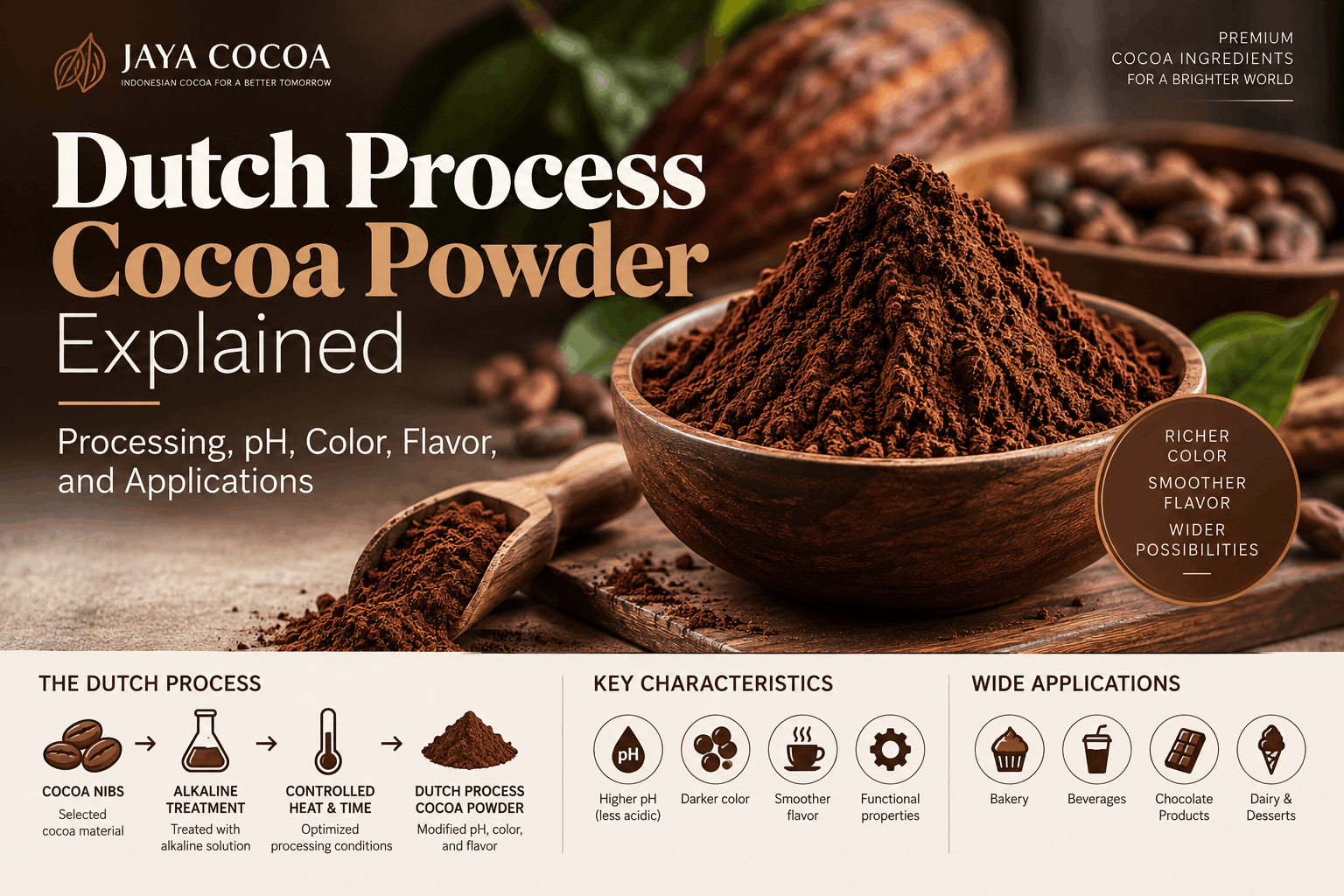
Dutch Process Cocoa Powder Explained: Processing, pH, Color, Flavor, and Applications Dutch process cocoa powder is cocoa powder that has undergone an alkalization treatment designed to modify its natural acidity, color, flavor, and certain functional properties. The term Dutch process cocoa is commonly used interchangeably with alkalized cocoa powder or Dutch-processed cocoa. In industrial cocoa processing, alkalization is an optional processing step rather than a universal requirement for producing cocoa powder. For food manufacturers, bakers, beverage producers, and cocoa ingredient buyers, understanding Dutch process cocoa is important because the degree of alkalization can influence how cocoa powder behaves in a finished formulation. The resulting cocoa powder can range from relatively light brown or reddish-brown to very dark brown or nearly black, depending on the raw material and processing conditions. The process can also raise cocoa powder pH and modify flavor and other physicochemical characteristics. What Is Dutch Process Cocoa Powder? Dutch process cocoa powder is cocoa powder that has been treated with an alkaline compound during cocoa processing to reduce acidity and modify characteristics such as pH, color, flavor, and functionality. The treatment is known as alkalization, while “Dutch process” or “Dutching” is the commonly used industry terminology. The International Cocoa Organization (ICCO) describes alkalization as an optional process used to modify the flavor and color of chocolate liquors and cocoa powders. According to ICCO, selected cocoa material such as cocoa cake, nibs, or cocoa liquor can be mixed with an aqueous solution of an alkaline compound under elevated temperatures and, in some processes, increased pressure. Common alkaline compounds identified by ICCO include: Potassium carbonate Calcium carbonate Sodium hydroxide The exact compound, concentration, temperature, processing time, and processing stage depend on the manufacturer’s process and the characteristics required for the finished cocoa product. Why Is It Called Dutch Process Cocoa? The term Dutch process comes from the historical development of cocoa alkalization associated with Dutch cocoa processing. Today, however, the term is used broadly throughout the cocoa industry. In practical purchasing terminology: Dutch process cocoa ≈ alkalized cocoa powder However, the terminology does not tell a buyer the complete technical specification. Two products both described as “Dutch process cocoa” may differ substantially in: pH Color Fat content Moisture Particle size Flavor Degree of alkalization Microbiological specifications Application performance Therefore, professional buyers should evaluate the technical specification and Certificate of Analysis (COA) rather than relying only on the term “Dutch process.” How Does the Dutch Process Work? The exact industrial process varies between manufacturers, but the basic principle is straightforward. 1. Cocoa Material Is Prepared Cocoa beans undergo conventional processing, including fermentation, drying, roasting, and grinding. Depending on the manufacturing route, alkalization can subsequently be applied to different cocoa materials. ICCO identifies three possible materials for alkalization: Cocoa nibs Cocoa liquor Cocoa cake This distinction is important because the point at which alkalization occurs can influence the final characteristics of the cocoa product. 2. Cocoa Is Treated With an Alkaline Solution The selected cocoa material is mixed or treated with an aqueous alkaline solution. The alkaline material reacts with components of the cocoa matrix and modifies its acidity. The specific alkaline compound and processing conditions depend on the desired product. There is therefore no single universal Dutch process recipe. A manufacturer producing a light alkalized cocoa powder does not necessarily use the same conditions as a manufacturer producing a very dark cocoa powder. 3. Heat and Time Are Controlled Temperature and processing time are important variables. Research has demonstrated that alkalization conditions can significantly influence cocoa powder properties. For example, Demirci et al. (2024) investigated the effects of alkali concentration, temperature, and processing time on cocoa powder quality and found significant effects on parameters including pH and color. Sioriki et al. (2021) likewise investigated alkalization at different temperatures, alkali concentrations, and processing times and observed substantial changes in cocoa powder properties during treatment. This is why degree of alkalization is an important concept in cocoa manufacturing. What Happens to Cocoa During Dutch Processing? Alkalization can produce several changes simultaneously. The most commercially visible changes involve: pH Color Flavor Solubility and other functional properties Certain phytochemical components Let’s look at each one. 1. Dutch Process Cocoa Has a Higher pH One of the defining effects of alkalization is a reduction in cocoa’s natural acidity. Natural cocoa powder generally retains an acidic character, while alkalized cocoa powder has a higher pH. However, there is no single pH value that defines all Dutch process cocoa powders. This is extremely important for industrial buyers. Depending on the degree of alkalization, commercial cocoa powders can have significantly different pH values. A research study by Sioriki et al. found that cocoa powder pH was affected by alkali concentration, while Demirci et al. demonstrated that alkalization process conditions could be optimized to produce different cocoa powder characteristics. Therefore: Dutch process does not automatically mean pH 7, pH 8, or any other single value. The actual product specification should always be checked. For a deeper explanation, see our guide to [Cocoa Powder pH]. 2. Dutch Process Cocoa Becomes Darker One of the most recognizable characteristics of Dutch process cocoa is its darker color. Depending on the degree of alkalization, cocoa can develop colors ranging from: Light brown Reddish brown Dark brown Brown-black Very dark or charcoal-like ICCO notes that alkalization can produce cocoa colors ranging from light red to charcoal black. Research has also demonstrated a relationship between alkalization conditions and cocoa powder color. Sioriki et al. observed a reduction in lightness as temperature and alkali concentration increased under the studied conditions. Demirci et al. also found significant relationships between alkalization conditions and color-related parameters. This is why manufacturers can produce different commercial grades of alkalized cocoa powder for different applications. For more information, see our guide to [Cocoa Powder Color]. 3. Dutch Process Cocoa Has a Different Flavor Profile Natural cocoa can have a relatively acidic, sharp, or astringent flavor. Alkalization can reduce some of this acidity and change the overall sensory profile. Research has shown that
What Is Alkalized Cocoa Powder?
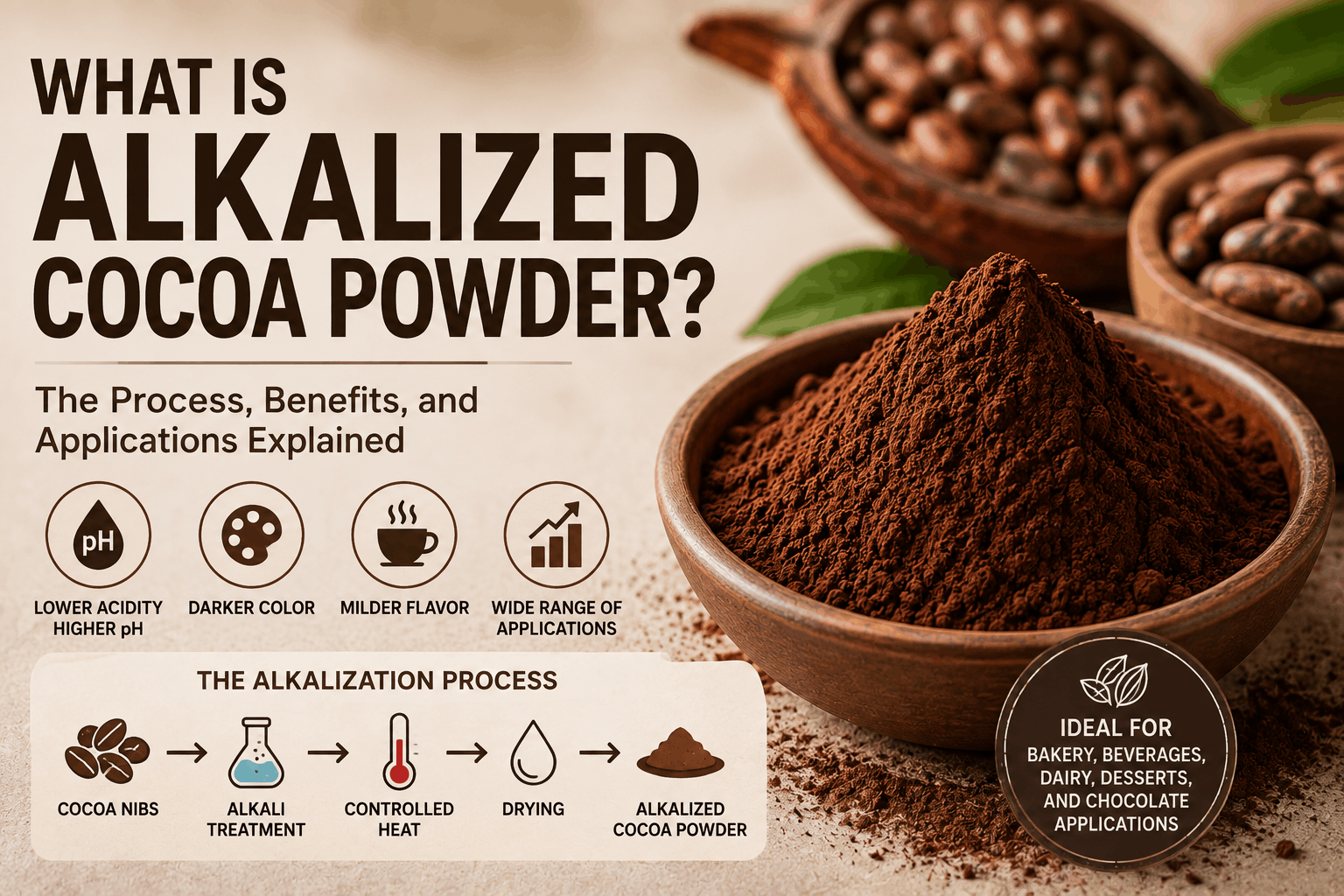
What Is Alkalized Cocoa Powder? A Complete Guide for Food Manufacturers Alkalized cocoa powder is cocoa powder that has been treated with an alkaline substance during cocoa processing to modify its acidity, color, flavor, and functional characteristics. Also known as Dutch-process cocoa powder, alkalized cocoa powder is widely used in bakery products, beverages, chocolate applications, dairy products, desserts, and other food formulations where a specific cocoa color, flavor profile, or pH is required. Unlike natural cocoa powder, which generally retains the naturally acidic characteristics of cocoa, alkalized cocoa powder undergoes an additional processing step that changes some of its chemical and physical properties. For food manufacturers and ingredient buyers, understanding how alkalization works is important when selecting cocoa powder because the degree and conditions of alkalization can significantly affect the final product. What Is Alkalized Cocoa Powder? Alkalized cocoa powder is cocoa powder that has undergone treatment with an alkaline compound to reduce its acidity and modify properties such as pH, color, and flavor. The process is commonly known as alkalization or Dutch processing. According to the International Cocoa Organization (ICCO), alkalization is an optional cocoa-processing step used to modify the flavor and color of cocoa liquor and cocoa powder. The process can involve treating cocoa material with an aqueous alkaline solution under controlled temperature and, depending on the process, pressure. The cocoa material used for alkalization may include: Cocoa nibs Cocoa liquor Cocoa cake After alkalization, the material can continue through subsequent processing steps depending on the manufacturer’s production system and the desired cocoa powder specification. The resulting cocoa powder can range from relatively light reddish-brown shades to very dark brown or nearly black colors, depending on the alkalization conditions. Why Is Cocoa Powder Alkalized? Cocoa is naturally acidic. Alkalization is used to intentionally modify this natural acidity and other characteristics of the cocoa ingredient. Food manufacturers may choose alkalized cocoa powder when they need: A darker cocoa color A less acidic flavor profile A different pH for formulation Specific sensory characteristics Improved compatibility with particular food applications A particular appearance in finished products However, alkalization is not simply a process of “making cocoa darker.” The treatment can influence multiple characteristics simultaneously, including pH, color, flavor, phytochemical composition, and other quality parameters. Research published in Food Research International in 2024 found that alkalization process conditions can significantly influence cocoa powder quality, including color, pH, ash content, and phenolic-related characteristics. How Is Alkalized Cocoa Powder Made? The exact industrial process varies between manufacturers, but the general concept can be explained in several stages. 1. Cocoa Beans Are Processed Cocoa beans are first cleaned and processed through conventional cocoa-processing steps such as fermentation, drying, roasting, and grinding. ICCO describes cocoa processing as a sequence involving cleaning, fermentation, roasting, grinding, alkalization when required, pressing, and further processing. 2. Cocoa Material Is Selected Depending on the manufacturer’s process, alkalization may be applied to: Cocoa nibs Cocoa liquor Cocoa cake The choice of material affects the processing route and the characteristics of the final cocoa product. 3. An Alkaline Compound Is Added The cocoa material is treated with an alkaline compound. Common alkaline materials used in cocoa processing include: Potassium carbonate Calcium carbonate Sodium hydroxide ICCO specifically identifies these compounds as examples used in cocoa alkalization. The exact compound and dosage depend on the desired product characteristics and manufacturing process. 4. Controlled Heat and Processing Conditions The alkaline treatment is carried out under controlled processing conditions. Important variables can include: Alkali concentration Temperature Processing time Moisture Pressure Type of cocoa material Processing sequence These variables are important because alkalization is not a single standardized treatment that produces one universal type of cocoa powder. Research by Demirci et al. (2024) demonstrated that processing conditions can be optimized to influence different quality parameters of cocoa powder. 5. Drying and Further Processing After treatment, the cocoa material is processed further according to the manufacturer’s production system. When cocoa cake is used, it may subsequently be milled into cocoa powder with the required particle size. The final product is then tested against its specification before packaging. What Does Alkalization Do to Cocoa Powder? One of the most important things for buyers to understand is that alkalization affects more than pH. It can influence several important characteristics. 1. It Increases Cocoa Powder pH The most obvious effect of alkalization is modification of cocoa’s acidity. Natural cocoa powder generally has an acidic pH, while alkalized cocoa powders can have substantially higher pH values depending on the degree and conditions of treatment. However, there is no single universal pH value for all alkalized cocoa powder. Commercial specifications can vary considerably. For this reason, buyers should evaluate the actual pH specification and COA provided by the supplier rather than assuming that every alkalized cocoa powder has the same pH. A 2024 study described pH as an important indicator for the classification of alkalized cocoa powder and demonstrated that alkali concentration and other process conditions affect cocoa powder pH. 2. It Changes Cocoa Powder Color Color is one of the most visible effects of alkalization. Depending on the process, cocoa powder can move from relatively light brown or reddish-brown shades toward darker brown and very dark colors. This is why alkalized cocoa powders are commonly associated with: Red cocoa Dark brown cocoa Very dark cocoa Black cocoa However, color should not be used as the only indicator of alkalization level. Two cocoa powders with similar visual colors may have different pH values, processing histories, or application performance. Recent research has shown relationships between alkalization conditions and cocoa powder color, with stronger processing conditions generally producing darker products. For food manufacturers, color should therefore be evaluated together with pH, flavor, fat content, particle size, and application performance. 3. It Changes Flavor Natural cocoa has a characteristic acidic and sometimes sharper flavor profile. Alkalization can reduce some of the perceived acidity and change the flavor characteristics of cocoa powder. The final sensory profile depends on: Cocoa bean origin Fermentation Roasting Alkali type Alkali concentration
