Cocoa Cake Explained: What It Is, How It Is Made, and Its Role in Cocoa Powder
When cocoa beans are processed, they can be transformed into several important cocoa ingredients, including cocoa mass, cocoa butter, cocoa cake, and cocoa powder.
Among these products, cocoa cake is an important intermediate material because it connects the cocoa pressing stage with the production of cocoa powder.
For food manufacturers and cocoa buyers, understanding cocoa cake helps explain where cocoa powder comes from, how its fat content is controlled, and why pressing conditions can influence the final product.
This article explains what cocoa cake is, how it is produced, how it differs from cocoa powder, what happens to it after pressing, and which quality parameters buyers should consider.
What Is Cocoa Cake?
Cocoa cake is the solid material remaining after part or most of the fat has been removed from cocoa nibs or cocoa mass through pressing.
The Codex Alimentarius standard CXS 141-1983 defines cocoa cake as the product obtained by the partial or complete removal of fat from cocoa nib or cocoa mass. The current Codex document was adopted in 1983 and amended in 2025.
In industrial cocoa processing, cocoa cake is normally produced during the pressing of cocoa liquor or cocoa mass.
The basic process can be simplified as:
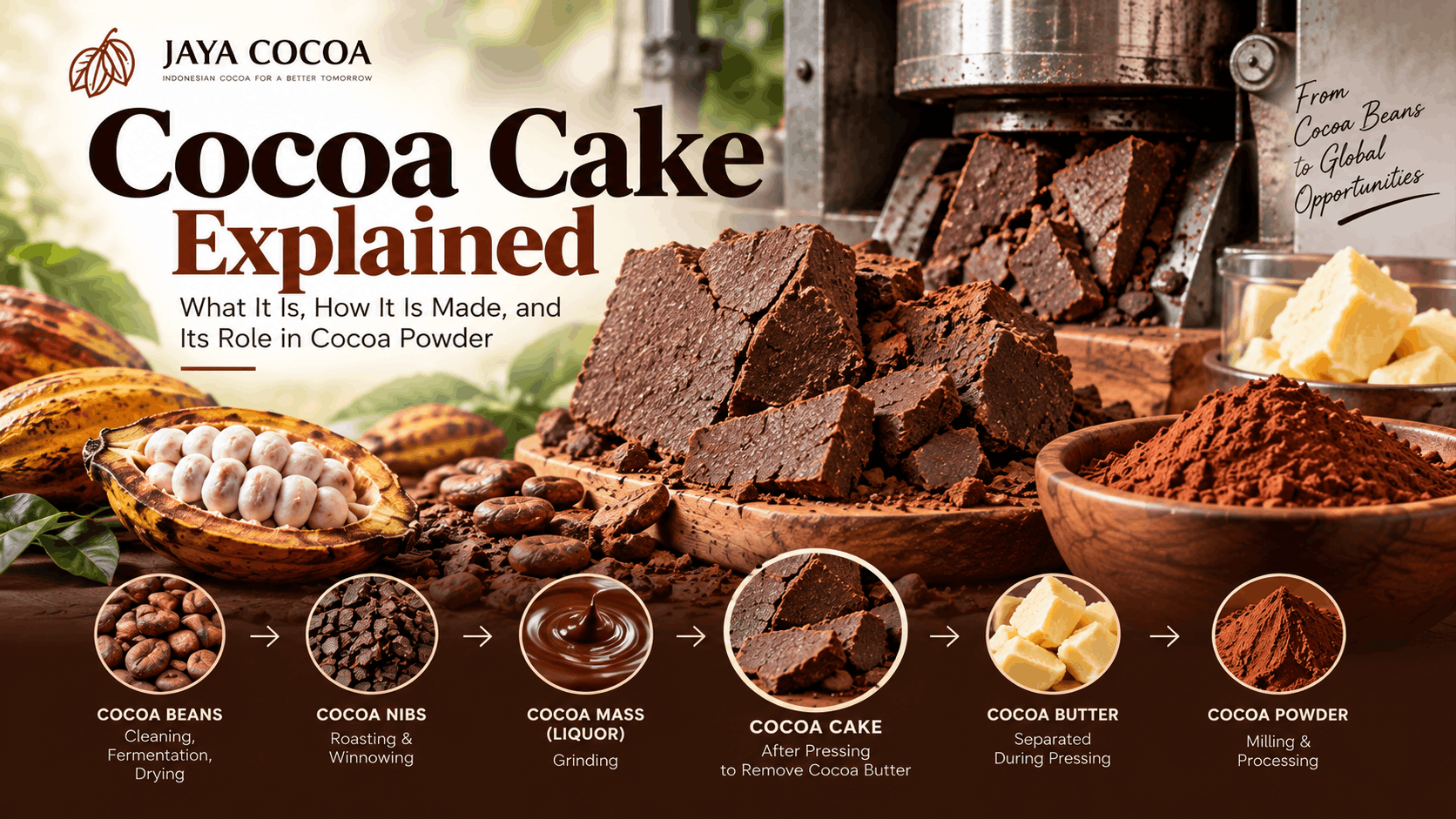
Cocoa Beans → Cocoa Nibs → Cocoa Mass/Liquor → Pressing → Cocoa Butter + Cocoa Cake → Milling → Cocoa Powder
This makes cocoa cake an important intermediate material in cocoa powder manufacturing.
Is Cocoa Cake the Same as Cocoa Powder?
No.
Although cocoa cake and cocoa powder are closely related, they are not the same product.
Cocoa cake
Cocoa cake is the solid material produced after cocoa mass has undergone fat removal.
Cocoa powder
Cocoa powder is produced when cocoa cake is subsequently broken, cooled, milled, and processed into a powder suitable for its intended application.
The International Cocoa Organization explains that after liquor pressing, the resulting cocoa cake is broken and milled to particle sizes determined by the intended end use.
A simplified comparison is:
| Cocoa Cake | Cocoa Powder |
|---|---|
| Intermediate cocoa processing material | Finished or further-processed cocoa ingredient |
| Produced during pressing | Produced by milling cocoa cake |
| Contains residual cocoa butter | Contains residual cocoa butter |
| Solid cake structure | Fine powder |
| Requires further processing for conventional powder production | Ready for formulation after appropriate processing |
| Particle structure is relatively coarse | Controlled particle-size distribution |
Therefore, it is more accurate to think of cocoa powder as a milled and processed form of cocoa press cake, rather than as a completely separate raw material.
How Is Cocoa Cake Made?
Cocoa cake is produced during the cocoa liquor pressing stage.
Before pressing, cocoa beans go through several processing steps.
1. Cocoa Bean Cleaning
Foreign materials and unwanted materials are removed from the cocoa beans.
The ICCO describes cleaning as an important stage before further cocoa processing.
2. Fermentation and Drying
For conventionally fermented cocoa, fermentation contributes significantly to the development of cocoa flavor.
The beans are then dried to reduce moisture to a level suitable for storage and further processing. ICCO notes that cocoa beans can be reduced from around 55% moisture after fermentation to approximately 7.5% during drying under the process conditions it describes.
The actual processing profile can vary according to origin, processor, equipment, and product requirements.
3. Roasting
Cocoa beans or nibs may be roasted to develop the desired flavor profile.
Roasting conditions are not universal. ICCO notes that manufacturers select roasting parameters according to their desired flavor system and product requirements.
4. Winnowing
The shells are separated from the cocoa nibs.
The nib is the part of the cocoa bean that is subsequently processed into cocoa mass.
5. Nib Grinding
The cocoa nibs are ground to produce cocoa mass, also commonly called cocoa liquor or chocolate liquor.
The grinding process generates heat, and the cocoa mass becomes a fluid or semi-fluid material because cocoa butter is released from the cocoa particles.
Codex defines cocoa mass/cocoa liquor as a product obtained from cocoa nibs, with or without roasting and with or without removal or addition of constituents within the standard’s provisions.
6. Cocoa Liquor Pressing
This is the critical stage for cocoa cake production.
Cocoa liquor is placed into a press where mechanical pressure separates part of the cocoa butter from the cocoa solids.
The two principal products are:
Cocoa butter
and
Cocoa cake
ICCO describes industrial liquor pressing as the separation stage in which hot cocoa liquor is pressed, producing cocoa cake and cocoa butter.
Cocoa Cake and Cocoa Butter: How Are They Related?
Cocoa cake and cocoa butter are not unrelated ingredients.
They are two fractions produced from the same cocoa mass during pressing.
Before pressing, cocoa mass contains both cocoa solids and cocoa butter.
During pressing:
Cocoa Mass
↓ Mechanical pressing
Cocoa Butter + Cocoa Cake
The amount of cocoa butter removed affects the composition of the resulting cake.
This is one reason why pressing is so important in cocoa powder manufacturing.
A processor can adjust the pressing process to produce cocoa cake with a specified residual fat level, subject to the equipment, process conditions, raw material, and product specification.
What Determines the Fat Content of Cocoa Cake?
The residual fat content of cocoa cake is influenced by the pressing process.
Factors can include:
- Press pressure
- Pressing time
- Cocoa liquor characteristics
- Temperature
- Cocoa bean composition
- Equipment configuration
- Target product specification
Commercial cocoa powder products are often categorized according to their residual cocoa butter content. Industry references describe examples such as approximately 10–12% and 20–24% fat powders, although commercial specifications can vary between manufacturers.
It is important to distinguish this commercial practice from the Codex definition.
Codex CXS 141-1983 defines cocoa cake but does not establish one universal residual-fat percentage for all cocoa cake.
Therefore, a buyer should not assume that every cocoa cake has the same fat content.
What Happens to Cocoa Cake After Pressing?
Freshly pressed cocoa cake is not yet the fine cocoa powder normally used by food manufacturers.
After pressing, the cake must undergo further physical processing.
The general sequence is:
Pressing
↓
Cocoa Cake
↓
Cooling
↓
Breaking / Kibbled Cake
↓
Milling
↓
Particle-Size Classification
↓
Cocoa Powder
ICCO explains that pressed cocoa cake goes through cooling before grinding and that hammer mills, disc mills, and classifiers can be used in the powder-production stage.
The final particle-size characteristics are determined according to the intended application.
Why Is Cooling Important?
Cocoa cake contains residual cocoa butter.
During processing, cocoa butter can exist in different physical states depending on temperature.
ICCO explains that pressed cocoa cake goes through cooling before grinding and that cocoa powder is subsequently tempered so that the cocoa butter forms a stable crystal configuration.
This is important because proper physical handling can influence:
Therefore, cocoa powder manufacturing is not simply a matter of mechanically grinding a piece of cocoa cake.
Cocoa Cake and Particle Size
Particle size is another important connection between cocoa cake and cocoa powder.
After pressing, the cake is broken and milled.
However, ICCO notes an important technical point: the term “grinding” can be somewhat misleading because the particle size of the finished cocoa powder is influenced by the particle size of the cocoa liquor that was pressed. Common mills may primarily break up agglomerates rather than continuously reducing the underlying particle size.
This means:
More grinding does not automatically mean better cocoa powder.
The final powder must be designed around the application.
For example, requirements for:
may differ.
This is why professional buyers should specify the required particle-size characteristics rather than simply asking for the “finest” cocoa powder.
Can Cocoa Cake Be Alkalized?
Yes.
Alkalization can be applied to cocoa cake as part of cocoa processing.
ICCO identifies cocoa cake, cocoa nibs, and cocoa liquor as possible materials for alkalization. The process involves treatment with an alkaline solution under controlled processing conditions and can modify characteristics such as color and flavor.
Common alkaline materials described by ICCO include:
- Potassium carbonate
- Calcium carbonate
- Sodium hydroxide
The resulting color can range from relatively light red to very dark or charcoal black, depending on the process.
Therefore, the processing chain can involve different configurations depending on the manufacturer’s technology and the desired cocoa powder profile.
Natural Cocoa Cake vs Alkalized Cocoa Cake
The distinction can be useful when discussing cocoa powder production.
Natural cocoa processing
A natural cocoa powder is generally produced without an alkalization treatment.
The resulting product retains a more acidic cocoa profile.
Alkalized cocoa processing
An alkaline treatment is used to modify characteristics such as:
The exact process conditions determine the final characteristics.
Importantly, natural versus alkalized is a processing characteristic, not a measure of whether the cocoa cake is “better” or “worse.”
The appropriate process depends on the intended food application.
Cocoa Cake From Indonesian Cocoa
Cocoa processing research in Indonesia also demonstrates that processing conditions can influence the properties of cocoa press cake.
A 2025 open-access study in the Journal of Agriculture and Food Research investigated cocoa butter and press cake produced from Indonesian unfermented cocoa beans under different processing configurations. The researchers found that changes in deshelling, roasting, and pressing conditions affected the resulting butter and press-cake characteristics.
The study also reported substantial phenolic compounds in the press cake under the tested conditions and noted that the suitability of press cake for cocoa powder depends on characteristics including flavor and appearance.
This is a useful reminder for cocoa buyers:
The quality of cocoa powder begins before the powder is milled.
Bean characteristics and processing conditions upstream can influence the resulting press cake and ultimately the finished cocoa powder.
What Does Codex Say About Cocoa Cake?
For international cocoa buyers, Codex CXS 141-1983 is one of the most useful references.
The current Codex standard covers:
- Cocoa mass / cocoa liquor
- Cocoa cake
For cocoa cake, Codex defines the product as material obtained through partial or complete fat removal from cocoa nib or cocoa mass.
The standard also specifies limits relating to cocoa shell and germ.
For cocoa cake, the standard specifies:
- Maximum 5% m/m calculated on fat-free dry matter, or
- Maximum 4.5% calculated on an alkali-free basis for cocoa shell only.
The standard also addresses hygiene, food additives, flavorings, and labeling.
For international trade, non-retail containers should follow the applicable Codex requirements for non-retail food labeling.
Does Codex Specify the Fat Content of Cocoa Cake?
This is an important point.
No single universal cocoa-cake fat percentage is established by CXS 141-1983.
Codex defines cocoa cake based on the partial or complete removal of fat, but it does not create commercial categories such as “10/12 cake” or “20/22 cake” in the way that cocoa powder is often commercially specified.
Therefore, when purchasing cocoa cake, buyers should request the supplier’s actual specification.
This may include:
- Fat
- Moisture
- Particle characteristics
- pH
- Color
- Microbiological parameters
- Contaminant requirements
- Sensory characteristics
The exact specification should be agreed between buyer and supplier.
Cocoa Cake Quality: What Should Buyers Check?
If cocoa cake is being purchased as an intermediate ingredient or raw material for further processing, buyers should evaluate more than its appearance.
1. Residual Fat
Fat content affects the economics and intended downstream application.
Ask for a defined specification and test method.
2. Moisture
Moisture can affect storage stability, handling, and processing.
The buyer should specify an acceptable range appropriate to the product.
3. Color
Color can provide useful information about processing history and is particularly important if the cake will become cocoa powder.
4. pH
pH is particularly relevant if the cocoa cake has undergone alkalization.
5. Particle Characteristics
The physical structure of the cake can influence subsequent milling and powder performance.
6. Flavor and Aroma
Flavor quality originates from the cocoa bean and is influenced by fermentation, roasting, and subsequent processing.
7. Microbiological Quality
Food manufacturers should establish microbiological requirements appropriate to the destination market and application.
8. Contaminants
Requirements may include applicable limits for contaminants and other food-safety parameters.
9. Shell and Germ
Codex establishes requirements relating to cocoa shell and germ for cocoa cake.
Cocoa Cake vs Cocoa Mass vs Cocoa Powder
Understanding the three products makes the cocoa-processing chain much easier to understand.
| Product | What It Is | Main Processing Stage |
|---|---|---|
| Cocoa Mass / Cocoa Liquor | Ground cocoa material containing cocoa solids and cocoa butter | Produced by grinding nibs |
| Cocoa Cake | Solid material after partial or complete fat removal | Produced by pressing cocoa mass |
| Cocoa Powder | Milled cocoa cake used as a cocoa ingredient | Produced after cake breaking, cooling, milling, and appropriate finishing |
Codex specifically defines cocoa mass/cocoa liquor and cocoa cake as separate products under CXS 141-1983.
This distinction is particularly important when communicating with international suppliers because the terms cocoa mass, cocoa liquor, cocoa cake, and cocoa powder are not interchangeable.
Cocoa Cake vs Cocoa Butter
Cocoa cake and cocoa butter are essentially two major outputs of the pressing stage.
Cocoa butter
The fat fraction separated from cocoa mass.
It is widely used in chocolate and other food applications.
Cocoa cake
The solid fraction remaining after fat removal.
It is subsequently used to produce cocoa powder.
The ICCO identifies cocoa butter as the other product obtained from cocoa liquor pressing, alongside cocoa cake.
This relationship can be represented as:
Cocoa Nibs
↓
Cocoa Mass / Liquor
↓
Pressing
↙️ ↘️
Cocoa Butter Cocoa Cake
↓
Milling
↓
Cocoa Powder
Why Cocoa Cake Matters to Cocoa Powder Quality
It can be tempting to evaluate cocoa powder only after it has been milled and packaged.
However, the characteristics of the press cake are part of the story.
Pressing influences the amount of cocoa butter remaining in the solid material.
The cocoa bean and upstream processing influence:
- Flavor
- Color
- Chemical composition
- Physical characteristics
The pressing process then influences the separation of cocoa butter from the solids.
Finally, milling and subsequent processing determine the physical characteristics of the cocoa powder.
A simplified quality chain is therefore:
Bean Quality
→ Fermentation
→ Drying
→ Roasting
→ Grinding
→ Pressing
→ Cocoa Cake
→ Milling
→ Cocoa Powder
This is why changing suppliers can sometimes produce different powder performance even when two products appear to have similar headline specifications.
Cocoa Cake and Food Manufacturing
Cocoa cake itself is primarily an intermediate material in the production of cocoa powder.
Once milled into cocoa powder, the resulting ingredient can be used in applications including:
- Bakery
- Biscuits
- Beverages
- Ice cream
- Desserts
- Confectionery
- Chocolate-flavored food products
Scientific and industry references describe cocoa powder as an important cocoa ingredient used across these food applications.
The final application determines the required characteristics of the powder.
For example, a beverage manufacturer may prioritize:
- Color
- Flavor
- Dispersion
- Fat content
- Particle characteristics
while a bakery manufacturer may place different emphasis on:
- Color
- Flavor
- pH
- Fat content
- Interaction with the formulation
What Should a Buyer Ask a Cocoa Cake Supplier?
If your company is purchasing cocoa cake for further processing, consider asking the supplier:
Product Specification
- What is the residual fat content?
- What is the moisture specification?
- Is the cake natural or alkalized?
- What is the pH?
- What is the color?
- What is the expected particle profile?
Processing
- What type of press is used?
- Is pressing hydraulic or another system?
- How is the fat content controlled?
- Is the cake cooled before milling?
- Is the product intended for direct use or further milling?
Quality
- Can you provide a Certificate of Analysis?
- What microbiological tests are performed?
- What contaminant tests are available?
- How is shell and germ controlled?
- Is batch traceability available?
Supply
- What is the MOQ?
- What is the production capacity?
- What packaging is available?
- What is the shelf life?
- What Incoterms are available?
These questions help buyers move from a simple price comparison to a more meaningful technical evaluation.
Is Cocoa Cake a Finished Product?
It depends on the commercial context.
In many cocoa-processing systems, cocoa cake is an intermediate material that is subsequently milled into cocoa powder.
However, Codex CXS 141-1983 covers cocoa cake as a defined cocoa product and states that the products covered by the standard are intended for use in manufacturing cocoa and chocolate products and may also be sold directly to consumers.
Therefore, buyers should distinguish between:
Cocoa cake as an intermediate industrial material
and
Cocoa cake supplied as a defined commercial cocoa product.
The intended use and specification should always be clearly stated in the commercial agreement.
Final Takeaway
Cocoa cake is an essential product in the cocoa-processing chain.
It is produced when cocoa mass or cocoa nib material undergoes partial or complete fat removal, leaving a solid cocoa-rich material that can subsequently be processed into cocoa powder. This definition is established by Codex CXS 141-1983.
In industrial cocoa processing:
Cocoa Mass → Pressing → Cocoa Butter + Cocoa Cake → Milling → Cocoa Powder
The characteristics of the final cocoa powder depend on much more than milling alone. Bean quality, fermentation, roasting, cocoa liquor characteristics, pressing conditions, residual fat, cooling, and milling all contribute to the final product.
For buyers, the key lesson is simple:
To understand cocoa powder quality, it is useful to understand the cocoa cake behind it.
A professional cocoa specification should therefore consider the complete processing chain and define the parameters that matter for the intended application.
Frequently Asked Questions
What is cocoa cake?
Cocoa cake is the solid product obtained after partial or complete removal of fat from cocoa nib or cocoa mass. This is the definition provided by Codex CXS 141-1983.
Is cocoa cake the same as cocoa powder?
No. Cocoa cake is the material produced during pressing, while cocoa powder is generally produced by further breaking, cooling, milling, and processing the cake.
What is cocoa cake used for?
Its primary industrial role is as the material from which cocoa powder is produced. Cocoa powder is subsequently used in beverages, bakery, biscuits, confectionery, ice cream, desserts, and other food applications.
Does cocoa cake contain cocoa butter?
Yes. Cocoa cake contains residual cocoa butter after the pressing stage. The amount depends on the processing conditions and product specification.
Can cocoa cake be alkalized?
Yes. ICCO identifies cocoa cake, cocoa nibs, and cocoa liquor as materials that can undergo alkalization.
Does Codex specify one standard fat content for cocoa cake?
No. CXS 141-1983 defines cocoa cake based on partial or complete fat removal but does not establish one universal commercial residual-fat percentage for cocoa cake.
What is the difference between cocoa cake and cocoa butter?
Cocoa butter is the fat fraction separated during pressing, while cocoa cake is the solid material remaining after fat removal.
References & Sources
- Codex Alimentarius — CXS 141-1983, Standard for Cocoa (Cacao) Mass (Cocoa/Chocolate Liquor) and Cocoa Cake.
Codex CXS 141-1983 Official Standard - International Cocoa Organization (ICCO) — Processing Cocoa.
International Cocoa Organization — Processing Cocoa - Journal of Agriculture and Food Research (2025) — Effects of processing methods of unfermented cocoa beans from Indonesia on the chemical and physical characteristics of butter and cake.
Research article — Effects of processing methods of unfermented cocoa beans from Indonesia - Beg et al. — Status, supply chain and processing of cocoa: A review. Trends in Food Science & Technology. Provides broader context on cocoa processing and the relationship between cocoa liquor, butter, and powder.
ScienceDirect — Status, supply chain and processing of cocoa - Codex Alimentarius — Related Cocoa Product Standards.
Codex — Cocoa and Chocolate Related Standards