OEM Cocoa Powder Manufacturing Services: A Complete Guide for B2B Buyers
For food brands, distributors, beverage manufacturers, bakery companies, and international ingredient buyers, building a cocoa powder product does not always require owning a cocoa-processing factory.
An alternative is to work with an OEM cocoa powder manufacturer that produces cocoa powder according to an agreed product specification, packaging requirement, and commercial arrangement.
OEM manufacturing can allow a buyer to develop a cocoa powder product under its own brand while relying on an established manufacturer for production, quality control, packaging, and in some cases export logistics.
However, choosing an OEM cocoa powder manufacturer requires more than comparing prices per kilogram.
The buyer needs to understand the product specification, processing capability, quality system, packaging, regulatory requirements, minimum order quantity, documentation, and supply consistency before entering a long-term agreement.
This guide explains how OEM cocoa powder manufacturing works and what international B2B buyers should evaluate when sourcing from Indonesia.
What Is OEM Cocoa Powder Manufacturing?
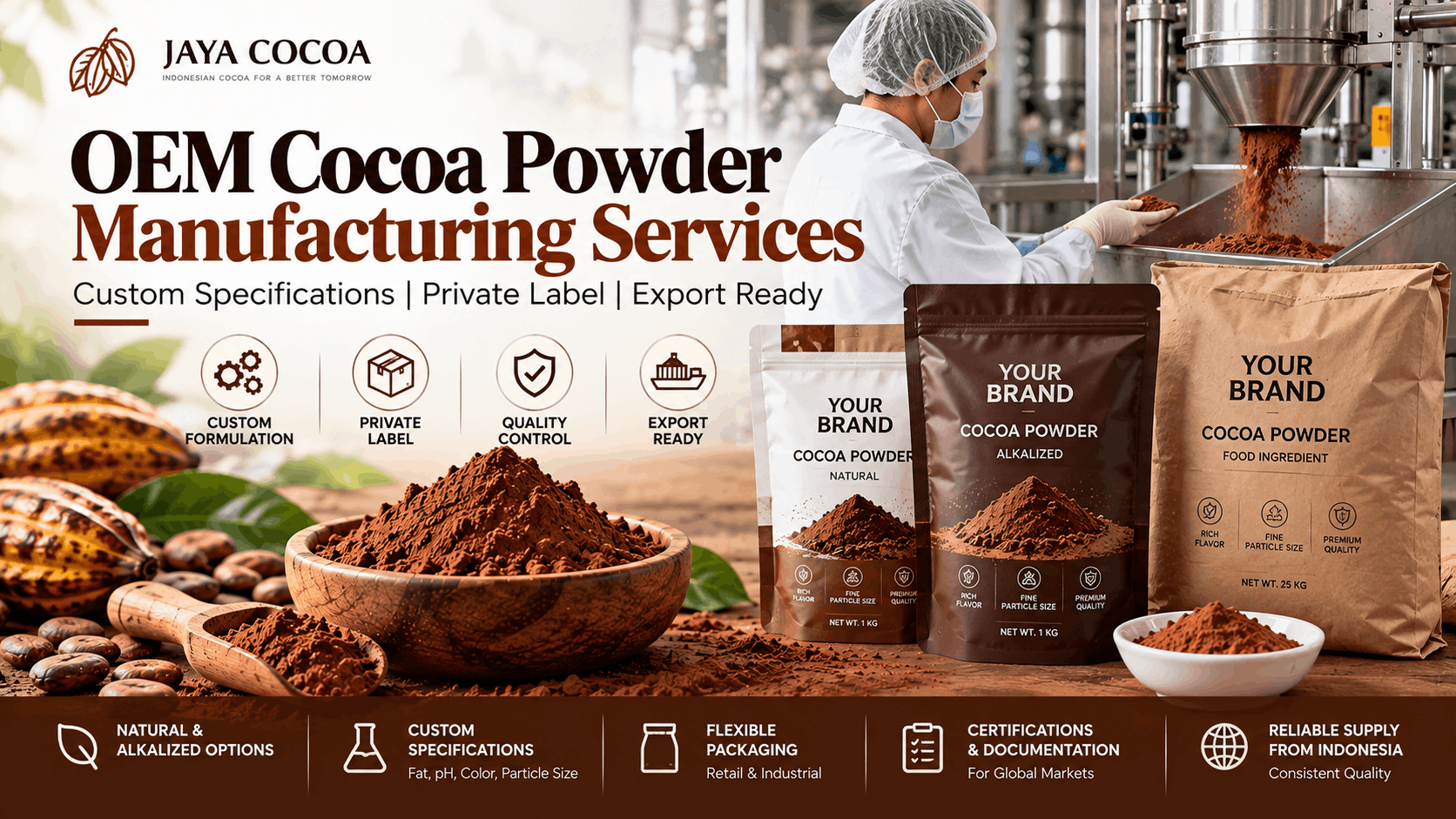
OEM cocoa powder manufacturing is a production arrangement in which a manufacturer produces cocoa powder for another company according to agreed specifications, branding, packaging, or commercial requirements.
OEM stands for Original Equipment Manufacturer, although in food manufacturing the term is often used more broadly to describe customized or contracted production.
In practical cocoa trade, an OEM arrangement may involve:
- Manufacturing cocoa powder to a buyer’s specification
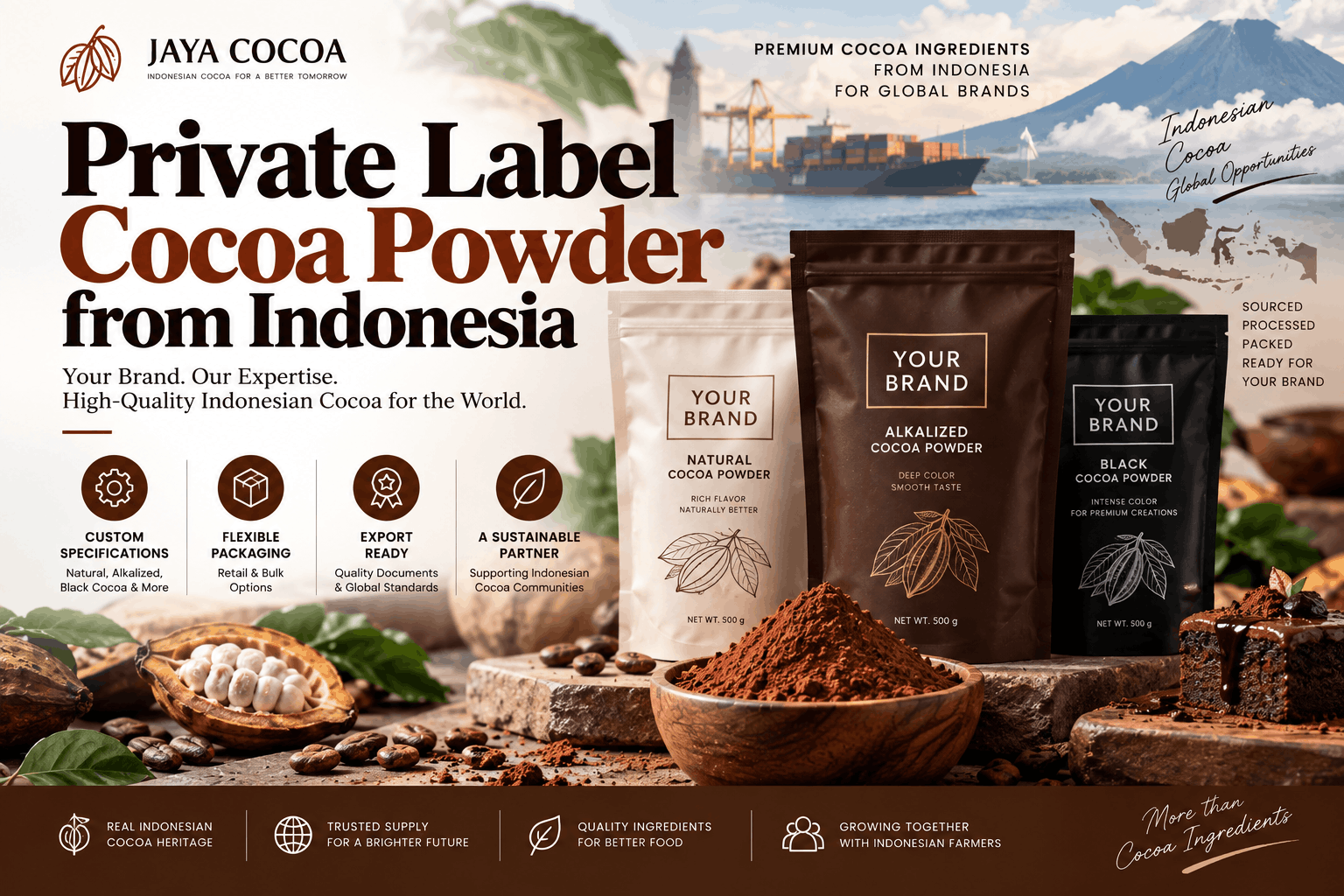
- Producing under the buyer’s brand
- Customized packaging
- Customized product parameters
- Batch production
- Quality-control testing
- Documentation
- Export preparation
- Long-term supply agreements
The exact scope depends on the commercial contract.
An OEM manufacturer may therefore act as a production partner, while the buyer remains responsible for its own brand, market, distribution, and customer relationships.
OEM vs Private Label vs Contract Manufacturing
These terms are related, but buyers should not automatically assume they are identical.
| Model | Typical Meaning |
|---|---|
| OEM Manufacturing | Manufacturer produces a product according to buyer-defined requirements |
| Private Label | Existing or customized product is sold under the buyer’s own brand |
| Contract Manufacturing | Manufacturer produces products under a contractual production arrangement |
| Custom Manufacturing | Product characteristics are specifically developed or adjusted for the buyer |
In the cocoa industry, suppliers may use these terms differently.
Therefore, instead of focusing only on the terminology, buyers should ask:
Exactly what manufacturing, customization, packaging, quality-control, and branding services are included?
This is much more important than whether a supplier calls its service “OEM” or “private label.”
Why Use an OEM Cocoa Powder Manufacturer?
Building a cocoa-processing operation requires substantial infrastructure.
A manufacturer may need equipment for:
- Bean cleaning
- Roasting
- Cracking and winnowing
- Nib grinding
- Cocoa liquor processing
- Pressing
- Cake breaking
- Milling
- Alkalization
- Powder cooling and tempering
- Packaging
- Quality control
The International Cocoa Organization describes cocoa processing as a sequence that can include nib grinding, optional alkalization, liquor pressing, cocoa-cake milling, and powder tempering. International Cocoa Organization
For a brand owner, investing in all of this infrastructure may not be commercially justified.
OEM manufacturing allows the buyer to focus more on:
- Brand development
- Product positioning
- Sales
- Distribution
- Marketing
- Customer relationships
while the manufacturer manages the production side.
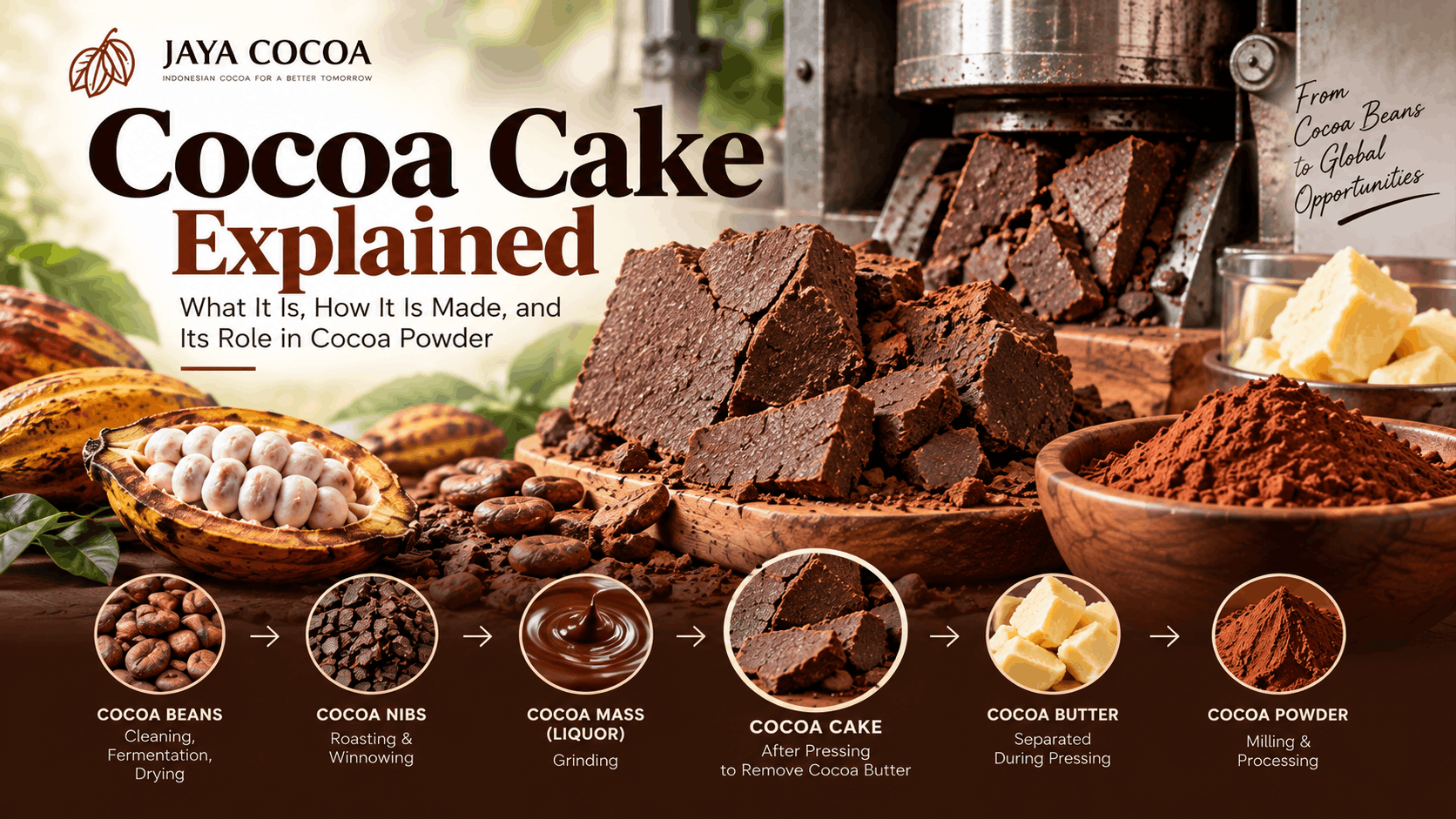
How Cocoa Powder Is Manufactured
Before evaluating an OEM supplier, it helps to understand the basic cocoa-processing chain.
A simplified process is:
Cocoa Beans
↓
Cleaning
↓
Roasting
↓
Cracking & Winnowing
↓
Cocoa Nibs
↓
Grinding
↓
Cocoa Mass / Cocoa Liquor
↓
Pressing
↓
Cocoa Butter + Cocoa Cake
↓
Milling
↓
Cocoa Powder
The International Cocoa Organization describes liquor pressing as the stage where cocoa liquor is pressed to separate cocoa butter from cocoa cake. The resulting cake is then broken and milled according to the intended end use. International Cocoa Organization
Depending on the product, alkalization may also be incorporated into the process.
ICCO notes that alkalization can be applied to cocoa cake, nibs, or cocoa liquor to modify characteristics such as color and flavor. International Cocoa Organization
What Can Be Customized in OEM Cocoa Powder?
One of the most important advantages of an OEM relationship is the possibility of defining a product around a particular application.
Depending on the manufacturer’s capabilities, customization can include:
1. Cocoa Powder Type
Common commercial categories include:
- Natural cocoa powder
- Alkalized cocoa powder
- Dark alkalized cocoa powder
- Black cocoa powder
- Fat-reduced cocoa powder
- Higher-fat cocoa powder
The actual product should always be defined by its technical specification rather than its commercial name alone.
2. Fat Content
Fat content is an important cocoa powder parameter because it can influence:
- Flavor
- Mouthfeel
- Color perception
- Processing
- Formulation
- Cost
- Application performance
Codex CXS 105-1981 distinguishes cocoa powder categories according to cocoa butter content, including cocoa powder with at least 20% cocoa butter, fat-reduced cocoa powder with at least 10% but less than 20%, and highly fat-reduced cocoa powder with less than 10%. The current Codex standard is listed as amended in 2025. FAOHome
This provides an important international reference, but an OEM buyer should still agree on the actual commercial specification and analytical method with the manufacturer.
3. Natural or Alkalized Processing
The buyer can specify whether the intended product should be natural or alkalized.
Natural cocoa powder is generally produced without an alkalization step.
Alkalized cocoa powder undergoes an alkaline treatment that can modify:
- pH
- Color
- Flavor
- Application characteristics
ICCO describes alkalization as an optional cocoa-processing stage and identifies potassium carbonate, calcium carbonate, and sodium hydroxide among alkaline compounds used in cocoa processing. International Cocoa Organization
The degree of alkalization should be defined by the resulting technical characteristics rather than simply by the term “Dutch process.”
4. Color
Color is often one of the most commercially important characteristics for cocoa powder.
A buyer may require a specific color profile for:
- Chocolate beverages
- Biscuits
- Cakes
- Cookies
- Ice cream
- Dessert products
- Confectionery
However, color should be specified using an agreed measurement system or reference standard.
A statement such as “very dark cocoa powder” is not sufficient as a technical specification.
5. pH
pH is particularly relevant when comparing natural and alkalized cocoa powders.
It can influence:
- Flavor
- Color
- Reaction with leavening systems
- Formulation
- Product appearance
An OEM buyer should therefore establish the required pH range before commercial production.
6. Particle Size
Particle size can influence:
- Dispersion
- Flowability
- Mouthfeel
- Processing
- Mixing
- Application performance
ICCO explains that cocoa cake is broken and milled to particle sizes according to the intended end use. International Cocoa Organization
For technical buyers, it is better to specify a measurable particle-size requirement than simply request “fine cocoa powder.”
Depending on the application, the specification may use:
- D10
- D50
- D90
- Sieve results
- Another agreed measurement method
The analytical method should also be documented.
7. Moisture
Moisture is another important specification.
Codex CXS 105-1981 provides a maximum moisture level of 7% m/m for cocoa powders covered by the standard. FAOHome
However, this should not automatically be treated as the commercial target for every OEM product.
The buyer and manufacturer can establish a tighter specification based on:
- Product characteristics
- Packaging
- Storage conditions
- Destination climate
- Application
- Customer requirements
8. Packaging
OEM cocoa powder can potentially be supplied in:
- Industrial bags
- Retail bags
- Pouches
- Printed bags
- Bulk packaging
- Customized cartons
- Other food-grade packaging formats
The appropriate format depends on the intended market.
For industrial B2B buyers, the focus may be on:
- Product protection
- Moisture barrier
- Handling
- Palletization
- Container loading
For retail brands, additional considerations include:
- Artwork
- Branding
- Package size
- Consumer labeling
- Shelf presentation
OEM Cocoa Powder Packaging and Branding
Packaging is often where OEM manufacturing becomes different from ordinary bulk cocoa powder supply.
A standard bulk order might use the manufacturer’s existing packaging.
An OEM project may require:
Buyer-approved packaging + buyer-approved artwork + buyer-approved labeling.
The buyer may need to provide:
- Brand logo
- Product name
- Package size
- Artwork
- Country-of-origin information
- Ingredients
- Nutrition information where applicable
- Storage instructions
- Lot coding requirements
- Regulatory information
Packaging should be approved before production begins.
Labeling Requirements for OEM Cocoa Powder
Labeling depends heavily on the destination market and the way the product is sold.
For Indonesia, BPOM provides specific guidance for contract-produced processed foods. Its labeling guidance states that contract-produced products should identify the contracting party and contracted manufacturer using wording such as “Diproduksi oleh … untuk …” or “Dikemas oleh … untuk …” where applicable. Rumah Sari POM
BPOM also distinguishes B2B processed food sold to businesses for further processing from retail products and identifies information that should appear on B2B labeling, including product name, net weight, producer/importer information, production date/code, and expiry information where applicable. Rumah Sari POM
For exports, however, Indonesian labeling rules are only part of the picture.
The OEM manufacturer and buyer must also verify the requirements of the destination country.
A label compliant in Indonesia is not automatically compliant in the United States, European Union, Middle East, or another export market.
OEM Cocoa Powder Quality Control
A good OEM agreement should define quality control before production begins.
The buyer should establish the key parameters in a Product Specification.
Depending on the product, this may include:
| Parameter | Why It Matters |
|---|---|
| Fat | Formulation and product characteristics |
| Moisture | Storage and physical stability |
| pH | Acidity/alkalinity and formulation |
| Color | Product appearance |
| Particle Size | Processing and application |
| Ash | Composition |
| Microbiology | Food safety and quality |
| Heavy Metals | Regulatory compliance |
| Pesticide Residues | Market requirements |
| Mycotoxins | Food safety requirements |
| Sensory Characteristics | Flavor and aroma |
Not every parameter is required for every cocoa powder.
The specification should reflect the actual product, application, and destination market.
Certificate of Analysis for OEM Cocoa Powder
A Certificate of Analysis (COA) is one of the most important documents for B2B cocoa powder buyers.
A batch-specific COA may contain:
- Product name
- Batch/lot number
- Production date
- Test parameters
- Test results
- Specification limits
- Analytical methods
- Laboratory or QC identification
The buyer should compare the COA against the approved product specification.
For example:
Product specification: Moisture ≤ X%
COA result: Moisture = Y%
This provides an objective basis for batch approval.
Why Product Specifications Matter More Than Product Names
One of the most common problems in international ingredient sourcing is relying on vague product descriptions.
Terms such as:
- Premium cocoa powder
- High-quality cocoa
- Dark cocoa
- Fine cocoa
- Bakery cocoa
- Beverage cocoa
can have different meanings between suppliers.
An OEM relationship should therefore move from:
Commercial product name
to:
Measurable technical specification
For example:
Instead of:
Premium alkalized cocoa powder
A stronger specification might define:
- Alkalized
- Fat content: agreed range
- pH: agreed range
- Color: agreed measurement
- Moisture: agreed maximum
- Particle size: agreed distribution
- Microbiology: agreed limits
- Packaging: agreed format
This creates a much more reliable basis for manufacturing.
OEM Cocoa Powder Sampling Process
Before a commercial order, the buyer should ideally go through a sample-approval process.
Step 1 — Buyer Provides Product Brief
The buyer explains:
- Application
- Target market
- Product type
- Desired specification
- Package size
- Estimated volume
Step 2 — Manufacturer Reviews Requirements
The manufacturer evaluates whether the specification can be produced consistently.
Step 3 — Sample Production
A representative sample is prepared.
Step 4 — Buyer Testing
The buyer tests:
- Color
- Flavor
- Aroma
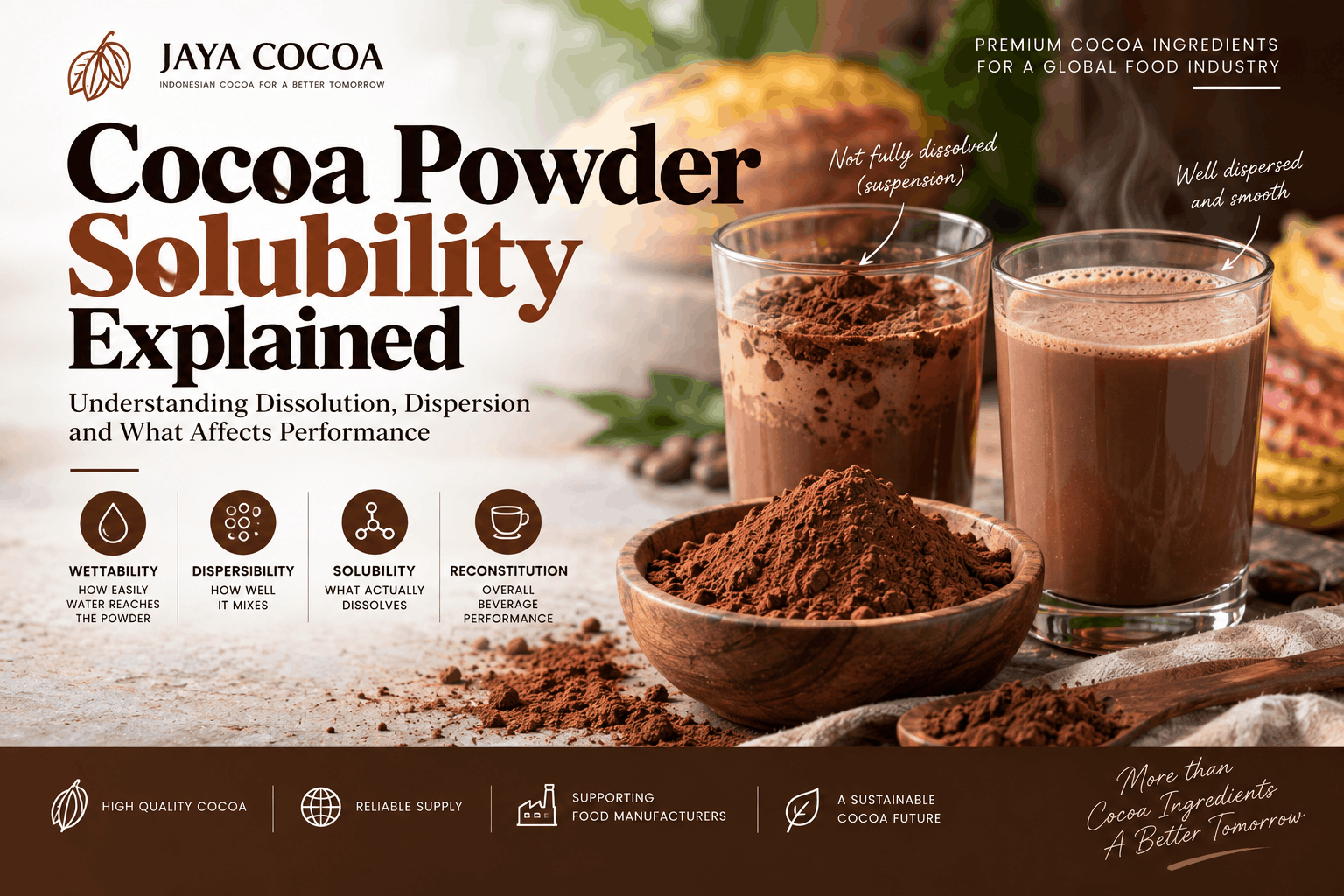
- Dispersion
- Application performance
- Other required technical parameters
Step 5 — Specification Approval
The approved sample becomes a reference for the agreed specification.
Step 6 — Commercial Production
The manufacturer produces the order according to the approved specification.
This process is particularly important when the cocoa powder is intended for a specific food formulation.
OEM Cocoa Powder for Different Applications
An OEM manufacturer may supply different cocoa powder profiles depending on the application.
Bakery
Typical considerations include:
- Color
- Flavor
- Fat
- pH
- Particle characteristics
Beverages
Important considerations may include:
- Dispersibility
- Color
- Flavor
- Fat
- Particle characteristics
- Sedimentation behavior
Biscuits and Cookies
Color and cocoa flavor can be particularly important.
Ice Cream
The buyer may prioritize:
- Color
- Flavor
- Fat
- Dispersion
- Interaction with the formulation
Confectionery
The required cocoa powder profile may depend heavily on the specific product formulation.
The key principle is:
The application should determine the cocoa powder specification.
Not the other way around.
OEM Cocoa Powder Manufacturing Process
A typical OEM project can be organized into the following stages:
1. Product Brief
The buyer defines the desired product.
2. Technical Review
The manufacturer evaluates feasibility.
3. Sample Development
Samples are produced.
4. Sample Approval
The buyer approves the product.
5. Specification Approval
The final technical specification is documented.
6. Packaging Approval
Artwork and packaging are finalized.
7. Purchase Order
Commercial terms are confirmed.
8. Production
The manufacturer produces the batch.
9. Quality Control
The product is tested against the agreed specification.
10. Packaging
The finished cocoa powder is packed using the approved packaging.
11. Documentation
COA and required export documents are prepared.
12. Shipment
The goods are prepared for export according to the agreed Incoterm and logistics arrangement.
This workflow reduces the risk of misunderstandings between buyer and manufacturer.
What Is the MOQ for OEM Cocoa Powder?
There is no universal MOQ for OEM cocoa powder manufacturing.
The minimum order quantity can depend on:
- Product type
- Factory production batch
- Packaging format
- Printed packaging MOQ
- Raw-material availability
- Customization level
- Testing requirements
- Buyer destination
- Contract volume
A buyer should ask for at least two different quantities:
Product MOQ
The minimum amount of cocoa powder required for production.
Packaging MOQ
The minimum quantity of printed or customized packaging required by the packaging supplier.
These may be different.
For example, a manufacturer may be able to produce a small quantity of cocoa powder but require a larger minimum quantity for custom printed packaging.
How Much Does OEM Cocoa Powder Manufacturing Cost?
There is no universal OEM price.
The final quotation may depend on:
- Cocoa powder type
- Fat content
- Color
- pH
- Processing requirements
- Particle size
- Quality requirements
- Packaging
- Printing
- Testing
- Certification
- Quantity
- Incoterm
- Destination
For this reason, buyers should avoid comparing OEM manufacturers using only:
USD/kg
A better comparison is:
Specification + packaging + documentation + quantity + Incoterm + payment terms + lead time
This provides a more meaningful commercial comparison.
OEM Cocoa Powder from Indonesia
Indonesia is an established cocoa-processing origin.
For an international buyer, Indonesian OEM sourcing can be attractive when the manufacturer can provide the required combination of:
- Processing capability
- Product consistency
- Quality control
- Customized packaging
- Export documentation
- Supply capacity
However, buyers should evaluate individual manufacturers rather than assuming that all Indonesian cocoa companies offer the same OEM capability.
The manufacturer’s actual factory capabilities, certifications, production capacity, specifications, and export experience should be verified directly.
Indonesian Cocoa Standards and OEM Production
Indonesia has its own national standards for cocoa products, while international buyers may also work with Codex and destination-country requirements.
Codex currently lists CXS 105-1981 — Standard for Cocoa Powders (Cocoas) and Dry Mixtures of Cocoa and Sugars, with the standard amended in 2025. FAOHome
Codex also lists related cocoa standards including:
- CXS 86-1981 — Cocoa Butter
- CXS 87-1981 — Chocolate and Chocolate Products
- CXS 141-1983 — Cocoa Mass/Liquor and Cocoa Cake FAOHome
These standards provide useful international references, but they do not replace destination-country regulations or buyer-specific specifications.
OEM Manufacturer Certifications
Depending on the buyer and market, an OEM cocoa powder manufacturer may be asked to provide evidence of food-safety systems and certifications.
Potential documentation can include:
- HACCP
- ISO 22000
- FSSC 22000
- Halal
- Kosher
- GMP-related documentation
- Product-specific laboratory reports
- COA
- Traceability documentation
However, buyers should verify the validity and scope of each certificate.
A supplier having a certification logo on a website is not enough.
Ask for:
- Certificate number
- Certification body
- Scope
- Issue date
- Expiry date
- Certified site
- Product/process covered
The certification must actually cover the manufacturing activity relevant to the cocoa powder being purchased.
OEM vs Buying Bulk Cocoa Powder
Which option is better depends on the buyer’s business model.
| Bulk Cocoa Powder | OEM Cocoa Powder |
|---|---|
| Standard product | Customized product possible |
| Supplier packaging | Buyer packaging possible |
| Usually simpler | More development required |
| Faster procurement | More preparation |
| Lower customization | Higher customization |
| Suitable for ingredient users | Suitable for brands and specialized buyers |
| Easier initial sourcing | Stronger long-term partnership potential |
A bakery purchasing cocoa powder as an ingredient may prefer bulk supply.
A company launching a branded cocoa powder product may prefer OEM.
How to Choose an OEM Cocoa Powder Manufacturer
A serious OEM evaluation should cover at least eight areas.
1. Factory Capability
Can the manufacturer actually produce the required cocoa powder?
2. Product Specification
Can the manufacturer consistently meet the required parameters?
3. Quality Control
Is there a documented QC system?
4. Laboratory Capability
Can the manufacturer perform or arrange the required testing?
5. Packaging
Can the supplier produce the required packaging format?
6. Traceability
Can each batch be traced to production and QC records?
7. Export Experience
Does the company understand international shipping and documentation?
8. Commercial Reliability
Can the manufacturer consistently meet:
- Quantity
- Quality
- Lead time
- Packaging
- Documentation
These factors can be more important than obtaining the lowest initial quotation.
Questions to Ask an OEM Cocoa Powder Manufacturer
Before signing an agreement, ask:
Product
- What cocoa powder types can you manufacture?
- What fat-content ranges are available?
- What pH ranges are available?
- What color specifications can you achieve?
- What particle-size specifications can you provide?
- Can you develop a product from our reference sample?
Manufacturing
- Where is the product manufactured?
- Is the facility owned or outsourced?
- What is the production capacity?
- What processing stages are performed in-house?
- Can you handle alkalization?
- How is batch consistency controlled?
Quality
- Can you provide a product specification?
- Can you provide batch-specific COAs?
- What laboratory methods are used?
- What microbiological testing is performed?
- What contaminant testing is available?
- What traceability system is used?
Packaging
- Can you use our packaging design?
- What package sizes are available?
- What is the packaging MOQ?
- Can you supply retail and industrial formats?
- How is packaging artwork approved?
Export
- What Incoterms are available?
- Which port is used?
- What export documents are provided?
- What is the normal production lead time?
- Can third-party inspection be arranged?
Commercial
- What is the MOQ?
- What payment terms are available?
- How are claims handled?
- How is a specification deviation handled?
- What happens if a shipment fails inspection?
OEM Contract: What Should Be Defined?
An OEM relationship should ideally be supported by a written agreement.
Important elements may include:
Product Specification
Defines exactly what is being produced.
Packaging Specification
Defines materials, dimensions, printing, and labeling.
Quality Acceptance
Defines test methods and acceptable limits.
Sample Approval
Defines which sample or specification is the reference.
Production Tolerance
Defines acceptable variation where appropriate.
Batch Testing
Defines what parameters are tested and when.
Non-Conformance
Defines what happens if the product does not meet specification.
Confidentiality
Important if the buyer provides proprietary product specifications or formulations.
Intellectual Property
Particularly relevant for custom formulations, artwork, and proprietary brand assets.
Forecast and Supply
Defines expected order volume and production planning.
Payment Terms
Defines deposit, balance, payment method, and conditions.
Incoterms
Defines the responsibility for freight, insurance, customs, and risk.
A well-defined contract reduces ambiguity later in the relationship.
Common Mistakes When Choosing an OEM Cocoa Powder Supplier
Mistake 1: Choosing Only by Price
The cheapest supplier is not necessarily the lowest-cost supplier over the life of the contract.
Inconsistent quality can create:
- Production problems
- Customer complaints
- Rejected shipments
- Rework
- Lost sales
Mistake 2: Not Approving a Sample
A product description cannot replace physical testing.
Always evaluate a representative sample where possible.
Mistake 3: Using Vague Specifications
“Premium cocoa powder” is not enough.
Define measurable parameters.
Mistake 4: Ignoring Packaging
A good cocoa powder can still experience quality problems if packaging and storage conditions are inadequate.
Mistake 5: Checking Certifications Only by Logo
Always verify:
- Certificate
- Scope
- Site
- Validity
- Certification body
Mistake 6: Ignoring Destination Regulations
The product requirements of the destination market may differ from those of Indonesia.
Mistake 7: Not Defining the COA
The buyer should know:
- Which parameters are tested
- Which method is used
- Which laboratory performs the test
- What acceptance limits apply
OEM Cocoa Powder for Long-Term Supply
OEM manufacturing becomes especially valuable when the buyer is building a long-term brand.
A strong relationship can allow both parties to improve:
- Product consistency
- Packaging efficiency
- Production planning
- Quality control
- Forecasting
- Logistics
- Cost efficiency
Instead of treating each shipment as an independent transaction, the relationship can develop into a structured supply program.
For a growing food brand, this can be significantly more valuable than simply finding the cheapest cocoa powder available.
Final Takeaway
OEM cocoa powder manufacturing is a production partnership, not simply a packaging service.
A professional OEM program should connect:
Product Specification → Manufacturing → Quality Control → Packaging → Documentation → Logistics
The cocoa-processing chain itself is technically complex. ICCO describes stages including nib grinding, optional alkalization, liquor pressing, cocoa-cake milling, and powder tempering. International Cocoa Organization
For buyers, the most important step is therefore to define the product before discussing the final price.
A strong OEM cocoa powder project should establish:
- Cocoa powder type
- Fat content
- pH
- Color
- Particle size
- Moisture
- Microbiological requirements
- Contaminant requirements
- Packaging
- Labeling
- MOQ
- COA
- Certifications
- Lead time
- Incoterm
- Payment terms
The current Codex framework provides an important international reference for cocoa powder, with CXS 105-1981 listed as amended in 2025. FAOHome
But Codex is only one part of the evaluation.
The final product must also satisfy the buyer’s specification and the regulatory requirements of the destination market.
For companies looking for an Indonesian OEM cocoa powder partner, the strongest approach is therefore not simply:
“Find a cheap cocoa powder factory.”
It is:
“Find a manufacturer capable of producing our specification consistently, documenting the quality, packaging it correctly, and supporting our target market over the long term.”
Frequently Asked Questions
What is OEM cocoa powder manufacturing?
OEM cocoa powder manufacturing is a production arrangement in which a manufacturer produces cocoa powder for another company according to agreed product, packaging, branding, or technical requirements.
Is OEM the same as private label?
Not necessarily. The terms are often used interchangeably in commercial markets, but OEM generally emphasizes manufacturing according to buyer requirements, while private label emphasizes selling a product under the buyer’s brand.
Can OEM cocoa powder be customized?
Depending on the manufacturer’s capabilities, buyers may be able to customize fat content, pH, color, particle size, processing profile, packaging, and other specifications.
Can Indonesian companies provide OEM cocoa powder?
Yes, Indonesian cocoa processors and exporters can offer customized cocoa powder production, but capabilities, certifications, MOQs, packaging options, and processing technology vary between manufacturers.
What documents should an OEM buyer request?
Common documents may include a product specification, batch COA, food-safety certifications, laboratory reports, traceability documentation, and export documents appropriate to the shipment and destination.
What is the MOQ for OEM cocoa powder?
There is no universal MOQ. It depends on the product, manufacturing batch, packaging, printing, customization, and supplier.
Can OEM cocoa powder be sold under my own brand?
Yes, if the commercial agreement and labeling/regulatory requirements allow it. The brand owner and manufacturer should clearly define responsibilities for artwork, labeling, intellectual property, and regulatory compliance.
How do I choose an OEM cocoa powder manufacturer?
Evaluate manufacturing capability, product consistency, quality systems, laboratory testing, certifications, packaging capability, export experience, MOQ, lead time, and contractual terms—not price alone.
References
- International Cocoa Organization (ICCO) — Processing Cocoa
Sumber utama untuk proses cocoa processing, alkalization, liquor pressing, cocoa cake, milling, dan tempering. International Cocoa Organization - Codex Alimentarius — CXS 105-1981, Standard for Cocoa Powders (Cocoas) and Dry Mixtures of Cocoa and Sugars
Standar internasional utama untuk cocoa powder; current Codex listing menunjukkan terakhir diamendemen pada 2025. FAOHome - Codex Alimentarius — Related Cocoa Product Standards
Mencakup standar terkait cocoa butter, chocolate, cocoa powder, cocoa mass/liquor, dan cocoa cake. FAOHome - BPOM — Label Pangan Olahan
Referensi Indonesia untuk ketentuan labeling, termasuk produk yang diproduksi melalui kontrak dan B2B food products.