Cocoa Butter vs Cocoa Powder: Differences, Uses, and How to Choose
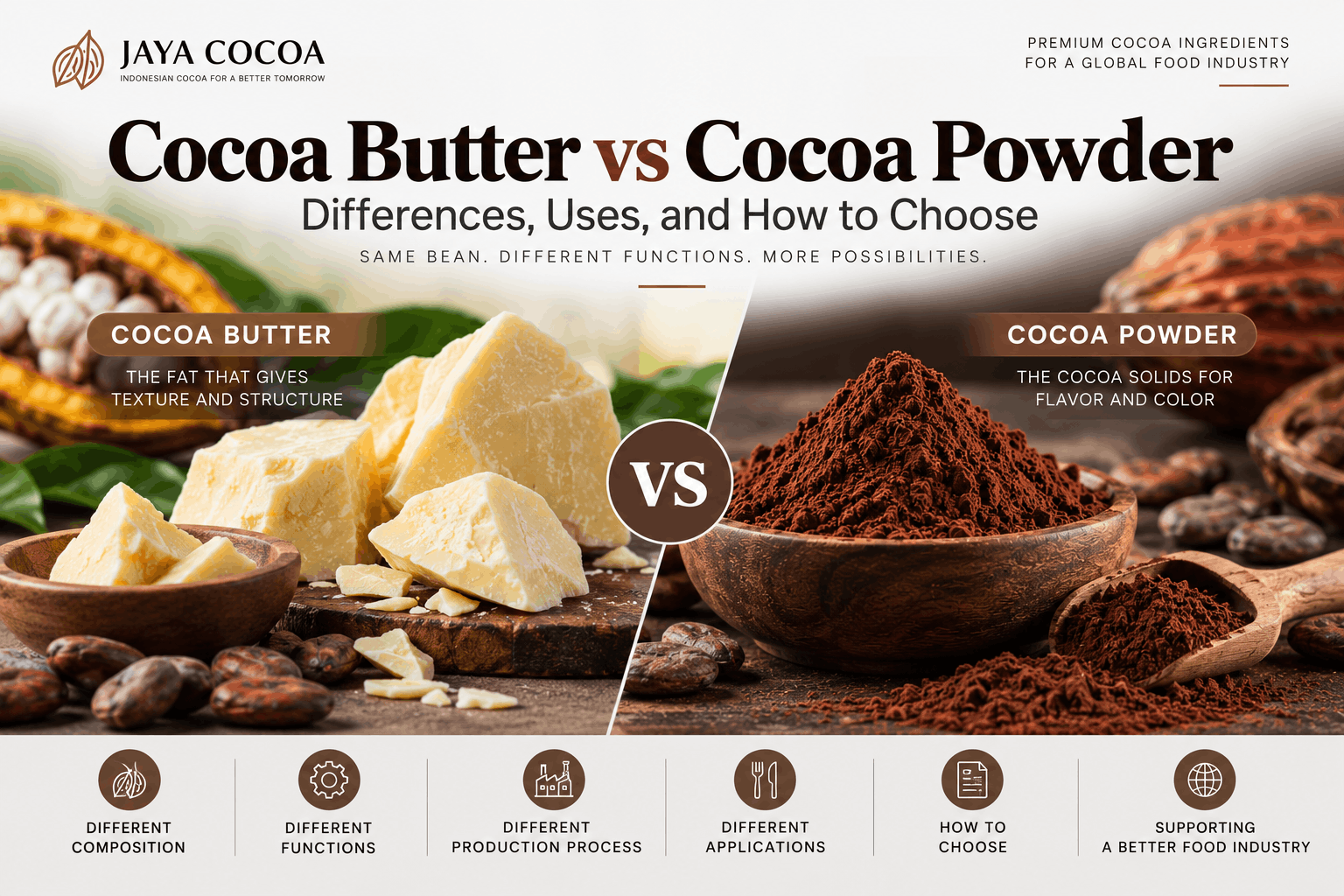
Cocoa butter and cocoa powder are two of the most important ingredients derived from cocoa beans, but they serve very different functions in food manufacturing.
Cocoa butter is the fat fraction obtained from cocoa liquor, while cocoa powder is produced from the cocoa cake remaining after part of the cocoa butter has been removed. Because they come from different fractions of the same cocoa-processing stream, their physical properties, functionality, and applications are significantly different.
For food manufacturers, understanding the difference between cocoa butter and cocoa powder is important when developing chocolate, bakery products, beverages, desserts, confectionery, and other cocoa-based formulations.
This guide explains the differences between cocoa butter and cocoa powder, how each is produced, their key characteristics, common applications, and what buyers should consider when selecting either ingredient.
What Is Cocoa Butter?
Cocoa butter is the fat naturally present in cocoa beans.
During cocoa processing, fermented and dried cocoa beans are cleaned, roasted, and processed into cocoa nibs. The nibs are then ground into cocoa liquor, also known as cocoa mass or cocoa/chocolate liquor.
The cocoa liquor contains both cocoa solids and cocoa fat. Through pressing, the cocoa butter is separated from the solid portion.
According to the International Cocoa Organization (ICCO), cocoa butter is one of the products obtained from pressing cocoa liquor and is an important ingredient in chocolate manufacturing.
Cocoa butter is therefore primarily used when a formulation requires cocoa fat, melting characteristics, texture, or chocolate-processing functionality.
What Is Cocoa Powder?
Cocoa powder is the powdered cocoa material produced after cocoa liquor has been pressed and the resulting cocoa cake has been broken and milled.
The amount of cocoa butter remaining in the powder depends on the degree of pressing and the specification of the product.
The Codex standard for cocoa powders classifies cocoa powder according to cocoa butter content, including:
| Product classification | Cocoa butter content |
|---|---|
| Cocoa powder | ≥20% |
| Fat-reduced cocoa powder | ≥10% and <20% |
| Highly fat-reduced cocoa powder | <10% |
The same Codex standard specifies a maximum moisture content of 7% for products covered by the standard.
Cocoa powder is primarily used to provide cocoa flavor, color, and cocoa solids to food formulations.
How Cocoa Butter and Cocoa Powder Are Produced
The easiest way to understand the difference is to look at where they appear in the cocoa-processing chain.
Cocoa beans
↓
Fermentation and drying
↓
Roasting and processing
↓
Cocoa nibs
↓
Grinding
↓
Cocoa liquor
↓
Pressing
↙︎ ↘︎
Cocoa Butter Cocoa Cake
↓
Grinding
↓
Cocoa Powder
This relationship is important because cocoa butter and cocoa powder are not unrelated cocoa ingredients.
They are two different fractions obtained from the same cocoa-processing stage.
ICCO describes the pressing of cocoa liquor as the point at which cocoa butter is separated and cocoa cake is formed. The cake can subsequently be broken and milled according to the required end use.
Cocoa Butter vs Cocoa Powder: Key Differences
The most important differences are related to composition, physical form, functionality, and application.
| Characteristic | Cocoa Butter | Cocoa Powder |
|---|---|---|
| Main component | Cocoa fat | Cocoa solids with residual cocoa butter |
| Physical form | Solid/semi-solid fat | Fine powder |
| Primary function | Fat, texture, melting behavior | Cocoa flavor, color, cocoa solids |
| Production | Pressed from cocoa liquor | Milled from cocoa cake |
| Fat level | Predominantly cocoa fat | Lower fat than cocoa liquor |
| Main applications | Chocolate, confectionery, fillings, coatings | Bakery, beverages, desserts, mixes |
| Color contribution | Limited compared with cocoa powder | Important formulation characteristic |
| Flavor contribution | Cocoa aroma and fat-soluble flavor characteristics | Strong cocoa flavor contribution |
| Formulation role | Structural and textural ingredient | Cocoa solids and flavor ingredient |
The distinction is especially important in industrial formulation.
A manufacturer generally cannot substitute cocoa powder for cocoa butter on a 1:1 functional basis, because the two ingredients contribute very different properties to a formulation.
Cocoa Butter vs Cocoa Powder: Composition
Cocoa Butter
Cocoa butter is predominantly the fat fraction of cocoa.
Its functionality comes from its fat composition and melting behavior. This makes it particularly important in chocolate and confectionery systems where the fat phase affects texture, mouthfeel, melting, and processing.
ICCO notes that cocoa butter is used in chocolate manufacturing and can also be involved in adjusting chocolate viscosity during standardization.
Typical functional roles include:
- Providing cocoa fat
- Contributing to chocolate texture
- Influencing melting behavior
- Contributing to mouthfeel
- Helping control chocolate viscosity
- Supporting confectionery coatings and fillings
Cocoa Powder
Cocoa powder contains cocoa solids together with a controlled amount of residual cocoa butter.
The remaining fat level is an important commercial specification because it influences the powder’s formulation behavior and characteristics.
For example, a higher-fat cocoa powder and a highly fat-reduced cocoa powder can behave differently in bakery, beverage, and dry-mix applications.
Codex recognizes different cocoa powder categories based on cocoa butter content, reinforcing the importance of fat level when specifying cocoa powder.
Cocoa Butter vs Cocoa Powder in Chocolate Manufacturing
Chocolate manufacturing is one of the clearest examples of why the two ingredients should not be treated as interchangeable.
ICCO identifies cocoa liquor, cocoa butter, and sugar as major ingredients used in chocolate production. Cocoa butter can also be used during standardization to adjust viscosity.
Cocoa butter contributes:
- Fat phase
- Melting behavior
- Texture
- Mouthfeel
- Viscosity control
- Chocolate structure
Cocoa powder can contribute:
- Cocoa flavor
- Cocoa solids
- Color
- Cocoa character
In some formulations, both ingredients may be used together because they perform different jobs.
For example, a chocolate or compound-style formulation may require a controlled fat phase while also requiring a specific level of cocoa solids and color.
Cocoa Butter vs Cocoa Powder in Bakery Products
Cocoa powder is commonly used in bakery applications such as:
- Cakes
- Brownies
- Cookies
- Biscuits
- Muffins
- Chocolate fillings
- Cake premixes
It provides cocoa flavor and color while also contributing cocoa solids to the formulation.
Cocoa butter can have a different role.
It may be used in:
- Chocolate coatings
- Bakery fillings
- Confectionery layers
- Chocolate decorations
- Specialty fat systems
The correct ingredient therefore depends on what the formulation is trying to achieve.
If the formulation requires cocoa solids and chocolate flavor, cocoa powder may be the more relevant ingredient.
If it requires cocoa fat and specific fat functionality, cocoa butter may be more appropriate.
Cocoa Butter vs Cocoa Powder in Beverages
Cocoa powder is widely used in cocoa-based beverages because it provides the cocoa solids, flavor, and color expected from a chocolate or cocoa drink.
ICCO lists cocoa powder among cocoa-derived products used in chocolate-flavored drinks and other food products.
However, cocoa powder selection matters.
Different cocoa powders can vary in:
- Fat content
- pH
- Color
- Flavor
- Particle size
- Dispersibility
- Processing history
For example, natural cocoa powder and alkalized cocoa powder can produce noticeably different results in beverage formulations.
This is why beverage manufacturers should select cocoa powder according to the desired formulation rather than simply choosing the darkest or highest-fat powder available.
Cocoa Butter vs Cocoa Powder in Desserts and Ice Cream
Cocoa powder is commonly used to provide chocolate flavor and color in:
- Ice cream
- Frozen desserts
- Chocolate sauces
- Puddings
- Mousse
- Dessert mixes
Cocoa butter may instead be used when the formulation requires cocoa fat or a specific fat phase.
The choice becomes particularly important in products where texture, melting behavior, or fat composition is critical.
For example, a dessert manufacturer looking for stronger cocoa flavor may focus on cocoa powder specifications, while a manufacturer developing a chocolate coating may be more concerned with cocoa butter functionality.
Does Cocoa Powder Contain Cocoa Butter?
Yes.
Cocoa powder is not necessarily completely fat-free.
The amount of cocoa butter remaining in the powder depends on the product specification and pressing process.
Under the Codex classification, cocoa powder contains at least 20% cocoa butter, while fat-reduced cocoa powder contains 10% to less than 20%, and highly fat-reduced cocoa powder contains less than 10%.
This distinction is particularly important for manufacturers specifying cocoa powder.
A buyer should therefore avoid treating the term “cocoa powder” as a single standardized fat level.
Can Cocoa Butter Be Made From Cocoa Powder?
Not normally through the standard cocoa-processing route.
Cocoa butter is separated from cocoa liquor through pressing before the cocoa cake is milled into cocoa powder.
The normal industrial sequence is:
Cocoa liquor → pressing → cocoa butter + cocoa cake → milling → cocoa powder
Therefore, cocoa powder is generally the downstream solid fraction after cocoa butter has been partially removed from cocoa liquor.
This is one of the most important concepts for understanding the relationship between the two ingredients.
Cocoa Butter vs Cocoa Powder: Which One Should You Choose?
The answer depends on the function required in the final product.
Choose cocoa powder when you need:
- Cocoa flavor
- Cocoa color
- Cocoa solids
- Chocolate character
- Powdered cocoa ingredients
- A specific fat level
- Natural or alkalized cocoa characteristics
Consider cocoa butter when you need:
- Cocoa fat
- Chocolate texture
- Specific melting characteristics
- Mouthfeel
- Fat-phase functionality
- Chocolate viscosity adjustment
- Confectionery coating functionality
For many industrial formulations, the decision is not necessarily cocoa butter vs cocoa powder.
It may be cocoa butter + cocoa powder, because the two ingredients can perform complementary functions.
What Should Food Manufacturers Check When Buying Cocoa Powder?
For B2B buyers, the word “cocoa powder” alone is not enough to define a suitable ingredient.
Manufacturers should review the technical specification and, where applicable, a Certificate of Analysis (COA).
Important parameters may include:
1. Cocoa butter content
Fat level can influence formulation behavior, flavor perception, and product performance.
2. pH
Particularly important when choosing between natural and alkalized cocoa powders.
3. Color
Color should be selected according to the target finished product rather than simply assuming darker cocoa is better.
4. Moisture
Moisture is an important quality parameter and is addressed by the Codex standard for cocoa powders.
5. Microbiological specifications
Buyers should review microbiological requirements according to the destination market and intended application.
6. Contaminant requirements
Destination-country regulations and customer specifications should be checked for relevant contaminants.
7. Particle size
Particle size can influence dispersion and application performance.
8. Processing type
Manufacturers should identify whether the powder is:
- Natural cocoa powder
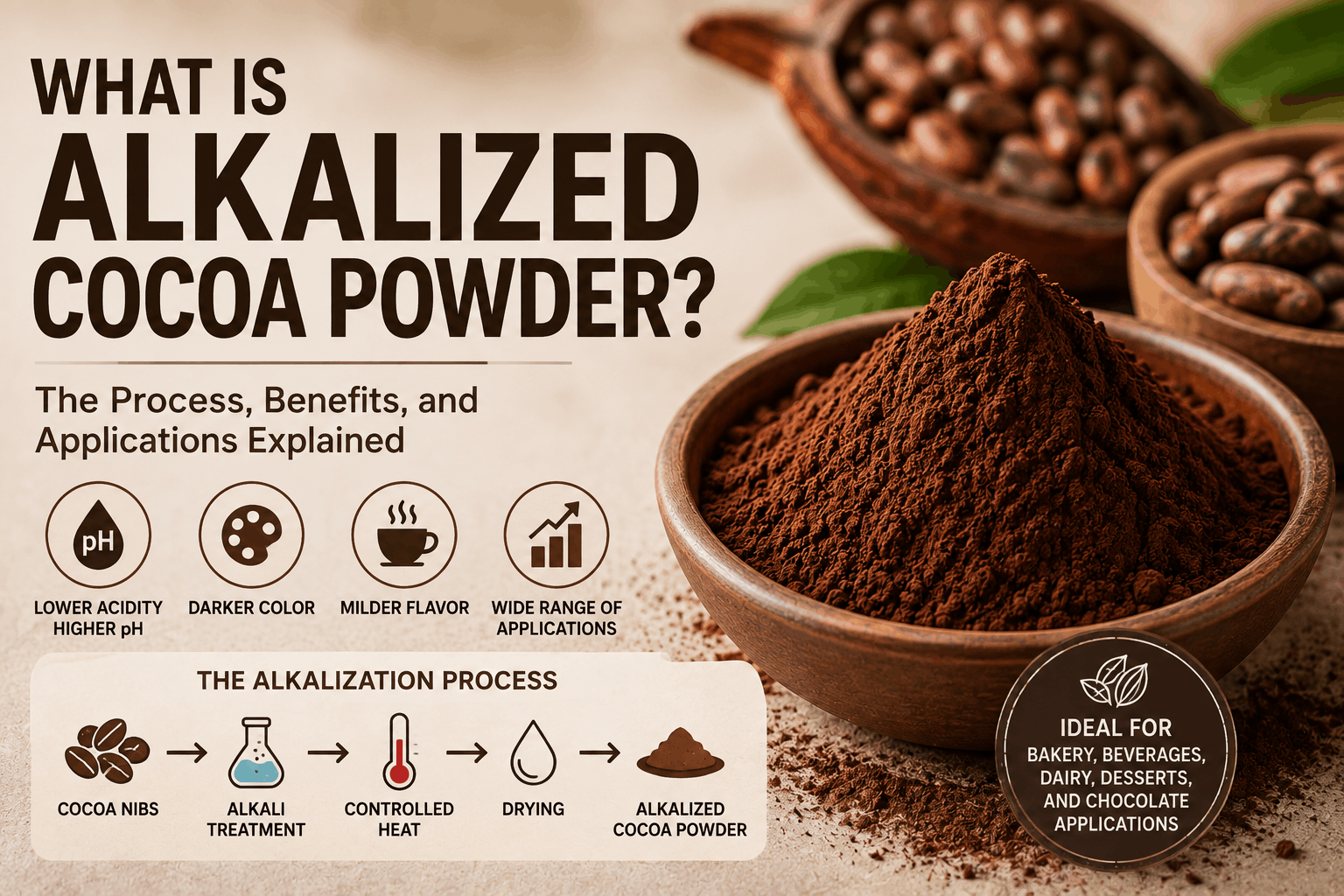
- Alkalized cocoa powder
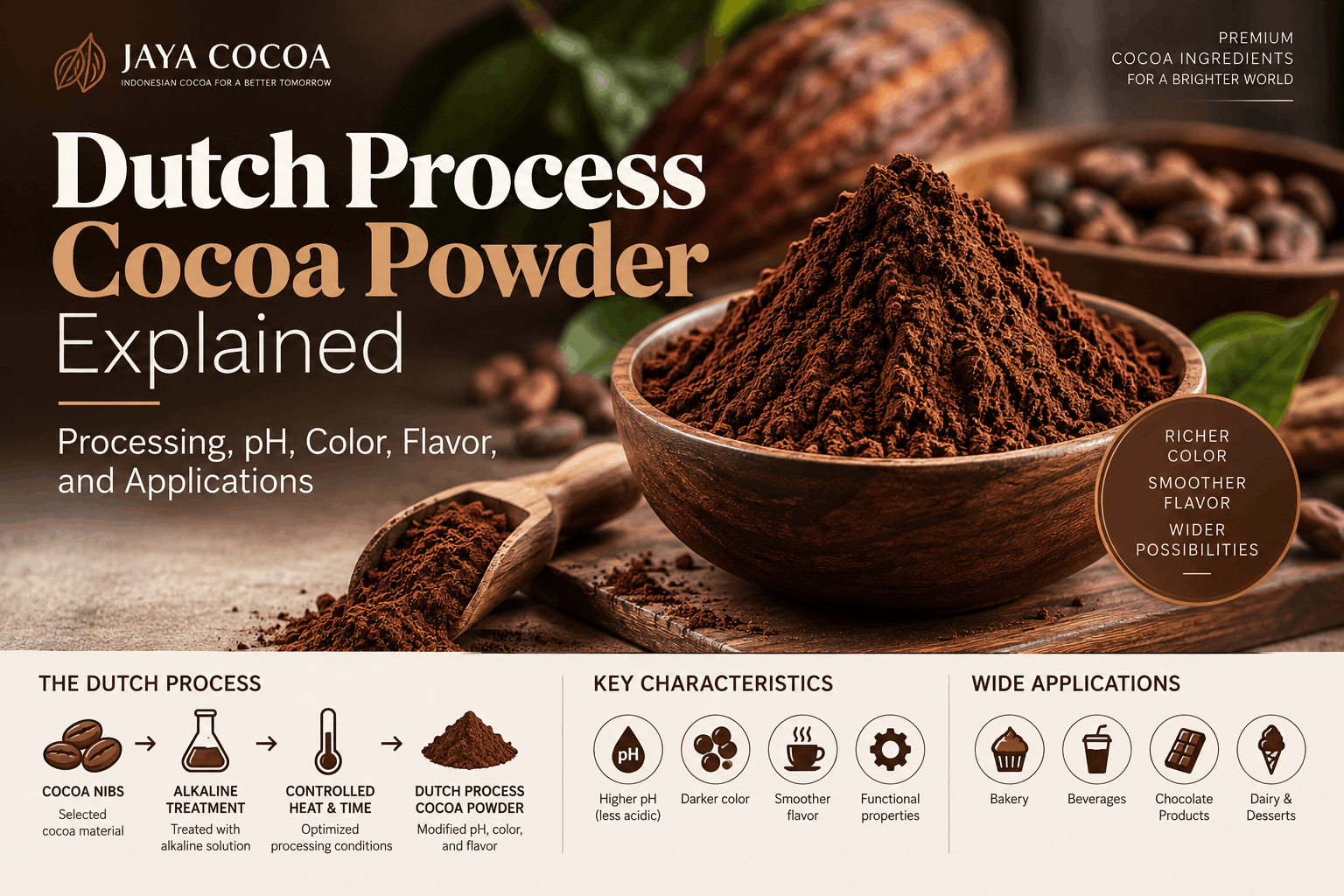
- Dutch process cocoa powder
- Fat-reduced cocoa powder
- Highly fat-reduced cocoa powder
9. Application testing
A sample should ideally be tested in the actual formulation before a commercial purchase.
What Should Buyers Check When Purchasing Cocoa Butter?
Cocoa butter buyers should evaluate specifications relevant to the intended application.
Depending on the market and product, buyers may consider:
- Source and origin
- Food-grade status
- Appearance and color
- Odor and flavor
- Free fatty acid parameters
- Moisture and volatile matter
- Melting characteristics
- Fat composition
- Processing method
- Refining/deodorization requirements
- Packaging
- Storage conditions
- Microbiological and contaminant requirements
- Certificate of Analysis
For chocolate manufacturers, additional technical requirements may be especially important because cocoa butter functionality directly affects processing and finished-product characteristics.
The applicable Codex standard for cocoa butter is CXS 86-1981, while cocoa powders are covered by CXS 105-1981. Both standards are listed by the Codex Alimentarius Commission.
Cocoa Butter vs Cocoa Powder: A Simple Way to Remember
The simplest way to remember the difference is:
Cocoa butter provides cocoa fat. Cocoa powder provides cocoa solids, flavor, and color.
Both originate from cocoa beans, but they represent different fractions of the cocoa-processing stream.
Cocoa liquor is the key intermediate.
When cocoa liquor is pressed:
Cocoa Butter → fat fraction
Cocoa Cake → solid fraction
When the cocoa cake is milled:
Cocoa Powder → powdered cocoa solids with residual cocoa butter
Understanding this relationship makes it much easier for food manufacturers to select the right cocoa ingredient.
Final Takeaway
Cocoa butter and cocoa powder are both important cocoa ingredients, but they are designed to perform different functions.
Cocoa butter is primarily a cocoa fat ingredient used for texture, melting behavior, mouthfeel, and chocolate-processing functionality.
Cocoa powder is primarily used to provide cocoa solids, flavor, color, and cocoa character across applications such as bakery products, beverages, desserts, and dry mixes.
Neither ingredient is universally “better.” The correct choice depends on the formulation, processing conditions, desired sensory characteristics, nutritional targets, and technical specifications.
For B2B food manufacturers and importers, the best approach is to define the required specification first and then select the cocoa ingredient that fits the application.
At Jaya Cocoa, understanding these technical differences is essential for helping international buyers identify the right Indonesian cocoa ingredients for their products.
References
- International Cocoa Organization (ICCO) – Processing Cocoa
- Codex Alimentarius – CXS 105-1981: Standard for Cocoa Powders (Cocoas) and Dry Mixtures of Cocoa and Sugars
- Codex Alimentarius – CXS 86-1981: Standard for Cocoa Butter
- Codex Alimentarius – Standards for Cocoa Products and Chocolate