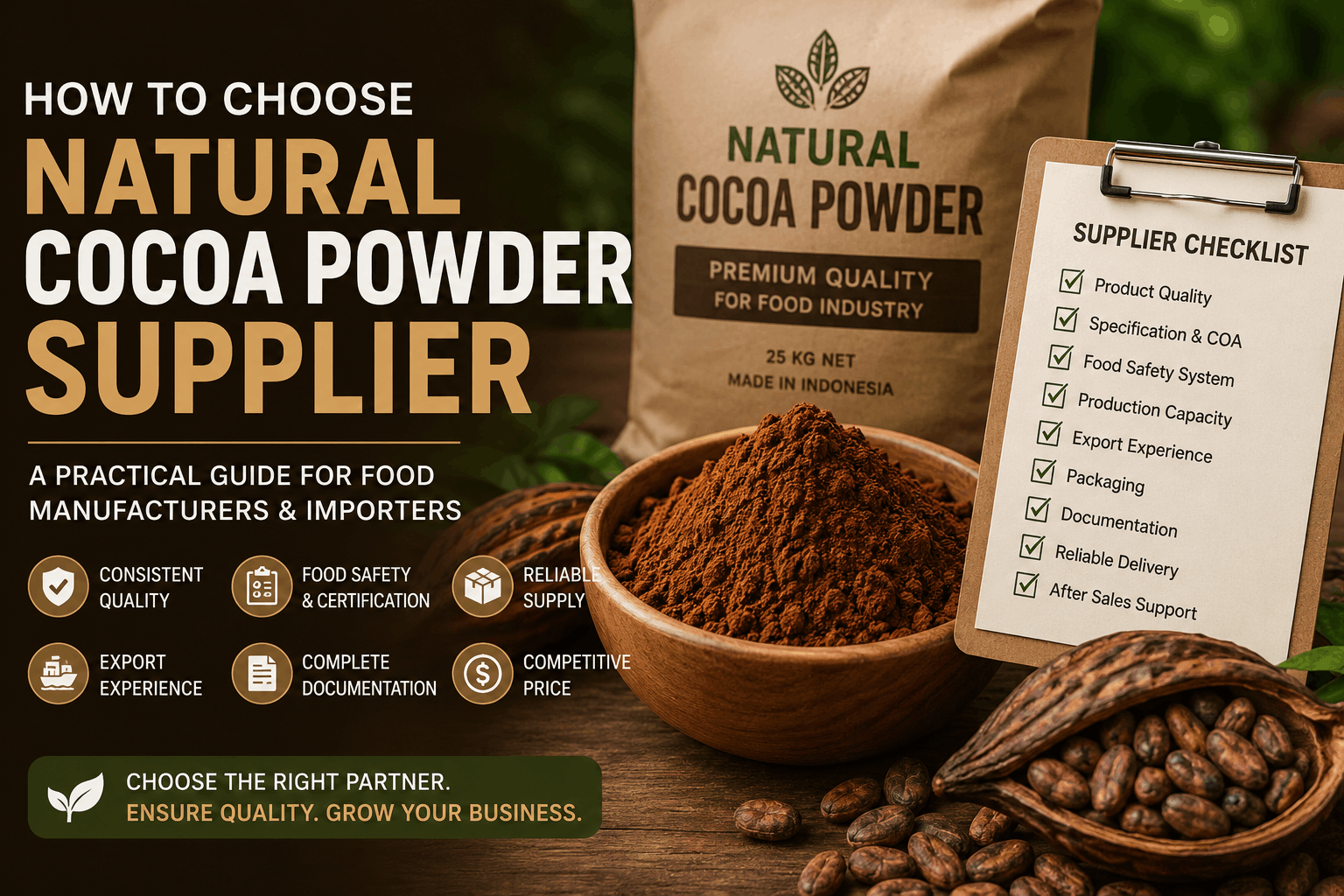
How to Choose a Natural Cocoa Powder Supplier: A Practical Guide for Food Manufacturers and Importers
Choosing the right natural cocoa powder supplier is an important decision for food manufacturers, importers, distributors, and product developers. The lowest price does not always represent the lowest procurement cost, particularly when inconsistent specifications, delayed shipments, documentation problems, or quality issues can affect production.
A reliable supplier should be able to provide more than cocoa powder. Buyers need consistent product specifications, food-safety controls, traceability, documentation, packaging, production capacity, and dependable export logistics.
This guide explains how to evaluate a natural cocoa powder supplier step by step and what buyers should check before placing a commercial order.
What Makes a Good Natural Cocoa Powder Supplier?
A good supplier should demonstrate capability across several areas:
- Product quality
- Specification consistency
- Food safety
- Traceability
- Production capability
- Documentation
- Packaging
- Export experience
- Communication
- Commercial reliability
For international buyers, supplier selection should therefore be treated as a quality and supply-chain decision, not simply a price comparison.
The Codex Standard for Cocoa Powders, CXS 105-1981, provides an important international reference for cocoa powder characteristics, hygiene, food additives, and labeling. The standard was most recently listed by Codex with a 2025 amendment.
1. Start With the Product Specification
Before comparing suppliers, define exactly what you need.
The term natural cocoa powder alone is not sufficient to establish a purchasing specification.
A buyer should consider parameters such as:
| Specification | Why It Matters |
|---|---|
| Product type | Confirms natural/non-alkalized cocoa |
| Fat content | Influences flavor, mouthfeel and formulation |
| pH | Important for acidity and formulation behavior |
| Moisture | Important for quality and storage |
| Color | Influences finished-product appearance |
| Particle size | Affects texture and processing |
| Flavor | Determines sensory performance |
| Microbiology | Important for food safety |
| Contaminants | May be subject to destination-market limits |
| Packaging | Protects product during storage and transportation |
| Shelf life | Important for inventory planning |
Codex CXS 105-1981 establishes internationally recognized requirements for cocoa powders, including composition and hygiene provisions. However, a buyer’s commercial specification can be more specific or restrictive than the Codex baseline.
This distinction is important.
Regulatory standard ≠ complete commercial specification.
Your supplier should understand both.
2. Confirm That the Product Is Actually Natural Cocoa Powder
One of the first questions to ask is:
Is the cocoa powder natural or alkalized?
Natural cocoa powder is produced without the conventional alkalization treatment used to modify cocoa’s acidity and other characteristics.
This matters because natural and alkalized cocoa powders can behave differently in food formulations.
For example, a bakery manufacturer may select natural cocoa powder because its acidity can interact with an alkaline leavening system.
A beverage manufacturer, meanwhile, may have completely different requirements concerning color, flavor, dispersion, and suspension.
Therefore, your purchase specification should clearly state:
Natural Cocoa Powder — Non-Alkalized
rather than simply:
Cocoa Powder
For a more detailed technical comparison, buyers can also review the differences between natural and alkalized cocoa powder.
3. Ask for a Technical Data Sheet
A professional supplier should be able to provide a Technical Data Sheet (TDS) or product specification.
At minimum, review whether the document clearly identifies:
- Product name
- Product type
- Fat content
- pH
- Moisture
- Color
- Particle size
- Microbiological parameters
- Packaging
- Shelf life
- Storage conditions
- Country of origin
The specification should also indicate whether values are:
- Typical values
- Minimum values
- Maximum values
- Guaranteed specifications
This distinction is extremely important.
For example:
Fat: 10–12%
is different from:
Fat: Typical 11%
The first can represent a defined commercial range, while the second may only describe an expected result.
4. Request a Recent Certificate of Analysis
A TDS tells you what the supplier says the product should be.
A Certificate of Analysis (COA) tells you what was measured for a particular batch.
When evaluating a supplier, request a recent COA and compare it against the product specification.
For example:
| Parameter | Specification | COA Result |
|---|---|---|
| Fat | 10–12% | 11.2% |
| Moisture | ≤5% | 3.8% |
| pH | 5.2–6.0 | 5.6 |
| Color | Agreed standard | Within specification |
| Microbiology | Buyer requirement | Pass |
The exact limits should be based on your agreed specification and applicable regulations.
A buyer should be cautious if a supplier:
- Cannot provide a COA
- Provides an incomplete COA
- Provides identical results for every batch without explanation
- Cannot explain its testing methods
- Cannot connect the COA to a batch or lot number
5. Check Specification Consistency Across Batches
This is one of the most important supplier-selection criteria.
A supplier may send an excellent sample and still struggle to reproduce the same quality commercially.
Therefore, ask:
Can the supplier maintain the same specification from batch to batch?
Look at parameters such as:
- Fat
- pH
- Moisture
- Color
- Particle size
- Microbiology
- Flavor
A useful approach is to compare COAs from multiple production batches, rather than evaluating only one sample.
For industrial food manufacturing, consistency is often more valuable than a small difference in purchase price.
6. Evaluate the Supplier’s Production Capability
Before placing a large order, understand the supplier’s actual production capability.
Ask:
Production
- What is the monthly production capacity?
- Is cocoa powder produced continuously or on a campaign basis?
- Is production performed in-house?
- What processing equipment is used?
- Can the supplier handle repeat orders?
Quality
- Is there an internal QC laboratory?
- Which tests are performed internally?
- Which tests are outsourced?
- How are batches released?
Supply
- Where is the raw cocoa sourced?
- Is there more than one sourcing region?
- How does the supplier manage raw-material variation?
A supplier that can produce your first 5 MT but struggles to deliver 50 MT consistently may not be suitable for long-term industrial procurement.
7. Understand Cocoa Processing Capability
Natural cocoa powder quality is influenced by the processing chain.
The International Cocoa Organization describes cocoa processing stages including cleaning, fermentation, roasting, grinding, pressing, and milling. Cocoa cake from the pressing stage is subsequently milled into cocoa powder according to the required particle characteristics and end use.
This means supplier evaluation should not stop at the finished powder.
Ask about:
- Cocoa bean sourcing
- Fermentation
- Drying
- Cleaning
- Roasting
- Grinding
- Pressing
- Cake milling
- Tempering
- Packaging
A supplier with stronger process control is generally better positioned to maintain product consistency.
8. Review Food Safety Management
Food safety should be one of the highest-priority criteria when selecting a cocoa powder supplier.
Ask whether the supplier operates under a documented food-safety management system.
Potential documentation may include:
- HACCP
- GMP
- ISO 22000
- Other recognized food-safety certifications
- Internal food-safety procedures
- Traceability procedures
ISO 22000 specifies requirements for food-safety management systems for organizations across the food chain and is designed to help organizations identify and control food-safety hazards.
However, buyers should not assume:
“Has ISO certification = product automatically meets every destination-country requirement.”
Certification is one part of supplier qualification.
You still need to evaluate the actual product specification and applicable regulations.
9. Check Microbiological Controls
Microbiological quality should be discussed before the commercial contract is finalized.
Depending on the buyer’s requirements, testing may include parameters such as:
- Salmonella
- E. coli
- Yeast and mold
- Total Plate Count
- Coliforms
The exact acceptance criteria should be established according to:
Destination-market regulation + customer specification + applicable food-safety requirements.
Codex CXS 105-1981 recommends that cocoa powders be prepared and handled according to relevant Codex hygiene practices, including the Code of Hygienic Practice for Low-Moisture Foods, and states that products should comply with applicable microbiological criteria.
This is why buyers should avoid simply copying microbiological limits from another supplier.
10. Ask About Contaminant and Heavy-Metal Controls
Depending on the destination market, buyers may need to evaluate contaminants such as:
- Lead
- Cadmium
- Pesticide residues
- Mycotoxins where applicable
- Other regulated contaminants
The applicable limits can differ by destination.
Therefore, ask the supplier:
“Can you provide the relevant analytical documentation for our destination market?”
Do not assume that compliance in one market automatically means compliance in another.
For international trade, destination-country requirements should always be checked separately.
11. Evaluate Traceability
Traceability is particularly important when purchasing food ingredients internationally.
A supplier should be able to connect:
Raw Material → Production Batch → Finished Product → Packaging → Shipment
At minimum, buyers should expect clear:
- Batch number
- Production date
- Lot identification
- Packaging identification
- COA reference
If there is a quality issue after delivery, traceability allows the buyer and supplier to identify the affected batch more efficiently.
12. Evaluate Packaging Quality
Even a high-quality cocoa powder can experience problems if packaging is inadequate.
Ask your supplier about:
- Bag construction
- Food-grade inner liner
- Moisture protection
- Net weight
- Palletization
- Container loading
- Labeling
- Lot identification
Packaging should be suitable for the expected transportation and storage conditions.
For export buyers, ask specifically:
How is the cocoa powder packed for export?
A supplier experienced in export shipments should be able to explain how the product is protected during container transportation.
13. Check Export Experience
This is particularly important if you are buying from a supplier in another country.
Ask:
- Which countries do you currently supply?
- What export documents can you provide?
- Which ports do you normally use?
- Can you handle container shipments?
- Can you issue a Certificate of Origin when required?
- Can you work with the buyer’s freight forwarder?
- Can you meet the buyer’s documentation requirements?
For Indonesian exporters, the Ministry of Trade provides an EXIM platform that allows businesses to check export procedures and requirements based on destination country and HS code.
Indonesia’s Directorate General of Customs and Excise also specifies export procedures involving the export customs declaration (PEB) and supporting customs documents.
This makes export capability an important part of supplier qualification—not merely a logistics issue.
14. Verify the Supplier’s Documentation
A professional supplier should be able to provide documentation appropriate to the transaction.
Depending on the destination and buyer requirements, this can include:
Product documents
- Technical Data Sheet
- Certificate of Analysis
- Product specification
- Allergen statement, where applicable
- GMO statement, where applicable
- Product declaration
Food-safety documents
- HACCP
- GMP
- ISO 22000 or equivalent certification
- Relevant laboratory reports
Export documents
- Commercial Invoice
- Packing List
- Bill of Lading
- Certificate of Origin, where required
- Export customs documentation
- Other destination-specific certificates
Indonesia’s Ministry of Trade identifies the Certificate of Origin (COO/SKA) as documentation certifying that exported goods originate from the exporting country.
15. Evaluate Supplier Communication
This sounds simple, but it can save significant problems later.
Pay attention to how the supplier responds before the first order.
Does the supplier:
- Answer technical questions clearly?
- Provide documents quickly?
- Understand buyer specifications?
- Explain deviations honestly?
- Confirm production timelines?
- Communicate shipping information?
- Respond consistently?
Poor communication during quotation often becomes a much bigger problem after payment.
A good supplier should be able to communicate with:
Procurement + QA/QC + Logistics + Finance
—not only sales.
16. Don’t Choose Based on Price Alone
Suppose three suppliers quote:
| Supplier | Price | Quality Consistency | Documentation | Export Capability |
|---|---|---|---|---|
| A | Low | Unclear | Limited | Limited |
| B | Medium | Strong | Complete | Strong |
| C | High | Strong | Complete | Strong |
Supplier A may look attractive from a purchase-price perspective.
But the actual procurement cost can increase if the buyer experiences:
- Rejected batches
- Production downtime
- Re-testing
- Delayed shipment
- Customs documentation problems
- Emergency replacement
- Customer complaints
Therefore, buyers should evaluate:
Total Cost of Ownership
rather than only:
Price per metric ton
17. Request a Sample Before a Large Order
Before committing to a large commercial shipment, request a representative sample.
Evaluate:
Technical
- Fat
- pH
- Moisture
- Color
- Particle size
Sensory
- Cocoa aroma
- Flavor
- Bitterness
- Acidity
- Aftertaste
Application
Test the cocoa powder in the actual formulation whenever possible.
This last point is often overlooked.
A cocoa powder can meet the written specification but still behave differently in your finished product.
18. Conduct a Supplier Qualification Process
For serious industrial procurement, consider using a formal qualification process.
Stage 1 — Document Review
Request:
- TDS
- COA
- Certifications
- Product specification
- Company information
Stage 2 — Sample Evaluation
Test:
- Physical characteristics
- Chemical parameters
- Microbiology
- Sensory profile
- Application performance
Stage 3 — Commercial Evaluation
Compare:
- Price
- MOQ
- Lead time
- Payment terms
- Incoterm
- Packaging
- Freight
Stage 4 — Trial Order
Start with a manageable quantity.
Stage 5 — Supplier Approval
Evaluate actual delivery against agreed specifications.
Stage 6 — Long-Term Agreement
Only after the supplier demonstrates consistency should the buyer consider larger recurring volumes.
19. Questions to Ask a Natural Cocoa Powder Supplier
Before placing an order, ask these questions:
Product
- Is the product natural or alkalized?
- What is the fat content?
- What is the typical pH?
- What is the moisture specification?
- What color standard is used?
- What is the particle-size specification?
Quality
- Can you provide a recent COA?
- Which laboratory performs the tests?
- What microbiological specifications do you guarantee?
- How do you manage batch-to-batch consistency?
Food Safety
- Do you have HACCP or ISO 22000?
- What traceability system do you use?
- How do you manage foreign-material risks?
- Can you provide contaminant testing where required?
Supply
- What is your monthly production capacity?
- What is your normal lead time?
- What is your MOQ?
- Can you support recurring container orders?
Export
- Which countries do you currently export to?
- Which export documents can you provide?
- What packaging do you use for container shipments?
- Which port do you normally load from?
These questions can quickly distinguish a trading intermediary, small supplier, and established industrial supplier.
Natural Cocoa Powder Supplier Evaluation Checklist
Before approving a supplier, use this checklist:
Product
☐ Natural/non-alkalized confirmed
☐ Technical specification received
☐ Sample approved
☐ Application test completed
Quality
☐ COA received
☐ Fat specification confirmed
☐ pH specification confirmed
☐ Moisture specification confirmed
☐ Color specification confirmed
☐ Particle size confirmed
Food Safety
☐ Microbiological requirements agreed
☐ Food-safety certification reviewed
☐ Traceability verified
☐ Contaminant requirements reviewed
Commercial
☐ Price confirmed
☐ MOQ confirmed
☐ Payment terms confirmed
☐ Lead time confirmed
☐ Incoterm confirmed
Export
☐ Packaging approved
☐ Export documents confirmed
☐ Certificate of Origin requirements checked
☐ Container loading procedure confirmed
☐ Destination-country requirements checked
Red Flags When Choosing a Cocoa Powder Supplier
Buyers should be cautious if a supplier:
❌ Cannot provide a product specification
A serious industrial supplier should understand its own product parameters.
❌ Cannot provide a batch-specific COA
This makes quality verification difficult.
❌ Gives an unusually low price without explaining the specification
The product may not be directly comparable.
❌ Avoids technical questions
Procurement should involve technical and quality discussions, not just commercial negotiation.
❌ Cannot explain the origin of the product
Traceability is important for food ingredients.
❌ Promises every specification without documentation
Claims should be supported by appropriate records or testing.
❌ Has no clear export process
This can create problems after the commercial agreement is signed.
How to Compare Two Natural Cocoa Powder Suppliers
A practical scoring system can make supplier selection easier.
| Evaluation Area | Suggested Weight |
|---|---|
| Product quality | 25% |
| Food safety | 20% |
| Specification consistency | 15% |
| Production capacity | 10% |
| Export capability | 10% |
| Documentation | 10% |
| Commercial terms | 10% |
| Total | 100% |
The weights should be adjusted according to the buyer’s business model.
For a multinational food manufacturer, food safety and consistency may receive higher weighting.
For a distributor, commercial terms and supply availability may be more important.
What Should You Look for in an Indonesian Natural Cocoa Powder Supplier?
Indonesia can be an attractive sourcing origin for cocoa products, but buyers should still evaluate suppliers individually rather than assuming that all Indonesian suppliers offer the same quality.
When sourcing from Indonesia, consider:
- Factory location
- Port access
- Cocoa sourcing
- Production capacity
- Export history
- Product specifications
- Food-safety system
- Packaging
- Documentation
- Communication
- Ability to meet destination-market requirements
The Indonesian Ministry of Trade’s export information platform provides country- and HS-code-based information for export procedures and requirements, making it a useful starting point when evaluating an export supply chain.
Natural Cocoa Powder Supplier vs Trader: Which Should You Choose?
Not every buyer needs to purchase directly from a manufacturer.
A trader can provide advantages such as:
- Smaller MOQ
- Multiple product sources
- Commercial flexibility
- Consolidated logistics
- Access to products from multiple factories
A manufacturer may provide advantages such as:
- Better production traceability
- Direct technical support
- Greater control over specifications
- More consistent production planning
- Potentially better long-term capacity
The important question is not simply:
Manufacturer or trader?
It is:
Can the supplier reliably control and document the product being sold to you?
A trader with strong quality controls can be a better supplier than a manufacturer with poor communication or inconsistent documentation.
How Jaya Cocoa Approaches Natural Cocoa Powder Supply
For buyers evaluating a natural cocoa powder supplier, the same principles should apply to every supplier—including Jaya Cocoa.
A professional supplier relationship should begin with:
Specification → Sample → Testing → Approval → Commercial Order → COA → Shipment → Performance Review
This process allows both buyer and supplier to establish clear expectations before larger recurring orders are placed.
For international buyers, product specifications should also be aligned with the destination market and the intended application.
Frequently Asked Questions
What is the most important factor when choosing a natural cocoa powder supplier?
There is no single factor. Consistency, food safety, specification compliance, production capability, documentation, and reliability should be evaluated together.
Should I choose the cheapest cocoa powder supplier?
Not necessarily. The lowest purchase price can become more expensive if it leads to inconsistent quality, rejected batches, delays, or additional testing.
What documents should a cocoa powder supplier provide?
Common documents include a Technical Data Sheet, product specification, batch-specific COA, food-safety documentation, and export documents appropriate to the destination market.
How can I verify natural cocoa powder quality?
Request a representative sample and recent COA, then test important parameters such as fat, pH, moisture, color, particle size, and microbiological quality according to your specification.
Is ISO 22000 enough to qualify a cocoa powder supplier?
No. ISO 22000 demonstrates a food-safety management system, but buyers should still evaluate the actual product specification, COA, traceability, manufacturing capability, and destination-market requirements. ISO describes ISO 22000 as a food-safety management system standard applicable to organizations in the food chain.
How do I choose a cocoa powder supplier for export?
Evaluate product specifications, food safety, documentation, packaging, production capacity, export experience, lead time, logistics, and the destination country’s requirements.
Conclusion
Choosing the right natural cocoa powder supplier requires more than comparing prices.
A strong supplier should demonstrate:
Consistent quality + food safety + technical capability + traceability + production capacity + documentation + export reliability.
The most effective procurement process is to define the specification first, request technical documentation and samples, verify quality through testing, evaluate the supplier’s production and food-safety systems, and then conduct a controlled commercial trial.
For international sourcing, buyers should also verify destination-market requirements and export documentation before finalizing the transaction.
The Codex Standard for Cocoa Powders provides an important international reference, while food-safety management systems such as ISO 22000 provide a framework for controlling food-safety hazards throughout the food chain.
Ultimately, the best natural cocoa powder supplier is not necessarily the supplier offering the lowest price. It is the supplier that can consistently deliver the right specification, with the right documentation, at the required volume and on the required schedule.
References & Trusted Sources
1. FAO/WHO Codex Alimentarius — CXS 105-1981
Standard for Cocoa Powders (Cocoas) and Dry Mixtures of Cocoa and Sugars.
Codex Alimentarius — Cocoa Powder Standard CXS 105-1981
2. International Cocoa Organization (ICCO) — Processing Cocoa
3. ISO — ISO 22000 Food Safety Management
ISO 22000 — Food Safety Management
4. Kementerian Perdagangan RI — EXIM
Kemendag RI — EXIM Export/Import Information