
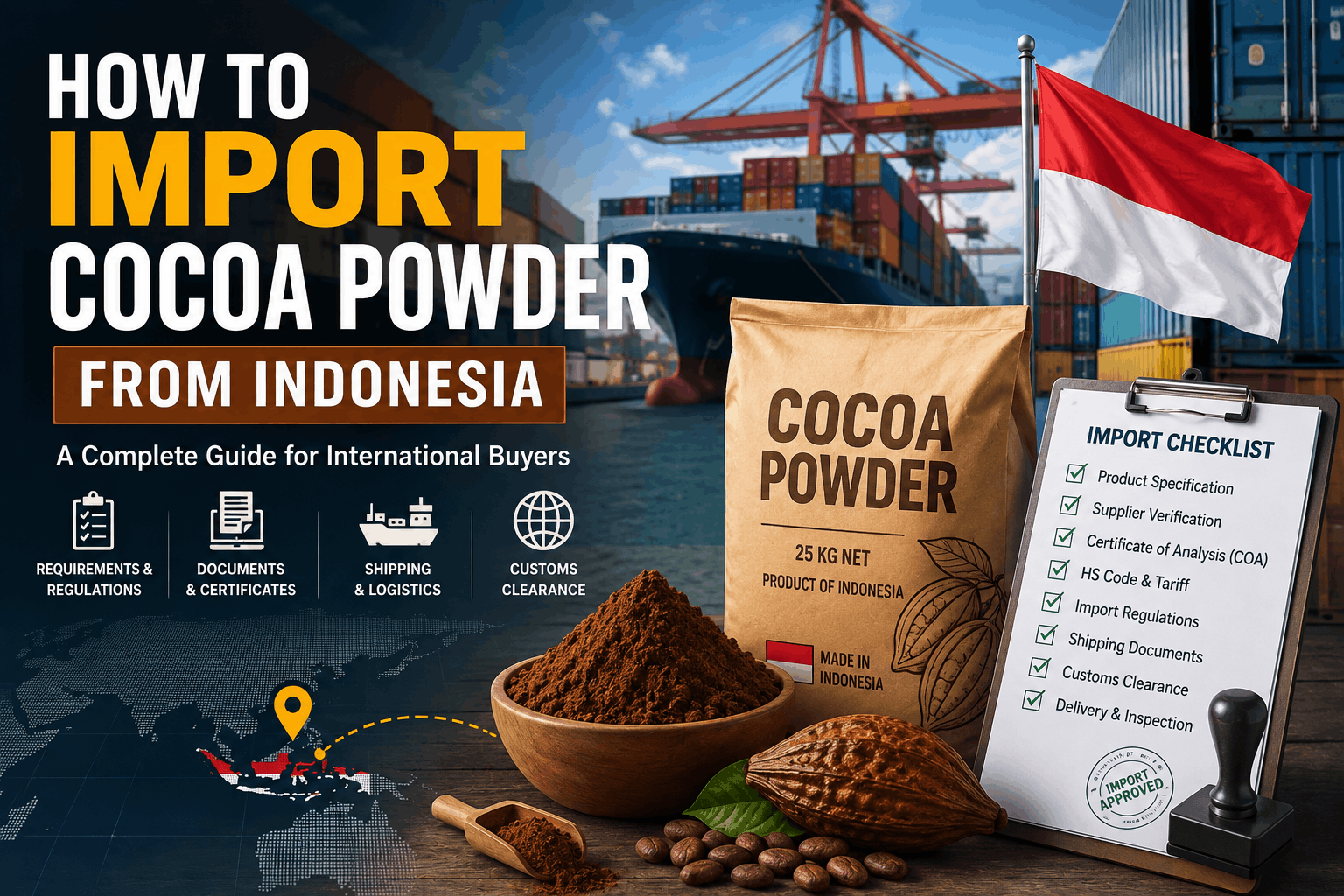
How to Import Cocoa Powder from Indonesia A Practical Guide for International Buyers, Importers, and Food Manufacturers Indonesia is an established cocoa producing and cocoa processing country, making it an attractive sourcing origin for companies looking for cocoa powder for bakery, beverage, dairy, confectionery, and other food applications. However, importing cocoa powder from Indonesia involves more than finding a supplier and arranging an international shipment. A successful import requires the buyer to evaluate the product specification, supplier, quality documentation, HS classification, destination-country regulations, import duties, trade agreements, shipping terms, customs documentation, and receiving procedures. This guide explains how international buyers can approach the process of importing cocoa powder from Indonesia in a structured way. Important: Import regulations are determined by the destination country. This guide provides general commercial and sourcing information and should not replace advice from the destination country’s customs authority, food regulator, or licensed customs broker. Why Import Cocoa Powder from Indonesia? Indonesia has an established cocoa-processing industry and supplies different types of cocoa-derived ingredients to international markets. Depending on the supplier, buyers may find products such as: Natural Cocoa Powder Alkalized Cocoa Powder High Fat Cocoa Powder Low Fat Cocoa Powder Black Cocoa Powder Cocoa Cake Cocoa Butter Cocoa Liquor The appropriate product depends on the buyer’s application and technical requirements. For example: Bakery may prioritize color, flavor, fat content, and interaction with leavening systems. Beverage manufacturers may place greater emphasis on dispersibility, color, flavor, and suspension performance. Industrial chocolate applications may require specific fat, flavor, particle size, and processing characteristics. Therefore, the first step is not choosing the cheapest supplier. It is defining what cocoa powder your production actually requires. 1. Define Your Cocoa Powder Specification Before contacting suppliers in Indonesia, prepare a clear product specification. A typical specification may include: Parameter Example Cocoa powder type Natural / Alkalized Fat content High Fat / Low Fat pH Buyer specification Color Buyer specification Moisture Buyer specification Particle size Buyer specification Microbiology Buyer specification Packaging 20–25 kg bags / custom Application Bakery / Beverage / Dairy Quantity Trial / FCL / annual volume The Codex Standard for Cocoa Powders (CXS 105-1981) defines cocoa powder and fat-reduced cocoa powder and specifies a maximum moisture content of 7% m/m for cocoa powders covered by the standard. However, buyers should not treat Codex as a complete commercial specification. A supplier and buyer may agree on tighter requirements depending on the application, destination market, and quality system. 2. Choose Natural or Alkalized Cocoa Powder One of the most important product decisions is whether you require natural cocoa powder or alkalized cocoa powder. Natural Cocoa Powder Natural cocoa powder generally retains a more acidic character and has a distinct cocoa flavor and color profile. Alkalized Cocoa Powder Alkalization modifies the cocoa powder’s acidity and can significantly affect: pH Color Flavor Solubility or dispersibility Functional behavior Different alkalization levels can produce very different products. Therefore, instead of requesting: “I need dark cocoa powder.” a professional buyer should specify requirements such as: Alkalized cocoa powder, target pH, target color, fat content, moisture, and intended application. This makes supplier quotations much more comparable. 3. Find Indonesian Cocoa Powder Suppliers Once the specification is ready, identify potential suppliers. Supplier sourcing can be conducted through: Direct supplier websites Indonesian trade directories Trade exhibitions Government-supported trade platforms Industry referrals B2B sourcing platforms Indonesia’s Ministry of Trade operates INAEXPORT, an online platform that can be used to promote Indonesian products and connect businesses with potential buyers. The Ministry also directs exporters toward EXIM for information on market requirements and export procedures. Indonesia Ministry of Trade EXIM Portal For buyers, however, a supplier appearing on a directory should be considered a lead, not automatically a verified supplier. 4. Verify the Supplier Before Ordering Before placing a commercial order, conduct basic supplier due diligence. Ask for: Company information Legal company name Business address Company registration information Export experience Production or sourcing capability Product information Product specification Technical Data Sheet COA Product photos Packaging specification Shelf-life information Quality information Where relevant, ask about: Food safety management system HACCP ISO 22000 or equivalent systems Traceability Microbiological testing Heavy-metal testing Allergen controls Certification requirements vary by buyer and destination market, so the supplier should provide documents that correspond to the actual product and facility. 5. Request a Sample Before a Full Shipment A sample is one of the most important steps before committing to a container. A cocoa powder may satisfy a specification on paper but behave differently in a real formulation. Depending on your application, evaluate: Color Aroma Flavor pH Fat content Moisture Particle size Dispersibility Microbiology Application performance For a food manufacturer, the most important question is: Does the cocoa powder perform correctly in my actual formulation? A laboratory or production trial is therefore often more useful than simply comparing supplier prices. 6. Review the Certificate of Analysis Request a Certificate of Analysis (COA) for the product. Depending on the supplier and buyer specification, the COA may contain: Moisture Fat pH Color Ash Particle size Total Plate Count Yeast & Mold Coliform Other microbiological parameters Do not simply ask: “Does the supplier have a COA?” Instead ask: “Does the COA demonstrate compliance with the specification we agreed to purchase?” That distinction is important. The COA should be reviewed against the buyer’s approved specification and, where necessary, verified through independent laboratory testing. 7. Confirm the HS Code HS classification should be confirmed before calculating import costs. For cocoa powder without added sugar or other sweetening matter, the relevant international HS heading is 1805. Indonesia’s tariff materials identify: 1805.00.00 — Cocoa powder, not containing added sugar or other sweetening matter. However, the buyer should not automatically classify every cocoa-containing product under HS 1805. Products containing added sugar or other ingredients may fall under different tariff classifications. The correct approach is: Product composition → HS classification → Import tariff → Import requirements If there is uncertainty, confirm the classification with the destination customs authority or a licensed customs broker. 8. Check Import Regulations in Your
Container Loading Guide for Cocoa Powder Export
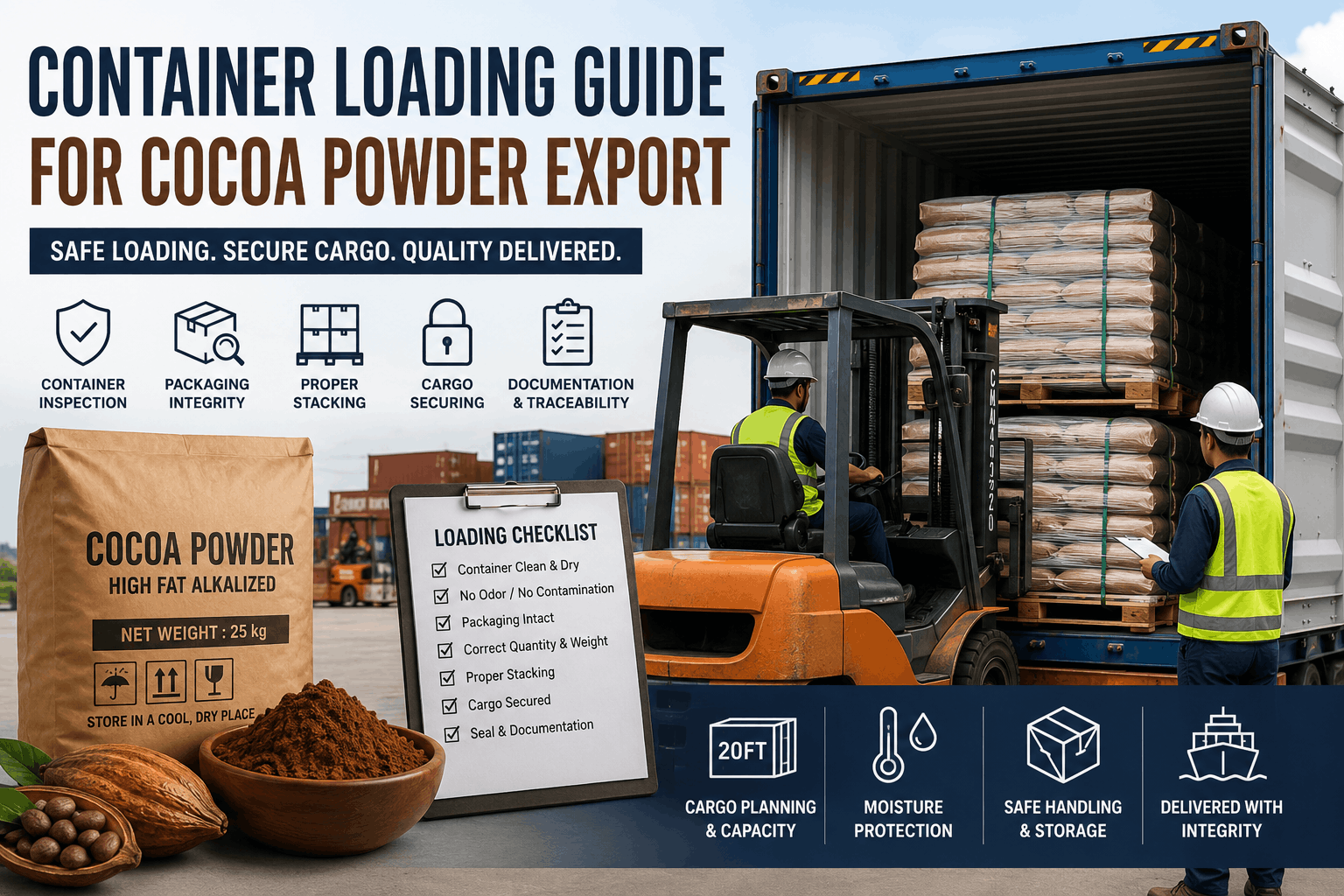
Container Loading Guide for Cocoa Powder Export A Practical Guide for Exporters, Importers, and Food Manufacturers Exporting cocoa powder is not only about producing a product that meets specification. The way the cargo is prepared, inspected, secured, and loaded into a shipping container can also affect product protection and the condition of the shipment when it reaches the buyer. For cocoa powder exporters, container loading should address several factors at the same time: food hygiene, packaging integrity, moisture protection, cargo stability, container condition, weight distribution, traceability, and shipping documentation. The Codex General Principles of Food Hygiene states that food should be adequately protected during transportation and that containers should be suitable for the food being transported, cleanable, maintained, and capable of protecting food from contamination and deterioration. This guide explains a practical approach to loading cocoa powder into export containers. Why Container Loading Matters for Cocoa Powder Cocoa powder is a dry, finely milled food ingredient. Although it has relatively low moisture, its quality can still be affected by inappropriate handling, humidity, contamination, physical damage, or unsuitable transportation conditions. During an international shipment, cocoa powder may pass through: Factory → Warehouse → Container → Port → Ocean Transit → Destination Port → Buyer Warehouse A problem that occurs during loading can therefore travel with the cargo throughout the entire supply chain. Common risks include: Damaged bags Torn packaging Moisture exposure Water ingress Contamination Foreign odors Unstable cargo Incorrect weight distribution Loss of batch traceability Documentation discrepancies For this reason, container loading should be treated as part of the export quality-control process, not simply as a logistics activity. Step 1: Confirm the Product and Packing Plan Before the container arrives, the exporter should already have a clear loading plan. The loading plan should identify: Product name Cocoa powder grade Number of bags Net weight per bag Total shipment weight Packaging format Palletized or floor-loaded configuration Number of pallets, if applicable Container type Container number Buyer requirements For example: Product: High Fat Alkalized Cocoa PowderPacking: 25 kg bagQuantity: According to approved packing listPackaging: Multi-layer paper bag with inner food-grade linerContainer: According to approved shipping plan The exact configuration should be agreed with the buyer and logistics provider before loading. Step 2: Inspect the Container Before Loading One of the most important steps is inspecting the empty container. Do not assume that a container provided by a carrier is automatically suitable for food cargo. The Codex General Principles of Food Hygiene recommends that food transportation containers be kept in an appropriate state of cleanliness, repair, and condition. Containers should protect food from contamination and, where necessary, be capable of maintaining environmental conditions required to protect the food. The IMO/ILO/UNECE CTU Code similarly recommends that closed cargo transport units should be clean, dry, and free from residues and persistent odors from previous cargoes. Container inspection checklist Before loading, check: Floor condition Roof Sidewalls Doors Door seals Door locking mechanism Roof for possible leakage Floor for damage or protruding objects Visible dirt Residue from previous cargo Persistent odors Signs of moisture Holes or light penetration Signs of pests If the container is wet, dirty, damaged, or has a strong foreign odor, do not simply proceed with loading. The issue should be reported to the relevant logistics provider and the container should be replaced or appropriately addressed. Step 3: Make Sure the Container Is Dry Moisture is particularly important for cocoa powder because the product is intended to remain a dry food ingredient. The Codex framework for food transportation requires containers to protect food from deterioration and contamination. A practical pre-loading inspection should therefore verify: Clean + Dry + No Foreign Odor + No Water Ingress Do not load cocoa powder into a container that has visible condensation, standing water, or evidence of leakage. This is especially important for international ocean freight, where cargo may experience changing environmental conditions during transit. Step 4: Inspect the Cocoa Powder Packaging The container is only one layer of protection. The product packaging itself should also be inspected before loading. For industrial cocoa powder, commercial packaging may include multi-layer paper bags with an internal food-grade liner. Before loading, check: Bag integrity Seams Inner liner Bag closure Net weight Product identification Batch number Production date Best-before date, where applicable Signs of moisture Signs of contamination Excessive deformation or damage A damaged bag should not simply be loaded because the container is clean. Both container condition and package integrity matter. Step 5: Verify Product Quantity The actual number of bags and total shipment weight should match the approved shipping documents. A simple loading record can include: Parameter Verification Product ✓ Grade ✓ Bag size ✓ Number of bags ✓ Net weight ✓ Batch number ✓ Packing list ✓ Container number ✓ This helps prevent discrepancies between: Physical Cargo → Packing List → Commercial Invoice → Shipping Documents For B2B food ingredients, maintaining this consistency is particularly important for buyer receiving and inventory control. Step 6: Decide Between Palletized and Floor-Loaded Cargo Cocoa powder can be shipped using different loading configurations depending on buyer requirements and logistics planning. Palletized Loading With palletized cargo, bags are arranged on pallets before being loaded into the container. Advantages Easier forklift handling Faster unloading Better warehouse organization Reduced direct contact with the container floor Easier batch segregation Considerations Pallets occupy additional container space Maximum pallet height must be considered Pallet dimensions affect container utilization Additional wrapping may be required Floor-Loaded Cargo With floor loading, bags are loaded directly onto the container floor without pallets. Advantages Potentially better utilization of available volume No pallet weight or pallet volume More flexible arrangement of bags Considerations More manual handling Unloading can take longer Greater attention is required for cargo stability Direct contact with the container floor must be controlled appropriately Neither configuration is automatically “better.” The correct method depends on: Buyer requirements + warehouse capability + packaging + container utilization + logistics cost. Step 7: Plan Weight Distribution Cargo should be distributed appropriately within the container. Do not concentrate
How Cocoa Powder Is Packed for Export
How Cocoa Powder Is Packed for Export: Packaging, Handling & Shipping Guide Cocoa powder is a sensitive food ingredient that requires appropriate packaging and handling throughout the export process. For international shipments, packaging must protect the powder from moisture, contamination, odors, physical damage, and unsuitable storage conditions while maintaining product traceability. For food manufacturers and importers, export packaging is more than a container for the product. The packaging format can affect warehouse handling, transportation efficiency, product protection, labeling, and the buyer’s ability to use the ingredient in industrial production. This guide explains how cocoa powder is commonly prepared and packed for export, what buyers should consider when selecting packaging, and how exporters can reduce the risk of quality problems during international transportation. Why Cocoa Powder Packaging Matters Cocoa powder is a dry, finely milled food ingredient. After cocoa cake is milled to the required particle size, the powder needs to be cooled and properly stored to maintain its physical condition. The International Cocoa Organization notes that cocoa powder should be properly stored to help maintain its color and keep it soft and flowable. Poor packaging or storage can expose cocoa powder to: Moisture Humidity Foreign materials Strong odors Physical damage Cross-contamination Temperature fluctuations Improper warehouse conditions For an export shipment, these risks can occur at several points, including the factory, warehouse, container loading area, port, ocean transit, destination port, and buyer’s warehouse. Therefore, packaging should be considered part of the quality control system, rather than simply a logistics requirement. Common Cocoa Powder Export Packaging There is no single packaging format that applies to every cocoa powder export shipment. The appropriate format depends on the product specification, destination market requirements, buyer requirements, transportation method, and intended use. For industrial cocoa powder, a common commercial format is a multi layer paper bag with an internal plastic liner. For example, Indonesian cocoa powder listings on the government’s Inaexport platform show 25 kg packaging using multi-ply kraft paper bags with an internal PE liner. A typical structure may include: Outer layer Kraft paper bag Provides mechanical strength Helps protect the inner liner during handling Inner layer Food-contact plastic liner such as PE Provides a barrier against moisture and contamination The exact material, thickness, number of paper layers, and liner specification should be confirmed against the buyer’s packaging specification and applicable food-contact requirements. 25 kg Bags for Industrial Cocoa Powder The 25 kg bag is a common format for industrial cocoa powder. It offers a practical balance between: Manual handling Warehouse storage Palletization Forklift handling Container loading Production-line usage However, 25 kg should not be treated as a mandatory international standard. Some buyers may request different formats depending on their production system, such as smaller bags for semi-industrial production or customized packaging for specific markets. The key principle is: Packaging should be specified according to the buyer’s application and logistics requirements. What Should Be Printed on Cocoa Powder Export Packaging? Packaging identification is important for traceability and warehouse control. Depending on the destination country’s requirements and the buyer’s specification, commercial packaging may include information such as: Product name Product type or grade Net weight Batch or lot number Production date Best-before date Manufacturer or exporter identification Country of origin Storage instructions Applicable product codes Codex’s General Standard for the Labelling of Prepackaged Foods provides general principles concerning product identification, date marking, and storage instructions, although destination-country requirements may impose additional requirements. This is particularly important for export because the label accepted in one destination market may not automatically satisfy another country’s regulations. Food-Grade Packaging Is Essential Cocoa powder intended for food manufacturing should be packed in materials suitable for food contact and appropriate for the product’s storage and transportation conditions. The exporter should be able to provide supporting information when requested by the buyer, such as: Packaging material specification Food-contact declaration, where applicable Inner liner specification Packaging weight Packaging dimensions Lot identification system This information becomes especially useful when a buyer is conducting supplier approval or a food-safety audit. Should Cocoa Powder Be Packed With an Inner Liner? For industrial export, an inner liner can provide an additional barrier between cocoa powder and the external environment. A common commercial configuration is: Cocoa powder → food-grade PE liner → multi-ply kraft paper bag Indonesian cocoa powder products listed through Inaexport demonstrate this type of packaging configuration, including 25 kg bags with an inner PE liner. However, the exact liner specification should be determined by the product, packaging supplier, buyer requirement, and applicable regulations. The objective is to provide sufficient protection against environmental exposure while maintaining safe contact with the food ingredient. Palletizing Cocoa Powder for Export For larger shipments, cocoa powder bags may be palletized to improve handling efficiency. Palletization can provide several advantages: Easier forklift handling Faster container loading and unloading Better warehouse organization Reduced direct contact with the floor Improved inventory control More efficient handling at ports and warehouses However, palletization also consumes container space. Therefore, exporters and buyers should agree beforehand on: Pallet dimensions Pallet material Number of bags per pallet Maximum pallet weight Pallet height Stretch wrapping requirements Whether pallets are required or optional For a full-container shipment, these details should be finalized during the packing and shipping planning stage rather than immediately before loading. Should Cocoa Powder Be Stretch-Wrapped? When cocoa powder is palletized, stretch wrapping can help stabilize bags during transportation and handling. The objective is not simply to make the pallet look secure. The wrapping system should prevent: Bags shifting Bags falling from the pallet Exposure to dirt during handling Damage caused by movement The wrapping should also be compatible with the buyer’s unloading process. For some shipments, buyers may prefer alternative securing methods depending on warehouse and container handling procedures. Container Loading for Cocoa Powder Container loading is an important part of export quality control. Before loading, the exporter should inspect the container for: Cleanliness Dryness Unusual odors Visible contamination Water ingress Structural damage Evidence of pests The container should be suitable for transporting food ingredients. This
