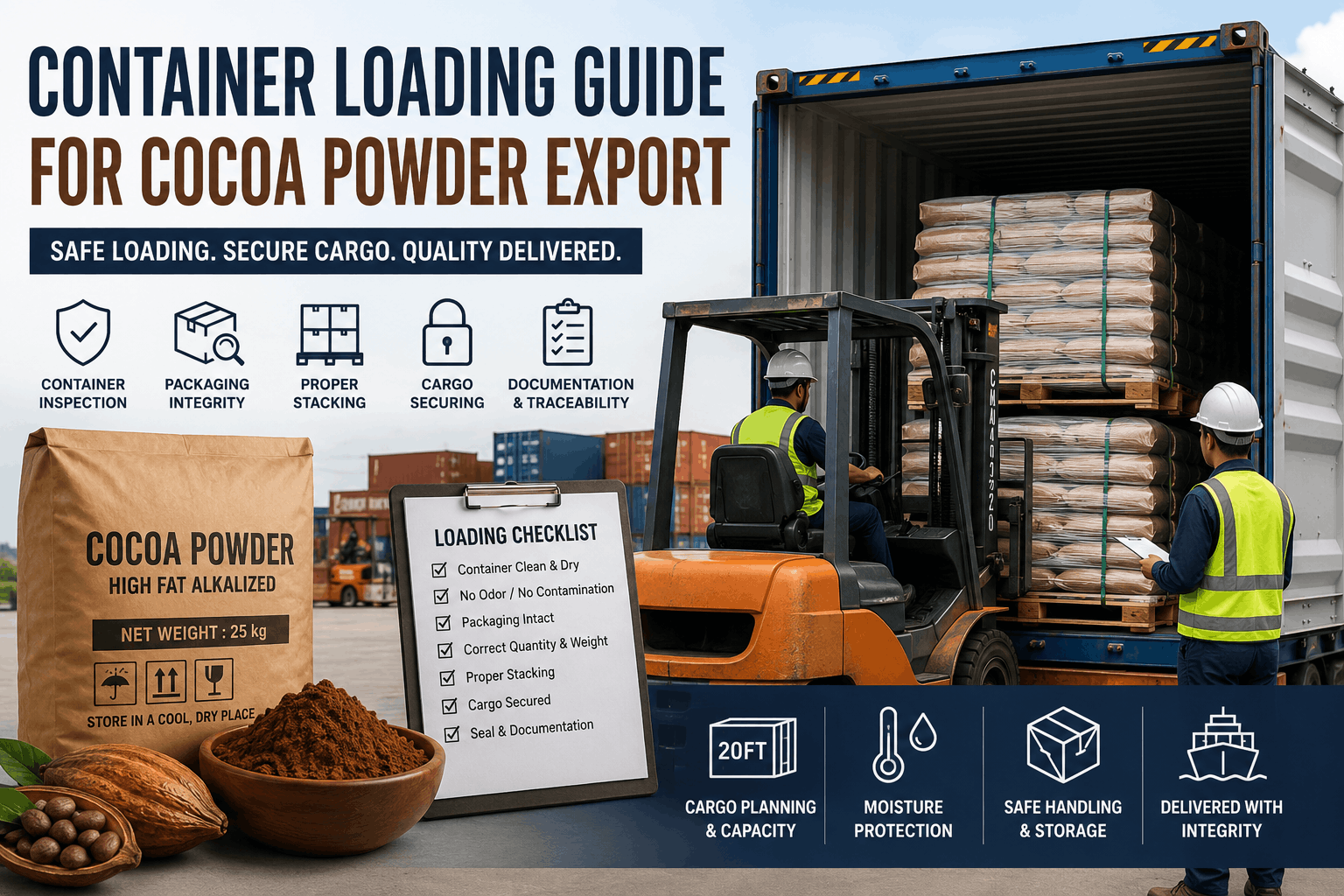
Container Loading Guide for Cocoa Powder Export
A Practical Guide for Exporters, Importers, and Food Manufacturers
Exporting cocoa powder is not only about producing a product that meets specification. The way the cargo is prepared, inspected, secured, and loaded into a shipping container can also affect product protection and the condition of the shipment when it reaches the buyer.
For cocoa powder exporters, container loading should address several factors at the same time: food hygiene, packaging integrity, moisture protection, cargo stability, container condition, weight distribution, traceability, and shipping documentation.
The Codex General Principles of Food Hygiene states that food should be adequately protected during transportation and that containers should be suitable for the food being transported, cleanable, maintained, and capable of protecting food from contamination and deterioration.
This guide explains a practical approach to loading cocoa powder into export containers.
Why Container Loading Matters for Cocoa Powder
Cocoa powder is a dry, finely milled food ingredient. Although it has relatively low moisture, its quality can still be affected by inappropriate handling, humidity, contamination, physical damage, or unsuitable transportation conditions.
During an international shipment, cocoa powder may pass through:
Factory → Warehouse → Container → Port → Ocean Transit → Destination Port → Buyer Warehouse
A problem that occurs during loading can therefore travel with the cargo throughout the entire supply chain.
Common risks include:
- Damaged bags
- Torn packaging
- Moisture exposure
- Water ingress
- Contamination
- Foreign odors
- Unstable cargo
- Incorrect weight distribution
- Loss of batch traceability
- Documentation discrepancies
For this reason, container loading should be treated as part of the export quality-control process, not simply as a logistics activity.
Step 1: Confirm the Product and Packing Plan
Before the container arrives, the exporter should already have a clear loading plan.
The loading plan should identify:
- Product name
- Cocoa powder grade
- Number of bags
- Net weight per bag
- Total shipment weight
- Packaging format
- Palletized or floor-loaded configuration
- Number of pallets, if applicable
- Container type
- Container number
- Buyer requirements
For example:
Product: High Fat Alkalized Cocoa Powder
Packing: 25 kg bag
Quantity: According to approved packing list
Packaging: Multi-layer paper bag with inner food-grade liner
Container: According to approved shipping plan
The exact configuration should be agreed with the buyer and logistics provider before loading.
Step 2: Inspect the Container Before Loading
One of the most important steps is inspecting the empty container.
Do not assume that a container provided by a carrier is automatically suitable for food cargo.
The Codex General Principles of Food Hygiene recommends that food transportation containers be kept in an appropriate state of cleanliness, repair, and condition. Containers should protect food from contamination and, where necessary, be capable of maintaining environmental conditions required to protect the food.
The IMO/ILO/UNECE CTU Code similarly recommends that closed cargo transport units should be clean, dry, and free from residues and persistent odors from previous cargoes.
Container inspection checklist
Before loading, check:
- Floor condition
- Roof
- Sidewalls
- Doors
- Door seals
- Door locking mechanism
- Roof for possible leakage
- Floor for damage or protruding objects
- Visible dirt
- Residue from previous cargo
- Persistent odors
- Signs of moisture
- Holes or light penetration
- Signs of pests
If the container is wet, dirty, damaged, or has a strong foreign odor, do not simply proceed with loading.
The issue should be reported to the relevant logistics provider and the container should be replaced or appropriately addressed.
Step 3: Make Sure the Container Is Dry
Moisture is particularly important for cocoa powder because the product is intended to remain a dry food ingredient.
The Codex framework for food transportation requires containers to protect food from deterioration and contamination.
A practical pre-loading inspection should therefore verify:
Clean + Dry + No Foreign Odor + No Water Ingress
Do not load cocoa powder into a container that has visible condensation, standing water, or evidence of leakage.
This is especially important for international ocean freight, where cargo may experience changing environmental conditions during transit.
Step 4: Inspect the Cocoa Powder Packaging
The container is only one layer of protection.
The product packaging itself should also be inspected before loading.
For industrial cocoa powder, commercial packaging may include multi-layer paper bags with an internal food-grade liner.
Before loading, check:
- Bag integrity
- Seams
- Inner liner
- Bag closure
- Net weight
- Product identification
- Batch number
- Production date
- Best-before date, where applicable
- Signs of moisture
- Signs of contamination
- Excessive deformation or damage
A damaged bag should not simply be loaded because the container is clean.
Both container condition and package integrity matter.
Step 5: Verify Product Quantity
The actual number of bags and total shipment weight should match the approved shipping documents.
A simple loading record can include:
| Parameter | Verification |
|---|---|
| Product | ✓ |
| Grade | ✓ |
| Bag size | ✓ |
| Number of bags | ✓ |
| Net weight | ✓ |
| Batch number | ✓ |
| Packing list | ✓ |
| Container number | ✓ |
This helps prevent discrepancies between:
Physical Cargo → Packing List → Commercial Invoice → Shipping Documents
For B2B food ingredients, maintaining this consistency is particularly important for buyer receiving and inventory control.
Step 6: Decide Between Palletized and Floor-Loaded Cargo
Cocoa powder can be shipped using different loading configurations depending on buyer requirements and logistics planning.
Palletized Loading
With palletized cargo, bags are arranged on pallets before being loaded into the container.
Advantages
- Easier forklift handling
- Faster unloading
- Better warehouse organization
- Reduced direct contact with the container floor
- Easier batch segregation
Considerations
- Pallets occupy additional container space
- Maximum pallet height must be considered
- Pallet dimensions affect container utilization
- Additional wrapping may be required
Floor-Loaded Cargo
With floor loading, bags are loaded directly onto the container floor without pallets.
Advantages
- Potentially better utilization of available volume
- No pallet weight or pallet volume
- More flexible arrangement of bags
Considerations
- More manual handling
- Unloading can take longer
- Greater attention is required for cargo stability
- Direct contact with the container floor must be controlled appropriately
Neither configuration is automatically “better.”
The correct method depends on:
Buyer requirements + warehouse capability + packaging + container utilization + logistics cost.
Step 7: Plan Weight Distribution
Cargo should be distributed appropriately within the container.
Do not concentrate excessive weight in one small area while leaving other areas lightly loaded.
The CTU Code emphasizes proper cargo securing and warns that poor packing practices can contribute to cargo incidents, including inadequate securing and overloading.
For cocoa powder shipments, the loading team should consider:
- Total cargo weight
- Bag arrangement
- Pallet weight
- Pallet position
- Center of gravity
- Cargo stability
- Container floor limitations
- Shipping line requirements
The actual maximum allowable cargo weight should always be determined from the applicable container specification, carrier instructions, route regulations, and legal weight limits.
Step 8: Load Bags Carefully
Cocoa powder bags should be handled carefully during loading.
Avoid:
- Throwing bags
- Dragging bags excessively
- Stepping on bags
- Using damaged lifting equipment
- Creating sharp pressure points
- Crushing the bottom layers
Physical damage can compromise the packaging and potentially expose the product to the environment.
For palletized cargo, forklifts should be operated carefully to avoid puncturing bags or damaging pallets.
Step 9: Keep the Cargo Stable
Cargo should be arranged so that it remains stable during transportation.
Ocean transportation can involve:
- Vessel movement
- Vibration
- Acceleration
- Deceleration
- Handling during terminal operations
The CTU Code exists specifically to provide guidance for the safe packing and securing of cargo transport units transported by sea and land.
Depending on the loading configuration, appropriate securing measures may include:
- Correct bag stacking
- Pallet wrapping
- Load bars or other suitable securing systems where appropriate
- Dunnage where required
- Anti-slip materials where appropriate
- Proper weight distribution
The specific securing method should be determined by the cargo configuration and applicable CTU/carrier requirements.
Step 10: Protect Cocoa Powder From Contamination
Cocoa powder is a food ingredient, so contamination prevention should remain a priority during loading.
The Codex General Principles of Food Hygiene states that transportation should protect food from potential contamination and damage that could make it unsuitable for consumption.
Potential contamination sources include:
- Dust
- Soil
- Chemicals
- Foreign materials
- Previous cargo residues
- Strong odors
- Pests
- Water
Loading activities should therefore take place in a controlled and clean environment.
Step 11: Avoid Strong Odors
One easily overlooked problem in containerized food shipments is odor contamination.
Cocoa powder can absorb or be affected by strong foreign odors.
Before loading, inspect for odors associated with:
- Chemicals
- Fuel
- Cleaning agents
- Agricultural products
- Animal products
- Mold
- Previous cargo
The CTU Code specifically identifies persistent odors from previous cargoes as a condition that should be avoided in closed cargo transport units.
This is a simple inspection that can prevent a potentially serious quality complaint.
Step 12: Record Batch and Container Information
Traceability should continue through the loading process.
A useful system connects:
Batch Number
↓
Packaging Record
↓
Packing List
↓
Container Number
↓
Seal Number
↓
Shipping Documents
↓
Buyer
For example:
Batch CP26081901 → Container ABCD1234567 → Seal 987654
This makes it easier to identify the shipment if a buyer later asks about a specific lot.
Step 13: Take Loading Photos
Photos can be useful as part of the export loading record.
Useful photos include:
Before loading
- Empty container
- Container number
- Container condition
During loading
- Product packaging
- Pallet arrangement
- Cargo stacking
- Loading process
After loading
- Final cargo arrangement
- Container doors
- Seal
- Container number
These photographs can provide supporting evidence for internal quality records and buyer communication.
They should not replace formal inspection or documentation, but they are useful supplementary records.
Step 14: Verify the Container Seal
After loading is complete, the container should be properly closed and sealed according to the shipment procedure.
Record:
- Container number
- Seal number
- Date of loading
- Loading location
- Product
- Total quantity
The seal number should correspond with the relevant shipping documentation where required.
This provides an additional layer of shipment integrity between the loading location and destination.
Cocoa Powder Container Loading Checklist
Here is a practical checklist that Jaya Cocoa can also adapt for its own internal SOP.
| Checkpoint | Status |
|---|---|
| Container number verified | ☐ |
| Container clean | ☐ |
| Container dry | ☐ |
| No abnormal odor | ☐ |
| No water leakage | ☐ |
| Floor inspected | ☐ |
| Walls and roof inspected | ☐ |
| Door condition checked | ☐ |
| Product packaging intact | ☐ |
| Batch numbers verified | ☐ |
| Quantity verified | ☐ |
| Packing list verified | ☐ |
| Pallet arrangement checked | ☐ |
| Cargo weight distributed appropriately | ☐ |
| Cargo secured | ☐ |
| Loading photos taken | ☐ |
| Container closed | ☐ |
| Seal installed | ☐ |
| Seal number recorded | ☐ |
What Is More Important: Container Capacity or Cargo Weight?
This is a common question in cocoa powder exports.
The answer is:
Both volume and weight must be considered.
A container may have enough physical volume for a certain number of bags, but the shipment still has to remain within applicable gross-weight and transport limits.
Container utilization depends on:
- Container size
- Bag dimensions
- Bag weight
- Pallet dimensions
- Pallet weight
- Loading configuration
- Carrier limitations
- Route regulations
Therefore, exporters should not advertise a universal statement such as:
“One 40-foot container always holds exactly X tonnes of cocoa powder.”
Instead, the shipment should be calculated from the actual packaging and loading configuration.
For example, if a buyer requests 25 kg bags, the exporter can calculate:
Number of bags × 25 kg = Product net weight
Then separately account for:
Pallet + packaging + cargo securing materials
to determine the relevant shipment weight.
Container Loading and Cocoa Powder Moisture
Moisture management remains important during container transport.
The Codex Standard for Cocoa Powders specifies not more than 7% m/m moisture for cocoa powders covered by the standard.
However, this specification is a product quality requirement, not a statement that a container itself can safely expose the product to humidity.
The exporter still needs to ensure:
- Packaging is intact
- Container is dry
- No water can enter
- Cargo is protected from contamination
- Storage and transportation conditions are appropriate
This distinction is important.
Low product moisture does not mean moisture exposure during shipping is harmless.
Should Desiccants Be Used in Cocoa Powder Containers?
This should not be treated as a universal requirement.
Some exporters may use moisture-control products depending on the cargo, packaging, route, climate, and buyer requirements.
However, the decision should be based on an appropriate risk assessment.
Before using desiccants, consider:
- Product packaging
- Container type
- Transit duration
- Climate
- Expected humidity
- Condensation risk
- Buyer specification
- Compatibility with food cargo
If used, the material should be appropriate for the intended application and handled according to its manufacturer’s instructions.
Do not add a desiccant simply because it is commonly used for other commodities.
Container Loading for Tropical Export Routes
This is particularly relevant for exporters operating from Indonesia.
Cargo may encounter:
Hot warehouse → Port → Hot/humid environment → Ocean transport → Different climate → Destination warehouse
Temperature and humidity fluctuations can create conditions where condensation becomes a concern.
The Codex code for cocoa transportation specifically recommends checking containers before loading to ensure they are clean, dry, and free from structural damage that could allow water to enter. The document is primarily written for cocoa beans, so it should not be treated as a cocoa-powder-specific container standard, but its cargo-protection principles are highly relevant to cocoa supply chains.
For cocoa powder exporters, this reinforces a simple principle:
Never load food cargo into a container whose condition has not been verified.
Export Documentation After Loading
Once loading is complete, the physical cargo should be reconciled with the shipping documentation.
Depending on the transaction and destination, documentation may include:
- Commercial Invoice
- Packing List
- Bill of Lading
- Certificate of Origin
- Certificate of Analysis
- Health or sanitary documents where required
- Fumigation-related documentation where applicable
- Other destination-specific certificates
The exact documentation depends on the destination country, buyer, product, and transaction terms.
The important point is that the physical shipment should match the documents.
For example:
Product name
Grade
Quantity
Number of packages
Net weight
Batch/lot information
should be consistent wherever those details are required.
Common Container Loading Mistakes
Here are several mistakes exporters should avoid.
1. Loading without inspecting the container
A container can look clean from the outside while having moisture, odor, damage, or residues inside.
2. Ignoring packaging damage
A small tear can become a major problem during ocean transportation.
3. Poor cargo securing
Unstable cargo can shift during transportation.
4. Ignoring odor
A container can be structurally sound but still unsuitable for food cargo because of persistent odors.
5. Incorrect weight calculation
Do not calculate only the product weight when pallets and other materials contribute to gross shipment weight.
6. Losing batch traceability
Once several lots are mixed without proper records, it becomes much harder to investigate a future complaint.
7. Loading during rain without adequate protection
Food packaging should be protected from direct rain and wet loading conditions.
A Practical Cocoa Powder Container Loading Workflow
For an export operation, the workflow can be simplified as:
This creates a clear connection between quality control and logistics.
What Should an International Buyer Ask About Container Loading?
If you are purchasing cocoa powder internationally, useful questions for the supplier include:
- What packaging format is used?
- Is the cargo palletized or floor-loaded?
- What is the net weight per bag?
- How is the container inspected before loading?
- How is the cargo secured?
- How is batch traceability maintained?
- Can loading photos be provided?
- What container type is used?
- How is the container seal recorded?
- What documents accompany the shipment?
These questions help buyers evaluate not only the cocoa powder itself but also the supplier’s export-control process.
Conclusion
Container loading is an important control point in cocoa powder exports.
A successful shipment requires more than fitting the maximum possible number of bags into a container. The exporter must balance:
Food Safety + Packaging Protection + Cargo Stability + Weight Distribution + Traceability + Documentation.
International food-hygiene guidance from Codex emphasizes that transportation should protect food from contamination and damage, while the IMO/ILO/UNECE CTU Code provides broader guidance for safe container packing and cargo securing.
For cocoa powder exporters, a practical loading standard is therefore:
Inspect the container → verify the cargo → load carefully → distribute and secure the cargo → document the loading → seal and record the shipment.
This approach helps reduce avoidable problems during international transportation and gives buyers greater confidence in the integrity of the shipment.
Frequently Asked Questions
How should cocoa powder be loaded into an export container?
Cocoa powder should be loaded into a clean, dry, suitable container after inspecting the packaging and verifying the cargo. Bags should be arranged and secured appropriately according to the loading configuration and transport requirements.
Should cocoa powder be palletized for export?
It depends on the buyer’s requirements, warehouse capability, packaging format, and container-utilization strategy. Palletization can simplify handling but consumes additional space.
How do you inspect a container before loading cocoa powder?
Check that the container is clean, dry, free from persistent odors, structurally sound, and free from water ingress or contamination risks. These principles are consistent with Codex food-transport guidance and the CTU Code.
Can cocoa powder be floor-loaded?
Yes, depending on the packaging, buyer requirements, warehouse operation, and loading plan. The cargo must still be protected from contamination and physical damage and appropriately arranged for transportation.
How much cocoa powder fits in a container?
There is no single universal quantity. The actual load depends on container type, bag weight and dimensions, palletization, cargo arrangement, and applicable weight restrictions.
Is a dry container suitable for cocoa powder?
A suitable dry container can be used for packaged cocoa powder when it meets the required cleanliness, dryness, structural, and food-cargo protection conditions.
Should cocoa powder containers use desiccants?
Not automatically. The decision should be based on packaging, route, climate, transit duration, condensation risk, buyer requirements, and a documented risk assessment.
References
1. FAO/WHO Codex Alimentarius — General Principles of Food Hygiene, General Principles of Food Hygiene (CXC 1-1969)
2. IMO/ILO/UNECE — CTU Code, IMO/ILO/UNECE Code of Practice for Packing of Cargo Transport Units
3. FAO/WHO Codex — Cocoa Code of Practice , Code of Practice for the Prevention and Reduction of Ochratoxin A Contamination in Cocoa (CXC 72-2013)
4. FAO/WHO Codex — Cocoa Powder Standard , Standard for Cocoa Powders (CXS 105-1981)