What Is Natural Cocoa Powder?
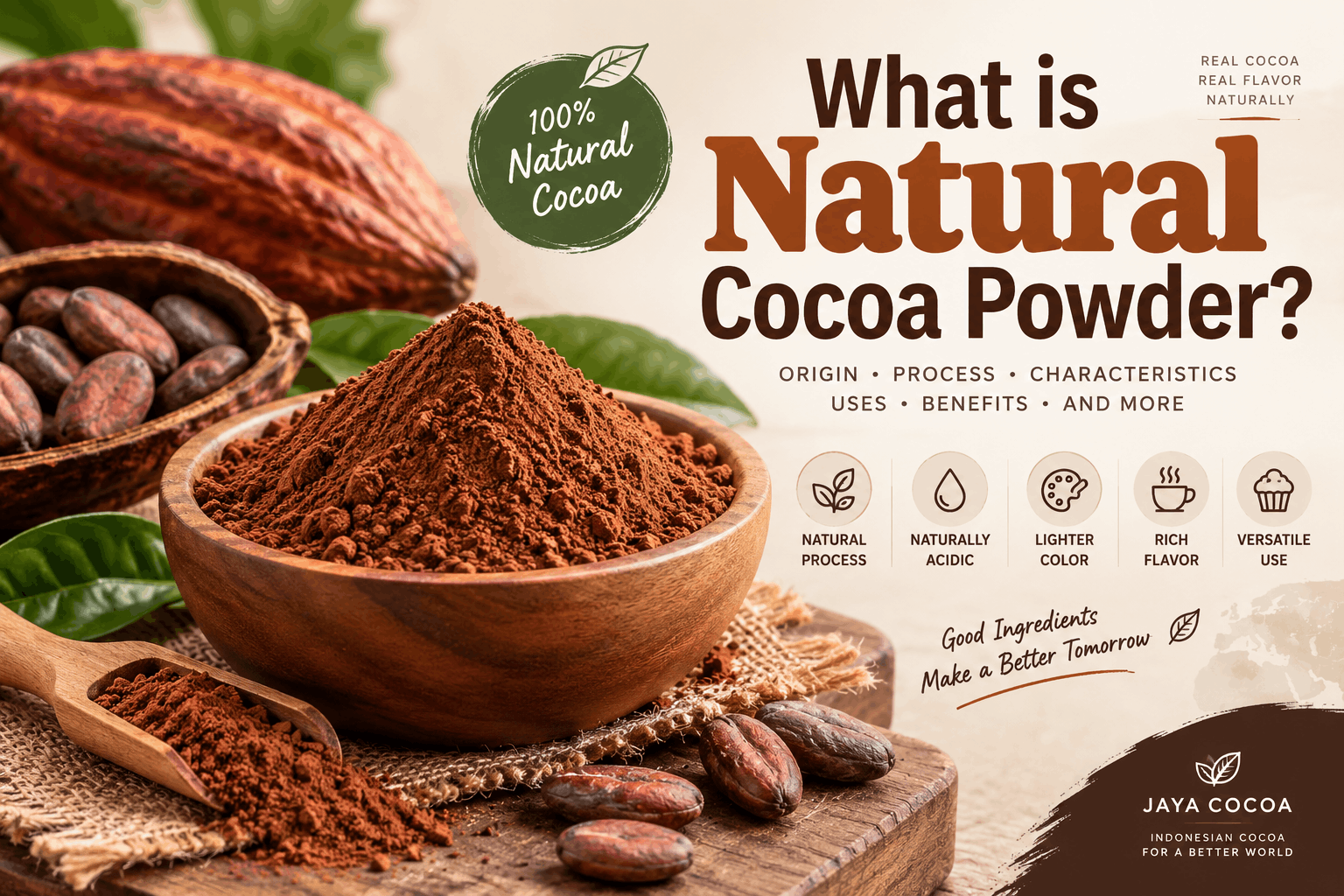
What is Natural Cocoa Powder? Natural cocoa powder is a cocoa ingredient produced from cocoa beans through cocoa processing without the conventional alkalization treatment used to modify cocoa powder’s acidity, color, and flavor.
It is widely used in bakery products, beverages, confectionery, desserts, dairy products, and other food applications where its characteristic cocoa flavor, color, and natural acidity are desirable.
Understanding natural cocoa powder is important for food manufacturers, ingredient buyers, and product developers because its pH, fat content, color, flavor, moisture, and processing characteristics can influence formulation performance.
However, natural cocoa powder is not simply “regular cocoa powder.” Its pH, fat content, color, flavor, moisture, particle size, and processing history can vary between products and suppliers.
For food manufacturers, understanding these characteristics is important when selecting cocoa powder for a specific formulation.
What Is Natural Cocoa Powder?
What is Natural Cocoa Powder? Natural cocoa powder is produced by processing cocoa beans into cocoa liquor or cocoa mass, pressing part of the cocoa butter from the cocoa mass, and milling the resulting cocoa press cake into a powder.
The Codex Standard for Cocoa Powders (CXS 105-1981) describes cocoa powder, fat-reduced cocoa powder, and highly fat-reduced cocoa powder as products obtained from cocoa cake and transformed into powder.
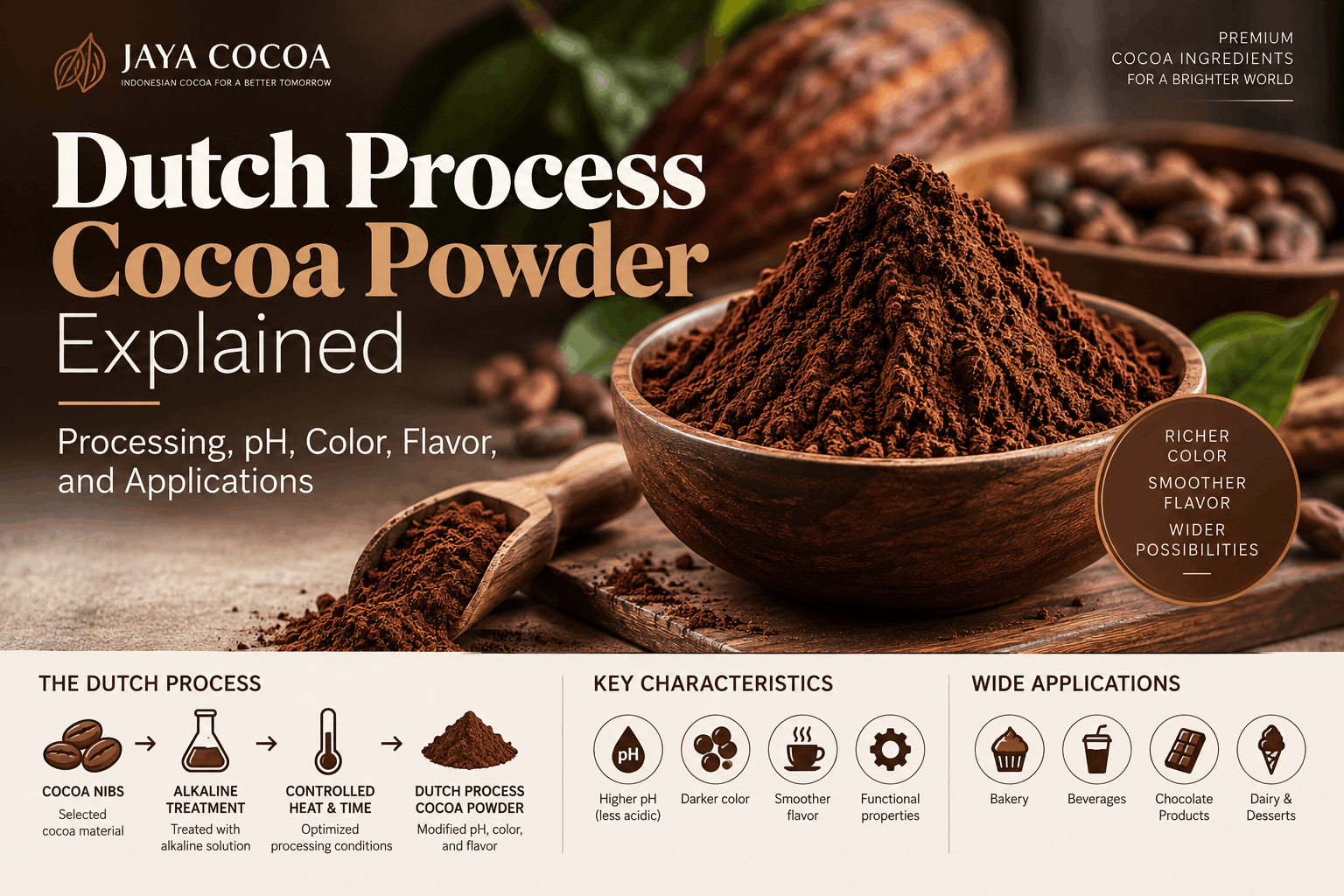
The word “natural” is commonly used in the cocoa industry to distinguish cocoa powder that has not undergone alkalization from alkalized or “Dutch-process” cocoa powder.
This distinction is important because alkalization can change several properties of cocoa powder, including pH, color, flavor, and chemical composition. Recent scientific reviews continue to describe alkalization as an optional processing step used to modify cocoa’s sensory and technological properties.
How Is Natural Cocoa Powder Made?
The production of natural cocoa powder begins with cocoa beans and involves several processing stages.
A simplified process is:
Cocoa Beans
↓
Cleaning
↓
Roasting
↓
Winnowing
↓
Grinding
↓
Cocoa Liquor / Cocoa Mass
↓
Pressing
↓
Cocoa Press Cake
↓
Milling
↓
Natural Cocoa Powder
The exact industrial process can vary according to the manufacturer, cocoa origin, equipment, and desired product specification.
1. Cocoa Bean Selection
Cocoa beans are selected according to quality requirements such as origin, fermentation, moisture, bean condition, and other quality parameters.
Bean characteristics can influence the flavor and color of the resulting cocoa ingredients.
2. Roasting
The cocoa beans are roasted under controlled conditions.
Roasting contributes to the development of cocoa’s characteristic aroma and flavor through complex chemical reactions.
Temperature and time are important processing variables because excessive or insufficient roasting can affect the final sensory characteristics.
3. Winnowing
After roasting, the shells are removed from the cocoa beans.
The resulting cocoa nibs are used for further processing.
4. Grinding
The nibs are ground to produce cocoa liquor or cocoa mass.
This occurs because the cocoa bean contains a substantial amount of cocoa butter, which becomes fluid during grinding and generates a cocoa mass with a characteristic flowable consistency.
5. Pressing
The cocoa liquor is mechanically pressed to separate part of the cocoa butter from the cocoa solids.
The remaining solid material is known as cocoa press cake.
6. Milling
The cocoa press cake is broken down and milled into a fine powder.
The resulting cocoa powder can then be screened and packaged according to the required particle-size and quality specifications.
Is Natural Cocoa Powder the Same as Alkalized Cocoa Powder?
No.
The primary distinction is whether the cocoa material has undergone an alkalization treatment.
Natural Cocoa Powder
Natural cocoa powder:
- Is not conventionally alkalized
- Generally retains more of cocoa’s natural acidity
- Usually has a lighter-to-medium brown color, although color varies considerably
- Has a characteristic cocoa flavor
- Can interact with alkaline leavening systems in formulations
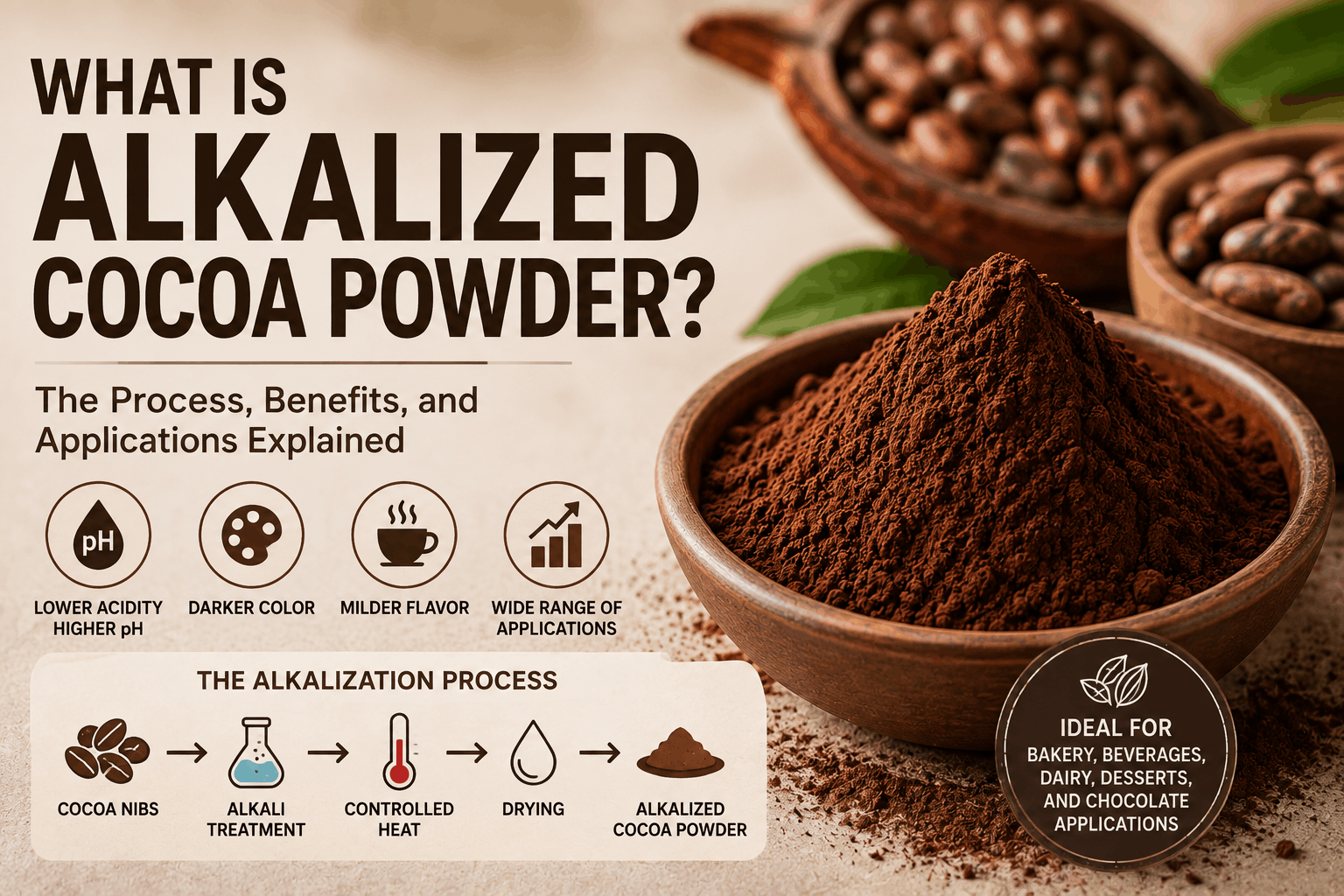
Alkalized Cocoa Powder
Alkalized cocoa powder undergoes treatment with an alkaline material.
The treatment can modify:
- pH
- Color
- Flavor
- Aroma
- Dispersibility
- Some chemical constituents
Scientific research has shown that alkalization can alter polyphenols, methylxanthines, volatile compounds, and other cocoa constituents, with the degree of change depending on the processing conditions.
This means natural and alkalized cocoa powder should not automatically be considered interchangeable in a food formulation.
For a deeper comparison, see our guide:
Natural vs Alkalized Cocoa Powder: What’s the Difference?
What Is the pH of Natural Cocoa Powder?
Natural cocoa powder is generally acidic.
A commonly reported range in scientific literature is approximately pH 5.0–5.6, although the actual value can vary depending on cocoa origin, processing, fermentation, and measurement conditions. A peer-reviewed study on commercial cocoa powders describes natural cocoa in this approximate pH range.
This acidity is one of the most important differences between natural and alkalized cocoa powder.
However, buyers should not purchase natural cocoa powder based on a generic pH range alone.
For industrial applications, the actual supplier specification and COA should be used.
For more information:
Why Does Natural Cocoa Powder Have an Acidic pH?
Cocoa beans naturally contain organic acids and other compounds that contribute to cocoa’s acidity.
Fermentation and subsequent processing influence the final chemical composition of cocoa.
Because natural cocoa powder does not undergo the conventional alkalization step, it generally retains more of this acidic character than alkalized cocoa powder.
Alkalization can significantly increase pH by neutralizing some acidic components and modifying the cocoa matrix. Research shows that changes in alkalization conditions can produce substantial changes in cocoa powder pH and other physicochemical properties.
What Color Is Natural Cocoa Powder?
Natural cocoa powder is commonly associated with light to medium brown colors, but there is no single universal color for all natural cocoa powders.
Color can be affected by:
- Cocoa bean origin
- Variety
- Fermentation
- Roasting
- Fat content
- Processing conditions
- Particle size
- Raw material characteristics
Therefore, the term natural cocoa powder does not automatically mean one specific color.
This is particularly important for industrial buyers.
A bakery manufacturer looking for a specific brown tone should define the required color using the supplier’s agreed specification or an appropriate color measurement system rather than relying only on the term “natural.”
See also:
Cocoa Powder Color Guide for Food Manufacturers
What Does Natural Cocoa Powder Taste Like?
Natural cocoa powder generally has a characteristic cocoa flavor with a more pronounced acidic character than many alkalized cocoa powders.
Depending on the cocoa origin and processing conditions, natural cocoa can exhibit:
- Cocoa notes
- Roasted notes
- Fruity notes
- Nutty notes
- Acidic or tangy notes
- Bitter notes
Flavor is influenced by much more than whether the powder is natural or alkalized.
Factors include:
- Cocoa genetics
- Origin
- Fermentation
- Drying
- Roasting
- Processing
- Storage
Therefore, two natural cocoa powders from different suppliers may not taste identical.
Natural Cocoa Powder Fat Content
Natural cocoa powder can be manufactured at different fat levels.
The Codex standard distinguishes:
| Cocoa Powder Category | Cocoa Butter Content |
|---|---|
| Cocoa powder | ≥20% |
| Fat-reduced cocoa powder | ≥10% and <20% |
| Highly fat-reduced cocoa powder | <10% |
These categories are based on cocoa butter content on a dry matter basis under CXS 105-1981.
In commercial specifications, buyers may encounter descriptions such as:
- High Fat Cocoa Powder
- Low Fat Cocoa Powder
- 10–12% Fat Cocoa Powder
- 20–22% Fat Cocoa Powder
The exact terminology used by suppliers should therefore be checked against the actual specification and COA.
For a more detailed explanation:
Cocoa Powder Fat Content Explained: Which One Should You Choose?
Natural Cocoa Powder Moisture
Moisture is an important quality parameter for cocoa powder.
The current Codex Standard for Cocoa Powders specifies:
No more than 7% m/m moisture
for cocoa powders covered by the standard.
However, this should not automatically be interpreted as the commercial specification of every supplier.
A buyer may have a tighter internal specification depending on:
- Application
- Storage conditions
- Shelf-life requirements
- Packaging
- Quality system
For procurement, the appropriate approach is to compare the supplier’s COA with the agreed product specification.
Natural Cocoa Powder vs Alkalized Cocoa Powder
Here is a simplified comparison:
| Characteristic | Natural Cocoa Powder | Alkalized Cocoa Powder |
|---|---|---|
| Alkalization | No conventional alkalization | Alkalized |
| Acidity | Generally more acidic | Generally less acidic |
| pH | Often around 5.0–5.6, but varies | Usually higher than natural cocoa |
| Color | Often lighter/medium brown | Can range from brown to very dark |
| Flavor | More pronounced natural cocoa acidity | Often smoother/more mellow |
| Leavening interaction | Can react with baking soda | Formulation-dependent |
| Processing | Standard cocoa powder processing | Additional alkalization step |
| Applications | Bakery, beverages, confectionery, etc. | Bakery, beverages, confectionery, etc. |
The table is a general guide rather than a universal specification. Actual cocoa powder properties vary by product.
How Is Natural Cocoa Powder Used?
Natural cocoa powder is used across many food applications.
1. Bakery
Natural cocoa powder can be used in:
- Cakes
- Brownies
- Cookies
- Biscuits
- Muffins
Its acidity can be relevant when the formulation uses alkaline leavening systems.
2. Beverages
Natural cocoa powder can be used in:
- Cocoa beverages
- Hot chocolate formulations
- Instant beverage mixes
- Milk-based cocoa drinks
The appropriate powder depends on the desired flavor, color, dispersion, and processing conditions.
3. Confectionery
Natural cocoa powder can contribute:
- Cocoa flavor
- Brown color
- Cocoa solids
to confectionery formulations.
4. Dairy Products
Applications can include:
- Chocolate milk
- Flavored dairy products
- Desserts
- Ice cream
5. Food Ingredients
Natural cocoa powder can also be used as an ingredient in compound formulations and food mixes.
The appropriate specification should always be selected according to the final application.
When Should You Choose Natural Cocoa Powder?
Natural cocoa powder may be a good choice when a formulation requires:
1. Natural cocoa acidity
The acidity can be useful in formulations where cocoa’s natural acid profile is desired.
2. Characteristic cocoa flavor
Some formulations specifically seek the flavor profile associated with non-alkalized cocoa.
3. Interaction with baking soda
In some bakery formulations, natural cocoa’s acidity can participate in acid-base reactions with sodium bicarbonate.
However, the correct leavening system should always be determined from the complete formulation rather than cocoa powder alone.
4. A lighter cocoa color
Natural cocoa powders are often lighter than heavily alkalized powders, although this is not an absolute rule.
When Might Natural Cocoa Powder Not Be the Best Choice?
Natural cocoa powder is not automatically the best option for every application.
A manufacturer may prefer alkalized cocoa powder when the formulation requires:
- Higher pH
- A specific dark color
- A different flavor profile
- Specific dispersion characteristics
- Particular processing performance
The decision should therefore be based on the finished product, not simply on the cocoa powder itself.
What Should Food Manufacturers Check When Buying Natural Cocoa Powder?
For industrial procurement, consider requesting a specification sheet and COA covering relevant parameters.
Depending on the product and application, these may include:
| Parameter | Why It Matters |
|---|---|
| Fat content | Influences flavor, mouthfeel, and formulation |
| pH | Important for flavor and formulation chemistry |
| Moisture | Relevant to quality and storage |
| Color | Determines visual appearance |
| Particle size | Influences texture and dispersion |
| Microbiology | Important for food safety |
| Flavor/aroma | Determines sensory performance |
| Packaging | Protects product during storage and transport |
| Shelf life | Important for inventory planning |
The Codex standard also recommends that cocoa powders be prepared and handled according to relevant Codex hygiene principles and codes for low-moisture foods.
How Should Natural Cocoa Powder Be Stored?
Natural cocoa powder should generally be stored in conditions that protect it from:
- Moisture
- Excessive heat
- Direct sunlight
- Strong odors
- Contamination
- Damaged packaging
Storage conditions should follow the supplier’s specification.
For industrial buyers, warehouse management should also consider:
- FIFO/FEFO practices
- Batch traceability
- Packaging integrity
- Humidity control
- Pest control
- Clean storage areas
For a more detailed discussion, see:
Cocoa Powder Shelf Life and Storage Guide
Is Natural Cocoa Powder Healthy?
Cocoa powder contains naturally occurring compounds such as flavanols, theobromine, and other cocoa constituents.
However, it is important to distinguish between:
the nutritional composition of cocoa powder
and:
health claims about consuming cocoa products.
Processing can affect the concentration and profile of some bioactive compounds. Research has shown that alkalization can reduce or alter certain phytochemicals, although the magnitude depends on processing conditions.
Therefore, it would be misleading to claim that natural cocoa powder is universally “healthier” than alkalized cocoa powder without specifying the nutritional parameter and processing conditions being compared.
For commercial food applications, the more useful question is usually:
Which cocoa powder specification is appropriate for the intended product?
Natural Cocoa Powder for Industrial Food Manufacturing
For B2B buyers, natural cocoa powder should be evaluated as a technical food ingredient, not simply as a commodity.
A procurement team should consider:
Application
↓
Required color
↓
Required pH
↓
Required fat content
↓
Moisture
↓
Microbiological specification
↓
Particle size
↓
Packaging
↓
Shelf life
↓
COA
↓
Supplier consistency
This approach is more reliable than selecting a cocoa powder solely by price.
Natural Cocoa Powder for Export
When buying natural cocoa powder internationally, buyers should also consider:
- Product specification
- Certificate of Analysis
- Packaging
- Lot identification
- Certificate of Origin where applicable
- Shipping conditions
- Container loading
- Storage requirements
- Destination-country food regulations
The Codex standard includes requirements related to product description, composition, hygiene, and labeling, including provisions for non-retail containers.
For international buyers sourcing from Indonesia, see:
How to Import Cocoa Powder from Indonesia
Frequently Asked Questions
Is natural cocoa powder the same as regular cocoa powder?
The term “regular cocoa powder” is not a precise technical classification. In many commercial contexts, natural cocoa powder means cocoa powder that has not undergone conventional alkalization. Buyers should rely on the supplier’s specification to confirm the processing method.
What is the pH of natural cocoa powder?
Natural cocoa powder is generally acidic. Scientific literature commonly reports values around pH 5.0–5.6, but the actual value varies by product and processing conditions.
Is natural cocoa powder acidic?
Yes. Natural cocoa powder generally retains cocoa’s acidic character because it has not undergone conventional alkalization.
Can natural cocoa powder be used for baking?
Yes. Natural cocoa powder is widely used in bakery products. Its acidity can be particularly relevant in formulations containing alkaline leavening agents such as baking soda.
Is natural cocoa powder better than alkalized cocoa powder?
Not necessarily. The appropriate choice depends on the formulation, desired color, pH, flavor, and functional requirements.
What is the difference between natural and Dutch-process cocoa powder?
Natural cocoa powder is generally non-alkalized, while Dutch-process cocoa powder is alkalized. The process changes properties such as pH, color, flavor, and chemical composition.
What is the fat content of natural cocoa powder?
Natural cocoa powder can be produced at different fat levels. Codex distinguishes cocoa powder at ≥20% cocoa butter, fat-reduced cocoa powder at ≥10% but <20%, and highly fat-reduced cocoa powder at <10%, on a dry matter basis.
What moisture level is allowed for cocoa powder?
The current Codex Standard for Cocoa Powders specifies a maximum moisture content of 7% m/m for cocoa powders covered by the standard. Commercial specifications can be stricter.
Conclusion
Natural cocoa powder is a non-conventionally alkalized cocoa ingredient produced by processing cocoa beans into cocoa liquor, pressing the liquor to remove part of its cocoa butter, and milling the resulting cocoa press cake into powder.
Its defining characteristic compared with alkalized cocoa powder is the absence of the conventional alkalization treatment.
Natural cocoa powder generally retains a more acidic profile and characteristic cocoa flavor, while its color, fat content, moisture, particle size, and sensory properties can vary according to cocoa origin and processing conditions.
For food manufacturers, there is no universally “best” cocoa powder.
The right choice depends on:
Application + pH + color + fat + flavor + processing performance + quality specification.
For commercial purchasing, buyers should always confirm the actual specification and COA from the supplier rather than relying on generic descriptions such as “natural,” “dark,” or “high fat.”
References
1. FAO/WHO Codex Alimentarius Commission
Standard for Cocoa Powders (Cocoas) and Dry Mixtures of Cocoa and Sugars — CXS 105-1981.
2. FAO/WHO Codex Alimentarius
General Standard for Food Additives — CXS 192-1995.
3. Binello, A., Cravotto, G., Mantegna, S., & Tagliapietra, S. (2026)
“An upgrade in cocoa alkalization: Functional changes, chemistry and new perspectives.” Food Chemistry, 499, 147370.
4. Sioriki, E., et al. (2021)
“Impact of alkalization conditions on the phytochemical content of cocoa powder and the aroma of cocoa drinks.” LWT — Food Science and Technology, 145, 111181.
5. “The effect of alkalization on the bioactive and flavor related components in commercial cocoa powder.”
Journal of Food Composition and Analysis.