Cocoa Powder Solubility Explained: What Affects Dissolution, Dispersion & Reconstitution?
Cocoa powder is widely used in beverages, bakery products, desserts, dairy products, chocolate applications, and other food formulations. However, one common misconception is that cocoa powder should dissolve in water in the same way as sugar or salt.
In reality, cocoa powder is a complex food powder containing cocoa solids and residual cocoa fat. Its interaction with water depends on several factors, including particle size, surface properties, fat content, processing method, agglomeration, lecithination, formulation, temperature, and mixing conditions.
For manufacturers, this means that asking whether a cocoa powder is simply “soluble” may not be enough.
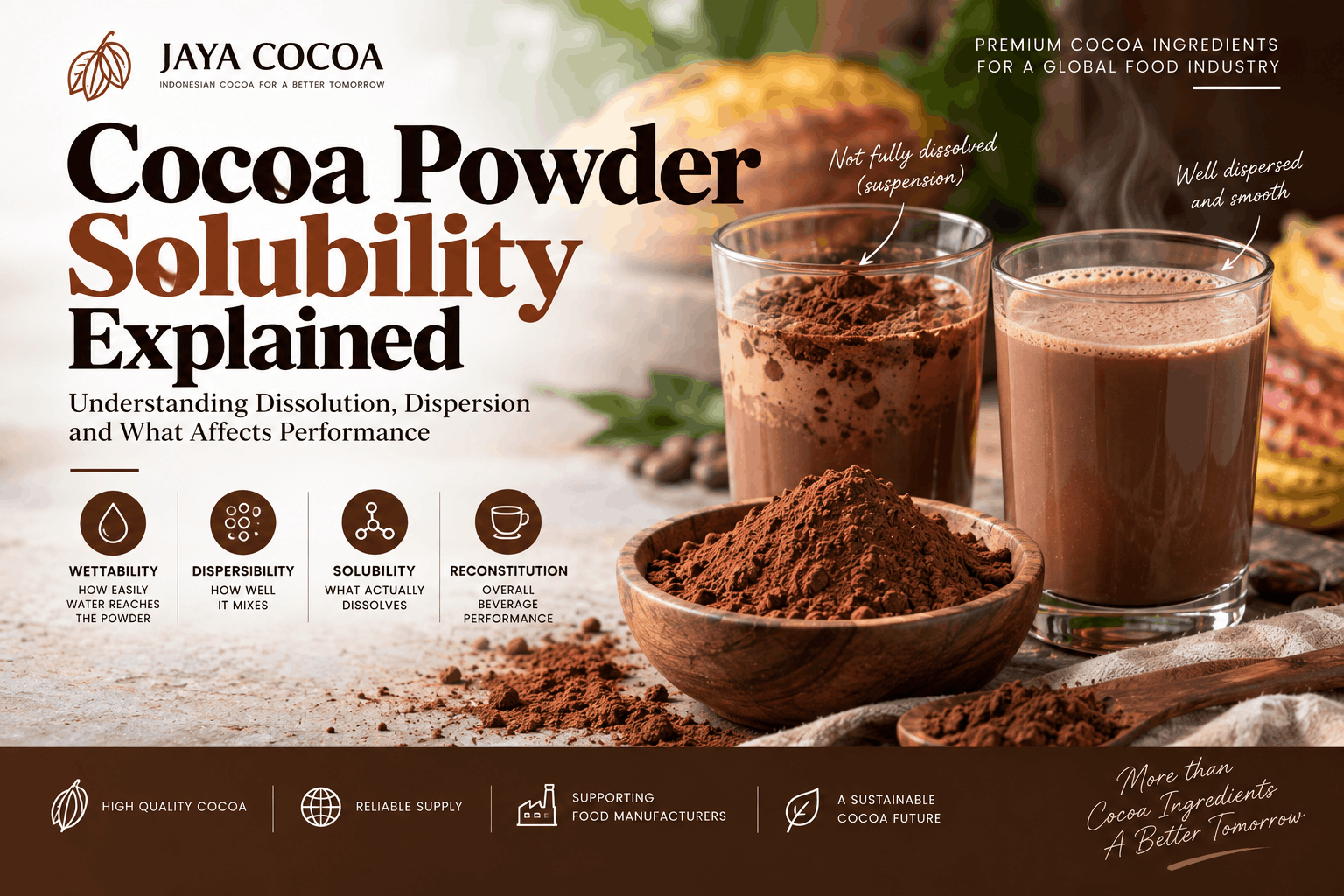
A better evaluation considers several related properties:
- Wettability — how easily liquid penetrates and wets the powder
- Dispersibility — how easily the powder becomes distributed throughout the liquid
- Solubility — how much of the material actually dissolves
- Reconstitution — how effectively the powder forms the intended beverage or food system
- Suspension stability — how well cocoa particles remain distributed rather than settling
Understanding these differences is important when selecting cocoa powder for beverage and other liquid applications.
Is Cocoa Powder Soluble in Water?
Cocoa powder is not completely soluble in water.
This is an important distinction for food manufacturers.
Cocoa powder contains insoluble or poorly water-soluble cocoa particles, along with residual cocoa butter and other cocoa components. As a result, when cocoa powder is mixed with water, some material may remain suspended rather than becoming a true molecular solution.
Research on cocoa powder describes the material as relatively hydrophobic, with cocoa butter and the nature of cocoa particle surfaces contributing to poor interaction with water.
Therefore, a cocoa beverage that looks uniform after mixing does not necessarily mean that all cocoa solids have dissolved.
The product may instead consist of a dispersion or suspension of cocoa particles in the liquid.
This distinction becomes especially important when evaluating instant cocoa beverage powders.
Solubility vs Wettability vs Dispersibility
These terms are related but they are not interchangeable.
1. Wettability
Wettability describes how readily a liquid can contact and penetrate the surface of a powder.
If cocoa powder has poor wettability, particles may initially:
- Float on the liquid surface
- Form lumps
- Resist penetration by water
- Require more agitation
Research on instantized cocoa beverage powders has shown that agglomeration can improve wettability because the resulting powder structure can interact with liquid more effectively.
2. Dispersibility
Dispersibility refers to how effectively the powder becomes distributed throughout the liquid.
A powder can become wet but still form lumps or settle rapidly.
Therefore:
Good wettability does not automatically guarantee excellent dispersion.
The powder structure, particle size, agglomeration, formulation, and mixing conditions can all influence the result.
3. Solubility
Solubility refers to the amount of material that actually dissolves in the liquid under defined conditions.
For cocoa powder, this is particularly important because not all cocoa components are water-soluble.
A measurement of cocoa powder solubility therefore depends on the test method and formulation.
This is why commercial specifications should state the test method when a supplier provides a numerical solubility value.
4. Reconstitution
Reconstitution describes the overall ability of a powder system to produce the intended liquid product after adding a liquid.
For a cocoa beverage, good reconstitution can involve:
Wet → Disperse → Hydrate/dissolve soluble components → Form a stable suspension
This is broader than solubility alone.
A 2025 Journal of Food Engineering study investigated reconstitution of powdered cocoa beverages and showed that processing conditions can improve wettability and reconstitution while also changing cocoa solubility and sedimentation behavior.
Why Is Cocoa Powder Difficult to Dissolve?
The main reason is the physical and chemical nature of cocoa powder.
Cocoa powder contains a mixture of components with different interactions with water.
One important factor is hydrophobicity.
Research on cocoa powder wetting and dispersion found that cocoa is a hydrophobic powder and that interaction between cocoa particles and water is not energetically favorable under the studied conditions.
Residual cocoa butter can also influence the powder’s surface properties.
A study investigating cocoa powder in a cinnamon-cocoa drink reported that cocoa powder wettability can be affected by fat content because cocoa butter on the particle surface contributes to hydrophobic behavior.
This explains why simply grinding cocoa powder finer does not necessarily make it behave like a fully soluble ingredient.
Factors That Affect Cocoa Powder Solubility
Several variables can influence how cocoa powder behaves in water.
1. Fat Content
Fat content is an important consideration for cocoa powder intended for beverage applications.
The relationship is not as simple as:
lower fat = always better solubility.
However, residual cocoa butter can affect surface hydrophobicity and wetting behavior.
A 2005 study of ten commercial powdered cocoa beverage products found significant differences in wettability, dispersibility, and solubility; among the variables examined, sugar content had the strongest main effect followed by fat content.
This is an important point for buyers:
Cocoa powder performance should be evaluated within the complete beverage formulation, not from fat content alone.
2. Particle Size
Particle size can affect powder-liquid interactions and processing behavior.
Very fine particles can have a large surface area relative to their mass, but this does not automatically mean they will wet or disperse more easily.
Fine powders can sometimes create:
- Floating particles
- Dust
- Lumping
- Poor wetting
- Strong particle-particle interactions
On the other hand, controlled agglomeration can create larger porous structures that improve liquid penetration.
Research on cocoa beverage powders has shown that agglomeration can modify particle size and improve wetting behavior.
Therefore:
Particle size and particle structure should be considered together.
This connects directly with our previous article:
Cocoa Powder Particle Size Explained
3. Agglomeration
Agglomeration involves joining smaller powder particles into larger, porous aggregates.
The objective is not simply to make particles larger.
The resulting structure can make it easier for liquid to penetrate the powder.
Research on instantized cocoa beverage powders found that steam-jet agglomeration produced porous agglomerates with improved wettability.
Another study on cocoa beverage powder found that agglomeration after lecithination further improved the measured solubility and reduced wetting time compared with simple blending.
This is why instant cocoa powder and conventional cocoa powder should not automatically be treated as equivalent products.
4. Lecithination
Lecithination is another approach used to improve powder wetting and dispersion.
Lecithin is a surface-active ingredient that can improve the interaction between powder particles and liquid.
A study published in the Jurnal Teknologi dan Industri Pangan at IPB University explains that cocoa beverage powder has wettability challenges partly because of cocoa butter hydrophobicity and that lecithination is commonly used to improve wettability.
Research published in Food Science and Technology also found that adding soy lecithin improved solubility in the studied cocoa beverage powder, while subsequent agglomeration improved it further.
However, lecithination should be evaluated according to the intended application and product formulation.
It is not necessarily appropriate for every cocoa powder specification.
5. Alkalization
Alkalization can change the physicochemical characteristics of cocoa powder.
It is therefore reasonable to investigate whether natural and alkalized cocoa powders behave differently in a particular beverage formulation.
Research on alkalized cocoa powder has measured changes in pH, wetting time, and solubility following different alkalization treatments. One study reported measurable differences in solubility and wetting behavior between treatments, demonstrating that processing conditions can affect these properties.
More recent research has also investigated alternative alkalization technologies and reported changes in cocoa solubility and wetting time under specific experimental conditions.
However, these results should not be interpreted as:
“Alkalized cocoa powder is always more soluble.”
The effect depends on the cocoa material, alkalization method, formulation, and measurement conditions.
6. Sugar and Other Ingredients
When cocoa powder is used in a beverage mix, its performance cannot be evaluated independently from the rest of the formulation.
Sugar, milk powder, fat, emulsifiers, and other ingredients can change:
- Wetting
- Dispersibility
- Reconstitution
- Sedimentation
- Apparent solubility
The 2005 study of commercial powdered cocoa beverages found that formulation variables significantly affected instant properties.
A newer 2025 study similarly found that changing how cocoa and other ingredients were incorporated during processing affected wettability, reconstitution, solubility, and sedimentation.
This is why a cocoa powder that performs well in one beverage formulation may behave differently in another.
7. Mixing Conditions
Mixing is another major variable.
Research on cocoa powder dispersion found that dispersion behavior depends on variables including:
- Agitation speed
- Temperature
- Powder concentration
One study reported a critical agitation speed of approximately 630 rpm under its experimental conditions.
However, this value should not be treated as a universal industrial mixing specification.
Different equipment, formulations, concentrations, temperatures, and powder properties require different processing conditions.
8. Temperature
Temperature can affect powder-liquid interactions and processing behavior.
Higher temperatures can change:
- Liquid viscosity
- Fat phase behavior
- Wetting
- Mixing
- Reconstitution
- Sedimentation
Research on cocoa powder dispersion has specifically examined the influence of temperature alongside agitation speed and powder concentration.
Therefore, a supplier test performed in room-temperature water should not automatically be assumed to represent the performance of the powder in a hot beverage process.
Does Finer Cocoa Powder Mean Better Solubility?
Not necessarily.
This is one of the most important points for buyers.
A smaller particle size can change the surface area and powder-liquid interactions, but extremely fine powders may also have poor flow and wetting behavior.
Meanwhile, agglomeration can create larger porous structures that improve wettability even though the individual primary particles remain fine.
The 2005 cocoa beverage study found that agglomeration increased average particle size while changing instant properties.
Therefore:
Particle size and solubility should not be treated as the same specification.
A buyer should evaluate the actual application performance rather than selecting a powder solely because it has a smaller micron size.
Cocoa Powder Solubility in Hot Water vs Cold Water
The apparent performance of cocoa powder can change depending on temperature.
In industrial applications, manufacturers may use:
- Cold water
- Warm water
- Hot water
- Milk
- Other liquid systems
The same powder can behave differently under each condition.
For example, the wetting and dispersion study on cocoa powder examined both temperature and agitation as variables affecting dispersion.
Therefore, a buyer should define the intended application when evaluating solubility.
A cocoa powder designed for:
hot chocolate production
may not have the same performance requirements as powder used in:
cold dairy beverages
Cocoa Powder Solubility and Sedimentation
A cocoa beverage can appear well dispersed immediately after mixing and still develop sediment later.
This happens because many cocoa particles remain suspended rather than becoming completely dissolved.
Therefore, sedimentation stability is a separate performance consideration.
A 2025 study found that wet-mixing improved cocoa solubility but also accelerated sedimentation and increased sediment volume in the reconstituted beverage under the experimental conditions.
This demonstrates an important formulation principle:
Improving one powder property does not necessarily improve every other property.
A manufacturer may need to optimize a balance between:
- Wettability
- Dispersibility
- Solubility
- Suspension stability
- Flavor
- Texture
How Is Cocoa Powder Solubility Measured?
There is no single number that universally represents the “solubility” of all cocoa powders.
The result depends on the test method and conditions.
A proper test should define variables such as:
- Sample mass
- Liquid volume
- Liquid type
- Temperature
- Mixing speed
- Mixing time
- Settling time
- Separation method
- Calculation method
This is particularly important when comparing supplier COAs.
Two suppliers could report different solubility percentages while using different methods.
Therefore:
Always ask for the analytical method behind a reported solubility value.
What Should a Buyer Ask a Cocoa Powder Supplier?
For beverage applications, buyers should ask more than:
“Is your cocoa powder soluble?”
A better technical questionnaire includes:
Product Specification
- Natural or alkalized?
- Fat content?
- pH?
- Color?
- Particle size?
- Moisture?
- Bulk density?
Functional Performance
- Wettability?
- Dispersibility?
- Solubility?
- Reconstitution performance?
- Sedimentation behavior?
Processing
- Is the cocoa powder agglomerated?
- Is it lecithinated?
- What is the particle-size distribution?
- What processing conditions were used?
Testing
- What analytical method is used?
- What temperature?
- What liquid?
- What powder-to-liquid ratio?
- What mixing conditions?
Application
- Hot beverage?
- Cold beverage?
- Dairy drink?
- Bakery?
- Chocolate?
- Instant beverage mix?
This produces a much more meaningful technical discussion than simply requesting a “solubility percentage.”
Cocoa Powder Solubility: What Buyers Should Compare
A useful procurement comparison could look like this:
| Parameter | Why It Matters |
|---|---|
| Fat content | Influences surface properties and formulation |
| Particle size | Affects powder-liquid interactions |
| D10 / D50 / D90 | Describes particle-size distribution |
| pH | Important for formulation and flavor |
| Alkalization | Can change physicochemical behavior |
| Wettability | Determines how readily liquid contacts powder |
| Dispersibility | Indicates distribution through liquid |
| Solubility | Indicates dissolved fraction under defined test conditions |
| Agglomeration | Can improve wetting and reconstitution |
| Lecithination | Can improve wetting/dispersion in suitable formulations |
| Sedimentation | Important for beverage stability |
| Mixing conditions | Strongly influence practical performance |
Is Cocoa Powder “Instant”?
Not necessarily.
The word instant should be used carefully.
An instantized cocoa beverage powder is typically engineered to improve properties such as wetting, dispersibility, and reconstitution.
Research on instantized cocoa powders describes agglomeration as a common process used to improve wetting and handling characteristics.
Therefore, buyers should distinguish between:
Standard cocoa powder
and
Instantized / specially treated cocoa beverage powder
because their physical properties and intended applications can differ substantially.
Cocoa Powder Solubility and Codex Standards
An important point for international buyers is that Codex CXS 105-1981 is a cocoa powder standard, but it does not establish one universal commercial “solubility percentage” for cocoa powder.
The current Codex listing identifies CXS 105-1981 as the standard for cocoa powders and dry mixtures of cocoa and sugars, with the standard currently listed as modified in 2025.
This means a supplier’s solubility specification should be understood as a functional or commercial specification, not automatically as a Codex-defined universal requirement.
This distinction is important when comparing COAs from different suppliers.
Choosing Cocoa Powder for Beverage Applications
For beverage manufacturers, the selection process should start with the intended application.
For conventional hot cocoa
Consider:
- Flavor
- Color
- Fat content
- pH
- Wetting
- Dispersibility
- Sedimentation
For instant beverage powder
Additional attention may be required for:
- Agglomeration
- Lecithination
- Wetting time
- Dispersibility
- Reconstitution
For cold beverages
Pay particular attention to:
- Wetting at the intended temperature
- Dispersion
- Suspension stability
- Sedimentation
- Mixing equipment
There is therefore no universal cocoa powder that is automatically ideal for every beverage system.
Final Takeaway
Cocoa powder does not behave like a fully soluble ingredient such as sugar.
Its performance in water depends on the interaction between the powder’s physical structure, cocoa fat, particle size, surface properties, processing history, formulation, and mixing conditions.
For this reason, solubility, wettability, dispersibility, reconstitution, and sedimentation should be evaluated separately.
Research has shown that factors such as fat content, sugar content, particle structure, agglomeration, lecithination, processing conditions, temperature, and mixing can influence the behavior of cocoa-based powders in liquids.
For international buyers, the most useful approach is therefore not simply to ask:
“Is this cocoa powder soluble?”
Instead, ask:
“How does this cocoa powder perform under the conditions of my application?”
A well-defined specification should include the relevant fat content, pH, particle-size distribution, processing method, and functional test conditions.
That approach gives food manufacturers a much more reliable basis for selecting cocoa powder for beverages and other liquid applications.
References & Sources
1. Chan & Zhou — 2025, Journal of Food Engineering
2. Moundanga et al. — 2024, Powder Technology
3. Food Chemistry — Factors Affecting Instant Properties of Powdered Cocoa Beverages
4. Food and Bioproducts Processing — Wetting Behaviour and Dispersion Rate of Cocoa Powder
5. IPB University — 2018
6. Codex Alimentarius — CXS 105-1981
Standard for Cocoa Powders (Cocoas) and Dry Mixtures of Cocoa and Sugars
7. Vissotto et al. — 2006