Cocoa Powder MOQ for International Buyers: A Practical Sourcing Guide
When sourcing cocoa powder internationally, one of the first questions buyers ask is: What is the minimum order quantity (MOQ)?
The answer depends on several factors, including the supplier’s production capacity, product type, packaging requirements, order specifications, and shipping arrangements. Some suppliers accept orders of around one metric ton, while others focus on larger shipments of 17 metric tons or more.
For importers, food manufacturers, distributors, and private label brands, understanding cocoa powder MOQ is important because it affects purchasing budgets, inventory planning, shipping costs, and supplier selection.
In this guide, we explain how cocoa powder MOQ works, what influences minimum order quantities, how to source smaller volumes, and how international buyers can negotiate a suitable order with suppliers.
1. What Is MOQ for Cocoa Powder?
MOQ stands for Minimum Order Quantity. It is the smallest quantity a supplier is willing to accept for a particular order under specified commercial conditions.
For cocoa powder, MOQ may be expressed in kilograms, metric tons (MT), bags, pallets, or containers.
For example:
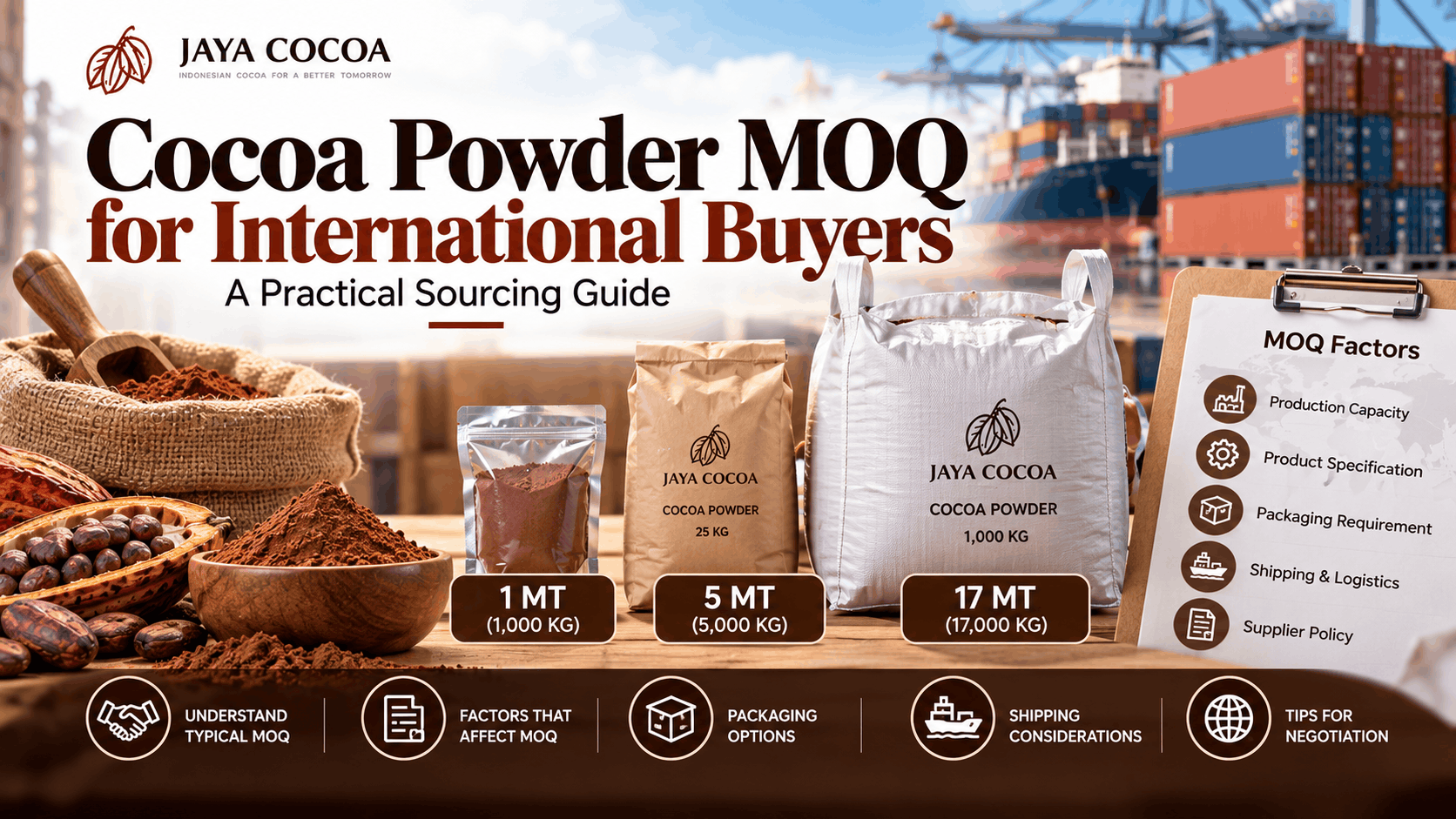
- 1,000 kg = 1 metric ton
- 5,000 kg = 5 metric tons
- 17,000 kg = 17 metric tons
However, the MOQ stated on a product listing does not necessarily apply to every product or packaging format offered by that supplier.
A supplier may accept a smaller quantity for standard cocoa powder available from existing stock but require a larger order for a custom specification, special production batch, or printed retail packaging.
Buyers should therefore confirm the MOQ for the exact product they intend to purchase.
2. What Is the Typical Cocoa Powder MOQ for International Buyers?
There is no universal MOQ for cocoa powder. Commercial offers from Indonesian exporters illustrate how widely minimum quantities can vary.
The following examples are based on publicly available product listings. They are reference points, not guaranteed current offers or industry-wide standards.
| Listed MOQ | Equivalent quantity | Example |
|---|---|---|
| 1,000 kg | 1 MT | Cocoa powder listing on Inaexport |
| 1,800 kg | 1.8 MT | Cocoa powder listing on Inaexport |
| 5,000 kg | 5 MT | Cocoa powder listing on Inaexport |
| 17,000 kg | 17 MT | Cocoa powder listing on Inaexport |
Sources:
- Inaexport — Cocoa Powder, minimum order 1,000 kg
- Inaexport — Cocoa Powder, minimum order 1,800 kg
- Inaexport — Cocoa Powder, minimum order 5,000 kg
- Inaexport — Cocoa Powder, minimum order 17 tons
These examples demonstrate that some exporters offer quantities below a full container, while others specify larger minimums.
The actual MOQ available to an individual buyer may differ depending on the supplier’s current inventory, production schedule, packaging, destination, and commercial terms.
Important: Do not assume that every cocoa powder supplier accepts a 1 MT order or that every export order must be a full container. Ask for a written quotation for your specific quantity.
3. What Factors Determine Cocoa Powder MOQ?
Several operational and commercial factors influence a supplier’s minimum order quantity.
A. Standard product availability
If a supplier already has the required cocoa powder in stock, it may be easier to accept a smaller order than to schedule a dedicated production batch.
Stock availability can vary by product type, fat content, color, pH, and other specifications.
B. Production batch size
Manufacturers organize production according to equipment capacity, processing schedules, cleaning requirements, and product specifications.
A custom order may require a dedicated production run. If the requested quantity is below the manufacturer’s practical batch size, the supplier may establish a higher MOQ.
C. Product specification
Natural cocoa powder, alkalized cocoa powder, and black cocoa powder may have different production requirements.
Other specifications can include:
- Cocoa butter or fat content
- pH range
- Color
- Particle-size distribution
- Moisture content
- Microbiological requirements
- Sterilization or other processing requirements, where applicable
A standard product may be available in smaller quantities than a highly customized product. This depends on the manufacturer’s capabilities and inventory.
D. Packaging requirements
Packaging can have its own minimum quantity.
Industrial cocoa powder may be supplied in bulk bags or sacks, while consumer-facing products may require individual pouches, printed bags, cartons, and retail labels.
A supplier might be able to manufacture a relatively small quantity of cocoa powder but still face a higher minimum order for custom-printed packaging.
E. Shipping and logistics
International freight, export documentation, port handling, and destination charges affect the economics of small shipments.
A supplier may prefer a larger order because it can simplify production planning or improve logistics efficiency. However, the most economical quantity depends on the actual quotation and destination.
4. Product MOQ vs. Packaging MOQ: Understand the Difference
This distinction is especially important for international buyers.
Product MOQ is the minimum amount of cocoa powder that the manufacturer requires for the order.
Packaging MOQ is the minimum quantity of packaging that can be ordered or produced by the packaging supplier.
These quantities may be different.
Consider this illustrative example:
| Requirement | Example quantity |
|---|---|
| Cocoa powder production MOQ | 1,000 kg |
| Custom printed pouch MOQ | 5,000 pouches |
| Intended first order | 1,000 kg |
The supplier might be able to produce 1,000 kg of cocoa powder, but the packaging manufacturer may require 5,000 printed pouches.
The buyer may need to purchase the packaging in advance, use standard packaging for the first order, or negotiate a different production arrangement.
The quantities above are illustrative only, not an industry standard.
For private-label projects, ask suppliers to quote the product MOQ and packaging MOQ separately before approving artwork or paying for printed materials.
5. How Packaging Format Affects Cocoa Powder MOQ
The packaging format can influence the minimum practical order quantity.
Industrial 25 kg bags
Industrial bags are commonly used for B2B cocoa powder shipments. They are suitable for food manufacturers, ingredient distributors, and industrial users who need larger quantities.
For example, an order of 1,000 kg packed into 25 kg bags would require 40 bags.
The number of bags does not determine the MOQ by itself. The supplier must confirm whether it accepts that total quantity.
Bulk packaging
Bulk packaging may be appropriate for larger industrial orders. The suitable format depends on the product, handling equipment, storage facilities, and transport arrangements.
Buyers should confirm packaging material, food-contact suitability, net weight, handling requirements, and protection against moisture and contamination.
Retail and private-label packaging
Retail pouches, printed bags, and branded cartons may introduce additional minimums for printing and packaging production.
If you are launching a new brand, ask whether the supplier can begin with standard packaging and add custom branding once sales volumes become more predictable.
For more information, read our related guide on private-label cocoa powder sourcing from Indonesia.
6. Does a Full Container Always Have the Best MOQ?
No. A full container is a shipping arrangement, not a universal minimum order requirement.
Some suppliers quote larger orders based on container loading, while others may accept less-than-container-load (LCL) shipments or smaller orders from available stock.
The appropriate option depends on the product quantity, destination, cargo handling, freight rates, and supplier terms.
Full-container load (FCL)
FCL means the shipment uses a container booked for that shipment. It may be suitable for larger, regular orders.
Potential advantages include more straightforward cargo planning and less handling of the goods by other cargo consolidators.
Less-than-container load (LCL)
LCL allows a buyer to ship a smaller consignment consolidated with other cargo.
It can be useful for initial orders, market testing, or buyers whose demand is below a full container.
However, LCL is not automatically cheaper. Consolidation fees, handling, destination charges, transit time, and cargo protection can make the total cost per kilogram higher.
Compare total landed cost
Instead of comparing suppliers only by their quoted price per kilogram, calculate the estimated total cost of obtaining the goods at the destination.
Consider:
- Product value
- Export packing and handling
- Inland transport
- Export documentation
- International freight
- Insurance, where applicable
- Import duties and taxes
- Customs clearance
- Destination handling and delivery
The allocation of these costs depends on the agreed Incoterm and contract.
For a meaningful comparison, request quotations for the same product specification, quantity, destination, and delivery basis.
7. How Can Buyers Negotiate a Lower Cocoa Powder MOQ?
Buyers do not always need to accept the first MOQ offered. The best approach is to explain the intended use and ask which practical options the supplier can support.
Strategy 1: Request available stock
Ask whether the supplier has a standard product available from existing inventory.
An available product may be easier to purchase in a smaller quantity than a product requiring a dedicated production run.
Confirm the batch information, remaining shelf life, specification, and documentation before committing.
Strategy 2: Start with a trial order
If the supplier accepts smaller quantities, a trial order can help evaluate product quality, documentation, packaging, and communication before a larger purchase.
Agree on the product specification and sample-approval process in advance.
A trial order should be commercially meaningful enough to evaluate the supplier but small enough to limit inventory exposure.
Strategy 3: Consider standard packaging
If custom-printed packaging is increasing the MOQ, ask whether standard food-grade industrial packaging is available.
This can be a practical option for ingredient buyers who do not need consumer-facing branding.
Strategy 4: Discuss a repeat-order plan
A buyer with a credible demand forecast may be able to negotiate a smaller first order and a schedule for future purchases.
The supplier may be more willing to consider flexibility if the forecast, specification, and payment terms are clear.
Do not promise future volumes that your business cannot reasonably support.
Strategy 5: Ask about a mixed order
Some suppliers may allow multiple cocoa powder types or grades to be combined in a single shipment. Others require a minimum quantity for each product.
Ask specifically whether the MOQ applies to the total shipment or to each product line.
Never assume that different grades can be combined to meet the MOQ without the supplier’s written confirmation.
8. What Should International Buyers Confirm Before Ordering?
Before placing an order, confirm the commercial and technical details in writing.
Product specification
Request the specification for the exact product, including the type of cocoa powder, fat content, pH, color, moisture, particle size, and other relevant quality parameters.
Confirm whether the product is natural, alkalized, black cocoa powder, or another specified type.
Quality documentation
Ask for a representative sample and a Certificate of Analysis (COA), where available and appropriate.
Clarify the required microbiological tests, contaminant limits, test methods, and acceptance criteria for the destination market.
A sample should be evaluated under the intended application conditions where practical.
Packaging
Confirm the bag or pouch size, packaging material, labeling, batch coding, palletization, and any special handling requirements.
For private-label products, confirm the packaging MOQ, artwork approval process, and responsibility for unused printed materials.
Production and delivery
Clarify whether the MOQ is based on stock or new production.
Ask about production lead time, order confirmation, shipment readiness, Incoterms, payment terms, and required export documents.
Payment protection
International buyers should verify the supplier and agree on clear contractual terms before transferring funds.
The contract should identify the product, quantity, quality specification, delivery basis, payment schedule, inspection arrangements, and the process for resolving non-conformities.
A purchase order alone does not guarantee that a shipment will proceed as expected. Clear terms and appropriate supplier due diligence reduce avoidable commercial risk.
9. A Practical Example: Choosing an MOQ for a First Import
Imagine an importer wants to test Indonesian cocoa powder for a beverage manufacturing business.
The buyer estimates that the initial requirement is 2 MT.
Rather than immediately committing to a larger shipment, the buyer could request quotations for three scenarios:
| Scenario | Quantity | What to compare |
|---|---|---|
| Trial order | 1 MT | Availability, sample approval, and minimum charges |
| Initial commercial order | 2 MT | Product price, LCL freight, and destination charges |
| Larger shipment | Supplier’s available higher MOQ | Price breaks, freight efficiency, and inventory exposure |
The buyer should compare the complete cost and conditions for each scenario.
A larger order may reduce certain per-unit costs, but it also ties up more working capital and increases inventory exposure. A smaller order may cost more per kilogram while reducing the financial commitment.
The best option is the one that balances product validation, demand, cash flow, quality requirements, and total landed cost.
The quantities in this example are illustrative, not a recommendation that every supplier will accept them.
10. Questions to Ask a Cocoa Powder Supplier
Before requesting a quotation, prepare a clear list of questions:
- What is your MOQ for the exact cocoa powder specification I need?
- Is the MOQ based on available stock or a new production batch?
- Does the MOQ apply to each product grade or to the total order?
- Can you accept a trial order or LCL shipment?
- What is the MOQ for standard versus custom packaging?
- Can you supply samples and a product specification?
- What quality documentation and testing are available?
- What are the production lead time and estimated shipment schedule?
- Which Incoterms and payment terms can you offer?
- Can you quote the total cost for my required quantity and destination?
Providing the product type, specification, quantity, packaging format, and destination port at the beginning helps suppliers prepare more useful quotations.
Frequently Asked Questions
What is the minimum order quantity for cocoa powder?
There is no universal MOQ. Publicly listed Indonesian offers include quantities ranging from around 1 MT to 17 MT or more. Actual minimums depend on the supplier, product, packaging, and commercial arrangement.
Can I import only 1 MT of cocoa powder?
Potentially, yes. Some public supplier listings specify minimum quantities around 1 MT, but acceptance depends on the supplier’s current terms, product availability, and destination logistics.
Why do some suppliers require 17 MT or more?
A supplier may set a higher MOQ because of production batch size, inventory planning, product specifications, packaging, or preferred shipment arrangements. Ask the supplier to clarify which factor determines its MOQ.
Is a full container always cheaper?
Not necessarily. A larger shipment may improve some transport economics, but it also increases the purchase commitment and inventory exposure. Compare the total landed cost for each realistic order quantity.
Can I combine natural and alkalized cocoa powder?
Some suppliers may allow mixed orders, while others require a separate MOQ for each grade. Confirm availability, specification, pricing, and packaging requirements in writing.
Does private-label cocoa powder have a higher MOQ?
It may. Custom printing, packaging procurement, and dedicated production requirements can introduce additional minimums. Ask for the product MOQ and packaging MOQ separately.
What information should I send when requesting a quotation?
Provide the cocoa powder type, target specifications, order quantity, packaging requirements, destination port, preferred Incoterm, and any documentation requirements.
Conclusion
Cocoa powder MOQ is not fixed across the international market. It varies with product availability, production requirements, packaging, shipping arrangements, and supplier policies.
For international buyers, the most effective approach is to request quotations for realistic quantities, distinguish product MOQ from packaging MOQ, and compare the total landed cost rather than relying on the quoted price per kilogram alone.
Smaller orders can be useful for testing a supplier and validating product performance. Larger orders may offer operational or freight advantages, but only when the additional quantity matches actual demand and available working capital.
At Jaya Cocoa, we support B2B discussions around cocoa powder specifications, packaging, and export requirements. International buyers are encouraged to provide their target product, quantity, packaging format, and destination so that the appropriate supply arrangement can be evaluated.
Looking for cocoa powder from Indonesia? Contact Jaya Cocoa to discuss your requirements and request a quotation based on your intended order quantity.
References and Further Reading
- Inaexport — Cocoa Powder, minimum order 1,000 kg.
https://inaexport.id/front_end/product/26502 - Inaexport — Cocoa Powder, minimum order 1,800 kg.
https://inaexport.id/front_end/product/25665 - Inaexport — Cocoa Powder, minimum order 5,000 kg.
https://www.inaexport.id/produk/cocoa-ingredients/28209/cocoa-powder - Inaexport — Cocoa Powder, minimum order 17 tons.
https://inaexport.id/front_end/product/19130 - International Cocoa Organization (ICCO) — Processing Cocoa.
https://www.icco.org/processing-cocoa/ - Codex Alimentarius (FAO/WHO) — Official Standards Database.
https://www.fao.org/fao-who-codexalimentarius/codex-texts/all-standards/en/