Lead Time for Cocoa Powder Export Orders: Production, Preparation, and Shipping Explained
When sourcing cocoa powder from an international supplier, one of the most important questions buyers ask is: How long will it take to receive my order?
For food manufacturers, distributors, and cocoa powder importers, delivery time directly affects production planning, inventory management, and supply chain reliability.
However, the lead time for a cocoa powder export order is not determined by production alone. It includes several stages, such as order confirmation, raw material procurement, production or stock allocation, quality inspection, packaging, export documentation, container loading, and international transportation.
Understanding these stages helps buyers establish realistic delivery expectations and helps exporters manage orders more efficiently.
In this guide, Jaya Cocoa explains the factors affecting cocoa powder export lead time, the typical stages involved, and how international buyers can reduce unnecessary delays when importing cocoa powder from Indonesia.
1. What Is Lead Time in Cocoa Powder Export?
Lead time is the total period between the start of an order process and the agreed delivery milestone.
In cocoa powder exports, the term can refer to different time periods depending on the agreement between the buyer and supplier.
There are three important terms to understand:
Order Lead Time
The time required to prepare an order after it has been formally confirmed. Depending on the agreement, this may include stock allocation, raw material procurement, production, quality control, and packaging.
Export Preparation Time
The period required to prepare the finished goods for export, including final inspection, export documentation, customs procedures, container loading, and delivery to the port.
Ocean Transit Time
The time required for the vessel to transport the cargo from the port of origin to the destination port.
These terms should not be treated as interchangeable.
For example, a supplier may complete production within three weeks, but the shipment may require additional time for port preparation, vessel scheduling, and ocean transportation.
For this reason, buyers should always clarify whether a supplier’s quoted lead time refers to goods-ready date, estimated vessel departure, or final delivery.
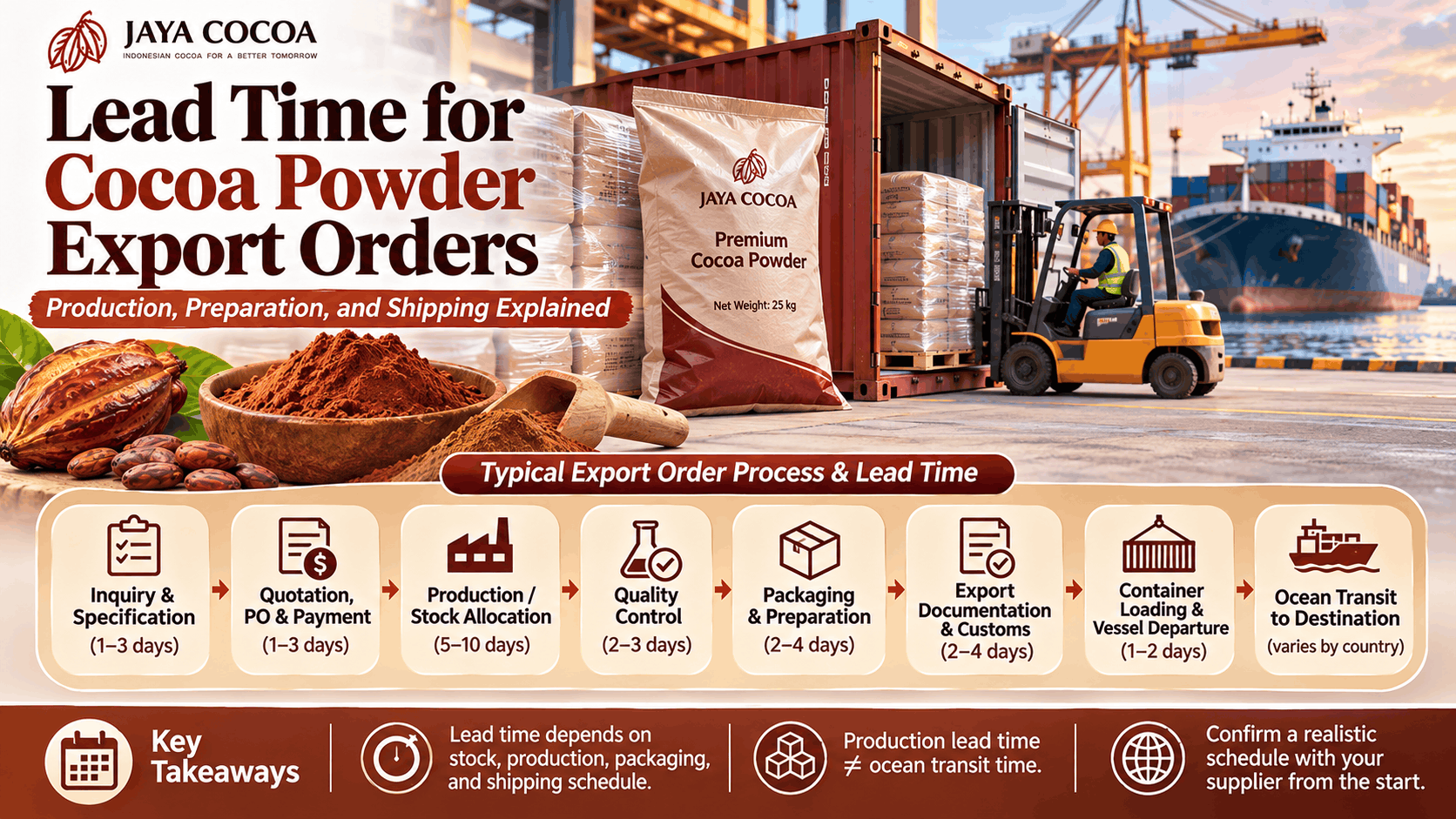
2. The Main Stages of a Cocoa Powder Export Order
A typical cocoa powder export order involves several stages.
Stage 1: Buyer Inquiry and Product Specification Confirmation
The process begins when the buyer sends an inquiry to the supplier.
At this stage, both parties need to establish the product and commercial requirements.
Important details include:
- Cocoa powder type: natural or alkalized
- Fat content
- pH value
- Colour
- Moisture content
- Fineness or particle size
- Microbiological requirements, if applicable
- Packaging specifications
- Order quantity
- Destination country and port
- Incoterms and payment terms
For example, a buyer requesting premium alkalized cocoa powder with a specific pH and colour may require a different sourcing or production arrangement from a buyer ordering an existing standard grade.
The more clearly the specifications are established, the lower the risk of delays caused by misunderstandings or product revisions.
Stage 2: Quotation, Purchase Order, and Payment Confirmation
After the product requirements are agreed, the supplier issues a quotation or proforma invoice.
The buyer then reviews the commercial terms and proceeds with the purchase order and agreed payment arrangements.
Depending on the contract, the order may require:
- Advance payment
- Deposit confirmation
- Letter of Credit arrangement
- Purchase Order approval
- Sales contract signing
Payment confirmation is an important milestone because some suppliers will not begin procurement or production until the agreed payment conditions have been fulfilled.
For this reason, buyers should clarify exactly when the supplier considers the order officially confirmed.
Stage 3: Raw Material Procurement or Stock Allocation
The next stage depends on the supplier’s inventory position.
There are two common situations.
A. Orders from Available Stock
If the required cocoa powder is already available and meets the buyer’s specifications, the supplier may proceed directly to quality verification, packaging preparation, and export arrangements.
This can significantly shorten the order lead time.
However, stock availability should always be confirmed by product grade, batch, quantity, and quality status.
B. Make-to-Order or Supplier Production
If the required product is unavailable, the supplier may need to coordinate with a manufacturer or arrange new production.
This stage can involve:
- Raw material availability
- Production scheduling
- Processing capacity
- Product blending or adjustment, where permitted
- Special quality requirements
- Manufacturing availability
Orders involving special specifications or large quantities may require additional preparation.
For exporters sourcing cocoa powder from third-party manufacturers, coordination between the exporter and manufacturer is particularly important.
Stage 4: Production and Quality Control
Once the product is available or manufacturing is completed, quality control is performed to verify that the goods meet the agreed specifications.
For cocoa powder, relevant parameters may include:
| Parameter | Purpose |
|---|---|
| Fat content | Confirms the required cocoa powder grade |
| pH | Evaluates acidity or alkalinity |
| Colour | Checks product appearance |
| Moisture | Evaluates moisture level |
| Fineness | Checks particle size |
| Microbiological parameters | Evaluates microbiological quality |
| Sensory characteristics | Evaluates aroma and flavour |
The exact testing requirements depend on the product specification, buyer requirements, and applicable regulations.
A Certificate of Analysis (COA) may be prepared to document the results.
If the buyer requires an independent laboratory test, additional time may be necessary.
Any discrepancy between the tested product and the agreed specification should be resolved before shipment.
Stage 5: Packaging and Export Preparation
After quality approval, cocoa powder is prepared for export.
Standard industrial packaging commonly includes multi-layer paper bags with an inner food-grade liner, although packaging requirements vary by buyer.
The preparation process may include:
- Packaging material procurement
- Bag printing or labelling
- Product filling and weighing
- Bag sealing
- Batch identification
- Palletizing, if required
- Warehouse preparation
- Final quantity verification
Special packaging, private-label requirements, or customized artwork may extend the preparation period.
Buyers should therefore approve packaging specifications and artwork as early as possible.
Stage 6: Export Documentation and Customs Clearance
Before the cargo can leave Indonesia, the exporter must complete the applicable export procedures.
Depending on the transaction and destination market, documents may include:
- Commercial Invoice
- Packing List
- Certificate of Analysis
- Certificate of Origin, when required
- Bill of Lading
- Other certificates or supporting documents required by the buyer or destination country
The exporter or its appointed customs service provider also prepares the required customs declaration, known in Indonesia as the Pemberitahuan Ekspor Barang (PEB).
Under Indonesian customs procedures, export goods are subject to document review and may be selected for physical inspection based on customs risk management.
Incomplete or inconsistent information can create additional work and delay cargo release.
Therefore, export documentation should be prepared and checked before the planned cargo delivery to the port.
Stage 7: Container Loading and Vessel Departure
After the required export procedures have been completed, the cargo is transported to the designated port and prepared for loading.
The process may include:
- Container booking confirmation
- Empty container availability
- Container condition inspection
- Cargo loading
- Container sealing
- Terminal gate-in
- Vessel loading
- Vessel departure
The shipment schedule depends on the shipping line, port operations, vessel rotation, and available space.
A completed order does not necessarily mean that the cargo will depart immediately.
If the goods miss the shipping line’s cargo cut-off or vessel schedule, the shipment may need to wait for the next available sailing.
3. How Long Does a Cocoa Powder Export Order Take?
There is no universal lead time for every cocoa powder export order.
The actual duration depends on stock availability, production arrangements, order quantity, packaging requirements, quality inspection, documentation, and shipping schedules.
For planning purposes, the following table provides an illustrative framework.
| Order condition | Indicative preparation planning |
|---|---|
| Available stock with standard packaging | Shorter preparation period |
| Available stock with customized packaging | Additional packaging preparation |
| Make-to-order production | Additional procurement and production time |
| Special specifications or additional testing | Additional technical approval and QC time |
| Large-volume order | Depends on production capacity and scheduling |
The table is intentionally not expressed as a guaranteed number of days. Actual supplier commitments should be based on confirmed stock, production schedules, packaging readiness, and export arrangements.
Example of an Export Order Timeline
Consider a hypothetical order for 24 metric tons of alkalized cocoa powder from Indonesia.
The following is an example of how the order may progress:
| Process | Illustrative duration |
|---|---|
| Specification and commercial confirmation | 2–3 working days |
| Stock allocation or production preparation | 5–10 working days |
| Quality control and approval | 2–3 working days |
| Packaging and final preparation | 2–4 working days |
| Export documentation and port coordination | 2–4 working days |
These figures are illustrative planning assumptions, not published industry standards or a guaranteed Jaya Cocoa delivery commitment. Some activities can overlap, while others must be completed sequentially.
Ocean transit time is excluded from this example.
The most reliable approach is to request a shipment-specific schedule from the supplier and freight forwarder.
4. Factors That Affect Cocoa Powder Export Lead Time
Several factors can influence how quickly an export order is completed.
4.1 Product Availability
Available stock is one of the most important factors.
A supplier with sufficient stock of the required grade may be able to prepare an order faster than a supplier that needs to arrange new production.
However, available inventory must match the buyer’s specifications and quality requirements.
4.2 Order Quantity
Large-volume orders may require more extensive production planning, stock allocation, packaging, and loading arrangements.
For example, a small trial order and a full-container order may follow different preparation schedules.
The supplier should confirm whether the requested quantity is available in one batch or requires multiple production lots.
4.3 Product Specifications
Special requirements may increase preparation time.
Examples include:
- Specific alkalization levels
- Particular fat content
- Custom colour requirements
- Special particle-size requirements
- Microbiological limits
- Sterilization or additional treatment, where required and agreed
The supplier may need to arrange additional testing, processing, or manufacturer coordination.
4.4 Packaging Requirements
Standard 25 kg industrial bags are generally simpler to prepare than customized retail packaging.
Packaging involving printed bags, private labels, special liners, jars, or customized cartons may require additional material sourcing and approval.
4.5 Payment Confirmation
Payment terms influence when procurement, production, or order allocation can begin.
If the agreed deposit is delayed, the supplier may need to revise its production or shipment schedule.
4.6 Quality Approval
A buyer may request a pre-shipment sample, additional laboratory testing, or independent inspection.
These requirements can extend the time between production completion and shipment readiness.
4.7 Port and Vessel Schedules
International shipping is affected by vessel availability, port congestion, transshipment arrangements, and shipping line schedules.
Even when the goods are ready, the actual departure date depends on the confirmed vessel booking.
5. Production Lead Time vs. Ocean Transit Time
One of the most common misunderstandings in international trade is confusing production lead time with shipping transit time.
These are two separate parts of the supply chain.
Production and Export Preparation Lead Time
This covers the period required to prepare the goods and complete the export process up to the agreed shipment milestone.
Ocean Transit Time
This covers the movement of cargo by sea from the port of origin to the destination port.
For example:
A supplier may require several weeks to prepare an order, while the ocean transportation period may require additional weeks depending on the destination and shipping route.
The World Bank’s Logistics Performance Index 2023 reported an average of approximately 44 days from a container entering the export port until it exits the destination port across the routes analyzed. This is a global reference, not a transit-time estimate for every cocoa powder shipment or a specific Indonesian trade route.
The World Bank also highlights that port dwell time and delays in logistics facilities contribute significantly to delivery-time variability.
For buyers, this means that the estimated arrival date should be calculated using both the supplier’s preparation schedule and the actual shipping route.
6. How Incoterms Affect Export Delivery Planning
Incoterms define the responsibilities of buyers and sellers regarding delivery, costs, risks, and related transportation arrangements.
They are important when establishing which part of the export process is managed by each party.
Common terms used in cocoa powder export transactions include:
EXW (Ex Works)
The seller makes the goods available at the agreed location. The buyer generally arranges collection and subsequent transportation.
FOB (Free on Board)
Under FOB, the seller delivers the goods on board the vessel nominated by the buyer at the named port of shipment. The seller handles the applicable export formalities.
CFR (Cost and Freight)
The seller arranges and pays for the carriage to the named destination port, while risk transfers to the buyer when the goods are on board the vessel at the port of shipment.
CIF (Cost, Insurance and Freight)
Similar to CFR, but the seller also arranges the required insurance cover under the CIF rule.
An important consideration is that the delivery point and risk-transfer point differ depending on the Incoterms rule.
For containerized shipments, buyers and sellers should also consider whether FCA is more appropriate than FOB, depending on how the goods are handed over to the carrier.
Incoterms do not establish a universal production lead time or guarantee a vessel arrival date. The parties should separately agree on production readiness, shipment dates, and delivery expectations.
7. Common Causes of Delays in Cocoa Powder Export Orders
Understanding potential delays allows both buyers and suppliers to take preventive action.
| Potential delay | Possible cause | Recommended action |
|---|---|---|
| Product preparation | Insufficient stock or production capacity | Confirm stock and production allocation before order confirmation |
| Payment | Delayed deposit or payment verification | Agree on clear payment milestones |
| Packaging | Customized materials are not ready | Approve packaging specifications early |
| Quality control | Product does not meet the agreed specification | Confirm specifications and testing requirements before production |
| Documentation | Incorrect or incomplete export information | Prepare and cross-check documents in advance |
| Container loading | Container or trucking availability | Coordinate with the freight forwarder early |
| Vessel departure | Missed cut-off or schedule changes | Confirm the latest shipping schedule |
| Destination delivery | Customs clearance or port delays | Prepare destination documents and import requirements in advance |
Delays are not always caused by production. In many cases, they occur because different parties in the supply chain are not working from the same schedule.
8. How Buyers Can Reduce Cocoa Powder Export Lead Time
International buyers can help improve delivery efficiency by preparing important information before placing an order.
8.1 Finalize Product Specifications Before Ordering
Avoid changing product specifications after the purchase order has been confirmed.
Buyers should provide clear requirements for fat content, pH, colour, moisture, particle size, and other relevant parameters.
8.2 Confirm Stock Availability
Ask the supplier whether the requested cocoa powder is available in finished stock or requires new production.
Also confirm the batch quantity and whether the available stock has already passed the required quality checks.
8.3 Approve Samples and Packaging Early
If the buyer requires customized packaging or a product sample, these requirements should be addressed before the main order is scheduled.
8.4 Make Payment According to the Agreed Schedule
Delayed payments can affect production allocation, packaging procurement, and shipping arrangements.
Both parties should clearly define the payment conditions and the date from which the agreed lead time begins.
8.5 Agree on a Realistic Shipment Schedule
The supplier should provide a target goods-ready date, estimated port delivery date, and planned vessel departure.
Buyers should also request updates if the shipping line changes its schedule.
8.6 Maintain Regular Communication
A simple progress update can help prevent misunderstandings.
Buyers may request updates at important milestones:
- Order confirmation
- Stock allocation or production start
- Production completion
- Quality approval
- Packaging completion
- Container loading
- Vessel departure
9. What Should Buyers Ask Their Cocoa Powder Supplier About Lead Time?
Before confirming an international purchase order, buyers should ask the supplier several practical questions.
- Is the requested cocoa powder available in finished stock?
- If not, how long will production preparation take?
- When does the official lead time start?
- Does the quoted lead time include quality inspection and packaging?
- When will the Certificate of Analysis be available?
- Are customized packaging materials available?
- What is the estimated goods-ready date?
- When is the planned container loading date?
- What is the expected vessel departure date?
- What factors could cause a change in the shipment schedule?
These questions help buyers evaluate whether the supplier has a clear and realistic order-management process.
10. Frequently Asked Questions About Cocoa Powder Export Lead Time
How long does it take to export cocoa powder from Indonesia?
There is no fixed duration for every order. The preparation period depends on stock availability, production requirements, packaging, quality inspection, export documentation, and vessel schedules. Buyers should request a confirmed schedule for their specific order.
Does cocoa powder in stock have a shorter lead time?
Generally, available finished stock can reduce the need for new production. However, the supplier still needs to verify the product batch, quantity, quality status, packaging, and export readiness.
Does the export lead time include ocean shipping?
Not necessarily. Some suppliers quote only the time required to prepare goods for shipment, while others may provide a separate estimated arrival schedule. Buyers should clarify the exact milestone covered by the quotation.
Can customized packaging increase lead time?
Yes. Customized bags, printed labels, retail packaging, and special packaging materials may require additional procurement, artwork approval, and preparation.
Can buyers request an urgent cocoa powder shipment?
Urgent orders may be possible if the required product is available and the export arrangements can be completed within the requested period. However, availability and vessel schedules must be confirmed before a delivery commitment is made.
What is the difference between shipment date and arrival date?
The shipment date generally refers to the date the cargo is loaded and departs from the origin port. The arrival date refers to the estimated or actual arrival at the destination. The two dates are separated by ocean transit time and may also be affected by port operations.
Conclusion
Lead time is an important part of international cocoa powder sourcing because it affects production planning, inventory management, and delivery reliability.
A successful export order requires coordination between the buyer, exporter, manufacturer, quality-control team, customs service provider, freight forwarder, and shipping line.
The most effective way to manage lead time is to confirm product specifications early, verify stock availability, establish clear payment milestones, complete quality approval, prepare export documentation, and coordinate vessel schedules in advance.
For international buyers sourcing cocoa powder from Indonesia, understanding each stage of the export process makes it easier to plan purchases and reduce unnecessary delays.
Looking for a cocoa powder supplier from Indonesia?
Jaya Cocoa supplies cocoa powder for international food manufacturers, distributors, and importers.
Contact our team to discuss your required product specifications, order quantity, packaging requirements, and estimated shipment schedule.
References and Further Reading
- World Bank. (2023). Logistics Performance Index 2023: Supply Chain Reliability and Connectivity.
https://lpi.worldbank.org/ - World Bank. (2023). Understanding the Speed of Trade and the Nature of Delays.
https://documents1.worldbank.org/curated/en/099042123145531599/pdf/P17146804a6a570ac0a4f80895e320dda1e.pdf - International Chamber of Commerce (ICC). Incoterms® 2020: Rules for International Trade.
https://iccwbo.org/business-solutions/incoterms-rules/ - International Chamber of Commerce (ICC). (2024). Incoterms® 2020 FCA and CPT: Best Practice for Shipping Containers Through Ports.
https://2go.iccwbo.org/incotermsr-2020-fca-and-cpt-best-practice-for-shipping-containers-through-ports.html - Directorate General of Customs and Excise, Indonesia. Tata Laksana Ekspor.
https://www.beacukai.go.id/tata-laksana-ekspor - Directorate General of Customs and Excise, Indonesia. FAQ Tata Laksana Ekspor.
https://www.beacukai.go.id/faq-tatalaksana-ekspor - Jaya Cocoa. Cocoa Powder Export: Container Loading Guide.
https://jayacocoa.co.id/container-loading-guide-for-cocoa-powder-export/ - Jaya Cocoa. How Cocoa Powder Is Packed for Export.
https://jayacocoa.co.id/how-cocoa-powder-is-packed-for-export/