Dutch Process Cocoa Powder Explained: Processing, pH, Color, Flavor, and Applications
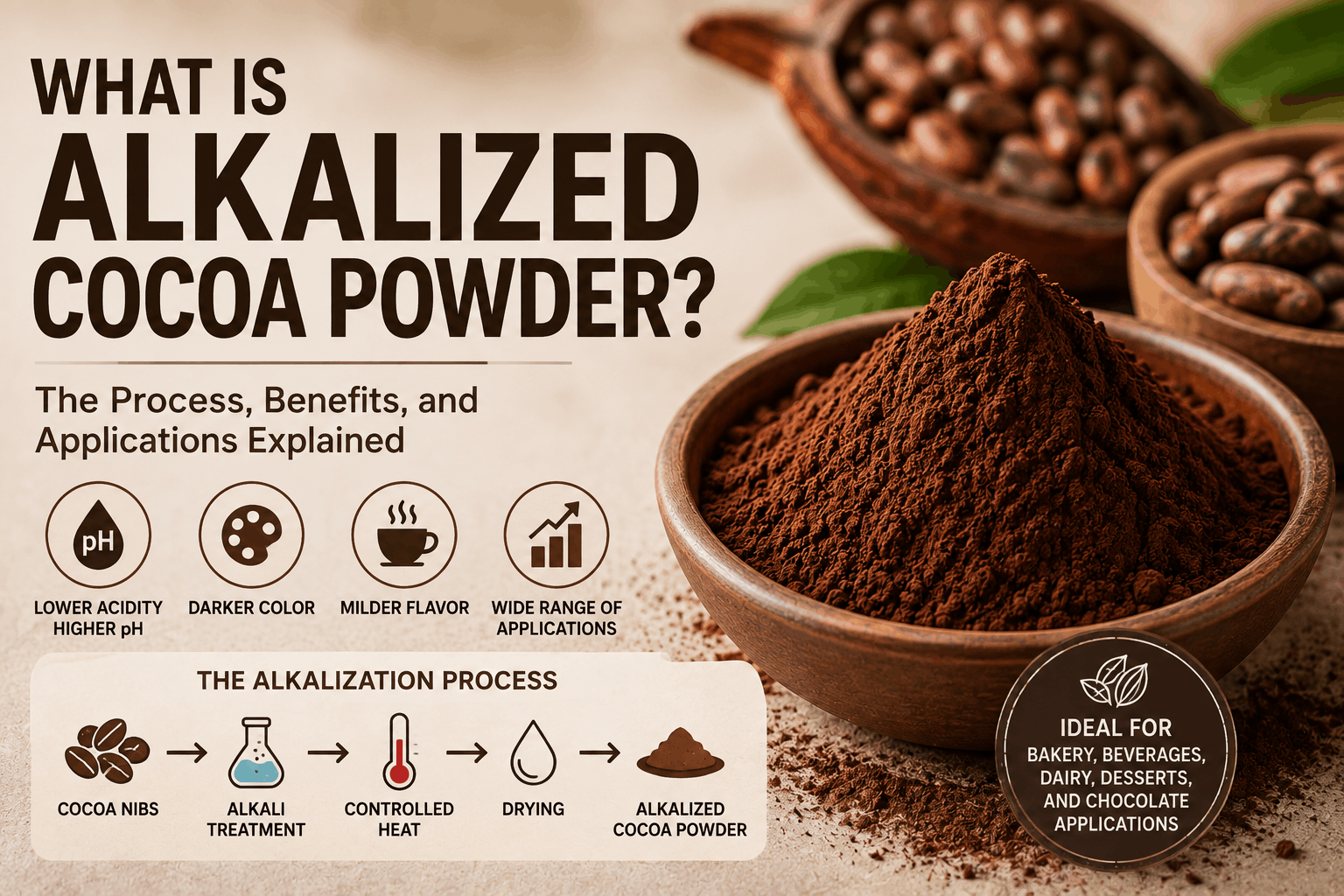
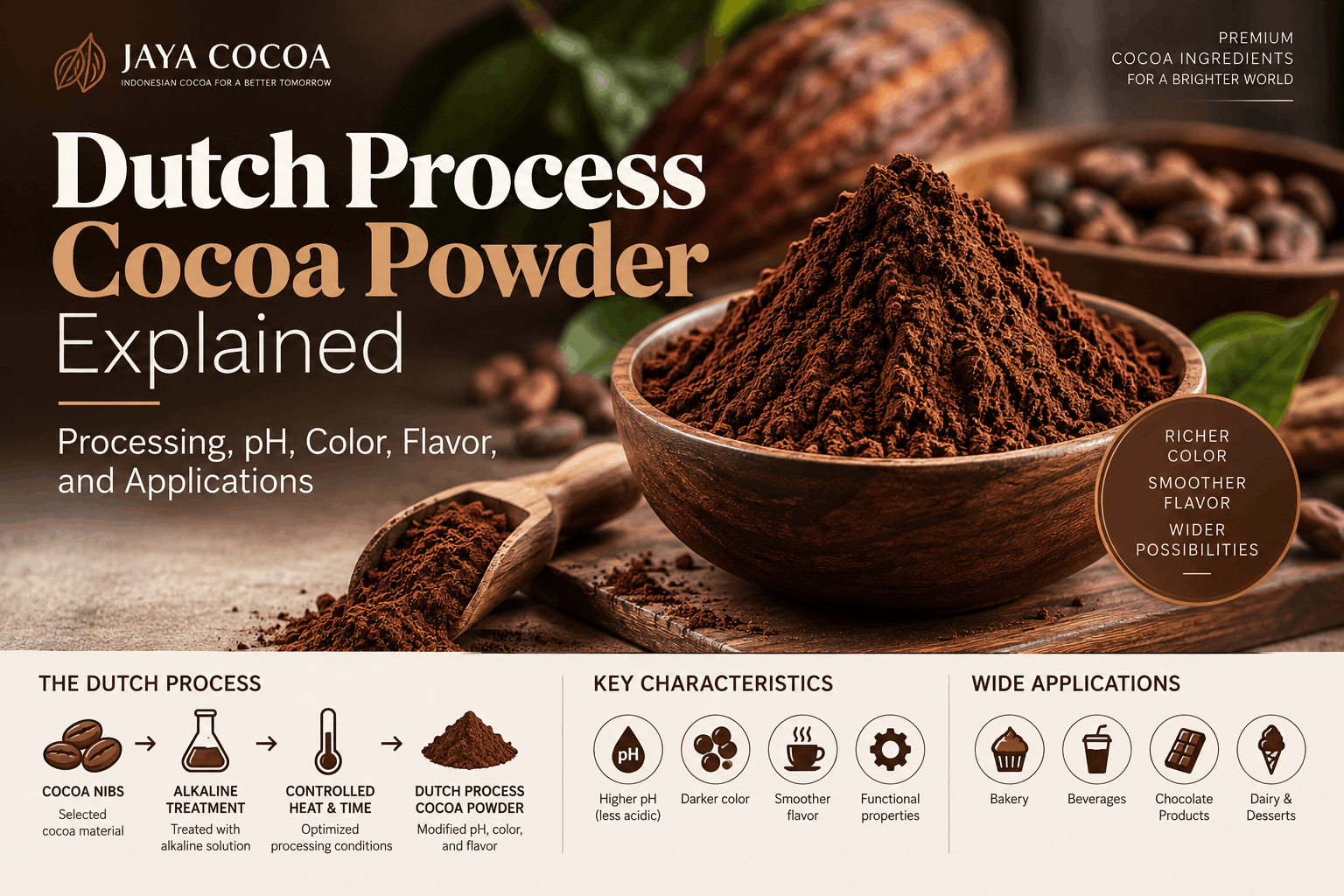
Dutch process cocoa powder is cocoa powder that has undergone an alkalization treatment designed to modify its natural acidity, color, flavor, and certain functional properties.
The term Dutch process cocoa is commonly used interchangeably with alkalized cocoa powder or Dutch-processed cocoa. In industrial cocoa processing, alkalization is an optional processing step rather than a universal requirement for producing cocoa powder.
For food manufacturers, bakers, beverage producers, and cocoa ingredient buyers, understanding Dutch process cocoa is important because the degree of alkalization can influence how cocoa powder behaves in a finished formulation.
The resulting cocoa powder can range from relatively light brown or reddish-brown to very dark brown or nearly black, depending on the raw material and processing conditions. The process can also raise cocoa powder pH and modify flavor and other physicochemical characteristics.
What Is Dutch Process Cocoa Powder?
Dutch process cocoa powder is cocoa powder that has been treated with an alkaline compound during cocoa processing to reduce acidity and modify characteristics such as pH, color, flavor, and functionality.
The treatment is known as alkalization, while “Dutch process” or “Dutching” is the commonly used industry terminology.
The International Cocoa Organization (ICCO) describes alkalization as an optional process used to modify the flavor and color of chocolate liquors and cocoa powders. According to ICCO, selected cocoa material such as cocoa cake, nibs, or cocoa liquor can be mixed with an aqueous solution of an alkaline compound under elevated temperatures and, in some processes, increased pressure.
Common alkaline compounds identified by ICCO include:
- Potassium carbonate
- Calcium carbonate
- Sodium hydroxide
The exact compound, concentration, temperature, processing time, and processing stage depend on the manufacturer’s process and the characteristics required for the finished cocoa product.
Why Is It Called Dutch Process Cocoa?
The term Dutch process comes from the historical development of cocoa alkalization associated with Dutch cocoa processing.
Today, however, the term is used broadly throughout the cocoa industry.
In practical purchasing terminology:
Dutch process cocoa ≈ alkalized cocoa powder
However, the terminology does not tell a buyer the complete technical specification.
Two products both described as “Dutch process cocoa” may differ substantially in:
- pH
- Color
- Fat content
- Moisture
- Particle size
- Flavor
- Degree of alkalization
- Microbiological specifications
- Application performance
Therefore, professional buyers should evaluate the technical specification and Certificate of Analysis (COA) rather than relying only on the term “Dutch process.”
How Does the Dutch Process Work?
The exact industrial process varies between manufacturers, but the basic principle is straightforward.
1. Cocoa Material Is Prepared
Cocoa beans undergo conventional processing, including fermentation, drying, roasting, and grinding.
Depending on the manufacturing route, alkalization can subsequently be applied to different cocoa materials.
ICCO identifies three possible materials for alkalization:
- Cocoa nibs
- Cocoa liquor
- Cocoa cake
This distinction is important because the point at which alkalization occurs can influence the final characteristics of the cocoa product.
2. Cocoa Is Treated With an Alkaline Solution
The selected cocoa material is mixed or treated with an aqueous alkaline solution.
The alkaline material reacts with components of the cocoa matrix and modifies its acidity.
The specific alkaline compound and processing conditions depend on the desired product.
There is therefore no single universal Dutch process recipe.
A manufacturer producing a light alkalized cocoa powder does not necessarily use the same conditions as a manufacturer producing a very dark cocoa powder.
3. Heat and Time Are Controlled
Temperature and processing time are important variables.
Research has demonstrated that alkalization conditions can significantly influence cocoa powder properties.
For example, Demirci et al. (2024) investigated the effects of alkali concentration, temperature, and processing time on cocoa powder quality and found significant effects on parameters including pH and color.
Sioriki et al. (2021) likewise investigated alkalization at different temperatures, alkali concentrations, and processing times and observed substantial changes in cocoa powder properties during treatment.
This is why degree of alkalization is an important concept in cocoa manufacturing.
What Happens to Cocoa During Dutch Processing?
Alkalization can produce several changes simultaneously.
The most commercially visible changes involve:
- pH
- Color
- Flavor
- Solubility and other functional properties
- Certain phytochemical components
Let’s look at each one.
1. Dutch Process Cocoa Has a Higher pH
One of the defining effects of alkalization is a reduction in cocoa’s natural acidity.
Natural cocoa powder generally retains an acidic character, while alkalized cocoa powder has a higher pH.
However, there is no single pH value that defines all Dutch process cocoa powders.
This is extremely important for industrial buyers.
Depending on the degree of alkalization, commercial cocoa powders can have significantly different pH values.
A research study by Sioriki et al. found that cocoa powder pH was affected by alkali concentration, while Demirci et al. demonstrated that alkalization process conditions could be optimized to produce different cocoa powder characteristics.
Therefore:
Dutch process does not automatically mean pH 7, pH 8, or any other single value.
The actual product specification should always be checked.
For a deeper explanation, see our guide to [Cocoa Powder pH].
2. Dutch Process Cocoa Becomes Darker
One of the most recognizable characteristics of Dutch process cocoa is its darker color.
Depending on the degree of alkalization, cocoa can develop colors ranging from:
- Light brown
- Reddish brown
- Dark brown
- Brown-black
- Very dark or charcoal-like
ICCO notes that alkalization can produce cocoa colors ranging from light red to charcoal black.
Research has also demonstrated a relationship between alkalization conditions and cocoa powder color.
Sioriki et al. observed a reduction in lightness as temperature and alkali concentration increased under the studied conditions.
Demirci et al. also found significant relationships between alkalization conditions and color-related parameters.
This is why manufacturers can produce different commercial grades of alkalized cocoa powder for different applications.
For more information, see our guide to [Cocoa Powder Color].
3. Dutch Process Cocoa Has a Different Flavor Profile
Natural cocoa can have a relatively acidic, sharp, or astringent flavor.
Alkalization can reduce some of this acidity and change the overall sensory profile.
Research has shown that alkalization affects cocoa flavor-related compounds and the aroma profile of cocoa beverages.
However, flavor should not be attributed to alkalization alone.
The final flavor of cocoa powder is influenced by the complete processing history, including:
- Cocoa bean origin
- Fermentation
- Drying
- Roasting
- Alkalization
- Storage
This is why two Dutch process cocoa powders can have noticeably different flavor profiles even when their colors appear similar.
4. Alkalization Can Affect Solubility and Functional Properties
Another reason alkalization is commercially useful is that it can modify certain functional properties of cocoa powder.
A review published in Comprehensive Reviews in Food Science and Food Safety described alkalization as an optional processing step used to darken cocoa, modify taste, and increase natural cocoa solubility.
However, solubility and dispersion should not be treated as identical concepts.
For beverage applications, manufacturers may also need to consider:
- Particle size
- Suspension stability
- Dispersion
- Powder wetting
- Formulation composition
- Processing method
Therefore, a darker Dutch process cocoa powder is not automatically the best cocoa powder for a beverage application.
5. Alkalization Can Change Certain Cocoa Compounds
Dutch processing can also alter some naturally occurring compounds in cocoa.
Sioriki et al. investigated the effects of alkalization on compounds including:
- Epicatechin
- Catechin
- Theobromine
- Caffeine
The study found that processing conditions influenced certain phytochemical components, with stronger conditions generally associated with greater changes in some compounds.
Earlier research similarly reported changes in polyphenols, methylxanthines, amino acids, and volatile compounds following alkalization.
A 2026 review in Food Chemistry concluded that alkalization can enhance sensory and technological properties but can also produce changes in nutritional and physicochemical characteristics. The review also emphasizes that standardizing alkalization conditions is difficult because raw materials and alkaline treatments vary.
This is another reason why the phrase “Dutch process” alone is not enough to describe a cocoa powder technically.
Dutch Process Cocoa vs Natural Cocoa Powder
The easiest way to understand Dutch process cocoa is to compare it with natural cocoa powder.
| Characteristic | Natural Cocoa Powder | Dutch Process Cocoa Powder |
|---|---|---|
| Conventional alkalization | No | Yes |
| Natural acidity | Retained to a greater extent | Reduced |
| pH | Generally lower | Generally higher |
| Color | Often lighter/reddish brown | Can range from brown to very dark |
| Flavor | More acidic/sharp | Often less acidic and different in profile |
| Processing | Standard cocoa processing | Includes alkaline treatment |
| Color customization | More limited | Greater range |
| Baking chemistry | Often paired with acidic formulations | Can behave differently because of higher pH |
These are general tendencies, not universal specifications.
The actual characteristics depend on the cocoa material and processing conditions.
For a complete comparison, read our article on [Natural vs Alkalized Cocoa Powder].
Dutch Process Cocoa and Baking
One of the most important practical differences between natural and Dutch process cocoa concerns baking chemistry.
Natural cocoa is acidic.
Dutch process cocoa has had its acidity modified through alkalization.
This can affect the interaction between cocoa powder and chemical leavening systems.
For example, a recipe designed around natural cocoa powder may use an acidic cocoa ingredient as part of the overall acid-base balance.
Replacing it with strongly alkalized cocoa can therefore change the formulation’s behavior.
Potential effects include:
- Batter pH
- Cake volume
- Texture
- Crumb structure
- Color
- Flavor
- Leavening performance
This does not mean that Dutch process cocoa cannot be used in baking.
It means that the cocoa powder and the complete formulation need to be considered together.
For industrial food manufacturers, application testing is therefore preferable to assuming that all cocoa powders can be substituted at a 1:1 ratio.
What Are the Applications of Dutch Process Cocoa Powder?
Dutch process cocoa powder is used across many food applications.
Bakery
Common applications include:
- Cakes
- Brownies
- Cookies
- Biscuits
- Wafers
- Sponge cakes
Manufacturers may select an alkalized cocoa powder to achieve a specific color and flavor profile.
Chocolate Beverages
Dutch process cocoa is widely used in cocoa beverage formulations.
Potential advantages include:
- Darker appearance
- Modified cocoa flavor
- Reduced perceived acidity
- Specific dispersion characteristics
However, beverage manufacturers should evaluate the complete powder specification and application performance rather than selecting solely on color.
Dairy Products
Alkalized cocoa can be used in products such as:
- Chocolate milk
- Dairy beverages
- Ice cream
- Chocolate desserts
The appropriate cocoa grade depends on the formulation and processing conditions.
Desserts
Applications can include:
- Pudding
- Chocolate dessert mixes
- Frozen desserts
- Dessert sauces
- Chocolate-flavored products
Industrial Food Products
Dutch process cocoa is also used in a wide range of processed foods where manufacturers require specific cocoa characteristics.
The appropriate grade depends on:
- Target color
- Flavor
- pH
- Fat content
- Particle size
- Processing conditions
- Regulatory requirements
What Does “Degree of Alkalization” Mean?
The degree of alkalization describes how strongly the cocoa material has been subjected to alkaline treatment.
It is useful to think of cocoa powders as existing along a processing spectrum rather than in only two categories:
Natural cocoa
↓
Lightly alkalized cocoa
↓
Medium alkalized cocoa
↓
Strongly alkalized cocoa
↓
Very dark / black cocoa
The exact boundaries between these commercial descriptions are not universal regulatory categories.
Different suppliers may use different terminology and specifications.
This is why buyers should request measurable specifications such as:
- pH
- Color
- Fat
- Moisture
- Particle size
- Microbiological parameters
- Flavor profile
rather than asking only for “light,” “medium,” or “dark Dutch cocoa.”
Is Black Cocoa the Same as Dutch Process Cocoa?
Black cocoa is generally associated with a high degree of alkalization, producing an extremely dark color.
However, the term “black cocoa” itself is a commercial description rather than a universal international specification.
Therefore, a buyer should not assume that every product called black cocoa has exactly the same:
- pH
- processing conditions
- fat content
- flavor
- particle size
A technical specification and COA should always be requested.
Does Codex Define Dutch Process Cocoa as a Separate Category?
This is an important distinction for professional buyers.
The Codex Standard for Cocoa Powders (CXS 105-1981) defines cocoa powder products and establishes requirements concerning composition and quality factors, among other provisions. The current Codex document is identified as CXS 105-1981, adopted in 1981 and amended in 2025.
The standard describes cocoa powder and fat-reduced cocoa powder in relation to cocoa cake and cocoa butter content.
However, “Dutch process” is not simply a separate universal Codex product category equivalent to a specific pH or color range.
For international trade, buyers should therefore distinguish between:
Regulatory standard
and
Commercial product specification.
The supplier’s specification should define the actual characteristics of the cocoa powder being offered.
What Should Buyers Check When Purchasing Dutch Process Cocoa?
For B2B buyers, I recommend evaluating at least the following parameters.
1. pH
Confirm the required pH range for the intended application.
2. Color
Specify the desired color using an agreed measurement or reference standard where appropriate.
3. Fat Content
Different formulations may require different cocoa butter levels.
4. Moisture
Moisture is an important quality parameter for cocoa powder.
Codex CXS 105-1981 specifies a maximum moisture content of 7% for cocoa powders covered by the standard, although commercial specifications can be tighter.
5. Particle Size
Particle size can influence texture, dispersion, and application performance.
6. Flavor
Evaluate both cocoa intensity and any undesirable acidic, bitter, or off-flavor characteristics.
7. Microbiological Quality
Microbiological specifications should be appropriate for the intended food application and destination market.
8. Contaminants
Depending on the market and product requirements, buyers may need appropriate testing for contaminants such as heavy metals.
9. COA
Ask for a Certificate of Analysis corresponding to the supplied production batch.
10. Application Testing
Whenever possible, test the cocoa powder in the actual formulation before making a large purchase.
Is Dutch Process Cocoa Better Than Natural Cocoa?
Not necessarily.
The better choice depends on the product.
For example:
| Requirement | Potentially Suitable Cocoa |
|---|---|
| More acidic cocoa profile | Natural cocoa |
| Darker chocolate color | Alkalized cocoa |
| Specific higher pH | Alkalized cocoa |
| Formulation requiring natural cocoa acidity | Natural cocoa |
| Dark chocolate beverage | Often alkalized cocoa |
| Specific dark bakery appearance | Often alkalized cocoa |
| Application requiring acid-base interaction | Depends on formulation |
The correct question is therefore not:
“Which cocoa powder is better?”
but:
“Which cocoa powder fits the formulation and technical requirements?”
How to Select the Right Dutch Process Cocoa Powder
A professional sourcing process should begin with the finished product rather than the cocoa supplier’s catalog.
Step 1 — Define the application
Determine whether the cocoa will be used for:
Step 2 — Define the technical specification
Establish requirements for:
- pH
- Color
- Fat
- Moisture
- Particle size
- Flavor
- Microbiology
Step 3 — Request samples
A laboratory or production sample allows the manufacturer to evaluate actual performance.
Step 4 — Test the formulation
Evaluate the cocoa in the intended product rather than judging it only as a dry powder.
Step 5 — Verify documentation
Request:
- Product specification
- COA
- Food safety documentation
- Regulatory information
- Relevant contaminant testing
- Traceability information
Step 6 — Evaluate consistency
For recurring purchases, the supplier’s ability to maintain consistent specifications from batch to batch becomes critical.
Frequently Asked Questions
What is Dutch process cocoa powder?
Dutch process cocoa powder is cocoa powder that has undergone alkalization to modify its acidity, color, flavor, and other characteristics.
Is Dutch process cocoa the same as alkalized cocoa?
Yes. In common cocoa-industry terminology, Dutch process cocoa and alkalized cocoa generally refer to cocoa that has undergone alkaline treatment.
Is Dutch process cocoa acidic?
It is generally less acidic and has a higher pH than natural cocoa powder, but the actual pH depends on the degree and conditions of alkalization.
Why is Dutch process cocoa darker?
Alkalization can substantially reduce cocoa powder lightness and produce darker brown, red-brown, or nearly black colors depending on processing conditions.
Can Dutch process cocoa be used for baking?
Yes. It is widely used in bakery applications, but its higher pH can affect the acid-base balance of a formulation. Therefore, substitution should be tested rather than assumed to be identical.
Is black cocoa Dutch process cocoa?
Black cocoa is generally associated with extensive alkalization, but buyers should verify the actual technical specification rather than relying on the product name alone.
Does alkalization affect cocoa’s nutrients or phytochemicals?
Yes. Research has shown that alkalization can affect certain phytochemicals and other cocoa compounds, with the extent depending on processing conditions.
What alkaline compounds are used?
ICCO identifies potassium carbonate, calcium carbonate, and sodium hydroxide among compounds used in cocoa alkalization.
Conclusion
Dutch process cocoa powder is cocoa powder that has undergone an alkalization treatment to modify its acidity, color, flavor, and functional characteristics.
The process can produce cocoa powders ranging from relatively light brown to very dark or black, depending on the cocoa material and processing conditions.
However, “Dutch process” should not be treated as a complete technical specification.
The actual characteristics of the finished cocoa powder depend on variables such as:
- Cocoa material
- Alkali type
- Alkali concentration
- Temperature
- Processing time
- Processing stage
- Roasting
- Cocoa origin
Scientific research has demonstrated that alkalization can significantly influence cocoa powder pH, color, flavor-related characteristics, and certain phytochemical components. Recent research also emphasizes that there is considerable variability in alkalization processes and raw materials, making a single universal processing specification inappropriate.
For food manufacturers and international buyers, the best approach is therefore to select Dutch process cocoa based on measurable specifications, application performance, food-safety requirements, documentation, and batch consistency.
References
1. International Cocoa Organization (ICCO) — Processing Cocoa
2. FAO/WHO Codex Alimentarius — CXS 105-1981
Standard for Cocoa Powders (Cocoas) and Dry Mixtures of Cocoa and Sugars.
3. Sioriki, E., et al. (2021)
“Impact of alkalization conditions on the phytochemical content of cocoa powder and the aroma of cocoa drinks.” LWT – Food Science and Technology, 145, 111181.
4. Demirci, S., et al. (2024)
“Influence of process conditions of alkalization on quality of cocoa powder.” Food Research International, 182, 114147.
DOI: 10.1016/j.foodres.2024.114147.
5. Binello, A., Cravotto, G., Mantegna, S., & Tagliapietra, S. (2026)
“An upgrade in cocoa alkalization: Functional changes, chemistry and new perspectives.” Food Chemistry, 499, 147370.
DOI: 10.1016/j.foodchem.2025.147370.