Roasting Process for Cocoa Beans: Methods, Temperature, and Flavor Development
Cocoa bean roasting is one of the most important stages in cocoa processing. After fermentation and drying, cocoa beans undergo controlled heating to develop their characteristic aroma, flavour, colour, and other physical and chemical properties.
For cocoa processors and food manufacturers, roasting is more than simply heating dried cocoa beans. It is a carefully controlled operation that influences the quality of cocoa liquor, cocoa butter, cocoa cake, and cocoa powder.
The roasting conditions including temperature, time, airflow, and heating method must be selected according to the characteristics of the cocoa beans and the desired product profile.
In this guide, Jaya Cocoa explains how cocoa bean roasting works, the different roasting methods, the factors affecting roasting performance, and how proper process control contributes to consistent cocoa quality.
1. What Is Cocoa Bean Roasting?
Cocoa bean roasting is a thermal processing operation in which dried cocoa beans, cocoa nibs, or cocoa liquor are exposed to controlled heat.
The main objectives are to:
- Develop characteristic cocoa and chocolate aromas.
- Transform flavour precursors formed during fermentation.
- Reduce residual moisture.
- Reduce undesirable volatile acids and raw or harsh flavour notes.
- Develop the desired brown colour.
- Prepare cocoa materials for subsequent processing.
Roasting plays a major role in flavour development. During heating, chemical reactions such as the Maillard reaction and Strecker degradation contribute to the formation of aroma compounds associated with roasted cocoa and chocolate.
The final flavour depends on several factors, including cocoa bean origin, fermentation quality, moisture content, roasting equipment, and processing conditions.
It is important to understand that roasting cannot completely correct poor quality or inadequately fermented cocoa beans. Good flavour development begins with proper post harvest handling.
2. Why Is Roasting Important in Cocoa Processing?
Roasting influences several quality characteristics that are important to cocoa processors and downstream food manufacturers.
2.1 Flavour and Aroma Development
One of the primary purposes of roasting is to develop the characteristic flavour of cocoa.
Heat promotes reactions between amino acids and reducing sugars, contributing to the formation of aroma compounds such as pyrazines and other volatile substances.
Depending on the roasting conditions, the resulting flavour profile may include:
- Roasted cocoa notes
- Chocolate-like aroma
- Nutty characteristics
- Caramel-like notes
- Toasted or roasted flavours
Excessive roasting, however, can produce burnt, bitter, or overly harsh characteristics.
2.2 Moisture Reduction
Dried cocoa beans still contain a small amount of moisture. Roasting reduces this moisture further and changes the physical properties of the beans.
Moisture reduction can contribute to easier shell separation, improved grinding behaviour, and more consistent downstream processing.
The final moisture level depends on the initial bean condition, roasting method, temperature, and duration.
2.3 Reduction of Unwanted Acidity
Cocoa beans contain organic acids, including acetic acid, which are produced during fermentation.
Controlled roasting helps reduce some volatile acidic compounds, contributing to a less sharp and more balanced flavour.
However, roasting conditions must be carefully selected. Excessive heat may damage desirable flavour characteristics rather than improve them.
2.4 Colour Development
Roasting contributes to the development of brown colour through non-enzymatic browning reactions.
The final colour depends on the original cocoa beans, fermentation, roasting conditions, and subsequent processing.
Roasting is not the only factor responsible for cocoa powder colour. Alkalization, for example, can significantly change the colour of cocoa products.
3. How Does the Cocoa Bean Roasting Process Work?
The roasting process normally takes place after cocoa fermentation and drying.
A typical industrial processing sequence is outlined below.
Step 1: Raw Cocoa Bean Inspection
Before roasting, cocoa beans should be inspected to evaluate their physical condition and suitability for processing.
Important inspection parameters include:
- Moisture content
- Bean size and uniformity
- Foreign materials
- Mouldy or damaged beans
- Insect infestation
- Fermentation condition
- Unusual odours
Inconsistent bean size and moisture can result in uneven heat transfer during roasting.
Step 2: Cleaning and Sorting
Cocoa beans are cleaned to remove unwanted materials such as stones, dust, metal fragments, and other foreign objects.
Sorting may also be conducted to remove damaged or unsuitable beans.
Cleaning is important for food safety, product quality, and the protection of processing equipment.
Step 3: Preheating the Roasting Equipment
The roasting machine is brought to its operating temperature before the cocoa beans are loaded.
Preheating helps establish more consistent operating conditions and reduces temperature fluctuations during the roasting cycle.
The equipment should be clean and properly maintained to prevent contamination and unwanted odours.
Step 4: Roasting the Cocoa Beans
The cleaned cocoa beans are transferred into the roasting equipment.
During roasting, heat is transferred to the beans through hot air, contact with heated surfaces, or a combination of heating mechanisms.
The roasting operator controls important parameters such as:
- Roasting temperature
- Roasting duration
- Airflow
- Bean loading capacity
- Heating rate
- Cooling conditions
The beans must receive sufficiently uniform heat to achieve the intended roasting profile.
Step 5: Cooling the Roasted Beans
After reaching the target roasting condition, the beans should be cooled in a controlled manner.
Cooling helps prevent continued heat exposure and reduces the risk of excessive roasting.
Proper cooling also prepares the beans for subsequent shell separation and grinding operations.
Step 6: Cracking and Winnowing
After roasting and cooling, cocoa beans are commonly cracked to break the outer shell.
The shell is then separated from the cocoa nibs through a process called winnowing.
The objective is to obtain clean cocoa nibs with minimal shell contamination.
The roasted nibs can then be processed into cocoa liquor through grinding.
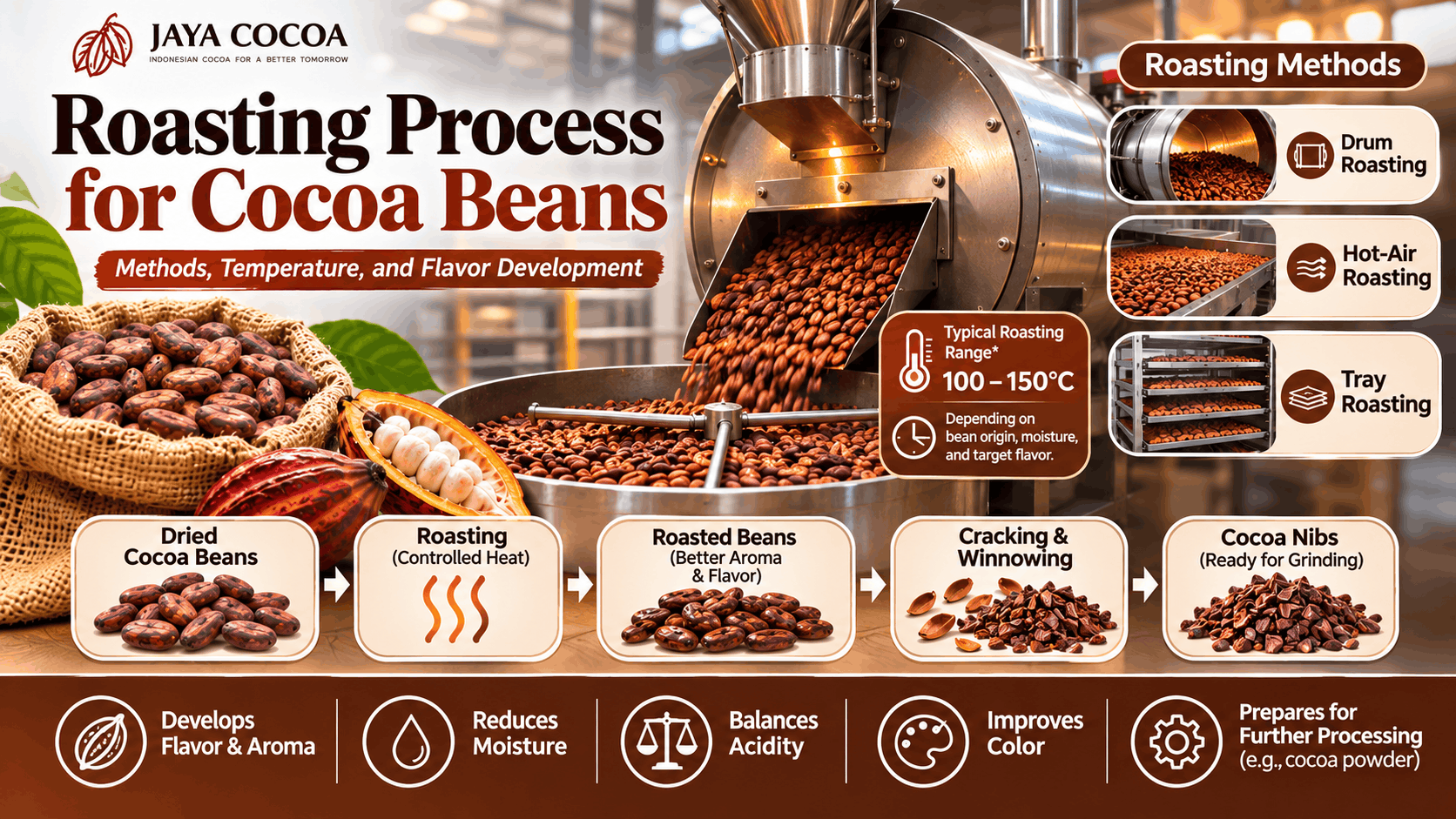
4. Different Cocoa Bean Roasting Methods
Industrial cocoa processors use different roasting technologies depending on production capacity, product requirements, and investment considerations.
4.1 Drum Roasting
Drum roasting uses a rotating heated drum to expose cocoa beans to heat.
The rotation helps move the beans during processing and supports more uniform heat exposure.
Key characteristics:
- Suitable for batch or continuous industrial applications, depending on equipment design.
- Provides controlled heating through drum rotation.
- Requires monitoring of temperature and roasting duration.
- Can be adjusted to achieve different flavour profiles.
Drum roasting is commonly associated with industrial cocoa and chocolate processing.
4.2 Hot-Air Roasting
Hot-air roasting uses heated air to transfer thermal energy to cocoa beans.
The beans are exposed to a controlled flow of hot air, allowing heat to reach their surfaces and gradually transfer inward.
Key characteristics:
- Provides convective heat transfer.
- Allows control of air temperature and airflow.
- Can be designed for batch or continuous operation.
- Requires attention to airflow distribution and bean loading.
4.3 Tray Roasting
Tray roasting uses stationary trays inside a heated chamber.
Cocoa beans are spread across the trays and exposed to controlled heat.
Key characteristics:
- Relatively straightforward equipment configuration.
- Useful for small-scale processing and laboratory trials.
- Allows different roasting conditions to be tested.
- Requires careful control of bean depth and heat distribution.
Tray roasting can be useful when evaluating cocoa bean samples and developing roasting profiles.
4.4 Fluidized-Bed Roasting
Fluidized-bed roasting uses a controlled stream of hot air to suspend and move the cocoa particles during heating.
This technology can provide rapid and relatively uniform heat transfer when properly designed.
It is particularly relevant to processing applications involving cocoa nibs and other appropriately sized materials.
Equipment design, particle size, airflow, and operating conditions must be considered carefully.
5. Cocoa Roasting Temperature and Time
Temperature and roasting duration are two of the most important parameters in cocoa processing.
However, there is no single universal temperature and time combination suitable for every cocoa bean.
Research commonly discusses cocoa roasting temperatures within approximately 100–150°C, although industrial and experimental conditions can extend beyond this range depending on the equipment, material, and process objective.
For example, the Cacao of Excellence quality assessment guidance provides illustrative convection-tray roasting conditions of:
- Low roast: 112°C for 25 minutes
- Medium roast: 120°C for 25 minutes
- High roast: 130°C for 25 minutes
These conditions are starting references for specific flavour-evaluation procedures, not universal industrial production specifications.
Actual roasting conditions should be established through trials using the intended cocoa beans and roasting equipment.
Factors affecting the appropriate roasting profile include:
- Cocoa bean origin and genetic characteristics
- Fermentation quality
- Initial moisture content
- Bean size and uniformity
- Roasting equipment and heat-transfer mechanism
- Product application and target flavour
- Desired colour and acidity
A roasting profile that works well for one cocoa bean source may not produce the same results with another source.
6. What Happens to Cocoa Beans During Roasting?
Roasting causes several physical and chemical transformations.
Understanding these changes helps processors control product quality more effectively.
6.1 Maillard Reaction
The Maillard reaction occurs between reducing sugars and amino compounds under suitable heating conditions.
This reaction contributes to the development of brown colour and many of the characteristic aromas associated with roasted cocoa.
6.2 Strecker Degradation
Strecker degradation involves reactions between amino acids and reactive carbonyl compounds.
It contributes to the formation of important aroma compounds during cocoa roasting.
6.3 Volatile Compound Transformation
Roasting changes the composition and concentration of volatile compounds in cocoa beans.
Some compounds associated with raw or acidic notes may decrease, while other compounds associated with roasted, nutty, and chocolate-like aromas may develop.
The balance depends on the roasting profile and the original characteristics of the beans.
6.4 Changes in Polyphenols
Cocoa contains polyphenolic compounds, including flavanols.
Roasting can change the concentration and composition of these compounds. The extent of change depends on temperature, duration, and other processing conditions.
Therefore, a higher roasting intensity should not automatically be considered better.
7. Factors That Affect Cocoa Roasting Quality
Consistent roasting requires more than setting a temperature and timer.
Several raw-material and operational factors influence the final result.
7.1 Initial Moisture Content
Cocoa beans with different moisture levels may respond differently to heat.
Moisture affects heat transfer, drying behaviour, and the time required to reach the target roasting condition.
7.2 Bean Size
Larger and smaller beans may heat at different rates.
A batch containing highly variable bean sizes can result in uneven roasting.
Sorting or grading beans by size may help improve consistency.
7.3 Fermentation Quality
Fermentation creates important flavour precursors that are transformed during roasting.
Poor fermentation may limit the development of desirable cocoa flavour, even when roasting is carefully controlled.
7.4 Roasting Equipment
Different machines transfer heat in different ways.
Drum, hot-air, tray, and fluidized-bed systems may require different operating parameters to achieve comparable results.
7.5 Roasting Time and Temperature
Temperature and time must be evaluated together.
A higher temperature applied for a shorter period can produce a different chemical and sensory result from a lower temperature applied for a longer period.
Both excessive and insufficient roasting can negatively affect the desired flavour profile.
8. Common Problems During Cocoa Roasting
Roasting problems can affect product consistency, flavour, and downstream processing.
| Problem | Possible cause | Potential impact |
|---|---|---|
| Burnt flavour | Excessive heat or roasting duration | Harsh and unpleasant flavour |
| Uneven roasting | Inconsistent bean size or heat distribution | Inconsistent colour and flavour |
| Excessive acidity | Insufficient reduction of volatile acids | Sharp or sour flavour |
| Weak roasted aroma | Inadequate roasting conditions | Underdeveloped flavour |
| Excessive moisture | Insufficient heat exposure or poor process control | Inconsistent shell separation and processing |
| Shell contamination | Inefficient cracking and winnowing | Lower nib purity |
Processors should investigate the underlying cause rather than simply increasing the roasting temperature.
A controlled adjustment of the roasting profile is generally more effective than making large, unvalidated changes.
9. Quality Control After Cocoa Roasting
Quality control is essential to ensure that roasted cocoa beans meet the requirements of subsequent processing.
Important quality checks include:
1. Moisture Content
Measure the moisture content of roasted beans or nibs using an appropriate method.
2. Colour Evaluation
Evaluate the roasted beans or nibs for colour consistency and signs of excessive heating.
3. Aroma and Flavour Assessment
Conduct sensory evaluation to identify roasted cocoa notes, acidity, bitterness, burnt characteristics, and other relevant flavour attributes.
4. Shell Separation Efficiency
Evaluate the efficiency of cracking and winnowing, including the level of shell remaining in the nibs.
5. Foreign Material Inspection
Check the roasted material for foreign objects and other physical contaminants.
6. Process Recordkeeping
Record the roasting temperature, duration, batch size, equipment settings, and quality evaluation results.
Maintaining batch records allows processors to compare results and reproduce successful roasting profiles.
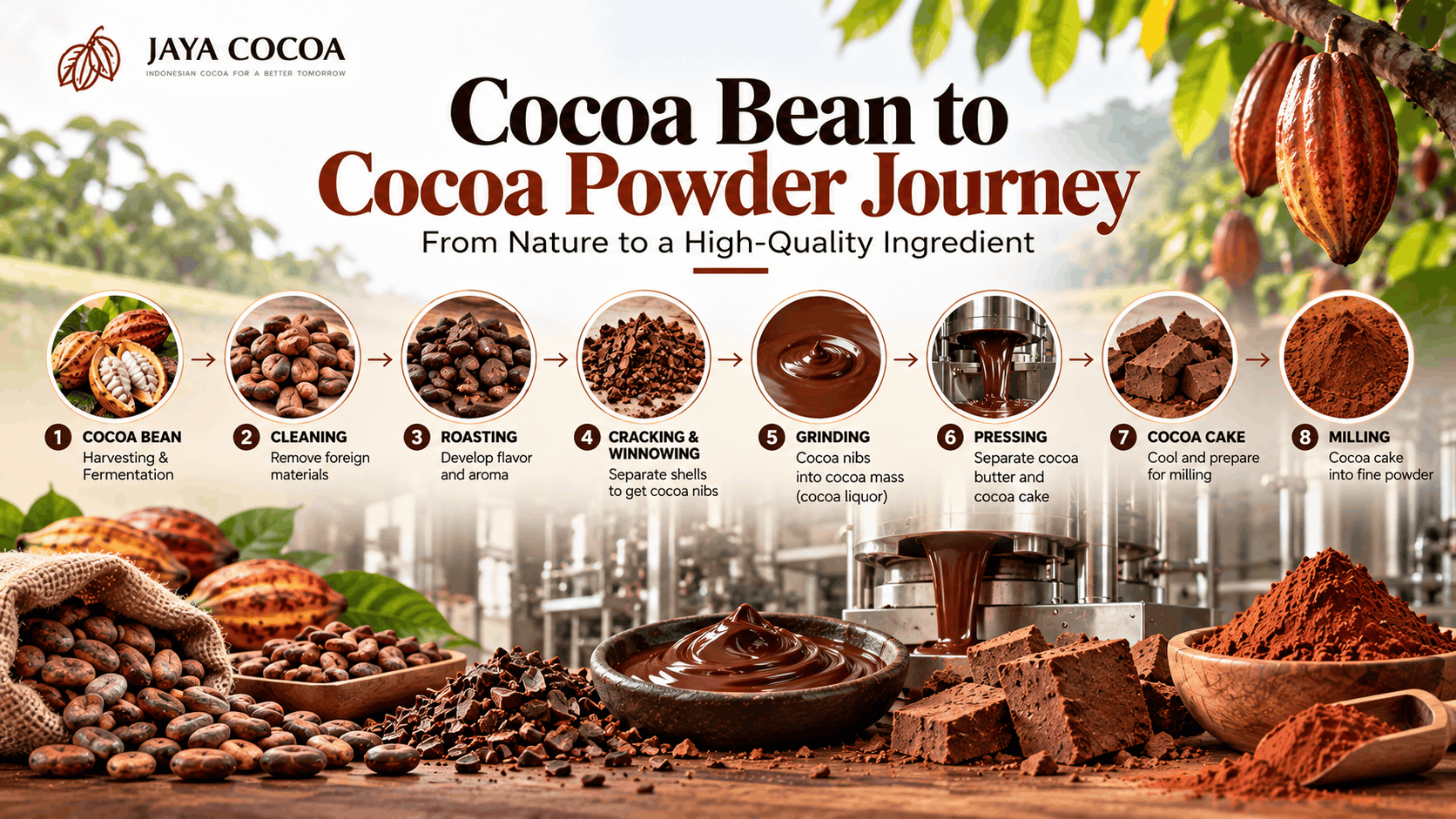
10. The Relationship Between Roasting and Cocoa Powder Production
Roasting is an important stage in the production of cocoa powder, but it is only one part of the complete manufacturing process.
After roasting, cocoa beans are cracked and winnowed to separate the shells from the nibs.
The nibs are then ground into cocoa liquor, which can be pressed to separate cocoa butter from cocoa solids.
The remaining cocoa cake is subsequently milled into cocoa powder.
The roasting profile can influence the flavour, aroma, colour, and processing characteristics of the cocoa liquor and the final cocoa products.
For manufacturers producing natural and alkalized cocoa powder, roasting must be considered together with other processing variables, including:
- Cocoa bean quality
- Fermentation and drying conditions
- Cocoa liquor characteristics
- Alkalization parameters
- Pressing conditions
- Final powder specifications
The interaction between these stages is important for achieving consistent product quality.
11. Frequently Asked Questions About Cocoa Bean Roasting
What is the purpose of roasting cocoa beans?
Roasting develops cocoa flavour and aroma, reduces residual moisture, changes colour, and prepares the beans for further processing.
What temperature is used for cocoa bean roasting?
Roasting conditions vary according to the cocoa beans, equipment, and desired flavour profile. Research commonly discusses temperatures around 100–150°C, but this should not be treated as a universal production specification.
How long does cocoa bean roasting take?
Roasting duration depends on temperature, bean size, moisture content, equipment design, and the desired result. Some controlled evaluation procedures use approximately 25 minutes, but industrial processes may require different conditions.
Can cocoa beans be roasted before shell removal?
Yes. Whole-bean roasting is one established processing approach. Cocoa nibs can also be roasted after shell removal. The choice depends on the desired product characteristics and processing system.
Does roasting reduce cocoa acidity?
Roasting can reduce some volatile acids, including acetic acid, and may produce a less sharp flavour. However, the result depends on the roasting conditions and initial bean characteristics.
Does higher roasting temperature always produce better cocoa flavour?
No. Excessive heat can cause burnt or harsh flavours and may degrade desirable compounds. The appropriate roasting profile should be selected through controlled trials and sensory evaluation.
Conclusion
The roasting process is a critical stage in cocoa manufacturing because it transforms the flavour, aroma, colour, and physical properties of cocoa beans.
Successful roasting requires careful control of temperature, duration, airflow, bean characteristics, and equipment performance.
For cocoa processors, the objective is not simply to apply higher temperatures or longer roasting times. It is to develop a repeatable roasting profile that delivers the required flavour characteristics while maintaining consistent product quality.
At Jaya Cocoa, we recognize the importance of understanding every stage of cocoa processing—from fermentation and drying to roasting, grinding, pressing, and milling—to support reliable cocoa ingredient quality for international food manufacturers.
Looking for cocoa powder for your food manufacturing requirements?
Explore Jaya Cocoa’s cocoa powder products and contact our team to discuss product specifications, applications, and international supply requirements.
References and Further Reading
- International Cocoa Organization (ICCO). Processing Cocoa.
https://www.icco.org/processing-cocoa/ - Peña-Correa, R. F., Mogol, B. A., & Fogliano, V. (2024). The impact of roasting on cocoa quality parameters. Critical Reviews in Food Science and Nutrition, 64(13), 4348–4361.
https://doi.org/10.1080/10408398.2022.2141191 - Cacao of Excellence. Guide for the Assessment of Cacao Quality and Flavour. See the roasting guidance in the JRF Knowledge Base.
https://qm.cocoaquality.eu/introduction/appendix-b/flavour-evaluation/roasters - Rojas, M., Hommes, A., Heeres, H. J., & Chejne, F. (2022). Physicochemical Phenomena in the Roasting of Cocoa (Theobroma cacao L.).
https://agris.fao.org/search/en/providers/122535/records/65de32ee4c5aef494fdae469 - Physicochemical Changes of Cocoa Beans during Roasting Process (2017).
https://doi.org/10.1155/2017/2969324 - Konar, N., et al. (2025). Recent advances in cocoa chemistry and roasting. Trends in Food Science & Technology, 162, 105036.
https://doi.org/10.1016/j.tifs.2025.105036