Cocoa Bean Drying Process: Methods, Moisture Content, and Quality Control
Cocoa bean drying is one of the most important stages in post-harvest cocoa processing. After fermentation, freshly fermented cocoa beans still contain a significant amount of moisture that must be removed before the beans can be safely stored, transported, and processed.
However, drying cocoa beans is not simply a matter of exposing them to sunlight or applying heat. The drying rate, temperature, airflow, weather conditions, and handling practices can influence the final quality of the beans.
Poor drying practices may lead to mold development, undesirable odors, excessive acidity, contamination, and inconsistent bean quality. On the other hand, properly controlled drying helps preserve the characteristics developed during fermentation and prepares cocoa beans for international trade and industrial processing.
For cocoa farmers, exporters, processors, and international buyers, understanding the cocoa bean drying process is essential for maintaining quality throughout the supply chain.
This guide explains how cocoa beans are dried, the available drying methods, recommended moisture levels, common problems, and the quality parameters buyers should evaluate.
1. What Is the Cocoa Bean Drying Process?
The cocoa bean drying process is a post-harvest operation that reduces the moisture content of fermented cocoa beans to a level suitable for storage and transportation.
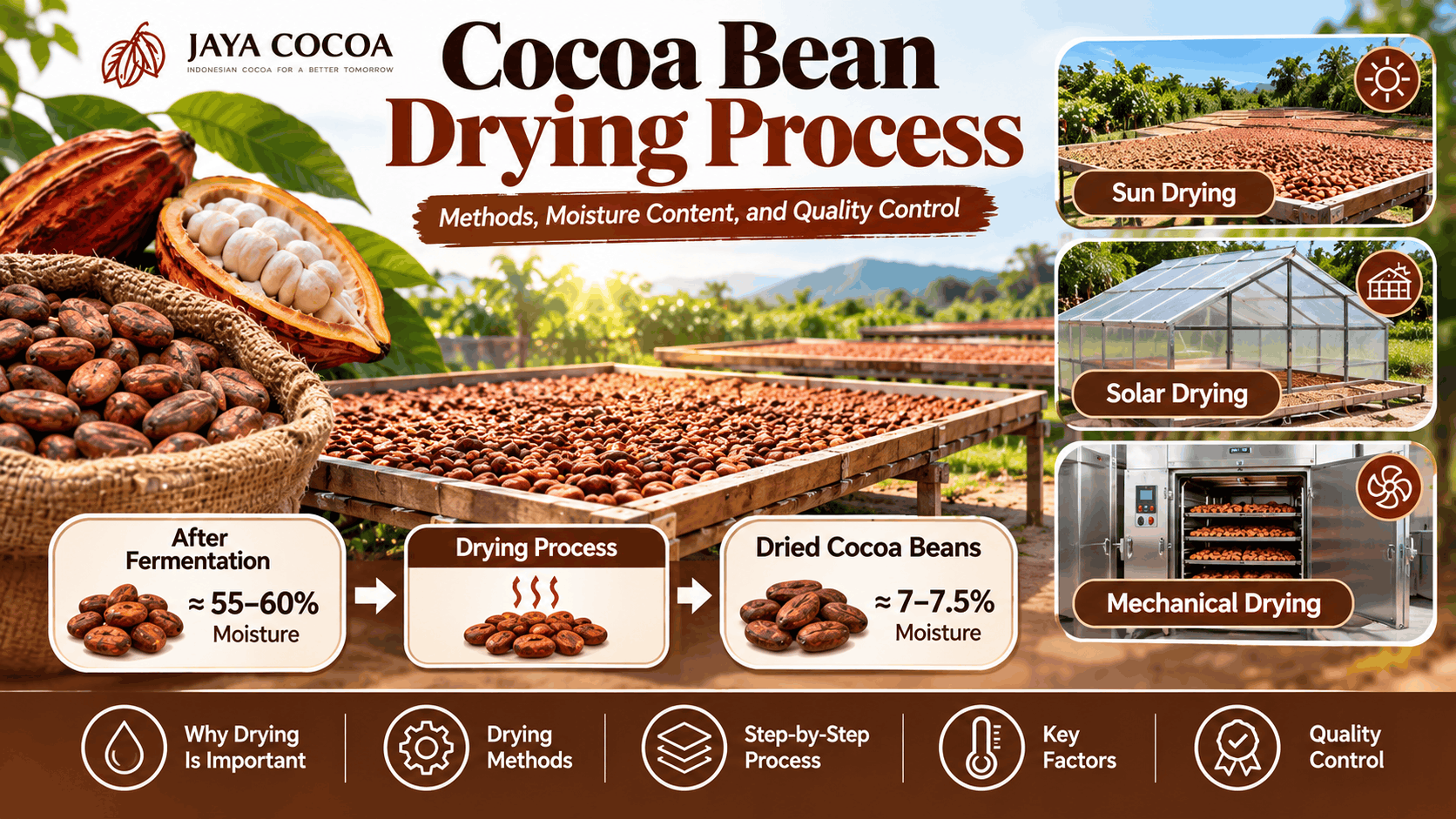
Freshly fermented cocoa beans typically contain approximately 55–60% moisture. Through drying, this moisture is reduced to approximately 7–7.5%, depending on the applicable specification and market requirements.
According to the International Cocoa Organization (ICCO), reducing moisture to around 7.5% is important for maintaining cocoa beans in suitable storage conditions.
Drying also contributes to the development of cocoa flavor. Chemical and biochemical changes continue during this stage, influencing acidity, color, volatile compounds, and other quality characteristics.
The drying process must therefore achieve two objectives:
- Reduce moisture to an appropriate level for storage.
- Preserve the physical, chemical, and sensory quality of the fermented beans.
Important: Drying is a separate operation from fermentation. It should follow fermentation promptly and should not be treated as a replacement for proper fermentation.
Reference: International Cocoa Organization (ICCO) – Processing Cocoa
2. Why Is Drying Important for Cocoa Beans?
Proper drying affects the quality, stability, and commercial value of cocoa beans.
A. Preventing mold development
Cocoa beans that retain excessive moisture may become susceptible to mold development during storage, particularly under warm and humid conditions.
Mold contamination can produce musty or unpleasant odors and may create food-safety concerns, including the potential presence of mycotoxins.
Reducing moisture to an appropriate level helps limit these risks, although moisture control alone does not guarantee microbiological safety.
B. Improving storage stability
Dried cocoa beans are more suitable for storage and transportation than freshly fermented beans.
Excess moisture can contribute to deterioration, especially when beans are stored in poorly ventilated warehouses or exposed to humid environments.
C. Supporting flavor development
Drying influences the concentration and transformation of organic acids, phenolic compounds, and volatile substances.
These changes contribute to the final sensory characteristics of cocoa beans and influence their performance during subsequent roasting.
D. Preparing beans for international transportation
Exported cocoa beans may travel long distances and experience changes in temperature and humidity.
Proper drying helps reduce the risk of deterioration during transportation and storage, provided that suitable packaging and warehouse conditions are also maintained.
E. Maintaining commercial quality
Moisture content is an important physical quality parameter in cocoa bean trading.
Buyers commonly include moisture requirements in their purchasing specifications alongside bean count, foreign matter, mold, slaty beans, and other quality criteria.
A shipment that does not meet the agreed moisture specification may require additional handling, drying, or commercial negotiation.
Reference: A Review of Cocoa Drying Technologies and the Effect on Bean Quality Parameters (2020)
3. What Is the Ideal Moisture Content for Dried Cocoa Beans?
Moisture content is one of the most important parameters used to evaluate dried cocoa beans.
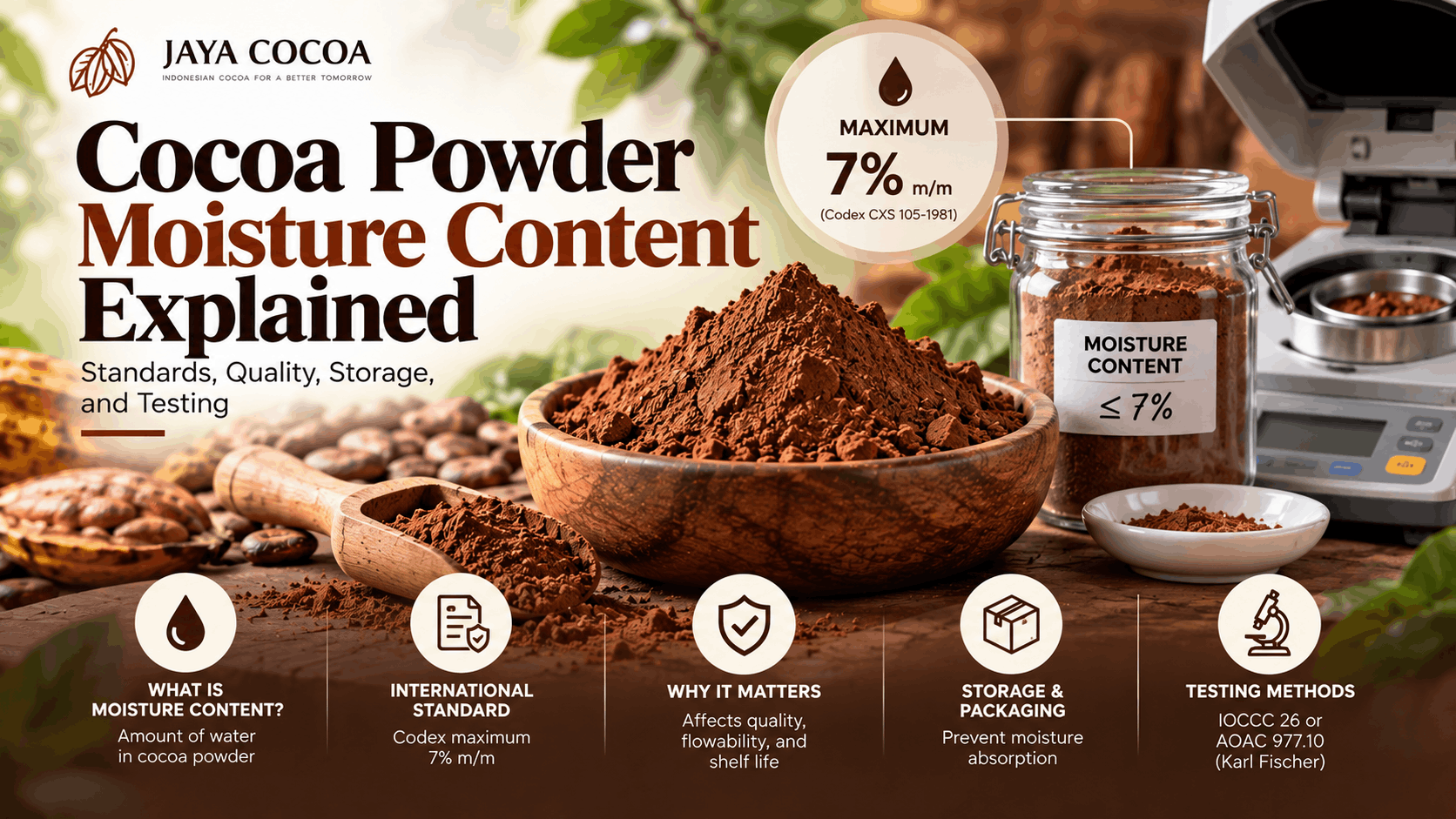
The ICCO identifies approximately 7.5% moisture as an appropriate target for cocoa bean storage.
The FAO/WHO Recommended International Code of Practice for Cocoa Beans also identifies moisture content below 8% as desirable for reducing microbial growth and supporting storage.
These figures should be understood as reference levels. Buyers and exporters must confirm the exact contractual specification and applicable national or destination-market requirements.
Understanding cocoa bean moisture levels
| Moisture condition | General interpretation |
|---|---|
| Around 55–60% | Typical moisture range of freshly fermented wet beans |
| Above 8% | May increase storage and mold risks |
| Around 7–7.5% | Common reference range for properly dried cocoa beans |
| Significantly below the agreed target | May indicate over-drying and unnecessary weight loss |
Over-drying is not automatically beneficial. Excessive drying can reduce saleable weight and may affect physical handling characteristics.
The objective is to reach the required moisture level consistently without damaging bean quality.
References:
- ICCO – Harvesting and Post-Harvest
- FAO/WHO – Recommended International Code of Practice for Cocoa Beans (CAC/RCP 72-2013)
4. Main Methods of Cocoa Bean Drying
Cocoa beans can be dried using natural sunlight, mechanical equipment, or a combination of both.
The appropriate method depends on production volume, local weather conditions, available infrastructure, energy costs, and the quality requirements of buyers.
A. Sun Drying
Sun drying is one of the most traditional and widely used methods of drying cocoa beans.
After fermentation, beans are spread over suitable drying surfaces and exposed to sunlight and natural airflow.
Common drying surfaces include:
- Raised bamboo platforms
- Wooden drying trays
- Suitable drying patios
- Solar drying beds
Raised platforms are generally preferable to direct ground contact because they improve airflow and help reduce contamination from soil, animals, and other external materials.
Advantages of sun drying:
- Low operating costs
- Minimal energy requirements
- Relatively simple equipment
- Suitable for smallholder production
- Can support good sensory quality when properly managed
Disadvantages of sun drying:
- Dependent on weather conditions
- Can take several days
- Rain and high humidity can interrupt the process
- Risk of contamination from dust, insects, and animals
- Drying rates may vary between batches
ICCO notes that sun drying commonly takes at least several days and may require more than a week, depending on the climate.
B. Mechanical Drying
Mechanical drying uses equipment to control the temperature and movement of air around cocoa beans.
Examples include:
- Tray dryers
- Cabinet dryers
- Rotary dryers
- Hot-air drying systems
- Other controlled drying equipment
Mechanical systems can be useful in regions with frequent rainfall or where larger quantities of cocoa beans must be processed consistently.
Advantages of mechanical drying:
- Greater control over drying conditions
- Less dependence on direct sunlight
- Potentially shorter drying time
- More predictable processing schedules
- Suitable for larger production operations
Disadvantages of mechanical drying:
- Higher equipment investment
- Energy consumption
- Maintenance requirements
- Risk of uneven drying if airflow is poorly controlled
- Potential smoke or fuel contamination when equipment is improperly designed
Mechanical drying must be carefully controlled. Excessive temperatures or unsuitable drying rates may negatively affect cocoa flavor and other quality characteristics.
C. Solar Drying
Solar drying uses solar energy to heat air within a designed drying structure.
Unlike open sun drying, some solar dryers use an enclosed chamber or greenhouse-style structure to improve environmental protection and airflow.
Depending on the design, solar dryers may include:
- Solar collectors
- Ventilation systems
- Drying trays
- Temperature monitoring equipment
- Moisture measurement instruments
Solar drying can help protect cocoa beans from rain, dust, and animals while making better use of available sunlight.
D. Hybrid Drying
Hybrid drying combines solar energy with an additional heat source or controlled ventilation system.
This approach can be useful when weather conditions are inconsistent and uninterrupted drying is required.
For example, a hybrid system may use solar heat during the day and supplementary heating or ventilation when solar energy is insufficient.
Research into hybrid solar drying has identified opportunities to improve drying efficiency and consistency, although the results depend on equipment design and operating conditions.
Scientific reference: A Systematic Literature Review of the Drying of Cocoa in 2003–2023
5. Step-by-Step Cocoa Bean Drying Process
A well-managed drying operation requires consistent handling and monitoring.
The following stages provide a practical overview.
Step 1: Transfer Beans After Fermentation
Once fermentation reaches its intended endpoint, cocoa beans should be transferred to the drying area without unnecessary delay.
This helps prevent continued fermentation and deterioration under unsuitable conditions.
Remove obvious foreign materials and inspect the beans before spreading them.
Step 2: Prepare the Drying Surface
The drying surface should be clean, hygienic, and protected from potential contamination.
Raised drying platforms are preferable where practical.
Avoid placing wet cocoa beans directly on soil, roads, or contaminated surfaces.
The drying area should have good sunlight exposure and adequate airflow.
Step 3: Spread the Beans Evenly
Spread cocoa beans in a reasonably uniform layer to allow air and heat to reach the beans.
The FAO/WHO cocoa code recommends that the drying layer should not exceed approximately 6 cm to avoid slow or inadequate drying.
The appropriate layer thickness may vary depending on the drying system and operating conditions.
Avoid creating large piles because beans in the center may retain more moisture than beans exposed to the surrounding air.
Step 4: Turn the Beans Regularly
Cocoa beans should be turned several times throughout the day to improve drying uniformity.
Turning helps expose different surfaces of the beans to sunlight and airflow.
It also helps reduce differences in moisture content between the upper and lower layers.
Beans at substantially different drying stages should not be mixed carelessly because this can make moisture management and quality control more difficult.
Step 5: Protect Beans from Rain and Dew
Cocoa beans should be protected from rain, excessive humidity, and nighttime dew.
If rain interrupts sun drying, cover the beans and protect them from water exposure.
Once the drying surface is dry and suitable conditions return, spread the beans again.
Repeated wetting and drying should be avoided because it may increase the risk of mold and deterioration.
Step 6: Monitor Temperature and Drying Conditions
During mechanical drying, temperature and airflow should be monitored carefully.
Excessive heat may negatively affect flavor development and other quality characteristics.
ICCO indicates that drying should be carried out carefully and discusses keeping bean temperatures below approximately 65°C.
This should be treated as an upper reference, not a universal operating target for every drying system.
The correct operating temperature depends on the dryer design, airflow, bean condition, and drying objective.
Step 7: Measure Final Moisture Content
When beans appear dry, moisture content should be measured using a suitable calibrated moisture meter or an appropriate laboratory method.
Visual inspection alone is not sufficient to confirm that cocoa beans have reached the required moisture level.
The result should be checked against the buyer’s agreed specification.
Step 8: Cool and Prepare for Storage
After drying, allow the beans to cool under clean and controlled conditions before packaging.
Packaging warm beans without adequate cooling may create condensation under certain conditions.
Once cooled, dried cocoa beans can be packed in suitable clean bags and transferred to a dry, ventilated storage area.
References:
- FAO/WHO – Recommended International Code of Practice for Cocoa Beans
- ICCO – Harvesting and Post-Harvest
6. Factors That Affect Cocoa Bean Drying Time
There is no single drying duration suitable for every cocoa bean batch.
Drying time depends on several interacting factors.
| Factor | Potential effect |
|---|---|
| Sunlight intensity | Influences the energy available for evaporation |
| Air temperature | Affects drying rate |
| Relative humidity | High humidity can slow moisture removal |
| Airflow | Helps carry moisture away from the beans |
| Layer thickness | Thick layers may dry unevenly |
| Turning frequency | Influences uniformity |
| Initial moisture | Higher starting moisture generally requires more drying |
| Bean size and condition | Can influence moisture movement |
| Dryer design | Determines heat and airflow distribution |
For traditional sun drying, the process commonly takes around 6–10 days under suitable conditions, although local weather can make it shorter or longer.
The duration should never be treated as the only measure of completion. Final moisture content and quality inspection are more important.
7. Common Problems During Cocoa Bean Drying
Poorly managed drying can create problems that affect the commercial value of cocoa beans.
A. Mold Development
Mold may develop when beans remain too moist or are exposed to unsuitable storage conditions.
Potential consequences include:
- Musty odors
- Visible fungal growth
- Quality deterioration
- Possible mycotoxin contamination
Prevention requires appropriate drying, clean handling, and controlled storage.
B. Smoke Contamination
Some mechanical dryers use fuel or biomass as a heat source.
If combustion gases or smoke come into direct contact with cocoa beans, undesirable odors and chemical contaminants may be introduced.
The FAO/WHO cocoa code and technical cocoa-quality guidance emphasize preventing contamination from smoke and combustion products.
Where fuel-fired dryers are used, appropriate heat exchangers and system design should prevent combustion gases from contacting the beans.
C. Uneven Drying
Uneven drying may occur when:
- Beans are spread too thickly.
- Turning is insufficient.
- Airflow is inconsistent.
- Different drying stages are mixed together.
- Drying surfaces are uneven.
This can result in batches with different moisture levels.
D. Excessively Rapid Drying
Drying too quickly under high temperatures may negatively affect the chemical and sensory characteristics of cocoa beans.
Research indicates that drying temperature and duration influence volatile compounds, organic acids, phenolic compounds, and other quality parameters.
E. Re-Wetting
Dried or partially dried beans may absorb moisture again when exposed to rain, dew, or humid environments.
Re-wetting increases the risk of mold development during subsequent storage.
The objective is not simply to dry cocoa beans as quickly as possible. It is to reach the required moisture content while preserving quality.
References:
- Unravelling Cocoa Drying Technology: A Comprehensive Review (2025)
- JRF Knowledge Base – Cocoa Bean Drying
8. How to Check the Moisture Content of Cocoa Beans
Moisture testing is essential for confirming whether cocoa beans are ready for storage, sale, or export.
Moisture Meter
A suitable calibrated moisture meter can provide a practical measurement during purchasing and warehouse inspection.
Buyers should confirm that the instrument is appropriate for cocoa beans and that the measurement procedure follows the manufacturer’s instructions.
Laboratory Testing
Laboratory testing can provide additional verification when required by the buyer or contract.
The parties should agree on the analytical method, sampling procedure, and reporting basis.
Representative Sampling
A moisture result is only useful if the sample represents the actual lot.
Samples should be collected from appropriate locations and bags rather than relying on a single handful of beans.
For commercial transactions, buyers and suppliers should agree on:
- Sampling method
- Number of sampling points
- Measurement equipment or laboratory method
- Acceptance limit
- Handling of borderline or disputed results
A batch should not be accepted or rejected solely on the basis of an unrepresentative sample.
9. Quality Parameters Buyers Should Evaluate
Moisture is important, but it is not the only indicator of cocoa bean quality.
International buyers and cocoa processors should consider several parameters when evaluating dried cocoa beans.
| Quality parameter | Why it matters |
|---|---|
| Moisture content | Storage stability and mold risk |
| Bean count | Indicates approximate bean size |
| Fermentation quality | Helps assess post-harvest processing |
| Slaty beans | May indicate insufficient fermentation |
| Moldy beans | Indicates quality deterioration and possible safety concerns |
| Foreign matter | Physical cleanliness |
| Broken beans | Physical condition and handling quality |
| Insect damage | Storage and product integrity |
| Odor | Helps identify smoke, mold, or other off-notes |
| Origin and traceability | Supports sourcing and supply-chain verification |
Acceptance limits vary according to the applicable standard, contract, destination market, and intended application.
Buyers should request a representative sample and relevant quality documentation before confirming a commercial order.
10. How Drying Affects Cocoa Processing and Finished Products
Drying takes place before cocoa beans enter an industrial processing facility, but its effects can remain relevant throughout the manufacturing chain.
After drying, cocoa beans may undergo:
- Cleaning
- Roasting
- Cracking and winnowing
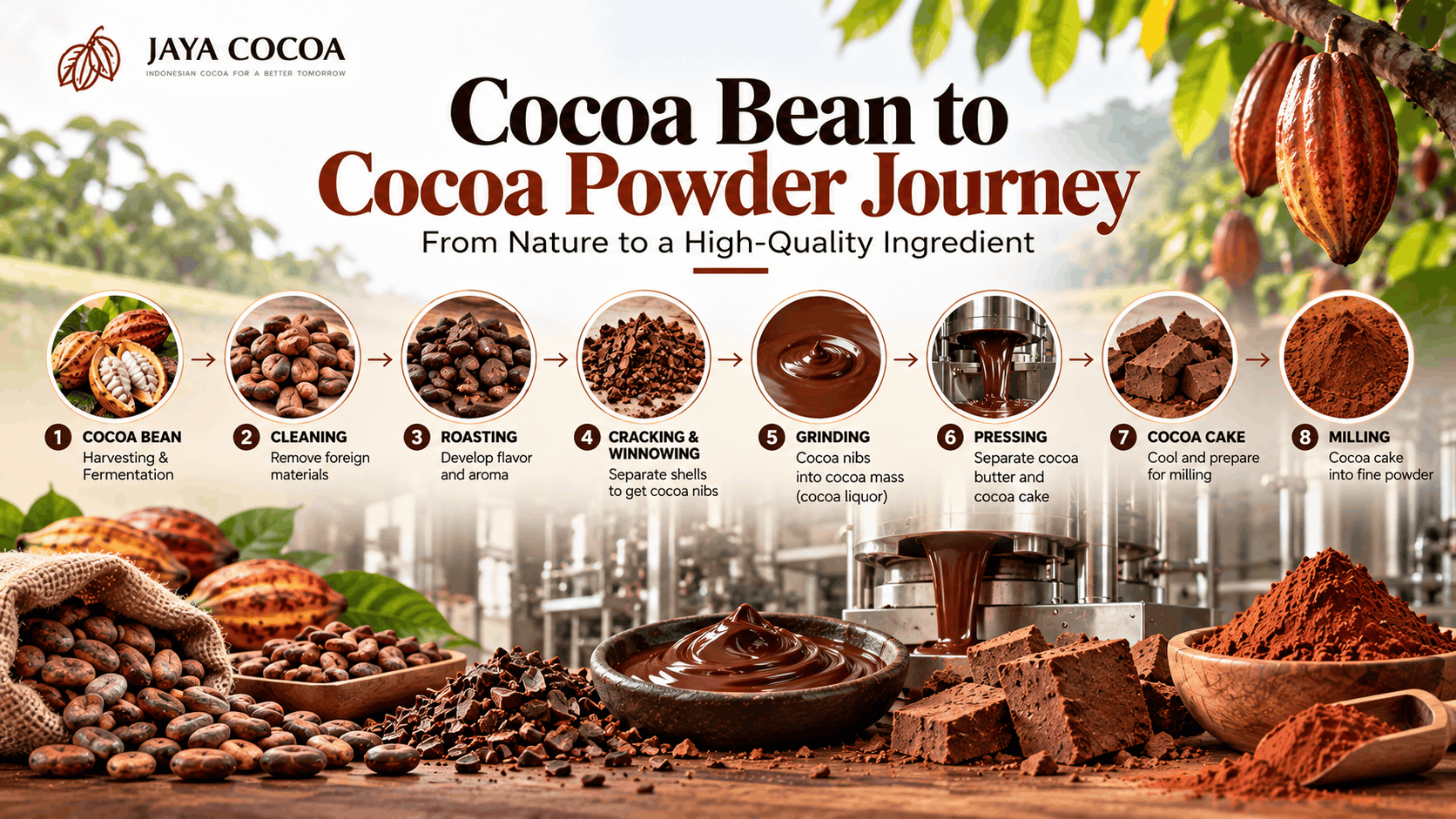
- Cocoa nib grinding
- Cocoa mass production
- Cocoa pressing
- Cocoa cake milling
- Cocoa powder production
The original bean quality and post-harvest handling influence the characteristics of the raw material entering the factory.
For cocoa powder manufacturers, consistent raw materials support better process control and help reduce variations in finished-product quality.
However, good drying alone cannot guarantee premium cocoa powder. Bean origin, fermentation, roasting, alkalization where applicable, pressing, milling, and quality control also contribute to the final product.
11. Cocoa Bean Drying in Indonesia: Practical Considerations
Indonesia has diverse cocoa-producing regions with different weather patterns, production scales, and post-harvest infrastructure.
In some areas, farmers rely heavily on traditional sun drying. In regions with frequent rainfall or high humidity, drying can become more challenging.
Several practical considerations are important for Indonesian cocoa producers and exporters:
Weather management
Drying operations should be planned around local rainfall patterns. Covered drying structures or suitable solar dryers can help protect beans when weather conditions change.
Drying infrastructure
Raised platforms, clean trays, protective covers, and adequate ventilation can improve hygiene and drying consistency.
Smallholder coordination
Where cocoa beans are collected from multiple farmers, exporters should establish clear post-harvest handling requirements and communicate moisture specifications before purchasing.
Batch segregation
Beans from different origins, fermentation conditions, or drying stages should be monitored and segregated where necessary to support traceability and consistent quality.
Quality verification
Exporters should measure moisture content and conduct physical quality inspections before accepting beans into storage or preparing shipments.
Recent Indonesian research on active solar drying has investigated the use of controlled solar heating and ventilation to improve drying efficiency and bean quality. However, performance depends on the equipment and operating conditions and should not be generalized to every production area.
Research reference: Inovasi Solar Dryer Aktif untuk Meningkatkan Kualitas dan Efisiensi Pengeringan Biji Kakao Pascapanen (2026)
12. Frequently Asked Questions About Cocoa Bean Drying
How long does it take to dry cocoa beans?
Traditional sun drying commonly takes around 6–10 days under suitable conditions. Actual drying time depends on weather, initial moisture, airflow, and the drying method.
What is the ideal moisture content for dried cocoa beans?
Approximately 7–7.5% is a common reference range. The exact acceptance limit should follow the buyer’s specification and applicable requirements.
Can cocoa beans be dried directly on the ground?
This is generally not recommended. Direct ground contact increases the risk of contamination from soil, dust, animals, and other foreign materials. Raised drying platforms are preferable where practical.
Is sun drying better than mechanical drying?
Neither method is universally better. Sun drying can be economical and produce good-quality beans when properly managed. Mechanical drying offers greater control and can be useful in areas with inconsistent weather, but requires careful temperature and airflow management.
Can cocoa beans be dried during rainy weather?
Drying can continue using suitable covered or mechanical systems. During rainfall, beans should be protected from water and re-spread when conditions are appropriate.
What happens if cocoa beans are over-dried?
Over-drying can reduce saleable weight and may affect physical handling characteristics. The aim should be to achieve the agreed moisture specification rather than removing as much moisture as possible.
Why is moisture content important for cocoa bean exports?
Moisture content influences storage stability, mold risk, transportation conditions, and commercial acceptance. International buyers commonly include moisture limits in their purchasing specifications.
Conclusion
The cocoa bean drying process is an essential part of post-harvest handling and plays a major role in preserving cocoa bean quality.
Proper drying reduces moisture from approximately 55–60% in fermented wet beans to around 7–7.5% as a common storage reference. It also helps limit mold development, supports storage stability, and influences the sensory characteristics of cocoa beans.
Whether using sun drying, mechanical drying, solar drying, or hybrid systems, producers must manage temperature, airflow, drying duration, turning, and hygiene carefully.
For exporters and international buyers, moisture testing, representative sampling, physical inspection, and proper storage practices are essential for maintaining consistent quality.
At Jaya Cocoa, we recognize that finished cocoa powder quality begins with careful raw-material selection and post-harvest handling. Understanding the drying process helps cocoa processors and buyers evaluate the quality and consistency of the beans entering the supply chain.
Looking for cocoa powder from Indonesia? Contact Jaya Cocoa to discuss product specifications, quality requirements, and export supply options.
References and Further Reading
- International Cocoa Organization (ICCO). Processing Cocoa.
https://www.icco.org/processing-cocoa/ - International Cocoa Organization (ICCO). Harvesting and Post-Harvest.
https://www.icco.org/harvesting-post-harvest-new/ - FAO/WHO Codex Alimentarius. Recommended International Code of Practice for Cocoa Beans (CAC/RCP 72-2013).
https://www.fao.org/input/download/standards/13601/CXP_072e.pdf - Dzelagha, B. F. et al. (2020). A Review of Cocoa Drying Technologies and the Effect on Bean Quality Parameters. International Journal of Food Science.
https://onlinelibrary.wiley.com/doi/10.1155/2020/8830127 - Santander, M. et al. (2025). Unravelling Cocoa Drying Technology: A Comprehensive Review of the Influence on Flavor Formation and Quality. Foods, 14(5), 721.
https://www.mdpi.com/2304-8158/14/5/721 - A Systematic Literature Review of the Drying of Cocoa in 2003–2023 (2024). Food and Humanity.
https://www.sciencedirect.com/science/article/pii/S2949824424001228 - JRF Knowledge Base. Cocoa Beans – Drying.
https://www.pm.cocoaquality.eu/aspects-of-cocoa-production-affecting-the-quality-requirements/post-harvest/drying - Mufarida, N. A. et al. (2026). Inovasi Solar Dryer Aktif untuk Meningkatkan Kualitas dan Efisiensi Pengeringan Biji Kakao Pascapanen. Jurnal Armatur.
https://scholar.ummetro.ac.id/index.php/armatur/article/view/10694