Beverage Grade vs Bakery Grade Cocoa Powder: What Is the Difference?
When sourcing cocoa powder for industrial food production, manufacturers may encounter terms such as beverage grade cocoa powder and bakery grade cocoa powder. These terms are useful commercially, but they can also create confusion because they do not represent one universal international classification.
In practice, the difference is mainly about how the cocoa powder performs in a particular application.
Beverage formulations often prioritize dispersibility, suspension stability, flavor, and color. Bakery formulations may place greater emphasis on pH, alkalization level, flavor, color, fat content, and compatibility with the recipe’s leavening system.
Understanding these differences can help food manufacturers, importers, and R&D teams select cocoa powder based on actual product requirements rather than relying only on commercial grade names.
What Does “Beverage Grade” Cocoa Powder Mean?
Beverage grade cocoa powder generally refers to cocoa powder selected or processed for use in cocoa-based beverages.
Typical applications include:
- Hot chocolate
- Chocolate milk
- Instant cocoa drinks
- Ready-to-drink beverages
- Chocolate-flavored powdered drinks
- Protein and nutrition beverages
- Dairy and plant-based chocolate beverages
The most important consideration is how the cocoa powder behaves when incorporated into a liquid system.
A cocoa powder with excellent chocolate flavor but poor dispersion may create sediment, floating particles, or an inconsistent appearance. Therefore, beverage manufacturers often pay close attention to dispersibility, wetting behavior, particle characteristics, color, pH, and flavor.
Research on cocoa drinks has shown that solubility is an important parameter because the soluble fraction contributes to the sensory experience of the beverage. Studies have also found measurable differences in solubility and wetting behavior between natural and alkalized cocoa powders.
Important: Cocoa Powder Is Not Completely Soluble
One common misconception is that beverage-grade cocoa powder should completely dissolve like sugar.
Cocoa powder is primarily composed of cocoa solids rather than a fully water-soluble ingredient. Therefore, beverage manufacturers often focus on dispersion and suspension performance, rather than expecting complete molecular dissolution.
Specially formulated beverage cocoa powders may also be processed to improve their behavior in liquid systems.
This distinction is important when evaluating suppliers because the phrase “high solubility” should always be clarified through the supplier’s actual specification and test method.
What Does “Bakery Grade” Cocoa Powder Mean?
Bakery grade cocoa powder generally refers to cocoa powder selected for baked products and bakery formulations.
Typical applications include:
- Cakes
- Brownies
- Cookies
- Biscuits
- Muffins
- Pastries
- Chocolate fillings
- Bakery toppings
Unlike beverages, bakery products are solid or semi-solid food matrices. Therefore, cocoa powder must perform properly during mixing, baking, and thermal processing.
Important specifications may include:
- pH
- Color
- Fat content
- Flavor
- Moisture
- Particle size
- Compatibility with leavening agents
The appropriate specification depends heavily on the formulation.
Beverage Grade vs Bakery Grade Cocoa Powder
The simplest way to understand the difference is to compare the performance requirements.
| Parameter | Beverage Grade | Bakery Grade |
|---|---|---|
| Primary application | Cocoa drinks and liquid products | Cakes, cookies, biscuits and bakery |
| Main concern | Dispersion and suspension | Formulation and baking performance |
| pH | Selected according to beverage formulation | Important for formulation and leavening |
| Color | Important for beverage appearance | Important for finished product appearance |
| Flavor | Smooth, balanced chocolate profile | Depends on bakery product |
| Solubility/dispersion | Usually highly important | Generally less critical |
| Fat content | Depends on mouthfeel and formulation | Depends on texture and product requirements |
| Particle characteristics | Important for dispersion | Important for mixing and mouthfeel |
| Alkalization | Often used to modify color, flavor and functionality | Selected according to formulation |
| Leavening compatibility | Usually not the primary concern | Can be important |
This table should not be interpreted as a universal specification standard. Different manufacturers may define their commercial grades differently.
Why Alkalization Matters
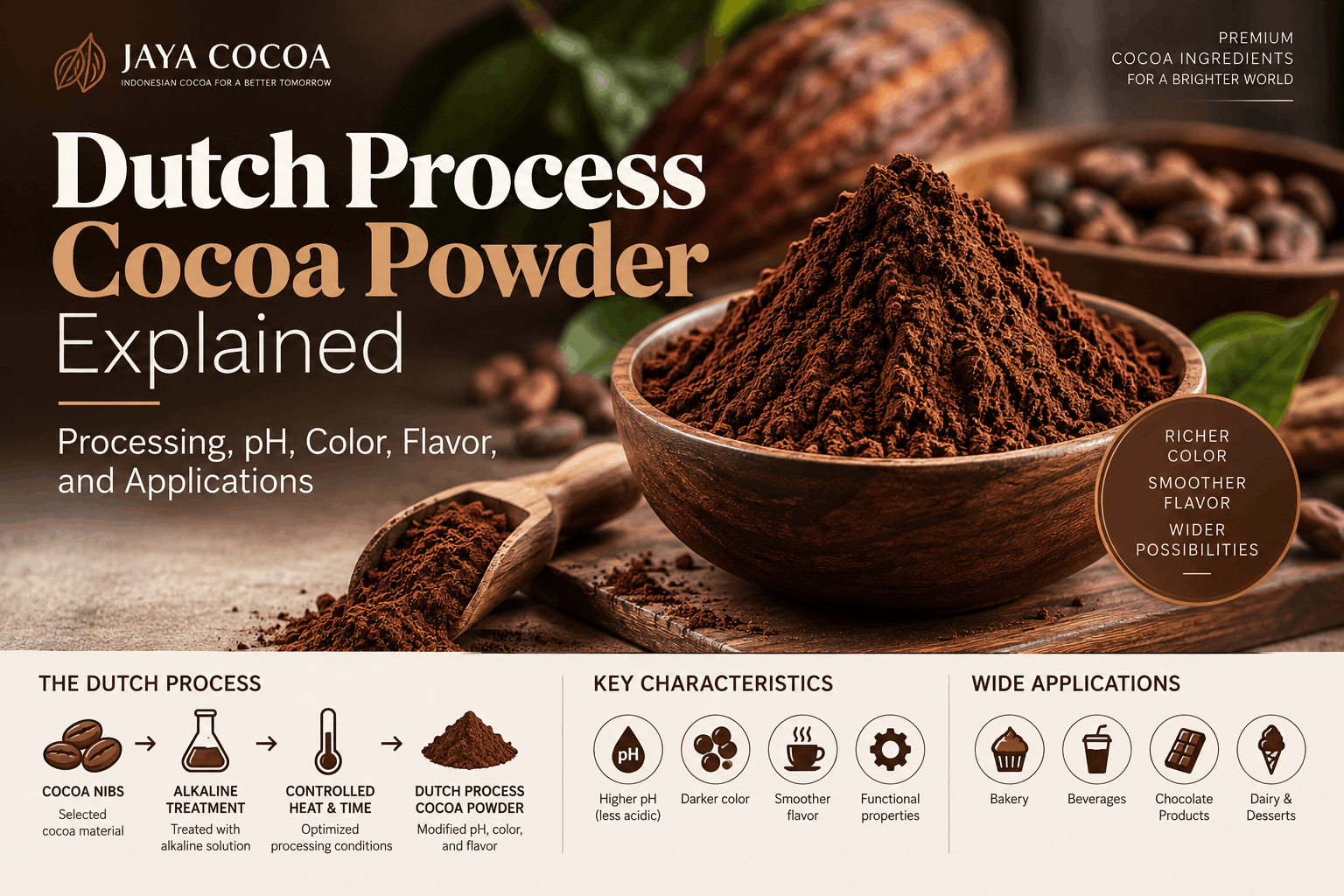
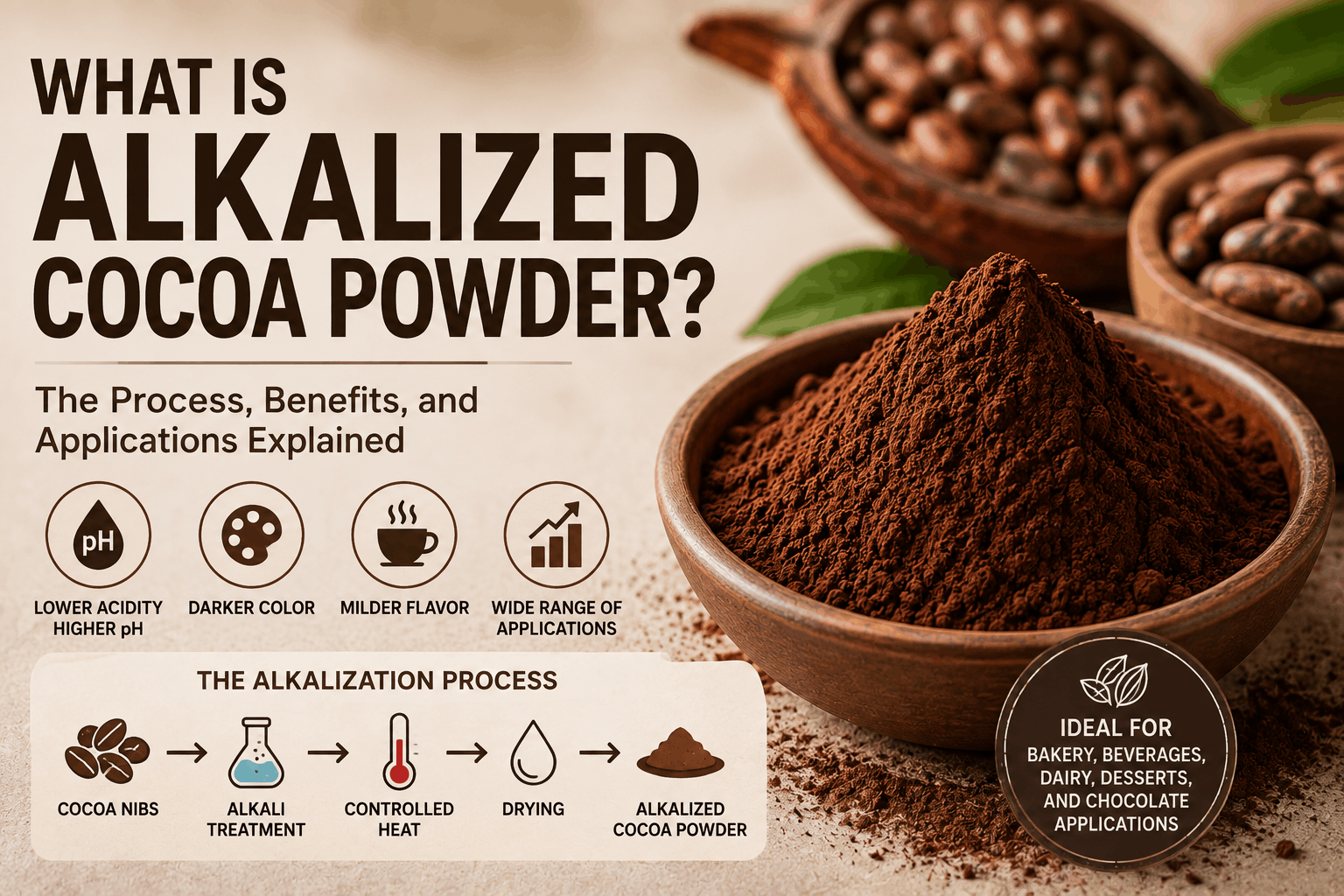
One of the most important variables connecting beverage and bakery cocoa powders is alkalization, also known as the Dutch process.
During alkalization, cocoa material is treated with a food-grade alkaline agent. The process can increase pH and modify color and flavor.
Scientific research has demonstrated that alkalization can substantially influence cocoa powder’s pH, color, flavor-related characteristics, and phytochemical profile. The extent of these changes depends on processing conditions such as alkaline concentration, temperature, and processing time.
This is why two cocoa powders with the same fat content may behave very differently in a food formulation.
Beverage Applications: What Should Buyers Look For?
For beverage manufacturers, I would recommend paying particular attention to the following parameters.
1. Dispersibility
Cocoa powder should disperse consistently throughout the liquid system.
Poor dispersion can result in:
- Sedimentation
- Floating particles
- Uneven color
- Inconsistent flavor distribution
Research has shown that cocoa powder solubility and wetting behavior can differ depending on processing, including alkalization.
2. Color
Color strongly influences consumer perception.
A darker cocoa powder may be desirable for products positioned as rich or premium, while lighter brown cocoa may be preferred for specific beverage formulations.
However, darker does not automatically mean better.
3. Flavor
Beverage manufacturers generally want a cocoa powder that provides a pleasant chocolate profile without excessive bitterness or acidity.
Alkalization can reduce acidity and alter the sensory characteristics of cocoa powder.
4. pH
pH should be evaluated according to the complete beverage formulation rather than independently.
Milk, sugar, proteins, stabilizers, minerals, flavors, and other ingredients can all influence the final beverage system.
Bakery Applications: What Should Buyers Look For?
Bakery manufacturers should evaluate a different set of priorities.
1. pH and Leavening System
This is one of the most important differences.
Natural cocoa powder retains more of its natural acidity, while alkalized cocoa powder has a higher pH.
In formulations where cocoa contributes meaningful acidity, changing from natural to strongly alkalized cocoa can alter the acid-base balance of the recipe.
Therefore, R&D teams should evaluate cocoa powder together with the formulation’s baking soda, baking powder, and other acidic ingredients.
Cocoa powder should not be selected solely because it has a darker color.
2. Color
Color is particularly important for:
- Chocolate cakes
- Sandwich biscuits
- Brownies
- Cookies
- Chocolate fillings
Alkalization can produce substantially darker cocoa powder. Research on cocoa powder used in sponge cakes found that alkalization conditions affected dough color, rheology, baked cake color, and texture.
3. Fat Content
Fat content affects the contribution of cocoa powder to flavor, richness, mouthfeel, and formulation characteristics.
However, there is no universal rule that bakery cocoa must have one particular fat percentage.
The correct fat level depends on the product formulation and desired sensory characteristics.
4. Flavor
Bakery manufacturers may prefer cocoa with a more acidic and fruity profile, a smoother chocolate profile, or a deeper roasted character depending on the product.
Therefore, sensory evaluation remains important alongside laboratory specifications.
Can Beverage Grade Cocoa Powder Be Used for Bakery?
Yes, potentially but the commercial grade name alone does not determine suitability.
A cocoa powder marketed for beverages may technically perform well in a bakery product if its specifications match the formulation.
For example, an alkalized cocoa powder selected for beverage applications may also be suitable for cookies, brownies, or cakes where its pH, color, flavor, and fat content are appropriate.
The reverse is also possible.
A cocoa powder marketed primarily for bakery may not provide the dispersion characteristics required for a powdered beverage.
Therefore, buyers should evaluate the actual technical specification, not simply the grade name.
Can Bakery Grade Cocoa Powder Be Used for Beverages?
Again, potentially yes.
The key question is whether the powder provides acceptable performance in the intended liquid system.
A bakery cocoa powder may provide excellent flavor and color but still perform poorly in a beverage if dispersion or suspension is inadequate.
For beverage development, manufacturers should therefore request application-specific information from suppliers.
What Should Buyers Ask Cocoa Powder Suppliers?
Instead of asking only:
“Do you have beverage grade cocoa powder?”
or:
“Do you have bakery grade cocoa powder?”
A professional buyer should provide the intended application and request the relevant technical specifications.
For example:
For Beverage Applications
Ask for:
- Cocoa powder type
- Natural or alkalized
- pH
- Color
- Fat content
- Moisture
- Particle size
- Dispersibility or solubility data
- Microbiological specifications
- COA
- Recommended dosage or application guidance, where available
For Bakery Applications
Ask for:
- Cocoa powder type
- Natural or alkalized
- pH
- Color
- Fat content
- Moisture
- Particle size
- Flavor profile
- Microbiological specifications
- COA
- Compatibility with the intended formulation
This approach gives R&D and purchasing teams much better information than relying on a commercial grade name.
A Practical Decision Guide
| If Your Product Is… | Prioritize… |
|---|---|
| Instant chocolate beverage | Dispersion, color, flavor, pH |
| Chocolate milk | Dispersion, flavor, color, stability |
| Protein drink | Dispersion, flavor, color, formulation compatibility |
| Chocolate cake | pH, color, flavor, fat content |
| Brownie | Flavor, color, fat content, formulation compatibility |
| Cookie | Color, flavor, pH and formulation |
| Sandwich biscuit | Dark color, flavor, alkalization level |
| Chocolate filling | Color, flavor, fat content, texture |
| Dairy dessert | Color, flavor, dispersion and formulation compatibility |
The Future of Application-Specific Cocoa Powder
The distinction between beverage and bakery applications points toward an important development in the cocoa ingredient industry: application-specific formulation.
Food manufacturers increasingly need ingredients that are optimized for a particular production system rather than generic commodities.
This creates opportunities for cocoa powder suppliers to develop specifications around:
- Better dispersion
- Controlled color
- Specific pH ranges
- Consistent fat content
- Improved flavor profiles
- Application-specific particle characteristics
- Consistent batch-to-batch performance
Scientific research on cocoa processing continues to demonstrate that processing variables can be optimized to obtain cocoa powders with desired properties for specific usage purposes.
For cocoa powder exporters and manufacturers, this means the future opportunity may not simply be selling “cocoa powder per metric ton.”
The greater opportunity is selling a technical ingredient solution matched to the customer’s application.
Conclusion
Beverage grade and bakery grade cocoa powder should not be treated as universal regulatory classifications. They are primarily commercial terms describing cocoa powders selected for different application requirements.
For beverages, manufacturers generally place greater emphasis on dispersion, suspension behavior, color, flavor, and formulation compatibility.
For bakery products, pH, color, flavor, fat content, and compatibility with the leavening system can become more important.
The right cocoa powder is therefore not necessarily the one with the highest fat content, darkest color, or highest pH. It is the powder whose technical characteristics are appropriate for the customer’s formulation and manufacturing process.
For buyers, the best approach is to communicate the intended application to the supplier and evaluate the COA, specification sheet, application data, and when necessary pilot trials before approving a cocoa powder for commercial production.
Frequently Asked Questions
Is beverage grade cocoa powder more soluble than bakery grade?
Not necessarily. “Beverage grade” is not a universal technical classification. Beverage suitability depends on properties such as dispersion, wetting, particle characteristics, processing, and formulation. Research has shown that natural and alkalized cocoa powders can differ in solubility and wetting behavior.
Is alkalized cocoa powder better for beverages?
Alkalized cocoa can offer advantages in color, flavor, and dispersion, but the appropriate degree of alkalization depends on the beverage formulation. It should not automatically be considered superior to natural cocoa powder.
Is natural cocoa powder better for bakery products?
Not always. Natural cocoa can be useful in formulations where its acidity contributes to the leavening system, but alkalized cocoa may also be appropriate depending on the recipe, desired color, flavor, and processing conditions.
Can the same cocoa powder be used for beverages and bakery?
Yes, if its technical specifications satisfy both applications. However, a powder optimized for one application may not provide the best performance in another.
What is the most important specification when buying beverage cocoa powder?
There is no single specification that is always the most important. For beverage development, dispersion/wetting behavior, color, flavor, pH, particle characteristics, and formulation compatibility should be evaluated together.
What is the most important specification when buying bakery cocoa powder?
The answer depends on the product. pH, color, flavor, fat content, and compatibility with the leavening system are commonly important considerations.
References
- Codex Alimentarius – General Standard for Food Additives (CXS 192-1995). Cocoa mixes and cocoa mass/cake are included within food category 05.1.1, demonstrating the broader food-industry context of cocoa products.
- Sioriki, E., et al. (2021). Impact of alkalization conditions on the phytochemical content of cocoa powder and the aroma of cocoa drinks. LWT – Food Science and Technology, 145, 111181.
- Demirci, S., et al. (2024). Influence of process conditions of alkalization on quality of cocoa powder. Food Research International, 182, 114147.
- Effect of the type and degree of alkalization of cocoa powder on the physico-chemical and sensory properties of sponge cakes. LWT – Food Science and Technology. The study evaluates how alkalization affects cocoa properties and the characteristics of sponge cakes.
- Investigating the effect of different types of cocoa powder and stabilizers on suspension stability of cinnamon-cocoa drink. The study evaluates cocoa powder characteristics and their relevance to cocoa beverage stability.