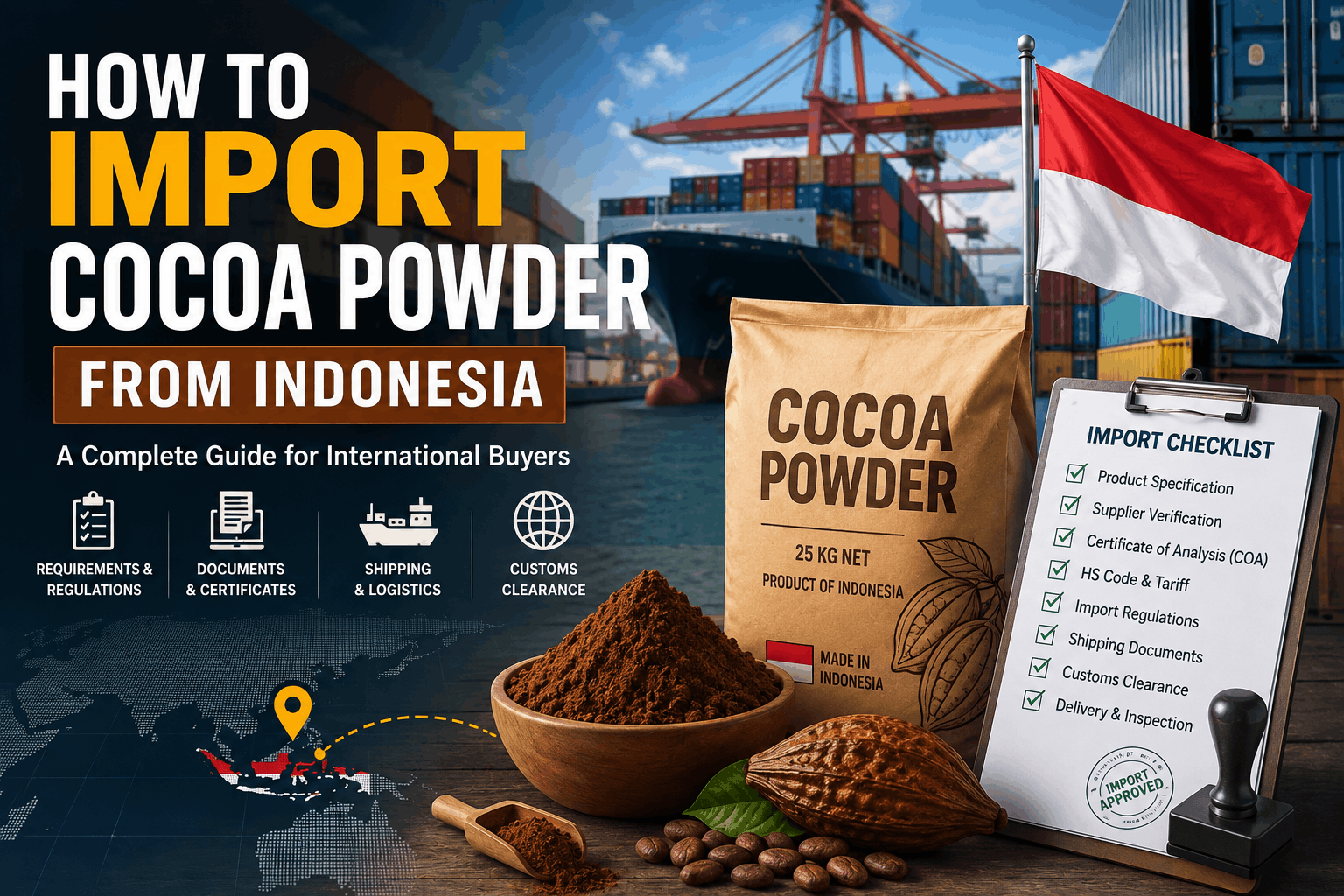
How to Import Cocoa Powder from Indonesia
A Practical Guide for International Buyers, Importers, and Food Manufacturers
Indonesia is an established cocoa producing and cocoa processing country, making it an attractive sourcing origin for companies looking for cocoa powder for bakery, beverage, dairy, confectionery, and other food applications.
However, importing cocoa powder from Indonesia involves more than finding a supplier and arranging an international shipment.
A successful import requires the buyer to evaluate the product specification, supplier, quality documentation, HS classification, destination-country regulations, import duties, trade agreements, shipping terms, customs documentation, and receiving procedures.
This guide explains how international buyers can approach the process of importing cocoa powder from Indonesia in a structured way.
Important: Import regulations are determined by the destination country. This guide provides general commercial and sourcing information and should not replace advice from the destination country’s customs authority, food regulator, or licensed customs broker.
Why Import Cocoa Powder from Indonesia?
Indonesia has an established cocoa-processing industry and supplies different types of cocoa-derived ingredients to international markets.
Depending on the supplier, buyers may find products such as:
- Natural Cocoa Powder
- Alkalized Cocoa Powder
- High Fat Cocoa Powder
- Low Fat Cocoa Powder
- Black Cocoa Powder
- Cocoa Cake
- Cocoa Butter
- Cocoa Liquor
The appropriate product depends on the buyer’s application and technical requirements.
For example:
Bakery may prioritize color, flavor, fat content, and interaction with leavening systems.
Beverage manufacturers may place greater emphasis on dispersibility, color, flavor, and suspension performance.
Industrial chocolate applications may require specific fat, flavor, particle size, and processing characteristics.
Therefore, the first step is not choosing the cheapest supplier.
It is defining what cocoa powder your production actually requires.
1. Define Your Cocoa Powder Specification
Before contacting suppliers in Indonesia, prepare a clear product specification.
A typical specification may include:
| Parameter | Example |
|---|---|
| Cocoa powder type | Natural / Alkalized |
| Fat content | High Fat / Low Fat |
| pH | Buyer specification |
| Color | Buyer specification |
| Moisture | Buyer specification |
| Particle size | Buyer specification |
| Microbiology | Buyer specification |
| Packaging | 20–25 kg bags / custom |
| Application | Bakery / Beverage / Dairy |
| Quantity | Trial / FCL / annual volume |
The Codex Standard for Cocoa Powders (CXS 105-1981) defines cocoa powder and fat-reduced cocoa powder and specifies a maximum moisture content of 7% m/m for cocoa powders covered by the standard.
However, buyers should not treat Codex as a complete commercial specification.
A supplier and buyer may agree on tighter requirements depending on the application, destination market, and quality system.
2. Choose Natural or Alkalized Cocoa Powder
One of the most important product decisions is whether you require natural cocoa powder or alkalized cocoa powder.
Natural Cocoa Powder
Natural cocoa powder generally retains a more acidic character and has a distinct cocoa flavor and color profile.
Alkalized Cocoa Powder
Alkalization modifies the cocoa powder’s acidity and can significantly affect:
- pH
- Color
- Flavor
- Solubility or dispersibility
- Functional behavior
Different alkalization levels can produce very different products.
Therefore, instead of requesting:
“I need dark cocoa powder.”
a professional buyer should specify requirements such as:
Alkalized cocoa powder, target pH, target color, fat content, moisture, and intended application.
This makes supplier quotations much more comparable.
3. Find Indonesian Cocoa Powder Suppliers
Once the specification is ready, identify potential suppliers.
Supplier sourcing can be conducted through:
- Direct supplier websites
- Indonesian trade directories
- Trade exhibitions
- Government-supported trade platforms
- Industry referrals
- B2B sourcing platforms
Indonesia’s Ministry of Trade operates INAEXPORT, an online platform that can be used to promote Indonesian products and connect businesses with potential buyers. The Ministry also directs exporters toward EXIM for information on market requirements and export procedures.
Indonesia Ministry of Trade EXIM Portal
For buyers, however, a supplier appearing on a directory should be considered a lead, not automatically a verified supplier.
4. Verify the Supplier Before Ordering
Before placing a commercial order, conduct basic supplier due diligence.
Ask for:
Company information
- Legal company name
- Business address
- Company registration information
- Export experience
- Production or sourcing capability
Product information
- Product specification
- Technical Data Sheet
- COA
- Product photos
- Packaging specification
- Shelf-life information
Quality information
Where relevant, ask about:
- Food safety management system
- HACCP
- ISO 22000 or equivalent systems
- Traceability
- Microbiological testing
- Heavy-metal testing
- Allergen controls
Certification requirements vary by buyer and destination market, so the supplier should provide documents that correspond to the actual product and facility.
5. Request a Sample Before a Full Shipment
A sample is one of the most important steps before committing to a container.
A cocoa powder may satisfy a specification on paper but behave differently in a real formulation.
Depending on your application, evaluate:
- Color
- Aroma
- Flavor
- pH
- Fat content
- Moisture
- Particle size
- Dispersibility
- Microbiology
- Application performance
For a food manufacturer, the most important question is:
Does the cocoa powder perform correctly in my actual formulation?
A laboratory or production trial is therefore often more useful than simply comparing supplier prices.
6. Review the Certificate of Analysis
Request a Certificate of Analysis (COA) for the product.
Depending on the supplier and buyer specification, the COA may contain:
- Moisture
- Fat
- pH
- Color
- Ash
- Particle size
- Total Plate Count
- Yeast & Mold
- Coliform
- Other microbiological parameters
Do not simply ask:
“Does the supplier have a COA?”
Instead ask:
“Does the COA demonstrate compliance with the specification we agreed to purchase?”
That distinction is important.
The COA should be reviewed against the buyer’s approved specification and, where necessary, verified through independent laboratory testing.
7. Confirm the HS Code
HS classification should be confirmed before calculating import costs.
For cocoa powder without added sugar or other sweetening matter, the relevant international HS heading is 1805.
Indonesia’s tariff materials identify:
1805.00.00 — Cocoa powder, not containing added sugar or other sweetening matter.
However, the buyer should not automatically classify every cocoa-containing product under HS 1805.
Products containing added sugar or other ingredients may fall under different tariff classifications.
The correct approach is:
Product composition → HS classification → Import tariff → Import requirements
If there is uncertainty, confirm the classification with the destination customs authority or a licensed customs broker.
8. Check Import Regulations in Your Country
This is one of the most important steps.
The fact that Indonesia allows a product to be exported does not automatically mean that the product can enter your country without additional requirements.
Before placing the order, check with:
- Customs authority
- Food safety authority
- Import authority
- Customs broker
- Relevant food regulator
Depending on the destination market, requirements may include:
- Importer registration
- Food facility registration
- Product registration
- Label requirements
- Food safety documentation
- Certificate of Analysis
- Certificate of Origin
- Health or sanitary documents
- Microbiological requirements
- Maximum contaminant limits
- Packaging requirements
The exact requirements vary by country.
9. Use Indonesia’s EXIM Portal
Indonesia’s Ministry of Trade operates an official EXIM information system.
The platform allows users to search trade procedures based on:
Country + Commodity + HS Code
It provides information concerning:
- Export procedures
- Import procedures
- Tariffs
- Rules of origin
- Non-tariff measures
- Technical requirements
- Trade regulations
Check Indonesia’s Official EXIM Information System
This is particularly useful for Indonesian exporters and buyers researching the regulatory environment of a specific destination market.
10. Check Import Duty and Trade Agreements
Do not assume that importing from Indonesia automatically means zero import duty.
The applicable tariff can depend on:
- Destination country
- HS code
- Country of origin
- Trade agreement
- Rules of Origin
- Preferential tariff eligibility
Indonesia has various trade agreements, including ASEAN agreements and bilateral/regional agreements.
The Ministry of Trade’s EXIM system provides information about preferential tariffs and Rules of Origin associated with trade agreements.
The buyer should therefore ask:
Is my country eligible for preferential tariff treatment for this product when imported from Indonesia?
Then confirm the actual rate with the destination customs authority.
11. Understand the Certificate of Origin
A Certificate of Origin (COO) proves the origin of exported goods.
Indonesia’s e-SKA system distinguishes between:
Preferential Certificate of Origin
Used to support claims for preferential tariff treatment under applicable trade agreements.
Non-Preferential Certificate of Origin
Used as an origin document where preferential tariff treatment is not being claimed or where the destination requires proof of origin.
Indonesia’s official e-SKA system explains that a preferential SKA can support tariff reductions or exemptions where the applicable trade agreement provides such treatment.
Indonesia e-SKA — Certificate of Origin Information
If you require preferential treatment, tell the supplier before shipment.
12. Choose the Appropriate Incoterm
The commercial contract should clearly identify the agreed Incoterm.
Common arrangements include:
FOB — Free on Board
The seller completes the required export-side responsibilities and delivers the goods on board the vessel at the agreed port.
The buyer generally arranges the main ocean freight and import-side process.
CIF — Cost, Insurance and Freight
The seller arranges carriage and insurance to the named destination port, while the buyer generally handles import clearance and associated destination obligations.
FCA — Free Carrier
May be suitable for buyers with their own logistics arrangements or where delivery to a named carrier is preferred.
The correct Incoterm depends on the transaction structure.
The important point is to avoid vague terms such as:
“FOB price including shipping.”
Instead, specify the exact Incoterm and named place or port.
13. Agree on the Commercial Contract
Before payment, document the transaction clearly.
The contract or purchase order should identify:
- Product
- Grade
- Specification
- Quantity
- Packaging
- Price
- Currency
- Incoterm
- Port of loading
- Destination
- Payment terms
- Production lead time
- Inspection requirements
- COA requirements
- Required documents
- Claim procedure
- Shelf-life requirements
For example:
Product: High Fat Alkalized Cocoa Powder
Fat: 10–12%
Packing: 25 kg/bag
Quantity: 17 MT
Incoterm: FOB Indonesia
Port: Agreed Indonesian port
The actual specification should be attached to the commercial agreement.
14. Arrange Payment
Payment terms should be agreed according to the relationship and risk profile of both parties.
Possible arrangements include:
- Advance payment
- Deposit + balance
- Letter of Credit
- Documentary collection
- Other mutually agreed structures
For a first transaction, supplier verification and payment security are especially important.
A very low quotation should not automatically be considered the best deal.
The buyer should evaluate:
Product cost + logistics + compliance + risk + consistency
rather than price alone.
15. Arrange International Shipping
After the commercial agreement is confirmed, shipping can be arranged.
A typical supply chain is:
Supplier Warehouse
↓
Container Loading
↓
Export Customs
↓
Port of Loading
↓
Ocean Freight
↓
Destination Port
↓
Import Customs
↓
Buyer Warehouse
Before loading, the exporter should verify the container condition, packaging integrity, cargo quantity, and seal information.
For a deeper explanation, Jaya Cocoa can internally link this section to:
Container Loading Guide for Cocoa Powder Export
and:
How Cocoa Powder Is Packed for Export
This creates a strong export-information cluster within the website.
16. Understand Indonesian Export Customs
The Indonesian exporter is responsible for completing the Indonesian export customs process.
Indonesia Customs states that exporters must submit a Pemberitahuan Ekspor Barang (PEB) to the customs office at the loading location. Supporting customs documents include the commercial invoice, packing list, and other required documents. The PEB can be handled directly by the exporter or through a licensed customs service provider (PPJK).
Indonesia Customs also states that the PEB is submitted no earlier than seven days before the estimated export date and no later than before the export goods enter the customs area, subject to the applicable procedure.
Indonesian Customs — Export Procedures
For the international buyer, this means the Indonesian supplier should coordinate the export declaration and supporting documents with the buyer’s agreed shipping schedule.
17. Review the Shipping Documents
Before the shipment departs, carefully review the documents.
Typical documents may include:
- Commercial Invoice
- Packing List
- Bill of Lading
- Certificate of Origin
- Certificate of Analysis
- Product Specification
- Other destination-specific documents
Not every shipment requires exactly the same documentation.
The buyer should establish the required document list before production and shipment, not after the container has departed.
18. Review the Bill of Lading
The Bill of Lading should be checked carefully.
Review:
- Shipper
- Consignee
- Notify party
- Product description
- Number of packages
- Gross weight
- Port of loading
- Port of discharge
- Container number
- Seal number
A small documentation error can create unnecessary delays during customs clearance.
19. Prepare for Import Customs Clearance
Once the shipment reaches the destination country, the buyer or appointed customs broker handles the import process.
The importer may need:
- Commercial Invoice
- Packing List
- Bill of Lading
- Certificate of Origin
- Import permit/registration
- Food regulatory documents
- Certificate of Analysis
- Other documents required by the destination authority
Customs may examine the shipment depending on the country’s risk-management system.
Therefore, the buyer should have the complete documentation ready before vessel arrival.
20. Inspect the Cocoa Powder After Arrival
Receiving inspection is the final important step.
Check the:
Packaging
- Torn bags
- Wet bags
- Damaged liners
- Broken packaging
- Signs of contamination
Product
- Color
- Aroma
- Appearance
- Caking
- Foreign material
Documentation
- Batch number
- COA
- Quantity
- Shipping documents
For critical applications, buyers may also perform laboratory testing according to their quality-control procedures.
This provides traceability from:
Supplier Batch → Container → Shipping Documents → Buyer Warehouse → Production
Cocoa Powder Import Checklist
Before importing cocoa powder from Indonesia, use this checklist:
| Stage | Buyer Checklist |
|---|---|
| Product | Specification confirmed |
| Supplier | Supplier verified |
| Sample | Approved |
| COA | Reviewed |
| HS Code | Confirmed |
| Destination regulations | Checked |
| Import license | Confirmed if required |
| Tariff | Verified |
| FTA | Checked |
| COO | Requirement confirmed |
| Incoterm | Agreed |
| Contract | Signed |
| Payment | Agreed |
| Packaging | Approved |
| Shipping | Arranged |
| Export documents | Confirmed |
| B/L | Reviewed |
| Customs broker | Appointed if required |
| Receiving inspection | Prepared |
Common Mistakes When Importing Cocoa Powder from Indonesia
1. Choosing a supplier based only on price
A cheaper supplier may not provide consistent quality or the required documentation.
2. Skipping sample approval
A product can meet a specification but still perform poorly in your formulation.
3. Not defining the cocoa powder type
Natural and alkalized cocoa powder are not interchangeable in every application.
4. Ignoring fat content and pH
These parameters can significantly affect formulation performance.
5. Checking import regulations too late
Import requirements should be checked before the commercial order.
6. Assuming HS 1805 applies to every cocoa product
Classification depends on the actual product composition.
7. Assuming all Indonesian exports qualify for preferential tariffs
Preferential treatment depends on the relevant trade agreement and Rules of Origin.
8. Not confirming the COO requirement
If preferential tariff treatment is expected, the appropriate origin documentation must be planned before shipment.
9. Ignoring remaining shelf life
The buyer should consider production, shipping, customs clearance, and warehouse time.
How Long Does It Take to Import Cocoa Powder from Indonesia?
There is no universal import timeline.
Total lead time depends on:
- Supplier production capacity
- Packaging requirements
- Sample approval
- Container availability
- Port of loading
- Ocean route
- Destination port
- Customs clearance
- Regulatory inspection
- Documentation
A typical sequence is:
Supplier Selection
→ Sample Approval
→ Contract
→ Production
→ Packing
→ Container Loading
→ Export Clearance
→ Ocean Freight
→ Import Clearance
→ Delivery
For first-time buyers, additional time should be allowed for supplier qualification and regulatory verification.
Is Indonesia a Good Source of Cocoa Powder?
Indonesia can be an attractive sourcing origin for cocoa powder, but the best supplier should not be selected based solely on country or price.
A better evaluation is:
Can the supplier consistently provide the required specification, quality, documentation, quantity, and logistics performance?
For food manufacturers, consistency is often more valuable than a small difference in purchase price.
The buyer should therefore evaluate the complete supply chain rather than only the product quotation.
Final Takeaway
Importing cocoa powder from Indonesia becomes much easier when the process is planned from the beginning.
The basic sequence is:
1. Define your cocoa powder specification
↓
2. Find and verify an Indonesian supplier
↓
3. Request and approve samples
↓
4. Review the COA and technical documentation
↓
5. Confirm HS classification
↓
6. Check destination-country import regulations
↓
7. Verify import duty and preferential tariff eligibility
↓
8. Confirm Certificate of Origin requirements
↓
9. Agree Incoterms and payment terms
↓
10. Sign the commercial contract
↓
11. Arrange production and shipping
↓
12. Review export documentation
↓
13. Complete destination customs clearance
↓
14. Inspect the shipment upon arrival
The most important principle is simple:
Importing cocoa powder is not simply a purchasing transaction. It is a complete supply-chain process from specification approval to final delivery.
Indonesia’s Ministry of Trade provides EXIM tools for checking procedures, tariffs, Rules of Origin, and destination-market requirements, while Indonesian Customs provides the formal export customs framework for the Indonesian side of the shipment.
Frequently Asked Questions
What is the HS code for cocoa powder imported from Indonesia?
Cocoa powder without added sugar or other sweetening matter is generally classified under HS heading 1805. Indonesia’s tariff materials identify 1805.00.00 for this product category. However, the buyer should confirm the final classification with the customs authority in the destination country because classification depends on the actual product.
Do I need a Certificate of Origin?
It depends on the destination market and whether proof of origin or preferential tariff treatment is required. Indonesia’s e-SKA system provides both preferential and non-preferential Certificate of Origin mechanisms.
Can I import natural and alkalized cocoa powder from Indonesia?
Yes. Buyers can source different cocoa powder types, but the specification should clearly identify the required type, pH, color, fat content, and application.
Should I request a COA before importing cocoa powder?
Yes. A COA should be reviewed against the agreed product specification and, when appropriate, verified through independent testing.
Can cocoa powder be imported in bulk?
Yes. Industrial cocoa powder is commonly supplied in commercial packaging such as bulk sacks or food-grade lined bags. The exact packaging should be agreed between the buyer and supplier.
Who handles export customs clearance in Indonesia?
The Indonesian exporter is responsible for the export declaration process and may submit the PEB directly or use a licensed PPJK/customs service provider.
Who handles import customs clearance?
Generally, the importer or its appointed customs broker handles clearance in the destination country. The exact procedure depends on local regulations.
References
1. FAO/WHO Codex Alimentarius. Standard for Cocoa Powders (Cocoas) and Dry Mixtures of Cocoa and Sugars — CXS 105-1981.
2. Directorate General of Customs and Excise of Indonesia. Tata Laksana Ekspor / Export Procedures.
Official information on PEB, export documentation, customs procedures, and PPJK.
3. Ministry of Trade of the Republic of Indonesia. EXIM — Export & Import Mechanism Information.
Official source for checking destination-market procedures, tariffs, Rules of Origin, and non-tariff measures.
4. Ministry of Trade of the Republic of Indonesia. e-SKA — Certificate of Origin Service.
Official information concerning Indonesian Certificates of Origin and preferential/non-preferential origin documentation.
5. Ministry of Trade of the Republic of Indonesia. FTA Support Center.
Provides information about Indonesia’s trade agreements and preferential trade frameworks.