What Is Alkalized Cocoa Powder? A Complete Guide for Food Manufacturers
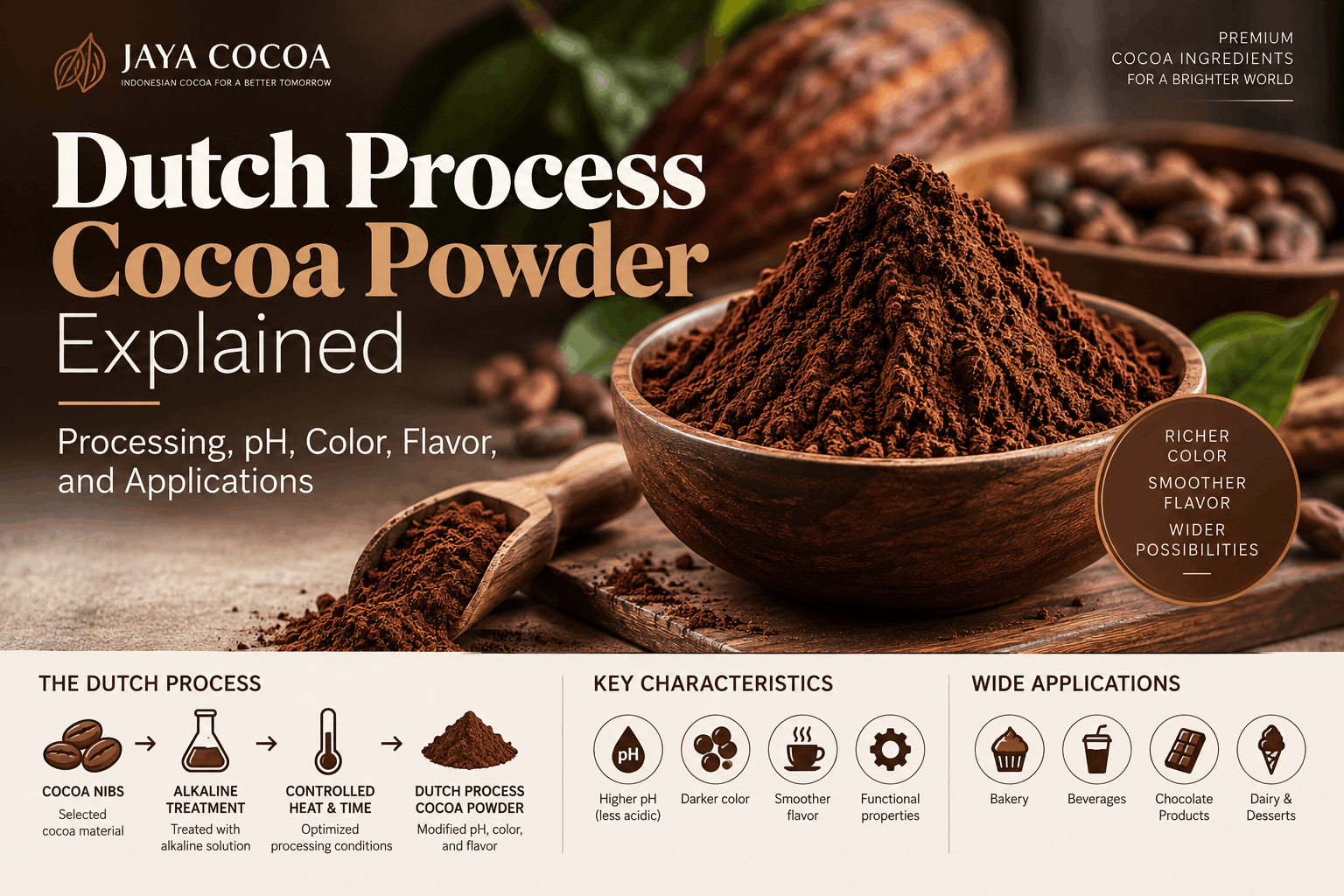
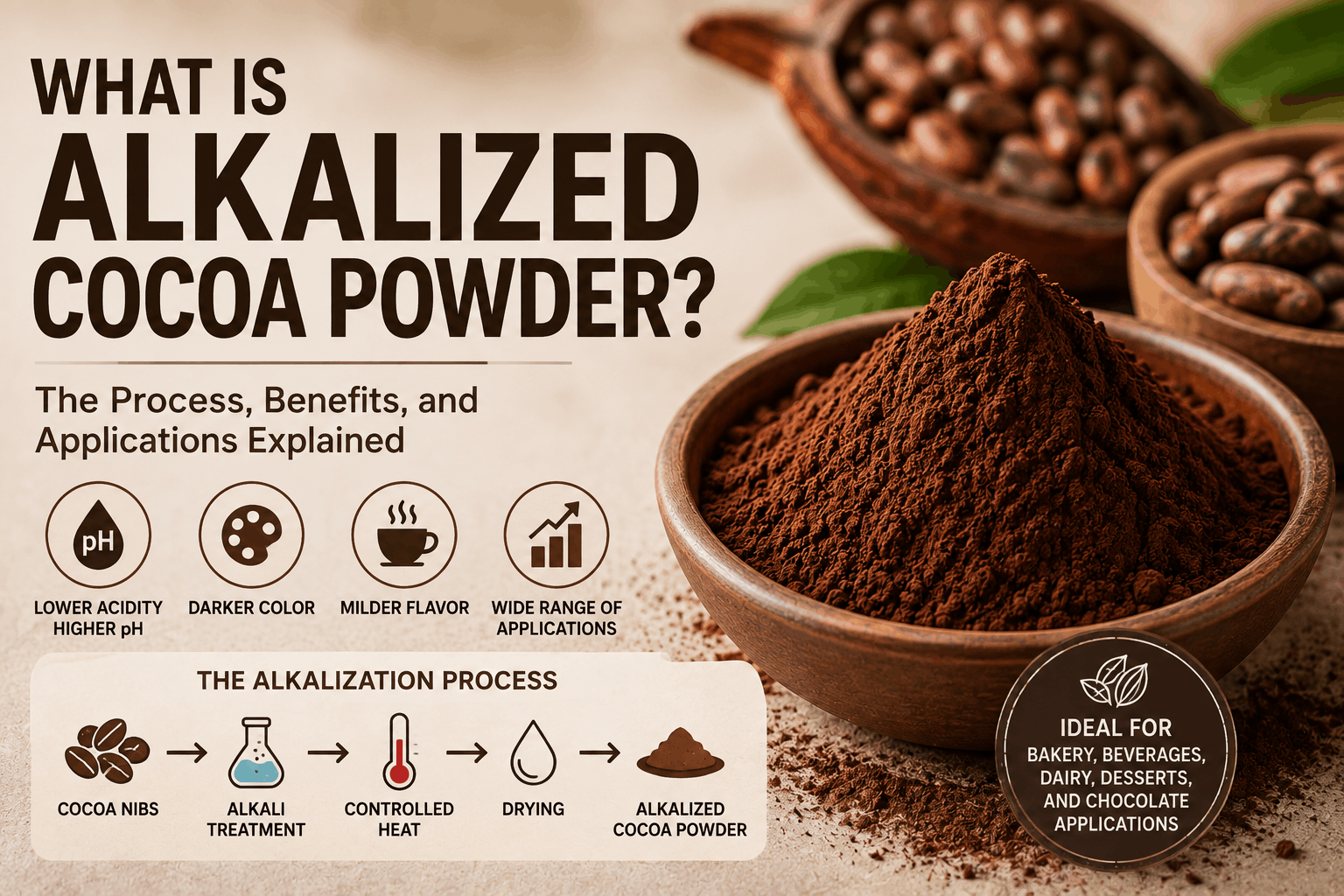
Alkalized cocoa powder is cocoa powder that has been treated with an alkaline substance during cocoa processing to modify its acidity, color, flavor, and functional characteristics.
Also known as Dutch-process cocoa powder, alkalized cocoa powder is widely used in bakery products, beverages, chocolate applications, dairy products, desserts, and other food formulations where a specific cocoa color, flavor profile, or pH is required.
Unlike natural cocoa powder, which generally retains the naturally acidic characteristics of cocoa, alkalized cocoa powder undergoes an additional processing step that changes some of its chemical and physical properties.
For food manufacturers and ingredient buyers, understanding how alkalization works is important when selecting cocoa powder because the degree and conditions of alkalization can significantly affect the final product.
What Is Alkalized Cocoa Powder?
Alkalized cocoa powder is cocoa powder that has undergone treatment with an alkaline compound to reduce its acidity and modify properties such as pH, color, and flavor.
The process is commonly known as alkalization or Dutch processing.
According to the International Cocoa Organization (ICCO), alkalization is an optional cocoa-processing step used to modify the flavor and color of cocoa liquor and cocoa powder. The process can involve treating cocoa material with an aqueous alkaline solution under controlled temperature and, depending on the process, pressure.
The cocoa material used for alkalization may include:
- Cocoa nibs
- Cocoa liquor
- Cocoa cake
After alkalization, the material can continue through subsequent processing steps depending on the manufacturer’s production system and the desired cocoa powder specification.
The resulting cocoa powder can range from relatively light reddish-brown shades to very dark brown or nearly black colors, depending on the alkalization conditions.
Why Is Cocoa Powder Alkalized?
Cocoa is naturally acidic. Alkalization is used to intentionally modify this natural acidity and other characteristics of the cocoa ingredient.
Food manufacturers may choose alkalized cocoa powder when they need:
- A darker cocoa color
- A less acidic flavor profile
- A different pH for formulation
- Specific sensory characteristics
- Improved compatibility with particular food applications
- A particular appearance in finished products
However, alkalization is not simply a process of “making cocoa darker.”
The treatment can influence multiple characteristics simultaneously, including pH, color, flavor, phytochemical composition, and other quality parameters.
Research published in Food Research International in 2024 found that alkalization process conditions can significantly influence cocoa powder quality, including color, pH, ash content, and phenolic-related characteristics.
How Is Alkalized Cocoa Powder Made?
The exact industrial process varies between manufacturers, but the general concept can be explained in several stages.
1. Cocoa Beans Are Processed
Cocoa beans are first cleaned and processed through conventional cocoa-processing steps such as fermentation, drying, roasting, and grinding.
ICCO describes cocoa processing as a sequence involving cleaning, fermentation, roasting, grinding, alkalization when required, pressing, and further processing.
2. Cocoa Material Is Selected
Depending on the manufacturer’s process, alkalization may be applied to:
- Cocoa nibs
- Cocoa liquor
- Cocoa cake
The choice of material affects the processing route and the characteristics of the final cocoa product.
3. An Alkaline Compound Is Added
The cocoa material is treated with an alkaline compound.
Common alkaline materials used in cocoa processing include:
- Potassium carbonate
- Calcium carbonate
- Sodium hydroxide
ICCO specifically identifies these compounds as examples used in cocoa alkalization.
The exact compound and dosage depend on the desired product characteristics and manufacturing process.
4. Controlled Heat and Processing Conditions
The alkaline treatment is carried out under controlled processing conditions.
Important variables can include:
- Alkali concentration
- Temperature
- Processing time
- Moisture
- Pressure
- Type of cocoa material
- Processing sequence
These variables are important because alkalization is not a single standardized treatment that produces one universal type of cocoa powder.
Research by Demirci et al. (2024) demonstrated that processing conditions can be optimized to influence different quality parameters of cocoa powder.
5. Drying and Further Processing
After treatment, the cocoa material is processed further according to the manufacturer’s production system.
When cocoa cake is used, it may subsequently be milled into cocoa powder with the required particle size.
The final product is then tested against its specification before packaging.
What Does Alkalization Do to Cocoa Powder?
One of the most important things for buyers to understand is that alkalization affects more than pH.
It can influence several important characteristics.
1. It Increases Cocoa Powder pH
The most obvious effect of alkalization is modification of cocoa’s acidity.
Natural cocoa powder generally has an acidic pH, while alkalized cocoa powders can have substantially higher pH values depending on the degree and conditions of treatment.
However, there is no single universal pH value for all alkalized cocoa powder.
Commercial specifications can vary considerably.
For this reason, buyers should evaluate the actual pH specification and COA provided by the supplier rather than assuming that every alkalized cocoa powder has the same pH.
A 2024 study described pH as an important indicator for the classification of alkalized cocoa powder and demonstrated that alkali concentration and other process conditions affect cocoa powder pH.
2. It Changes Cocoa Powder Color
Color is one of the most visible effects of alkalization.
Depending on the process, cocoa powder can move from relatively light brown or reddish-brown shades toward darker brown and very dark colors.
This is why alkalized cocoa powders are commonly associated with:
- Red cocoa
- Dark brown cocoa
- Very dark cocoa
- Black cocoa
However, color should not be used as the only indicator of alkalization level.
Two cocoa powders with similar visual colors may have different pH values, processing histories, or application performance.
Recent research has shown relationships between alkalization conditions and cocoa powder color, with stronger processing conditions generally producing darker products.
For food manufacturers, color should therefore be evaluated together with pH, flavor, fat content, particle size, and application performance.
3. It Changes Flavor
Natural cocoa has a characteristic acidic and sometimes sharper flavor profile.
Alkalization can reduce some of the perceived acidity and change the flavor characteristics of cocoa powder.
The final sensory profile depends on:
- Cocoa bean origin
- Fermentation
- Roasting
- Alkali type
- Alkali concentration
- Processing temperature
- Processing time
- Processing sequence
Research published in LWT – Food Science and Technology found that alkalization conditions affected cocoa powder physicochemical characteristics and the aroma profile of cocoa beverages.
Therefore, a buyer should not evaluate alkalized cocoa powder solely from its specification sheet.
Application testing and sensory evaluation are also important.
4. It Can Affect Cocoa’s Phytochemical Composition
This is an important point that is sometimes overlooked in commercial descriptions of alkalized cocoa.
Alkalization can affect certain naturally occurring compounds in cocoa.
Sioriki et al. (2021) studied the effect of alkalization temperature, alkali concentration, and processing time on cocoa powder.
The researchers observed changes in compounds including:
- Epicatechin
- Catechin
- Caffeine
The study reported that stronger alkalization conditions could reduce some phytochemical components.
This does not mean that all alkalized cocoa powder has the same nutritional or phytochemical profile.
The result depends on the cocoa material and processing conditions.
A 2026 review in Food Chemistry also highlighted that alkalization can produce important physicochemical and functional changes in cocoa and that newer approaches to cocoa alkalization continue to be investigated.
Natural Cocoa Powder vs Alkalized Cocoa Powder
The simplest way to understand the difference is to look at the processing treatment.
| Characteristic | Natural Cocoa Powder | Alkalized Cocoa Powder |
|---|---|---|
| Alkaline treatment | Generally no conventional alkalization | Yes |
| Acidity | Naturally acidic | Reduced acidity |
| pH | Generally lower | Generally higher |
| Color | Often lighter/reddish brown | Can range from brown to very dark |
| Flavor | More acidic/sharp cocoa profile | Often smoother or less acidic |
| Processing | Standard cocoa powder processing | Includes additional alkalization step |
| Applications | Bakery, beverages, food products | Bakery, beverages, dairy, desserts, chocolate applications |
| Color control | More limited | Greater ability to achieve darker shades |
These characteristics are general tendencies rather than universal specifications.
The actual performance of a cocoa powder depends on the cocoa origin, processing conditions, fat content, particle size, roasting, alkalization level, and other factors.
For a more detailed comparison, see our guide to [Natural vs Alkalized Cocoa Powder].
Is Alkalized Cocoa Powder the Same as Dutch-Process Cocoa?
In most cocoa-processing contexts, Dutch process or Dutch processing refers to cocoa that has undergone alkalization.
The terminology comes from the historical development of cocoa alkalization associated with Dutch processing.
Today, the terms are commonly used interchangeably in the cocoa industry:
Alkalized cocoa powder = Dutch-process cocoa powder
However, buyers should still request the actual product specification.
The terms “Dutch process” and “alkalized” alone do not tell you:
- Exact pH
- Fat content
- Color
- Alkali used
- Particle size
- Moisture
- Microbiological specification
- Heavy-metal specification
- Application performance
For B2B purchasing, the technical specification and COA are more useful than the product name alone.
What Are the Main Applications of Alkalized Cocoa Powder?
Alkalized cocoa powder is used across a wide range of food applications.
Bakery Products
Alkalized cocoa powder is commonly used in:
- Cakes
- Cookies
- Biscuits
- Brownies
- Wafers
- Sponge cakes
The darker color and modified acidity can be desirable depending on the formulation.
However, bakers should consider the interaction between cocoa powder acidity and the leavening system.
A formulation designed around natural cocoa powder may not perform identically when alkalized cocoa powder is substituted.
Beverages
Alkalized cocoa powder is also used in cocoa-based beverages and drink mixes.
Manufacturers may select it when they want:
- Darker beverage color
- Specific cocoa flavor
- Lower perceived acidity
- Particular visual characteristics
For beverage applications, other factors such as dispersion, suspension stability, particle size, and formulation should also be evaluated.
Dairy and Desserts
Alkalized cocoa powder can be incorporated into:
- Chocolate milk
- Dairy beverages
- Ice cream
- Puddings
- Chocolate desserts
- Dessert mixes
The appropriate grade depends on the formulation and desired sensory characteristics.
Chocolate and Compound Applications
Alkalized cocoa powder can also be used in certain chocolate and compound formulations.
However, the appropriate cocoa powder specification depends on the product design.
Important considerations may include:
- Cocoa butter content
- Color
- Flavor
- Particle size
- pH
- Fat compatibility
- Processing requirements
Therefore, there is no single “best” alkalized cocoa powder for every chocolate application.
How Does Alkalized Cocoa Powder Affect Baking?
This is one of the most important practical considerations.
Natural cocoa powder is acidic, while alkalized cocoa powder is less acidic.
That difference can affect the interaction between cocoa powder and chemical leavening systems.
For example, formulations that rely on an acid-base reaction may respond differently when natural cocoa is replaced with a more strongly alkalized cocoa powder.
This means that cocoa powder substitution should not be treated as a simple one-for-one ingredient replacement.
Food manufacturers should test:
- Batter pH
- Cake volume
- Texture
- Color
- Flavor
- Crumb structure
- Baking time
- Overall sensory performance
The appropriate cocoa powder should be selected based on the complete formulation rather than color alone.
How Dark Is Alkalized Cocoa Powder?
There is no single standard color for alkalized cocoa powder.
The final color can range from relatively light brown to extremely dark brown or black.
Color is influenced by factors such as:
- Cocoa bean characteristics
- Roasting
- Alkali type
- Alkali concentration
- Temperature
- Processing time
- Moisture
- Processing sequence
ICCO notes that alkalization can produce colors ranging from light red through to charcoal black.
This is why commercial cocoa suppliers may offer several alkalized grades.
For industrial purchasing, buyers should request a defined color specification or reference standard rather than simply asking for “dark cocoa powder.”
What Should Buyers Check When Purchasing Alkalized Cocoa Powder?
For food manufacturers and importers, the product name should be only the beginning of the evaluation.
A proper technical specification should typically address parameters relevant to the intended application.
Key parameters may include:
1. pH
Important for formulation and product performance.
2. Cocoa butter/fat content
Different applications may require different fat levels.
3. Moisture
Important for powder stability and quality.
4. Color
Should be defined according to the application.
5. Particle size
Important for mouthfeel, dispersion, and processing.
6. Flavor
Should be evaluated through sensory testing and application trials.
7. Microbiological quality
Relevant to food safety and destination-market requirements.
8. Contaminants
Depending on the destination market and intended use, buyers may need appropriate testing for contaminants such as heavy metals.
9. COA
The supplier should be able to provide a Certificate of Analysis for the relevant production batch.
10. Application performance
A laboratory sample should ideally be tested in the buyer’s actual formulation.
Does Codex Define Alkalized Cocoa Powder as a Separate Cocoa Powder Category?
This distinction is important.
The Codex Standard for Cocoa Powders (CXS 105-1981) provides an international standard for cocoa powders and dry mixtures of cocoa and sugars. The standard includes requirements concerning composition, quality factors, additives, hygiene, labeling, and related matters. The current Codex listing identifies CXS 105-1981 as the standard for cocoa powders and dry mixtures of cocoa and sugars.
However, commercial descriptions such as:
- Natural cocoa powder
- Alkalized cocoa powder
- Dutch-process cocoa
- Red cocoa
- Dark cocoa
should not automatically be interpreted as separate universal Codex product categories.
Commercial suppliers commonly differentiate products according to processing characteristics and specifications.
Therefore, buyers should always evaluate the actual technical specification of the product.
Is Alkalized Cocoa Powder Safe?
Alkalized cocoa powder can be used as a food ingredient when it is produced in accordance with applicable food-safety requirements and relevant regulations.
The important question for buyers is not simply whether a cocoa powder is alkalized, but whether:
- The alkaline treatment is food-grade and appropriately controlled
- The finished product complies with applicable standards
- Manufacturing hygiene is controlled
- Microbiological specifications are appropriate
- Contaminants are controlled
- Labeling requirements are satisfied
- Destination-country regulations are met
Codex CXS 105-1981 states that food additives used in products covered by the standard should comply with the relevant provisions of the General Standard for Food Additives and related Codex requirements.
For international trade, the buyer and supplier should also confirm the requirements of the destination market.
What Is the Best Alkalized Cocoa Powder?
There is no universally “best” alkalized cocoa powder.
The right product depends on the application.
For example:
| Application | Important Considerations |
|---|---|
| Bakery | pH, color, flavor, leavening compatibility |
| Chocolate beverage | Color, flavor, dispersion, suspension |
| Dairy beverage | Color, flavor, dispersion |
| Ice cream | Color, flavor, particle size |
| Cookies | Color, flavor, pH |
| Brownies | Color, flavor, fat content |
| Industrial food production | Specification consistency and supply reliability |
This is why professional buyers should define their requirements before selecting a cocoa supplier.
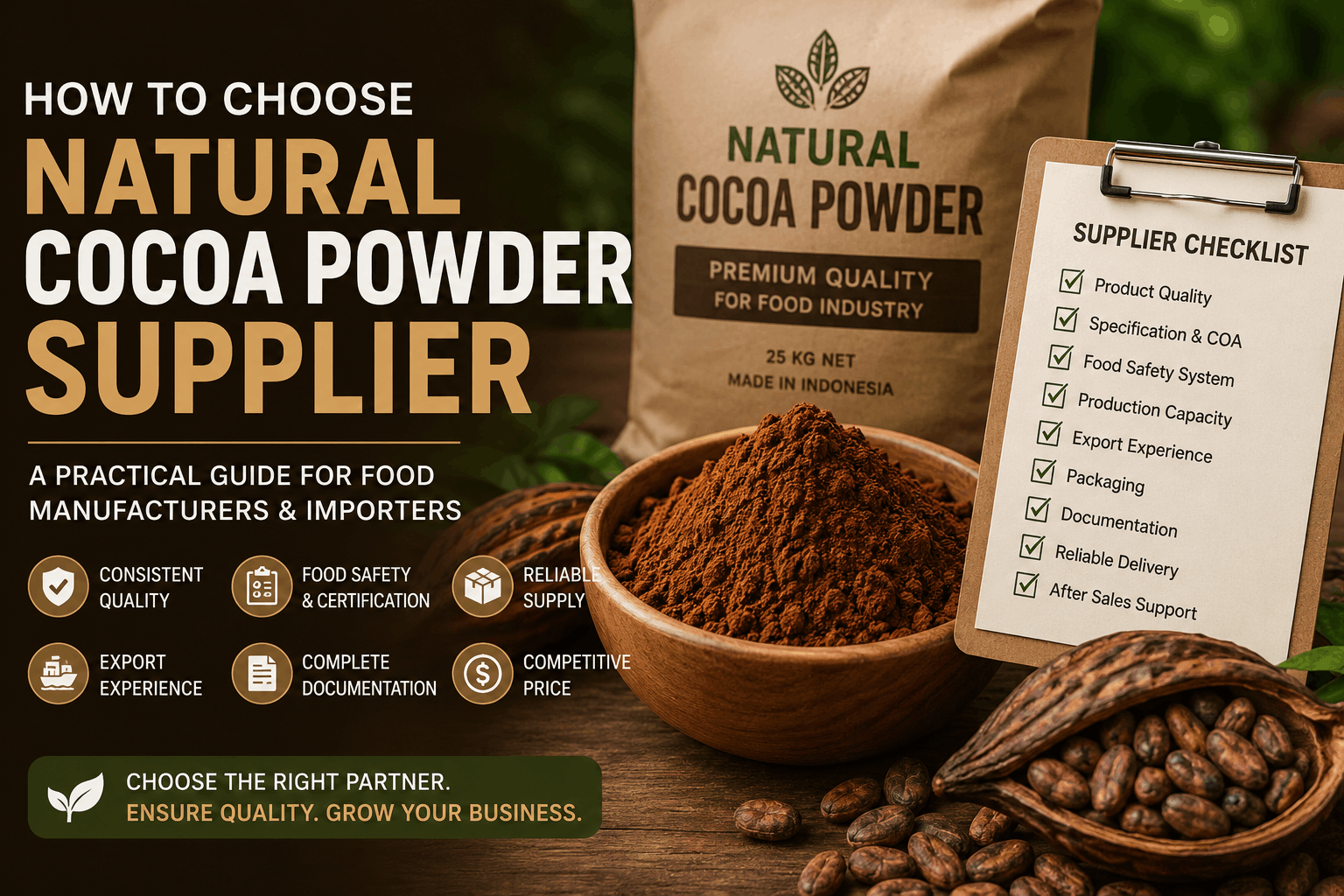
How to Choose an Alkalized Cocoa Powder Supplier
For B2B buyers, choosing the right supplier is just as important as choosing the right cocoa powder.
A supplier should ideally be able to provide:
Technical Documentation
Ask for:
- Product specification
- Certificate of Analysis
- Microbiological specification
- Allergen information where relevant
- Food safety documentation
- Product regulatory information
Product Consistency
Ask whether the supplier can maintain consistent:
- pH
- Color
- Fat content
- Moisture
- Particle size
- Flavor
between production batches.
Manufacturing Capability
Understand whether the supplier is:
- A manufacturer
- A processor
- A trader
- A distributor
and determine how this affects traceability, customization, quality control, and supply continuity.
Export Capability
For international buyers, also evaluate:
- Export experience
- Packaging capability
- Container loading
- Shipping documentation
- Certificate of Origin requirements
- Destination-market compliance
A low purchase price is not necessarily the lowest total cost if the supplier creates problems with inconsistent specifications, documentation, shipment delays, or rejected batches.
Frequently Asked Questions
What is alkalized cocoa powder?
Alkalized cocoa powder is cocoa powder treated with an alkaline compound during processing to modify its acidity, color, flavor, and other characteristics.
Is alkalized cocoa powder the same as Dutch-process cocoa?
Generally, yes. “Dutch-process cocoa” is a common term for cocoa that has undergone alkalization.
Is alkalized cocoa powder acidic?
Alkalized cocoa powder is generally less acidic and has a higher pH than natural cocoa powder, although the exact pH depends on the degree and conditions of alkalization.
Why is alkalized cocoa powder darker?
Alkalization can significantly reduce cocoa powder lightness and produce darker brown colors. The final color depends on the cocoa material and processing conditions.
Is black cocoa powder alkalized?
Black cocoa powder is generally associated with a high degree of alkalization, but buyers should verify the actual pH and technical specification rather than determining processing solely from appearance.
Can natural cocoa powder be replaced with alkalized cocoa powder?
Sometimes, but not always on a one-to-one basis. Because acidity and pH influence formulation chemistry, substitution can affect leavening, flavor, color, and finished-product characteristics.
What alkaline compounds are used in cocoa processing?
Common examples include potassium carbonate, calcium carbonate, and sodium hydroxide.
Does alkalization affect cocoa’s natural compounds?
Yes. Research has demonstrated that alkalization conditions can affect certain phytochemical and volatile components of cocoa.
Conclusion
Alkalized cocoa powder is cocoa powder that has been treated with an alkaline compound to modify its acidity, color, flavor, and functional characteristics.
It is commonly known as Dutch-process cocoa and is widely used in bakery products, beverages, dairy applications, desserts, and other food formulations.
However, alkalization is not a simple process that produces one standardized type of cocoa powder. The final characteristics depend on factors such as the cocoa material, alkaline compound, concentration, temperature, processing time, and other manufacturing conditions.
For food manufacturers and international buyers, the most important approach is therefore to evaluate cocoa powder based on measurable specifications and application performance, rather than relying solely on terms such as “Dutch process,” “dark cocoa,” or “alkalized.”
A reliable supplier should be able to provide a clear specification, relevant COA, appropriate food-safety documentation, consistent batch quality, and technical support for the intended application.
For buyers evaluating different cocoa powder grades, understanding pH, fat content, color, processing method, and application requirements is essential for selecting the right ingredient.
References & Sources
- International Cocoa Organization (ICCO) – Processing Cocoa
- Codex Alimentarius – CXS 105-1981, Standard for Cocoa Powders (Cocoas) and Dry Mixtures of Cocoa and Sugars
- Sioriki, E., et al. (2021). “Impact of alkalization conditions on the phytochemical content of cocoa powder and the aroma of cocoa drinks.” LWT, 145, 111181.
- Demirci, S., et al. (2024). “Influence of process conditions of alkalization on quality of cocoa powder.” Food Research International, 182, 114147.
- Binello, A., Cravotto, G., Mantegna, S., & Tagliapietra, S. (2026). “An upgrade in cocoa alkalization: Functional changes, chemistry and new perspectives.” Food Chemistry, 499, 147370.